enCore Energy: Leading America's Uranium Revival



enCore Energy leads U.S. uranium production with two Texas plants ramping to 1.8M lbs capacity, capturing supply deficits through operating leverage and 51.5M lbs resources.
- enCore Energy operates the largest In-Situ Recovery (ISR) uranium extraction operations in the United States with two licensed processing plants currently producing uranium in South Texas.
- The company controls 30.94 million pounds of measured and indicated uranium resources plus 20.54 million pounds inferred, positioning it to capitalize on structural supply deficits.
- South Texas operations ramped to 2,678 pounds per day in June 2025, with accelerated drilling expanding to 30 drill rigs across operations by Q3 2025.
- Strategic contracting approach balances pricing floors with significant spot market exposure, with current contracts representing less than 38% of planned extraction through 2033.
- The Dewey-Burdock project received fast-track permitting approval, adding a high-return development asset with 39% pre-tax IRR at $86/lb uranium prices.
Introduction: America's Uranium Independence Imperative
The uranium market has entered a fundamental transformation driven by structural supply shortages and surging reactor demand. With spot prices bottoming at $64.23 per pound in March 2025 before recovering to approximately $80 per pound by October, the market signals a shift from cyclical volatility to sustained supply constraints. Against this backdrop, enCore Energy has positioned itself as America's largest In-Situ Recovery uranium producer, operating two licensed processing facilities in South Texas while advancing a pipeline of development projects across multiple jurisdictions.
The investment case for domestic uranium production has strengthened considerably. According to the U.S. Energy Information Administration, 44% of uranium imported to the United States originates from Russia, Kazakhstan, and Uzbekistan, creating vulnerabilities that bipartisan legislation now addresses through the Nuclear Fuel Supply Act and related initiatives. This policy environment, combined with growing institutional recognition of nuclear energy's role in decarbonization strategies, creates tailwinds for established domestic producers with operating assets and growth potential.
Company Overview: Integrated Uranium Production Platform
enCore Energy has assembled a vertically integrated uranium extraction platform focused exclusively on In-Situ Recovery technology, which accounts for approximately 60% of global uranium production due to its economic advantages and minimal environmental impact. The company's operational footprint centers on South Texas, where it controls approximately 200,000 acres of private land across the prolific uranium belt that has historically produced approximately 80 million pounds of uranium.
The Alta Mesa Central Processing Plant represents the company's flagship production asset, designed with capacity for 1.5 million pounds of uranium annually from the main facility plus 500,000 pounds from satellite IX plants. Currently configured to operate at 1 million pounds annually, the facility achieved production rates averaging 2,678 pounds per day in June 2025, representing approximately 60% of its current configuration capacity. Wellfield development continues at an accelerated pace, with 75 wells added during Q2 2025 and drill rig count expanding from 24 to an anticipated 30 by Q3 2025.
The Rosita operations complement Alta Mesa through a different operational model utilizing satellite Ion Exchange plants that capture uranium from wellfield solutions before trucking uranium-loaded resin to the central processing facility. This modular approach enables the company to efficiently develop multiple dispersed wellfields without constructing full processing plants at each location. The Rosita project currently includes measured and indicated resources of 3.5 million pounds across the Upper Spring Creek and Rosita South areas.
Strategic Significance: Addressing the Supply-Demand Gap
The structural uranium supply deficit represents the fundamental driver supporting investment in domestic production capacity. Global reactor fuel requirements continue rising as approximately 70 reactors remain under construction worldwide with 100 additional reactors in planning stages. Simultaneously, years of underinvestment in mining capacity during the post-Fukushima price decline have constrained supply growth, while secondary sources including surplus inventories and recycled uranium continue depleting.
Recent uranium price action illustrates this dynamic. After bottoming near $64 per pound in March 2025, spot prices recovered to approximately $80 per pound by late October, with market analysts projecting the 2025-2026 price range between $85-95 per pound assuming current structural dynamics persist. These price levels significantly exceed the cash operating costs reported for ISR operations, which for enCore's development projects range from $15.51 to $23.81 per pound before royalties and taxes.
"We are reviewing additional contracting opportunities from 2029 and beyond. At current prices we plan to contract less than 50% of our planned annual extraction rates. Contracting will likely increase if spot prices begin to spike."
Policy developments further reinforce the investment thesis for domestic uranium production. The Nuclear Fuel Supply Act authorized $1.6 billion in 2024 to fund domestic production of Low Enriched Uranium and High-Assay Low Enriched Uranium. Recent executive orders have prioritized uranium production and nuclear energy expansion, streamlining regulations and declaring a national energy emergency to accelerate domestic energy independence.
Current Activities: Operational Momentum Building
enCore Energy's operational execution during 2025 demonstrates the company's ability to translate resource holdings into uranium production. Daily production at Alta Mesa averaged 2,678 pounds in June 2025, up from 2,103 pounds in May and 1,942 pounds in April, reflecting the phased ramp-up strategy as additional injection and recovery wells systematically connect to production lines. The company has maintained 24 drill rigs operating across South Texas operations as of Q2 2025, with plans to increase to 30 rigs during Q3 2025.
The Dewey-Burdock project in South Dakota achieved a significant milestone with approval for U.S. Government fast-track permitting on August 28, 2025. This designation recognizes the project's strategic importance to domestic uranium supply security and should accelerate the remaining permitting requirements. Technical studies indicate initial capital costs of $105 million supporting 21-year mine life producing 750,000 pounds annually, with pre-tax IRR of 39% at $86.34 per pound long-term uranium prices.
Exploration activities continue expanding the resource base supporting long-term production plans. At the Alta Mesa East Property, covering over 5,900 acres adjacent to existing wellfields, the company announced in October 2025 that exploration identified uranium mineralized roll fronts in at least three areas near existing wellfields. The Mesteña Grande Project has identified 52 linear miles of stacked uranium redox fronts with only 5 miles explored to date.
Market Position: Scale Within U.S. Uranium Sector
enCore Energy's production scale positions it prominently within the domestic uranium sector context. Among 21st century U.S. ISR facilities, only Cameco's Smith Ranch and Crow Butte operations have exceeded the 10 million pounds of historical production that Alta Mesa has generated since operations began. The company's current daily production rate of approximately 2,700 pounds, if maintained consistently, would translate to roughly 985,000 pounds annually.
The development project portfolio extends the production growth runway substantially. The Gas Hills project in Wyoming contemplates 880,000 pounds annual production over 11-year mine life with initial capital costs of $55.2 million. The project demonstrates 54.8% pre-tax IRR at $87 per pound uranium prices with cash operating costs of $15.51 per pound. The Dewey-Burdock project offers similar scale at 750,000 pounds annually over 21 years.
This project pipeline creates operational optionality to respond to uranium market conditions. The company's contracting strategy explicitly maintains flexibility, with current commitments representing less than 38% of planned extraction through 2033. Management has indicated willingness to increase contracting if spot prices spike substantially, while current market conditions support preserving spot exposure.
Technical Advantages: ISR Economics & Environmental Profile
In-Situ Recovery uranium extraction provides significant economic and environmental advantages relative to conventional mining methods. The process involves injecting oxygenated water through injection wells to dissolve uranium in underground ore zones, then pumping the uranium-bearing solution through recovery wells to surface processing facilities. This approach eliminates requirements for conventional mining infrastructure including shafts, open pits, ore crushing, and tailings facilities.
The environmental advantages of ISR technology have supported regulatory acceptance and community relationships in operating districts. The process occurs entirely underground within confined aquifer zones, leaving surface disturbance minimal and largely reversible. Monitoring wells surrounding operational wellfields ensure containment of uranium-bearing solutions, with recovery pumping maintained at rates deliberately lower than injection to prevent fluid migration beyond the target zone.
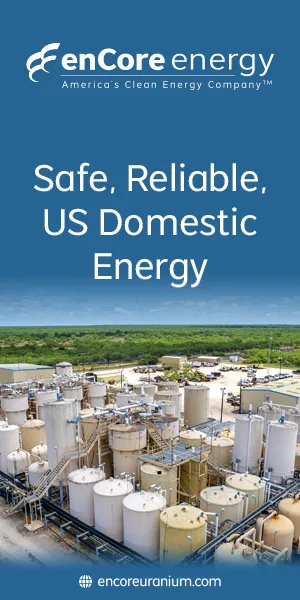
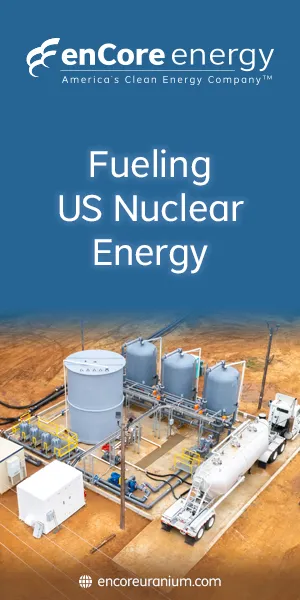
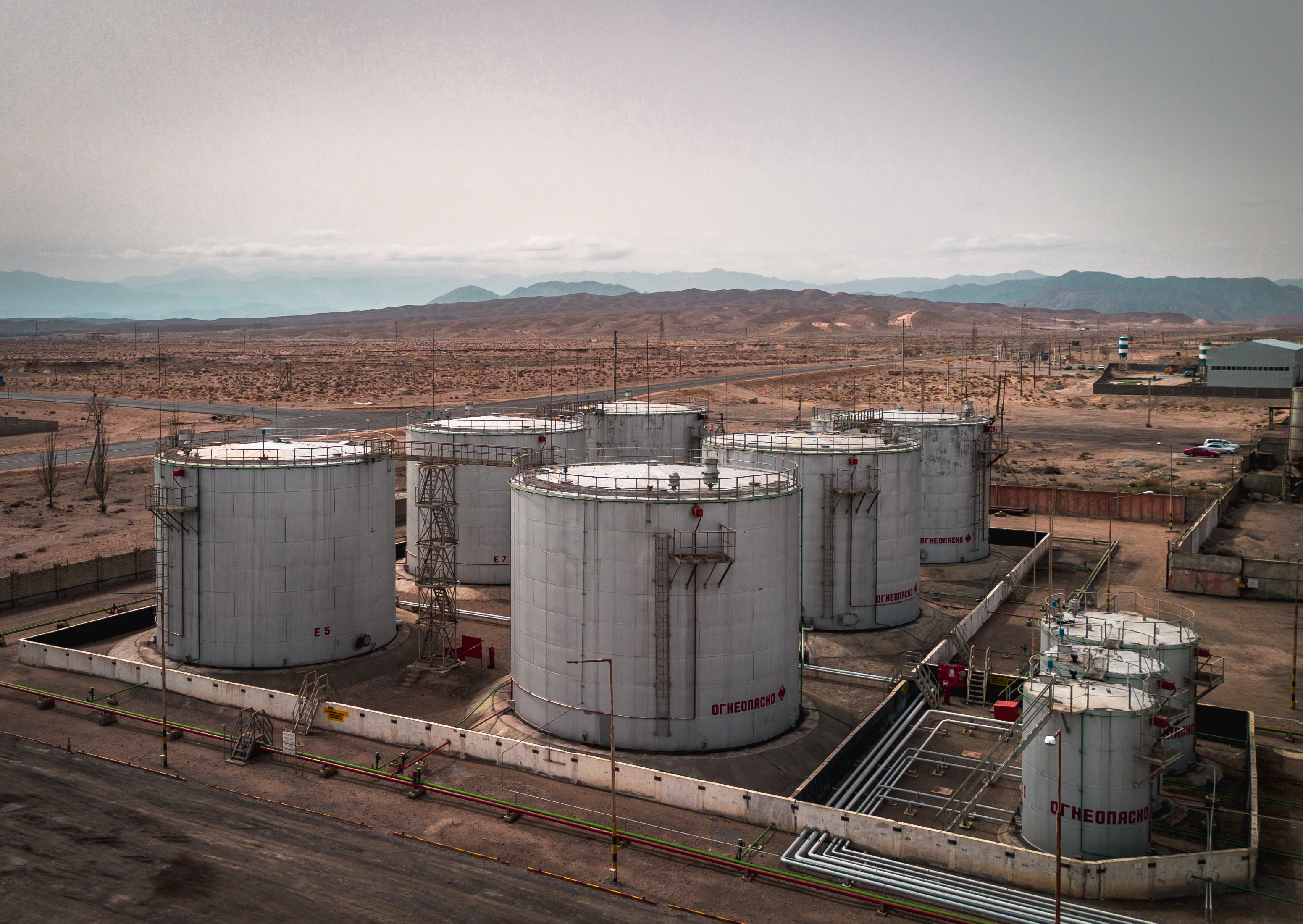
The processing facilities required for ISR operations similarly reflect the technology's efficiency advantages. The Alta Mesa Central Processing Plant occupies a modest footprint focused on ion exchange systems that capture uranium on resin beads from the wellfield solution. The Rosita facility's satellite IX plant model further reduces infrastructure requirements by locating modular ion exchange units near remote wellfields, then trucking uranium-loaded resin to the central plant for final processing.
Financial Considerations: Capital Structure & Funding
enCore Energy's financial position reflects the capital requirements of transitioning from development company to operating producer while advancing multiple growth projects. As of October 31, 2025, the company reported market capitalization of approximately $599 million at $3.20 per share, with 187.1 million shares outstanding. The capital structure includes 19.8 million warrants exercisable at CAD $3.75 to $4.05 through February 2026, plus 11 million options.
The company also holds a $115 million convertible note at 5.5% interest due August 2030, with conversion flexibility allowing principal payment in cash, shares, or combinations at the company's election. The convertible note structure includes redemption rights forcing convertibility if the stock price exceeds $4.28 USD for 20 of 30 trading days after August 21, 2028.
Revenue generation from current production operations partially offsets ongoing capital requirements for wellfield development and exploration programs. The company's contracting strategy, maintaining less than 38% of planned production under fixed commitments through 2033, preserves substantial exposure to spot uranium prices while inflation-adjusted floor pricing in existing contracts provides baseline revenue certainty.
Competitive Landscape: U.S. Uranium Production Context
The domestic uranium production sector remains concentrated among relatively few operators following industry consolidation during the extended price downturn after 2011. Cameco Corporation operates the Smith Ranch-Highland and Crow Butte facilities, which historically represented the largest U.S. ISR operations. Energy Fuels operates conventional mills in Utah and Wyoming along with ISR facilities, positioning itself as a diversified domestic producer.
enCore Energy's operational scale at Alta Mesa, combined with the Rosita facility and development pipeline, positions it prominently within this competitive landscape. The company's 70/30 joint venture structure with Boss Energy at Alta Mesa provides operational control while sharing capital requirements, a partnership model that includes collaboration on the proprietary Prompt Fission Neutron technology for real-time uranium assay.
The development project pipeline provides competitive differentiation through jurisdictional and geological diversification. While South Texas operations currently drive production, the Wyoming Gas Hills project and South Dakota Dewey-Burdock project both hold fully licensed status requiring final permitting coordination rather than fundamental approval processes.
Investment Thesis: The Case for Domestic Uranium Exposure
- Established production provides immediate revenue generation as uranium prices respond to structural supply shortages versus 3-7 year development timelines for greenfield projects.
- Two licensed processing plants in Texas plus advanced Wyoming and South Dakota projects create multiple pathways to production growth without single-project concentration risk.
- 20.54 million pounds of inferred resources plus 52 linear miles of minimally explored mineralized trends offer substantial reserve expansion potential through systematic drilling programs.
- Less than 38% of planned extraction through 2033 currently contracted preserves significant spot price exposure while inflation-adjusted floor/ceiling pricing provides downside protection.
- Bipartisan federal support for domestic uranium production through direct procurement programs, import restrictions, and streamlined permitting creates favorable operating environment.
- In-Situ Recovery operating costs approximately 85% lower than conventional mining provide margin resilience and economic viability across uranium price cycles.
enCore Energy represents direct exposure to the structural uranium supply deficit through operating production assets and near-term development pipeline in the United States. The company's two licensed processing facilities in Texas provide immediate revenue generation from current production exceeding 2,600 pounds daily, with clear pathway to capacity expansion as wellfield development continues.
The investment thesis centers on several interconnected factors converging to support domestic uranium production. Structural supply deficits driven by underinvestment during the price decline, combined with growing reactor fuel requirements globally, have created market tightness that recent price action reflects. Policy support for domestic production through federal procurement programs, import restrictions, and streamlined permitting strengthens the operating environment for U.S. producers specifically.
For investors evaluating uranium exposure, enCore Energy offers differentiated characteristics within the sector. Operating production distinguishes it from pure development companies while the growth pipeline provides production expansion potential beyond current operations. The balanced contracting strategy preserves substantial spot price exposure while floor pricing mechanisms provide downside protection.
TL;DR
enCore Energy operates America's largest ISR uranium production with two South Texas plants ramping toward 1.8 million pounds annual capacity, backed by 51.5 million pounds of resources and advanced development projects in Wyoming and South Dakota.
FAQs (AI-Generated)
enCore operates two licensed processing facilities currently producing uranium in Texas, providing immediate revenue generation versus development companies requiring 3-7 years before production begins.
Contracts represent less than 38% of planned production through 2033 with inflation-adjusted floor/ceiling pricing, preserving significant spot market exposure while providing baseline revenue protection.
Alta Mesa currently operates at 60% of its 1 million pound configured capacity with full utilization targeted by early 2026 as Wellfield 3 Extension comes online.
ISR operations require approximately 15% of the capital expenditure of conventional mines with cash operating costs of $15-24 per pound versus $30-50+ for conventional operations.
Fast-track status accelerates remaining permit coordination for a project with 39% pre-tax IRR that could add 750,000 pounds annual production over 21-year mine life.
Analyst's Notes





Subscribe to Our Channel







.jpg)

Stay Informed