enCore Energy's March 2026 Corporate Update: 8 Things You Need to Know


enCore Energy has two operational uranium plants, fast-track permitting approved, and a growing pipeline. Eight investor takeaways for 2026.
- enCore Energy is the only pure-play US ISR uranium producer with two operational central processing plants (CPPs) currently running in South Texas.
- The uranium spot price peaked at approximately US$106 per pound in February 2024 and was trading in the range of US$72 to US$78 per pound in early 2026, according to UxC spot pricing data, creating a buy-the-dip dynamic for patient investors.
- With less than 38% of planned extraction through 2033 currently contracted, enCore is deliberately positioned to capture upside from a structural uranium price reset anticipated in the 2026 to 2027 window.
- The company's project pipeline, spanning South Texas, South Dakota, and Wyoming, targets the exact window in which the World Nuclear Association (WNA) projects the global uranium supply gap to widen most acutely.
- The key investment variable is not production credibility, which has been established, but how enCore finances the next phase of capital-intensive development, including the US$264.2 million Dewey Burdock project against a US$489 million market capitalization as at February 18, 2026.
The uranium spot price peaked at approximately US$106 per pound in February 2024 and was trading in the range of US$72 to US$78 per pound in early 2026, according to UxC spot pricing data. Into that environment, enCore Energy is releasing its March 2026 corporate deck at a moment when domestic US uranium supply has become a national security priority. With operations underway at two South Texas central processing plants (CPPs), a growing wellfield development program, and a pipeline extending into South Dakota and Wyoming, enCore has completed the transition from developer to producer. Here are eight things investors need to understand.
1. enCore Is Already a Producer & That Changes the Risk Profile Entirely
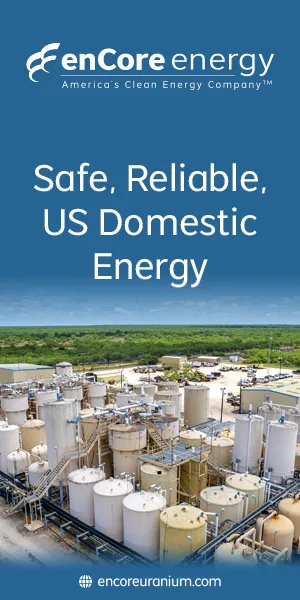
Operations are underway at both the Alta Mesa CPP and the Rosita CPP in South Texas. Alta Mesa commenced operations in the second quarter of 2024. The plant carries a nameplate capacity of 1.5 million pounds of uranium oxide (U3O8) annually at the central plant, plus an additional 500,000 pounds from satellite ion exchange (IX) plants, for a total design capacity of 2 million pounds per year. It is currently configured to operate at 1 million pounds per year. The Rosita CPP carries 800,000 pounds annual capacity and is now licensed to include the Upper Spring Creek (USC) project via satellite remote ion exchange (RIX) plants, with the first wellfield nearing production pending final permits.
For uranium equities long valued on optionality rather than cash flow, the producer status of enCore represents a meaningful de-risking event. The investment question shifts from "will they ever produce?" to "how fast can they scale?" and that is a far more tractable analysis.
2. The Alta Mesa Wellfield Buildout Is Accelerating
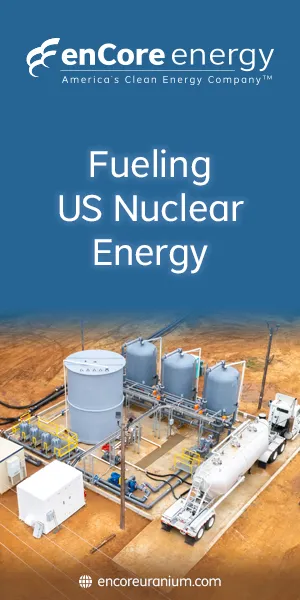
270 new production wells were turned on in 2025, averaging 22 per month or one every 1.35 days. Wellfield 7 has been producing throughout 2025, additional wells were brought online in the first quarter of 2026, and initial work has commenced on Wellfield 8. The Alta Mesa East property expansion, covering over 5,900 acres immediately adjacent to existing operations, is under active drilling to establish resources through 2026 and into 2027.
ISR uranium production scales through wellfield additions rather than single step-change capital events. The pace of well installation demonstrated in 2025 signals disciplined operational execution, and that trajectory should be the primary production metric investors track quarter over quarter.
3. The Collared Contract Strategy Is a Deliberate Bet on Higher Prices
enCore's contract structure uses pricing collars with inflation-adjusted floors that protect operating margins and ceilings that preserve spot price upside. Current contracts represent less than 38% of planned extraction through 2033. The company plans to contract less than 50% of planned annual extraction rates at current prices, with contracting expected to increase if spot prices spike.
UxC and analysts including Sprott Asset Management describe the term market as representing approximately 80% to 85% of uranium transaction volumes. enCore's approach preserves maximum leverage to term market repricing as utilities return to long-term contracting. The revenue profile is not fully visible yet, but the strategic rationale is coherent and consistent with a longer-cycle setup.
4. Dewey Burdock Economics Are Competitive & Fast-Track Permitting Has Been Approved
All figures are drawn from the Dewey Burdock Project S-K 1300 Technical Report Summary prepared by Stuart Bryan Soliz of SOLA Project Services, effective October 8, 2024. The project carries a 28-year mine life, annual production of 750,000 pounds, and life-of-mine (LOM) production of 14.1 million pounds. Initial capex is US$264.2 million, equivalent to US$18.72 per pound of LOM production. Cash operating costs total US$23.81 per pound. Pre-tax and post-tax net present value (NPV) at an 8% discount rate stand at US$180.1 million and US$133.6 million respectively, with a pre-tax internal rate of return (IRR) of 39% and post-tax IRR of 33%, based on a long-term uranium price of US$86.34 per pound.
The project received US Government Fast Track Permitting approval under the Fixing America's Surface Transportation Act (FAST-41) in August 2025. With a Nuclear Regulatory Commission (NRC) license already in timely renewal and Environmental Protection Agency (EPA) Aquifer Exemption approval in hand, the regulatory stack is further along than most comparable ISR developments. State permitting is expected to complete by end of 2027.
5. Gas Hills Offers the Highest Returns in the Pipeline and Is 100% Owned
All figures are drawn from the Gas Hills Uranium Project Preliminary Economic Assessment (PEA) prepared by WWC Engineering, effective December 31, 2024. Located in Wyoming, an Agreement State with established ISR permitting precedent, the project has an 11-year mine life, annual production of 880,000 pounds, and LOM production of 6.1 million pounds. Initial capex is US$55.2 million, equivalent to US$9.05 per pound of LOM production. Cash operating costs total US$15.51 per pound. Pre-tax and post-tax NPV at an 8% discount rate stand at US$166.9 million and US$141.8 million respectively, with a pre-tax IRR of 54.8% and post-tax IRR of 50.2%, based on a long-term uranium price of US$87 per pound. The project pipeline commences in 2028.
At US$55.2 million initial capex, Gas Hills is a project enCore could potentially self-fund with limited dilution. The 100% ownership contrasts with the 70/30 joint venture structure at Alta Mesa with Boss Energy.
6. The Supply-Demand Gap Validates enCore's Pipeline Timing
According to the IAEA Power Reactor Information System (PRIS) and the WNA, approximately 440 operable commercial nuclear reactors operate across 31 countries, with approximately 70 under construction and 115 additional reactors in the planned stage globally as of February 2026. The US Energy Information Administration (EIA) Domestic Uranium Production Report shows domestic uranium concentrate production running at approximately 200,000 pounds per year, against current annual reactor requirements of approximately 40 to 44 million pounds of U3O8, with demand projected to grow toward 48 million pounds per year.
According to the EIA Uranium Marketing Annual Report, Kazakhstan, Russia, and Uzbekistan collectively supplied approximately 44% of US uranium purchases in the most recently reported period. In January 2026, the US Department of Energy (DOE) announced US$2.7 billion in contracts to three companies to boost domestic enrichment capacity over the next decade. Alta Mesa and Rosita are producing now, while Dewey Burdock and Gas Hills are sequenced precisely for the window in which the supply gap is projected to widen most acutely.
7. The Financing Risk Is the Variable Most Investors Are Not Pricing Carefully
enCore carried a US$115 million convertible note at 5.5%, issued in August 2023, alongside a market capitalization of US$489 million at US$2.52 per share, with 194,088,865 shares issued and outstanding and a fully diluted share count of 202,508,899, all as at February 18, 2026.
Dewey Burdock's US$264.2 million initial capex alone exceeds the current equity market capitalization. Even with strong uranium prices and growing contract revenues through 2027, some combination of debt refinancing, equity issuance, or streaming and royalty arrangements will likely be required. The cost of capital and dilution impact of that financing will materially influence long-term shareholder returns.
What to Watch Next
The March 2026 update confirms enCore has cleared the most critical de-risking hurdle in the uranium junior space: it is producing. The wellfield buildout at Alta Mesa, USC satellite plant progression at Rosita, and FAST-41 status at Dewey Burdock all represent genuine forward momentum. With uranium spot prices in the range of US$72 to US$78 per pound in early 2026 per UxC data, and the supply-demand gap projected to widen materially from 2026 onward per WNA forecasts, enCore's leverage to a price recovery is among the highest of any US-domiciled producer currently in operation. The financing structure for the next development phase remains the key variable to monitor.
FAQs (AI-Generated)
Analyst's Notes





Subscribe to Our Channel




Stay Informed