




Fed Rate-Hike Repricing Keeps Gold Range-Bound Despite Escalating Iran War Risk



Gold remains range-bound as higher real yields outweigh Iran-driven safe-haven demand, while central bank buying and producer fundamentals support the long-term outlook.
- Gold traded near $4,070 per ounce on July 21, 2026, up 1.3 percent on the day but still about 27 percent below its January 28-29 record near $5,590, even as the US-Iran conflict pushed Brent crude toward $90 per barrel.
- Markets are pricing the Fed's July 28-29 meeting under Chair Kevin Warsh as an 85.6 percent probability of holding rates at 3.50 percent to 3.75 percent, while September hike odds have climbed to 55 percent from 51 percent in a single session, reinforcing expectations of a higher-for-longer policy path that continues to pressure gold.
- The World Gold Council's 2026 Central Bank Gold Reserves Survey, published June 16, 2026, found that 89 percent of reserve managers expect official-sector gold holdings to increase over the next 12 months, while a record 45 percent plan to expand their own reserves, reinforcing long-term structural demand despite a more hawkish Fed outlook.
- The Fed's July 28-29 decision is the key near-term catalyst for gold, with a hawkish signal likely to push prices back toward the high $3,900s, while a dovish shift could reopen a move above $4,200 by reshaping expectations for real yields.
Iran War Lifts Oil Prices & Keeps Real Yields High, Limiting Gold's Safe-Haven Rally
The US-Iran conflict escalated after a 60-day ceasefire collapsed on July 8, when Iran targeted commercial vessels in the Strait of Hormuz, prompting renewed US strikes. Houthi threats to Saudi oil exports have since put an estimated 2.5 million barrels per day of crude supply at risk, according to Rystad Energy, pushing Brent crude toward $90 per barrel. Such geopolitical shocks have historically supported gold through safe-haven demand.
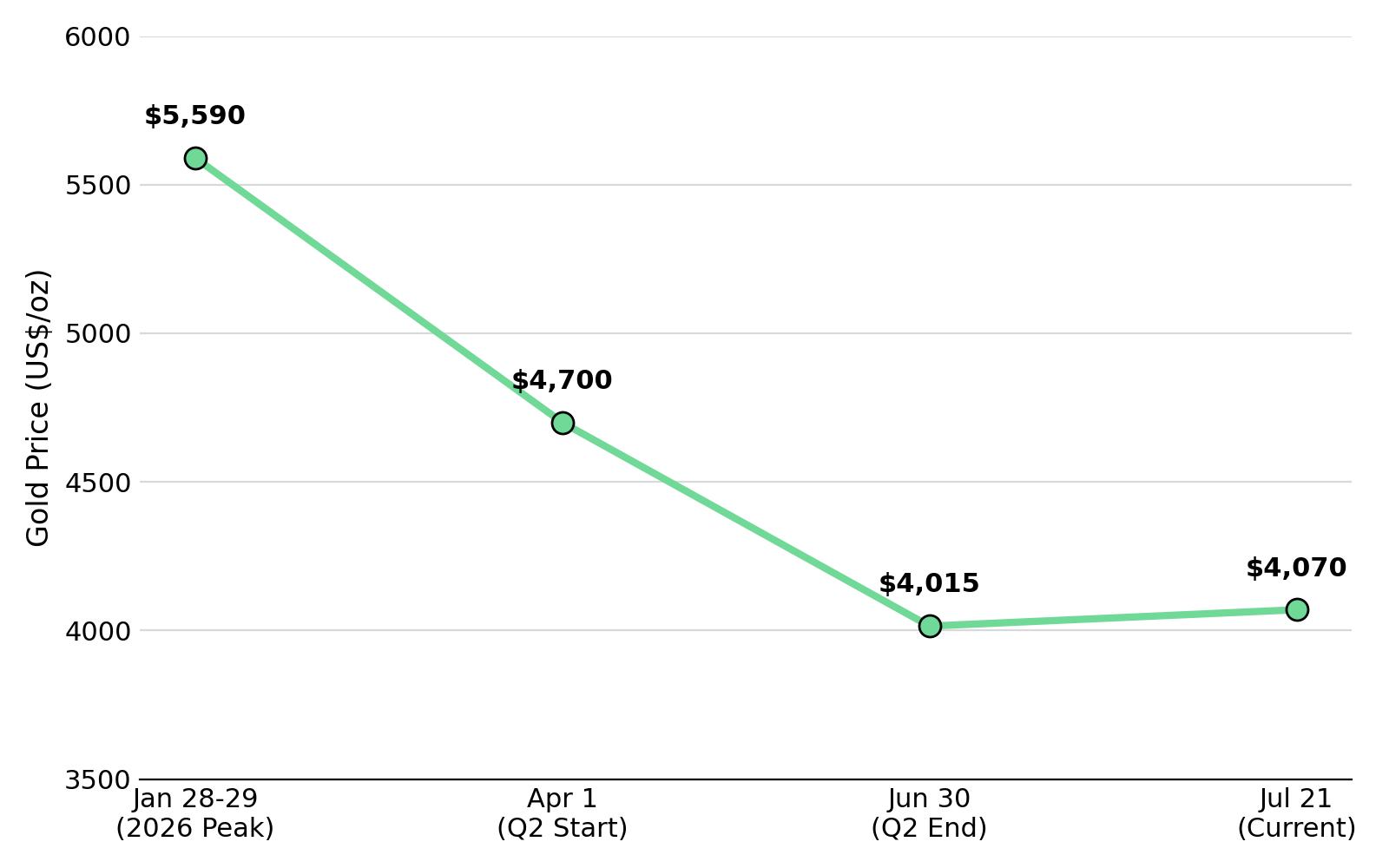
This time, however, gold has failed to rally. The metal fell from about $4,700 per ounce at the start of the second quarter of 2026 to roughly $4,015 by quarter-end, its worst quarterly decline since the 2013 taper tantrum. At about $4,070 on July 21, gold remained 27 percent below its January record near $5,590, suggesting the recent rebound remains part of a broader downtrend.
The same conflict lifting oil prices is also raising inflation expectations, reinforcing the case for higher-for-longer Fed policy. Elevated real yields increase the opportunity cost of holding non-yielding gold, outweighing safe-haven demand. Geopolitical risk and monetary policy are pulling gold in opposite directions, but for now, real yields remain the dominant driver.
Fed Rate-Hike Repricing Lifts Real Yields & Keeps Gold Sensitive to Economic Data
Kevin Warsh assumed the Fed chairmanship on May 22, 2026, and markets expect his first July 28-29 policy meeting to leave rates unchanged, with CME Group assigning an 85.6 percent probability to a 3.50 percent to 3.75 percent target range. More significant for gold, September rate-hike odds have risen to 55 percent from 51 percent in a single session, leaving upcoming data, including private payrolls, jobless claims, and flash purchasing managers' indices, under close scrutiny for their impact on Fed expectations and real yields.
Fed repricing, rather than the war itself, is also evident in investor positioning and bank forecasts. SPDR Gold Shares, the largest US-listed gold exchange traded fund, recorded about $14.4 billion in outflows between March 1 and July 16, 2026, although selling has eased with July outflows totaling roughly $46 million and a mid-July weekly inflow of about $447 million. Goldman Sachs cut its year-end 2026 gold target to $4,900 from $5,400 after removing all remaining 2026 rate cuts from its forecast, while J.P. Morgan maintained a fourth-quarter target of about $5,000 per ounce. Both outlooks reflect changing Fed expectations rather than a different geopolitical outlook.
Central Bank Buying Offsets Fed Headwinds & Provides Structural Support for Gold
Gold demand is not equally sensitive to Fed expectations. While exchange-traded fund investors and futures traders have reduced exposure as real yields have risen, central banks continue buying gold as part of long-term reserve diversification. The World Gold Council's 2026 Central Bank Gold Reserves Survey found that 89 percent of reserve managers expect global gold holdings to increase over the next 12 months, with a record 45 percent planning to expand their own reserves. That structural demand continues to support gold even as higher real yields weigh on prices.
The difference between structural central bank buying and Fed-sensitive investor flows helps explain why gold has held support in the high $3,900s to low $4,000s despite increasingly hawkish Fed expectations. With gold caught between higher real yields and sustained official-sector demand, investors should focus less on bullion's next move and more on producers that can protect margins and generate cash flow in a range-bound market.
Range-Bound Gold Prices Shift Investor Focus From Bullion to Producer Fundamentals
In a range-bound gold market, free cash flow depends less on higher bullion prices than on the margin between the gold price and each producer's all-in sustaining cost (AISC), the fully loaded cost of producing and sustaining an ounce of gold, including mine-site operating costs, sustaining capital, and reclamation. That operating margin is where the four producers examined here diverge, with each relying on a different operational or financial lever to protect profitability.
Energy Inflation Raises Mining Costs & Compresses Producer Margins Despite Gold Support
Integra Resources, a production-stage gold miner operating the Florida Canyon heap-leach mine in Nevada, saw 2026 site-level all-in sustaining cost guidance rise to $3,300–$3,500 per ounce from $2,750–$2,950 per ounce, direct evidence of higher oil prices flowing into producer cost structures. The increase, driven by higher mining volumes and inflation in diesel fuel and explosives, arrives even as an updated feasibility study effective June 25, 2026 increased proven and probable reserves by 74 percent to 1.19 million ounces and extended mine life to eight years, with the near-term cost guidance still well above the life-of-mine target of $2,331 per ounce. That gap shows how the same Iran-driven energy shock supporting gold is also compressing producer margins.
George Salamis, President and Chief Executive Officer of Integra Resources, says the increase reflects sector-wide inflation rather than issues unique to the company, highlighting how higher energy costs are affecting gold producers across the industry:
"It's affecting us right now, like every other gold producer out there. Fuel prices are high, explosive prices are high, and that's being reflected in our all-in sustaining costs right now."
Gold's Pullback Matters Less When Strong Operations Lower the Profitability Threshold
West Red Lake Gold Mines, the production-stage operator of the restarted Madsen mine in Ontario's Red Lake district, saw second-quarter 2026 gold production rise 51 percent to 8,576 ounces on the back of higher mining rates and a 23 percent improvement in average mined grade to 4.3 grams per tonne, margin expansion driven by operational execution rather than a stronger gold price. Mined tonnage increased 46 percent to 75,524 tonnes and mined ounces climbed 73 percent to 10,459 ounces, as the company gained access to higher-grade mining areas within the Madsen complex. The stronger operating performance has enabled the company to build cash and repay restart-related debt, illustrating how higher productivity and grade can strengthen free cash flow even as gold remains about 27 percent below its January peak.
Shane Williams, President and Chief Executive Officer of West Red Lake Gold Mines, says the combination of stronger operating performance and a much higher gold price has created a far wider margin for profitability than the mine's previous operator enjoyed:
"Our previous operator, Pure Gold, had to have an average gold production rate of around 4,000 ounces to break even. We have the luxury of the gold price being double what it was at this stage, and that gives you a lot of leeway."
Higher Interest Rates Reward Financial Strength as Much as They Pressure Gold
Serabi Gold, a production-stage underground miner operating the Palito and Coringa mines in Brazil, ended the first quarter of 2026 debt-free after repaying its final $5.3 million loan facility, insulating the company from the higher cost of capital that is pressuring both gold valuations and more leveraged producers. Rather than relying on debt or equity markets, Serabi's three-phase expansion plan targets approximately 100,000 ounces of annual production from current guidance of 53,000 to 57,000 ounces using internally generated cash flow, funded by a cash balance that grew to $64.4 million by quarter-end.
Mike Hodgson, Chief Executive Officer of Serabi Gold, says the company's strong operating margins generate the cash flow needed to fund growth internally, reducing its reliance on external financing despite a higher-rate environment:
"Wherever you want to put the gold price at the moment, on top of the all-in sustaining cost we're probably looking at a $2,000 margin, times our 53,000 to 55,000 ounces of guidance this year. So we should be looking at 80, 90, $100 million."
Higher Processing Recovery Improves Project Economics Without Higher Gold Prices
i-80 Gold, a production-stage miner operating exclusively in Nevada, is stockpiling roughly 4,000 recoverable ounces of sulphide ore rather than processing it through third-party facilities at a 55 to 60 percent payability factor, direct evidence that higher processing recovery can create value even in a range-bound gold market. Much of its ore is refractory, with gold locked in sulphide minerals that limit recovery through conventional cyanide leaching. The company's Lone Tree pressure oxidation circuit, scheduled to begin construction in the second half of 2026 and produce first gold in late 2027, is designed to lift recovery to about 92 percent. By holding that ore back instead of processing it at lower recoveries now, i-80 is sacrificing near-term production to improve future margins, demonstrating how operational efficiency can create value without higher gold prices.
Fed Policy & Iran Ceasefire Will Decide Whether Gold Breaks Out of Its Trading Range
The Fed's July 28-29 policy decision remains the dominant near-term catalyst for gold, although developments in the US-Iran conflict could amplify the market's reaction. A hawkish message validating higher September rate-hike expectations would likely lift real yields and pressure gold toward the mid-$3,900s support tested on July 17. Conversely, a more dovish tone, especially if the reported 10-day US-Iran ceasefire holds, could lift gold above the early July high near $4,203 toward the 55-day moving average around $4,323.
The ceasefire could produce a counterintuitive outcome for gold by easing oil-driven inflation pressures, lowering real yields, and supporting prices even as safe-haven demand fades. The key variable is not the ceasefire itself, but how it changes expectations for the Fed's reaction function. Investors should also watch the scheduled expiration of the 10 percent Section 122 tariff around July 24, as any impact on the US dollar and broader cross-asset positioning could influence near-term gold trading.
Real Yields Will Continue Driving Gold's Near-Term Range
The key lesson for gold through the rest of 2026 is that geopolitical conflict alone is unlikely to determine prices when Fed expectations are moving in the opposite direction. Real yields remain the dominant driver, while central bank reserve diversification continues to provide structural support independent of either the conflict or the next FOMC meeting.
For gold producers, the combination of higher real yields and resilient structural demand has shifted investor focus from gold-price leverage to operating margins, balance sheet strength, and processing efficiency. Until Fed expectations become materially more dovish, those company-specific fundamentals are likely to drive relative equity performance, making the July 28-29 FOMC decision, rather than developments in the war, the key catalyst for gold and gold equities through August.
The Investment Thesis for Gold
- Official-sector demand continues to provide structural support for gold that is far less sensitive to changes in the Fed's rate path than investor positioning, underscored by a record 45 percent of reserve managers planning to increase their own gold holdings over the next 12 months.
- Real yields, rather than geopolitical risk alone, remain the dominant driver of gold's near-term price action, meaning investors who focus only on war headlines risk overlooking the more influential signal coming from Fed expectations.
- Cost discipline has become a primary differentiator among gold producers in a range-bound gold market, as the same energy-driven inflation supporting safe-haven demand also raises operating costs and compresses margins.
- Higher-for-longer interest rates increase the value of strong balance sheets, as producers able to fund growth internally face less financing risk than those dependent on debt or equity markets.
- Processing infrastructure and higher recovery rates can unlock value from refractory or lower-payability ore, creating upside that is less dependent on near-term movements in the gold price.
- The upcoming FOMC decision is the key near-term catalyst for gold, as any shift in Fed expectations is likely to outweigh geopolitical developments in determining price direction over the coming week.
Gold has fallen despite heightened geopolitical risk because the same conflict lifting oil prices has reinforced expectations that the Fed will keep policy restrictive, leaving elevated real yields to outweigh safe-haven demand. The metal trades near $4,070 per ounce, about 27 percent below its January 2026 peak, with continued central bank buying providing structural support while the Fed's July 28-29 decision remains the key near-term catalyst. Gold producers including Integra Resources, West Red Lake Gold Mines, Serabi Gold, and i-80 Gold demonstrate how margin resilience, balance sheet strength, and operational execution are increasingly driving equity performance while bullion remains range-bound.
TL;DR
Gold has failed to rally despite escalating US-Iran tensions because the same conflict is raising oil prices and inflation expectations, reinforcing expectations that the Federal Reserve will keep interest rates higher for longer. Elevated real yields continue to outweigh safe-haven demand, while steady central bank buying provides structural support that has helped gold hold above the high $3,900s. With bullion likely to remain range-bound until the Fed's July 28-29 decision, investors should focus on producers with strong margins, healthy balance sheets, and operational improvements that can generate cash flow regardless of near-term gold prices.
FAQs (AI-Generated)
Analyst's Notes





Subscribe to Our Channel






.png)




Stay Informed






















