




162,000 Jobs Beat Consensus & Lift Fed Odds as Gold Demand Holds



Gold fell as a 162,000 payroll beat lifted Fed hike odds, while central-bank demand and slow mine supply support the longer-term case.
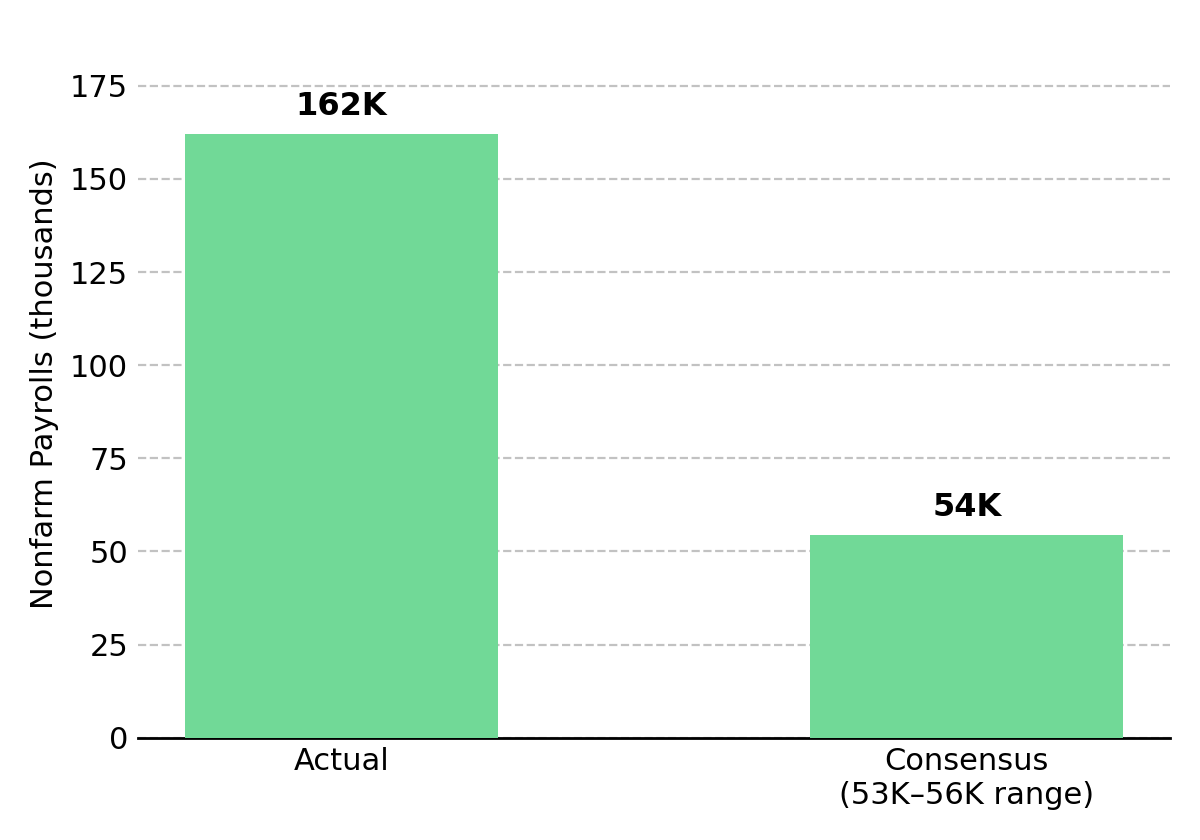
- Nonfarm payrolls rose 162,000 in August 2026, nearly three times the 53,000 to 56,000 consensus, lifting the odds of a 25 basis point Fed rate hike at the September 15-16 meeting from roughly 50% to the high 50s on the CME FedWatch Tool.
- Spot gold fell 1.14% to $4,429 per ounce as the 10-year Treasury yield rose to 4.79% and the US Dollar Index climbed to 99.16, increasing the opportunity cost of holding a non-yielding asset.
- The August Consumer Price Index (CPI), due September 11, 2026, is the final major inflation reading before the Fed's September 15–16 meeting, giving markets another key input into whether the current rate-hike pricing holds.
- World Gold Council (WGC) data show central banks bought 289 tonnes of gold in the second quarter of 2026, providing a source of physical demand that is less sensitive to weekly changes in Fed rate expectations.
- Permitting, financing, resource definition, and metallurgy keep new mine supply on multi-year timelines, limiting the supply response to short-term gold-price moves.
162,000 Jobs Lift Fed Hike Odds & Pressure Gold Through Higher Yields
The US Bureau of Labor Statistics reported that nonfarm payrolls rose by 162,000 in August 2026, close to three times the 53,000 to 56,000 consensus range, while the unemployment rate held at 4.1%. The upside surprise reduced evidence of labor-market cooling and strengthened the case for keeping rates restrictive, shifting near-term rate expectations against gold.
According to the CME FedWatch Tool, the probability of a 25 basis point Fed rate hike at the September 15-16 meeting rose from roughly 50% to the high 50s after the payrolls release. Following the release, the 10-year Treasury yield rose to 4.79%, the US Dollar Index climbed to 99.16, and spot gold fell 1.14% to $4,429 per ounce.
Higher Fed Rate Odds Raise Gold’s Opportunity Cost
Gold pays no interest or dividend, so higher real, inflation-adjusted Treasury yields increase the income forgone by holding the metal. When stronger labor data raise the odds that the Fed holds or hikes rates rather than cutting them, higher Treasury yields increase the opportunity cost of holding gold relative to interest-bearing assets.
The federal funds rate has remained at 3.50% to 3.75% throughout 2026, so the post-payroll repricing changed expectations for the next Fed decision rather than the current policy rate. The price move therefore reflected a change in expectations for the Fed's rate path rather than evidence of weaker physical gold demand from central banks.
September CPI Can Reverse Fed Repricing & Shift Gold’s Near-Term Direction
The August Consumer Price Index (CPI), due September 11, 2026, is the final major inflation reading before the Fed's September 15–16 meeting, giving markets another key input into whether current rate-hike pricing holds. The European Central Bank (ECB) rate decision arrives on September 10, one day before US CPI, and any change in euro-area rate expectations can affect the US Dollar Index and gold before the Fed meets.
A below-consensus CPI reading would likely reduce Fed hike odds and ease pressure from Treasury yields and the US dollar, while an above-consensus reading would increase the risk of further near-term pressure on gold. Because CPI is the final major inflation reading before the September 15-16 Fed meeting, it can either reinforce or reverse the rate repricing triggered by the August payrolls report.
Central-Bank Buying Supports Gold Despite Shifting Fed Rate Expectations
WGC data show central banks purchased 289 tonnes of gold in 2Q 2026, providing a substantial source of physical demand despite shifting Fed rate expectations. The People's Bank of China's reserve data show 21 consecutive months of net gold additions through July 2026, with no month of net selling despite shifts in Fed rate expectations during that period.
Speculative futures positions can adjust quickly as traders reprice Fed policy, while central-bank reserve purchases are generally driven by longer-term allocation and diversification objectives. The WGC's 2026 annual central-bank survey found that 45% of respondents plan to increase their own gold reserves over the next 12 months, supporting the case for continued official-sector demand beyond near-term Fed repricing.
WGC data show global gold-backed exchange-traded funds (ETFs) returned to net inflows in July 2026, adding roughly $3 billion and 23 tonnes after 2 consecutive months of outflows. The July reversal adds rate-sensitive investment demand to continued central-bank buying, broadening the sources of demand supporting gold beyond the official sector.
Gold Prices Move Fast, Mine Supply Responds Slowly & De-Risking Matters
Global gold mine production has grown by roughly 1% to 2% annually in recent years, limiting how quickly mined supply can respond when gold demand or prices rise. Higher gold prices translate into additional mine supply only as developers complete feasibility work, secure permits and financing, and advance projects toward construction. Because those development steps typically take years, short-term changes in the gold price cannot produce an immediate increase in mined supply.
Grade Sequencing & Phased Builds Improve Early Gold Project Economics
Cabral Gold, a development-stage company advancing its Cuiú Cuiú project in Brazil, is targeting first gold in the fourth quarter of 2026, with early production sequencing focused on higher-grade material at the MG deposit. Infill drilling at MG supports a mine sequence that places higher-grade near-surface material into the first 12 to 18 months of production, giving early output a higher grade than the life-of-mine average.
Alan Carter, President and Chief Executive Officer of Cabral Gold, explains the higher-grade sequencing planned for early production:
“We drilled about 165 holes and some of them were quite a bit higher than anticipated. The beauty of the first year or 18 months of production at MG is there's higher-grade material at the surface. The average life-of-mine grade here is about .7 grams a ton. We expect that the initial 12 to 18 months will be running at about a gram and a half.”
New Found Gold is targeting a phased build at its Queensway project in Newfoundland to reduce reliance on a single large upfront capital raise and spread financing requirements across development stages. Chief Executive Officer Keith Boyle cites a decline in New Found Gold's reported discovery cost from roughly $145 per ounce for its initial resource to below $100 per ounce for subsequently added ounces. The company compares that figure with an estimated $500 to $600 per ounce cost for acquiring gold through mergers and acquisitions, supporting continued exploration as the lower-cost route to resource growth.
Higher-Grade Resources & Permitting Reduce Gold Development Risk
Tudor Gold, a development-stage company advancing the Treaty Creek project in British Columbia, is defining a higher-grade portion of the Goldstorm deposit to support a lower-capital initial underground mine plan. Goldstorm contains 24.9 million ounces of indicated gold, including a 5.8 million ounce higher-grade subset defined at a US$125 per tonne net smelter return cut-off, which supports a smaller initial underground mine concept with lower upfront capital requirements.
US Gold Corp's CK Gold project in Wyoming has advanced through permitting and feasibility work, removing two major steps before a construction decision. The project's completed feasibility study reports an after-tax NPV of $632 million at a 5% discount rate and a 27% after-tax IRR using a base-case gold price of $3,250 per ounce, below the $4,429 per ounce spot price established earlier in the article.
Luke Norman, Executive Chairman of US Gold Corp, explains how higher gold prices affect project economics:
“As we start pushing up towards the spot price in gold, you see a tremendous shift.”
Permitting Timelines Shape Gold Project Risk & Present Value
Permitting requirements can change project timelines by determining when drilling, construction, or production can begin. US Gold Corp's CK Gold project sits on Wyoming state land with no direct federal permitting involvement, reducing the number of regulatory layers required before construction. Tudor Gold still requires a British Columbia provincial permit for an underground exploration ramp at Goldstorm, which would extend drilling of its higher-grade zone from a 4 to 5-month surface season to year-round access. Cabral Gold has secured its operating license and military-issued cyanide transport permit in Brazil, removing stated permitting requirements ahead of its targeted first gold pour. Longer permitting timelines push potential mine cash flows further into the future, reducing their present value at a given discount rate.
Hormuz Risk Raises Inflation Pressure & Strengthens Gold’s Hedge Demand
Conflict around the Strait of Hormuz creates a second channel for gold through the risk that shipping disruptions raise oil prices and feed into US inflation. The strait carries about 25% of global seaborne oil trade, so a sustained disruption could raise oil prices and energy-related inflation before the September 11 CPI release, increasing the risk that Fed rate expectations remain restrictive.
Gold is currently exposed to two competing price drivers: restrictive Fed expectations and demand for geopolitical hedges. Higher Fed hike probabilities can pressure gold by raising Treasury yields and the opportunity cost of holding a non-yielding asset, while conflict around the Strait of Hormuz can increase safe-haven demand even as higher oil-price risk supports more restrictive Fed expectations. These opposing channels leave gold's near-term direction sensitive to whether rate pressure or geopolitical demand has the larger effect on price.
The Investment Thesis for Gold
- Near-term gold pricing remains sensitive to the September 11 CPI release, with an above-consensus reading likely to reinforce restrictive Fed expectations while a below-consensus reading would reduce pressure from rates and Treasury yields.
- Central banks purchased 289 tonnes of gold in the second quarter of 2026, providing a source of physical demand that has remained less sensitive to short-term changes in Fed rate expectations.
- Projects that have completed permitting carry less development-timeline risk than those still dependent on financing, resource definition, or approvals, while longer timelines reduce the present value of potential future cash flows.
- Conflict around the Strait of Hormuz can support safe-haven demand for gold while higher oil-price risk can simultaneously reinforce restrictive Fed expectations.
- Grade sequencing, resource definition, permitting, financing, and metallurgical work can improve project economics over multi-year development timelines that do not change with a single month of gold or rate volatility.
The European Central Bank's decision on September 10, 2026, the Consumer Price Index print on September 11, 2026, and the Federal Reserve's meeting on September 15 and 16, 2026, form a 3-event window that will resolve which of these two narratives, a rates story or a demand story, dominates pricing through year-end. What will not resolve inside that window is the multi-quarter distance separating a resource estimate from a feasibility study, and a feasibility study from a construction decision, which is why the gap between how fast price can move and how slowly supply can follow it remains the operative case for gold beyond this month's data.
TL;DR
August payrolls rose 162,000, nearly three times consensus, lifting Fed hike odds and pushing spot gold down 1.14% to $4,429 per ounce as Treasury yields and the US dollar strengthened. September CPI is now the next major test for rate expectations. However, central banks bought 289 tonnes of gold in the second quarter of 2026, while ETF flows returned to positive territory in July. Mine supply also remains slow to respond because permitting, financing, resource definition, metallurgy, and construction operate on multi-year timelines. Hormuz disruption adds another variable by supporting safe-haven demand while potentially raising inflation and keeping Fed policy restrictive.
FAQs (AI-Generated)
Analyst's Notes





Subscribe to Our Channel







.jpg)




Stay Informed






















