




Fork, Starratt-Olson & the 8 Zone: What a Construction Decision Would Open at Madsen


West Red Lake Gold advances Fork toward a 2026 construction decision, linking near-mine ounces with district-scale exploration potential at Madsen.
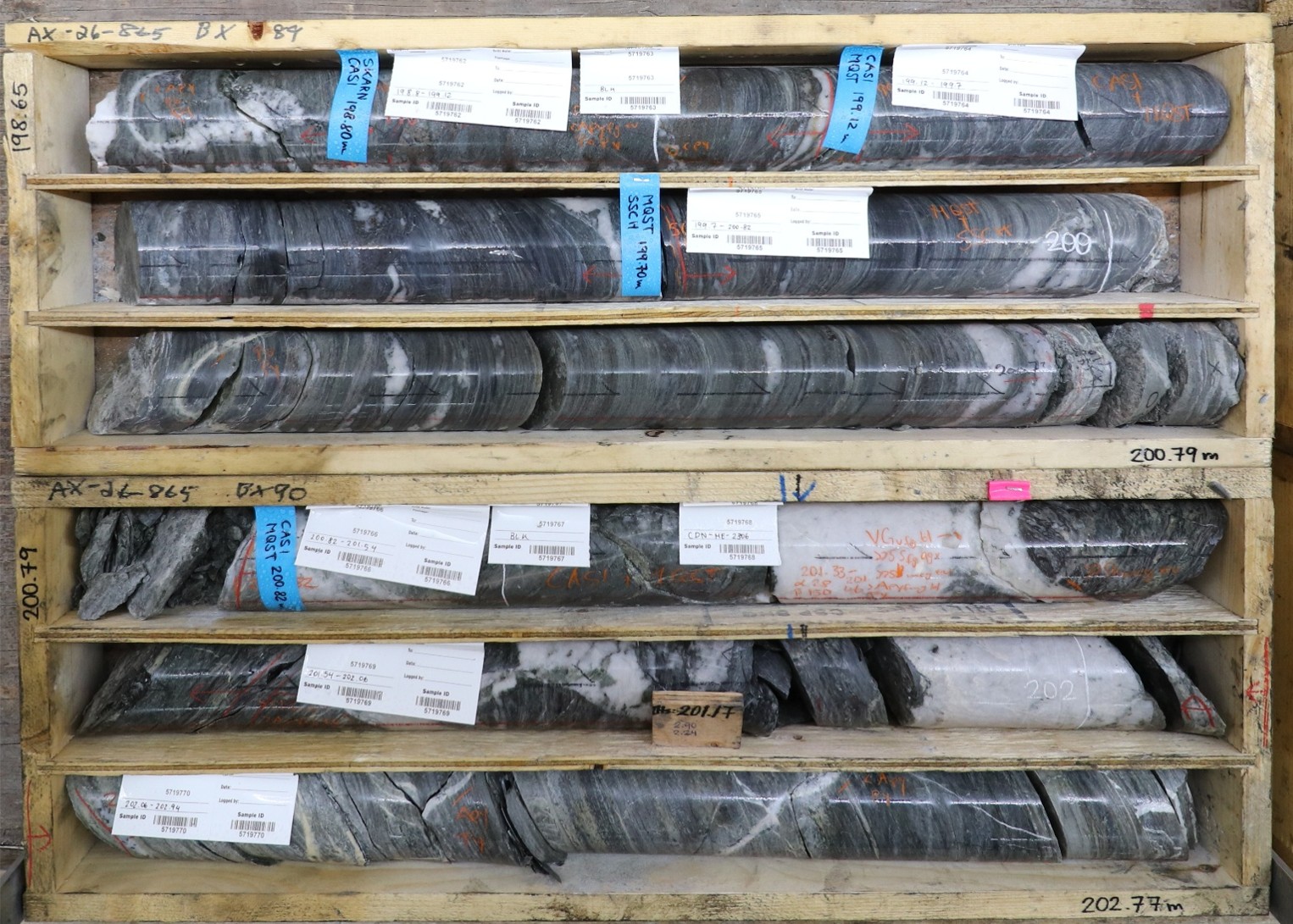
West Red Lake Gold Mines (TSXV: WRLG) completed a 3,204-metre, 17-hole surface infill program at its Fork deposit in March 2026, confirming grade and vein continuity across the 400 by 250-metre target zone and initiating initial mine design. The company framed the program as a construction decision gate: a necessary step in de-risking a near-mine, non-remnant gold resource sitting approximately 250 metres from existing underground infrastructure. The headline intercept, 1 metre at 41.25 grammes per tonne gold, including 0.5 metres at 77.8 grammes per tonne, confirmed visible gold in primary hard rock, while broader intercepts of 4.5 metres at 5.8 grammes per tonne and 3.3 metres at 4.22 grammes per tonne defined the mineable envelope.
Neither the confirmed grades nor the operational proximity to Madsen were what made the announcement geologically significant. West Red Lake Gold also disclosed that underground development toward Fork would follow the main structural trend running from Madsen toward the past-producing Starratt-Olson Mine, and that the lower of Fork's two shear zones occupies the same structural and stratigraphic position as the 8 Zone, Madsen's highest-grade Indicated resource domain, approximately 1.8 kilometres down plunge.
What Fork Is & What the Infill Program Confirmed
Fork is a shallow, non-remnant gold deposit hosted within two concordant shear zones spaced 100 to 150 metres apart. These zones strike north-northeast and dip at approximately 60 degrees. The Main Zone, the upper of the two lenses, follows a shear zone continuous to the southwest with the structures hosting the DV and CK Zones at Madsen. Gold distribution within it is controlled by intersections with ultramafic sills and iron formation units within the surrounding basalt. The deposit has been drill-tested over a 600-metre strike length and to 375 metres depth. Mineralized zones typically range from 1 to 5 meters thick.
The 2025 to 2026 infill program tightened data spacing to approximately 7 metres across the defined zone, consistent with West Red Lake Gold's definition-drilling approach across the main Madsen deposit. Results confirmed continuity across the target area, and the engineering team at Madsen has begun initial mine design. Fork currently hosts an Indicated mineral resource of 20,900 ounces at 5.3 grammes per tonne gold within 123,800 tonnes, and an Inferred resource of 49,500 ounces at 5.2 grammes per tonne gold within 298,200 tonnes. It is not part of the Madsen Mine Pre-Feasibility Study (PFS), and mining at Fork has not been demonstrated economic through a formal study.
President and Chief Executive Officer of West Red Lake Gold Mines, Shane Williams, puts the program's purpose plainly:
"Successful completion of the infill drilling program at Fork was an important step in de-risking this resource area ahead of a construction decision. The results of the drill program are very encouraging and further support the gold grade and vein continuity at Fork which will be necessary for efficient mine planning and any future extraction scenario."
The Corridor From Madsen to Starratt-Olson
Fork sits approximately 250 metres southwest of the Madsen Mine, with conceptual access from Level 3 of the McVeigh area via existing underground workings. That development corridor follows the same mineralised trend connecting Madsen to the Starratt-Olson Mine, a past-producing operation that yielded approximately 164,000 ounces of gold between 1948 and 1956.
That corridor has not seen systematic modern drilling. The structural trend controlling mineralisation at Madsen, Fork, and Starratt-Olson has been extensively drilled at the Madsen end, partially characterised at Fork through the programs that produced the current resource, and left largely untested between the two. Underground development driven toward Fork would, for the first time, open physical access for drilling along that intervening ground.
West Red Lake Gold has described this directly. The extension of underground development toward Fork "will also open significant exploration potential and underground drilling opportunities along the main structural trend from Madsen towards the past-producing Starratt-Olson Mine." That framing positions a Fork construction decision as a two-variable outcome: ore feed from the Fork deposit itself, and exploration access along a mineralised corridor that prior operators never systematically tested with modern methods.
The Fork Footwall Zone & Its Relationship to the 8 Zone
The second of Fork’s two shear zones, referred to as the Fork Footwall Zone, provides a key reference point for district-scale interpretation. It occurs within the Russet Lake Shear Zone and is hosted entirely in ultramafic volcanic rocks of the Russet Lake Ultramafic unit. Gold mineralisation is interpreted to be associated with shear intersections with internal flow contacts.
That control, shear intersecting ultramafic flow contacts, is the same mechanism governing the 8 Zone at Madsen. The 8 Zone is the highest-grade Indicated resource domain in the current Madsen inventory, carrying 152,000 tonnes at 18 grammes per tonne gold for 87,700 contained ounces. It sits approximately 1.8 kilometres down plunge to the northeast of the Fork Footwall Zone. They occupy the same structural and stratigraphic position, separated by distance and depth rather than geological character.
Williams describes what the mine is beginning to encounter as development advances below the previously mined sections.
"We're now getting down to that below 600 to 800 metre depth, and as we're finding, there's less of this remnant mining, there's more of the higher-grade material left, and that's where we're beginning to see it opening out much better than in the earlier stage of the mining."
The Fork Footwall target, a 300-metre southwestern extension of the Fork Footwall Zone, has been tested by only 11 drill holes and remains active. The geological model also identifies a third resource domain, the North-South Domain, modeled between the Fork Footwall Zone and the Fork Main Zone. Its relationship to the mapped structures is not yet fully characterised, suggesting the deposit architecture at Fork is more complex than the two-shear-zone framework currently captures.
What the District Pattern Suggests
The structural and lithological controls on high-grade mineralisation at Madsen recur across the land package in a pattern that is increasingly supported by recent definition drilling. High-grade gold in this district concentrates where structural corridors intersect specific host lithologies, particularly ultramafic units and iron formation contacts within the Balmer volcanic sequence. That template is visible at the 8 Zone, at the Upper 8 discovery sitting approximately 750 metres up-plunge from the 8 Zone, and now in the Fork Footwall Zone, which the geological model places within the same corridor.
Williams frames what this pattern implies for where undiscovered grade sits within the mine.
"We're now beginning to discover within these deposits the kind of jewelry box areas. We've got into one and we're just about to get into another one from our drilling perspective."
The Fork Footwall Zone has not been put through the tight spacing definition program that revealed the full grade distribution at South Austin and is now being applied at Fork and Austin 904. Comparable holes drilled in the 1990s and 2000s returned 1.3 metres at 50.48 grammes per tonne and 13.05 metres at 13.97 grammes per tonne within the broader Fork system. Those results predate modern geological interpretation. The question the Footwall Zone presents is not whether it is mineralised, but whether it carries grade characteristics similar to the 8 Zone when drilled at the density required to resolve continuity.
The Construction Decision & What It Changes
A Fork construction decision would advance through a defined sequence. Initial mine design is underway. If the economics support development, the company has flagged a mid-2026 development start as the target. That timeline implies a construction decision in the first half of the year, consistent with the approximately 5- to 6-month drill-to-design interval West Red Lake Gold applies across its mine planning.
Williams is precise about what that sequence demands and what it enables.
"The key is the process: getting the model right, where you have this drilling well ahead of yourself, you understand your orebody, you turn that into mine design, and then you put it into the mine plan. That sequence needs to be six to eight months ahead of yourself."
For Fork, that sequence is now in motion. Design work has begun. A positive economic determination would trigger development access from the McVeigh area, connecting Madsen's existing underground infrastructure to the Fork deposit via the structural corridor described above. That access would enable both ore extraction at Fork and systematic drilling along the trend toward Starratt-Olson.
Fork’s 70,400-ounce resource does not materially change Madsen’s total inventory. Its value as an ore feed source is incremental and bounded. The structural access it would open is not bounded in the same way.
What to Watch Next
Mine design completion is the immediate milestone. Completion of initial engineering will inform the economic evaluation that precedes a construction decision. The company has targeted mid-2026 as the development start window, subject to that decision being positive.
Any results from the Fork Footwall Zone following underground access would represent the first systematic test of that structural domain at modern drilling density. Those results carry implications for the corridor's grade potential that extend well beyond Fork's current resource outline.
The joint Madsen-Rowan PFS planned for the third quarter of 2026 will provide the formal framework within which Fork's potential contribution to Madsen's production profile can be quantified. Until that study is complete, Fork's role is that of a demonstrated near-mine resource with a structural access argument whose exploration implications are real but unquantified. The construction decision is the event that converts one into the other.
FAQs (AI-Generated)
The infill drilling program was designed to reduce geological uncertainty by tightening drill spacing and confirming grade and vein continuity. This level of confidence is required before advancing to mine design and making a construction decision.
Fork hosts an Indicated resource of 20,900 ounces at 5.3 grammes per tonne gold and an Inferred resource of 49,500 ounces at 5.2 grammes per tonne. Combined, this represents approximately 70,400 ounces, which is modest relative to the broader Madsen inventory.
The Fork Footwall Zone shares the same structural and lithological setting as the high-grade 8 Zone at Madsen. This suggests potential for similar grade characteristics, although it has not yet been drilled at sufficient density to confirm continuity.
A construction decision would extend underground development from Madsen to Fork, creating access for drilling along the structural corridor toward the Starratt-Olson Mine. This opens previously untested ground for modern exploration.
The company has indicated a potential start of development in mid-2026, subject to a positive economic evaluation. This timeline aligns with the typical 5 to 6 month interval between drilling, mine design, and development planning.
Analyst's Notes





Subscribe to Our Channel



Stay Informed






















