




From Feasibility to Construction: What U.S. Gold Corp. Still Has to Deliver at CK Gold


U.S. Gold Corp.'s CK Gold Project moves from feasibility toward construction, with financing, costs, timelines, and execution next shaping the investment case.
- The March 2026 feasibility study (FS) defines CK Gold’s 1.598 million ounces of gold equivalent in Proven and Probable reserves and outlines its engineering and economic framework.
- The project requires $394 million in initial capital expenditure (CAPEX) and $26 million in pre-production owners’ costs, compared with approximately $31 million in cash as of April 30, 2026.
- U.S. Gold Corp. is discussing debt, equity, streaming, and offtake financing, but no final structure or terms have been announced.
- Contractor engagement, major equipment bidding, site access improvements, and other early construction activities are underway.
- An expected 18- to 24-month construction period could support first production as early as late 2028, subject to financing and execution.
What the Feasibility Study Establishes
U.S. Gold Corp. (Nasdaq: USAU) completed a feasibility study (FS) in March 2026, prepared by Halyard Micon International under SK-1300, confirming Proven and Probable reserves of 1.598 million ounces of gold equivalent at CK Gold, comprising 1.015 million ounces of gold, 260 million pounds of copper, and 3.032 million ounces of silver. The FS incorporates three process optimizations: Glencore Technology Inc.'s Jameson cell flotation system, adopted to improve recoveries, a smaller plant footprint, and vacuum filtration of tailings.
Non-Independent Chairman and Co-founder of U.S. Gold Corp., Luke Norman, described the flotation choice in plain terms:
"Optimization from an engineering standpoint was definitely the Jam cell. It's an enclosed flotation cell that has the reagent infused into the ore by way of a bubble technology; it sounds more complicated than it is; it's just like a big SodaStream for the ore."
The FS is a modeled project plan, not a guarantee of those outcomes. It sits alongside permits already in hand, including the Mine Operating Permit, approved in April 2024, and the Industrial Siting Permit, updated through June 2027.
The Capital Requirement Between the Feasibility Study & Construction
That $394 million initial capital expenditure (CAPEX) figure, plus $26 million in pre-production owners' costs, sits alongside $35 million in sustaining capital and $27 million in reclamation costs over the life of the mine, the full capital profile the project carries between now and closure. Against the initial build cost, the company's balance sheet as of April 30, 2026 showed cash of $30.7 million, described in the shareholder update described as approximately $31 million. That cash position was built through a series of financings, including a $31.2 million private placement closed in December 2025, and registered direct offerings of $5.0 million in April 2023, $4.9 million in April 2024, and $10.2 million in December 2024.

Source: U.S. Gold Corp., CK Gold Project Investor Presentation, September 2026; U.S. Gold Corp., CEO Update, August 20, 2026.
Management has said it is in active discussions with potential debt, equity, streaming, and offtake partners and is prioritizing structures that would minimize shareholder dilution.
Separately, Norman described a preference for how that capital gets structured:
"So clearly we want to take as much debt as possible. This project lends itself tremendously well to debt and pays itself off very, very quickly in under two years. We will try not to get into any of the streams and all the other bells and whistles; we try and keep it as clean as possible."
The August 2026 shareholder update does not repeat that preference and lists streaming among the options still under active discussion, so it is unclear whether that earlier stated preference still holds. No financing structure, interest rate, streaming discount, or offtake commitment has been announced.
What Construction Readiness Looks Like Before Financing Closes
Separate from the financing question, the company has continued work that does not require a signed financing package to proceed. The company states that early contractor engagement resulted in improved capital cost and schedule and that the process plant design is now at FS level, with bids for major equipment being solicited.
The company's permitting materials also note that construction was initiated in January 2026 under the Industrial Siting Permit. The company describes initial site works to improve access to the project, including a completed access staging area, a listed distance of 4 miles to the initial open-pit works, and a rock-stripping area prepared for mine aggregate production. The staging area is designed to allow project traffic to turn safely into the site without affecting public transit on County Road 210.
This site-preparation, procurement, and contracting activity gives investors a way to track whether the project is progressing on the ground, independent of when a financing announcement is made.
How Gold Prices Change the Project's Financial Cushion
At $6,000 per ounce of gold, the FS shows an after-tax payback period of 1.1 years and an after-tax internal rate of return (IRR) of 57.50%. At the study's base case of $3,250 per ounce, the after-tax payback period extends to 2.5 years, with a 27% IRR and an after-tax net present value (NPV5%) of $632 million. At $2,000 per ounce, the payback period stretches to 5.6 years, with an 8.50% after-tax IRR. At $1,500 per ounce, the project's after-tax NPV5% turns negative, at negative $147 million.
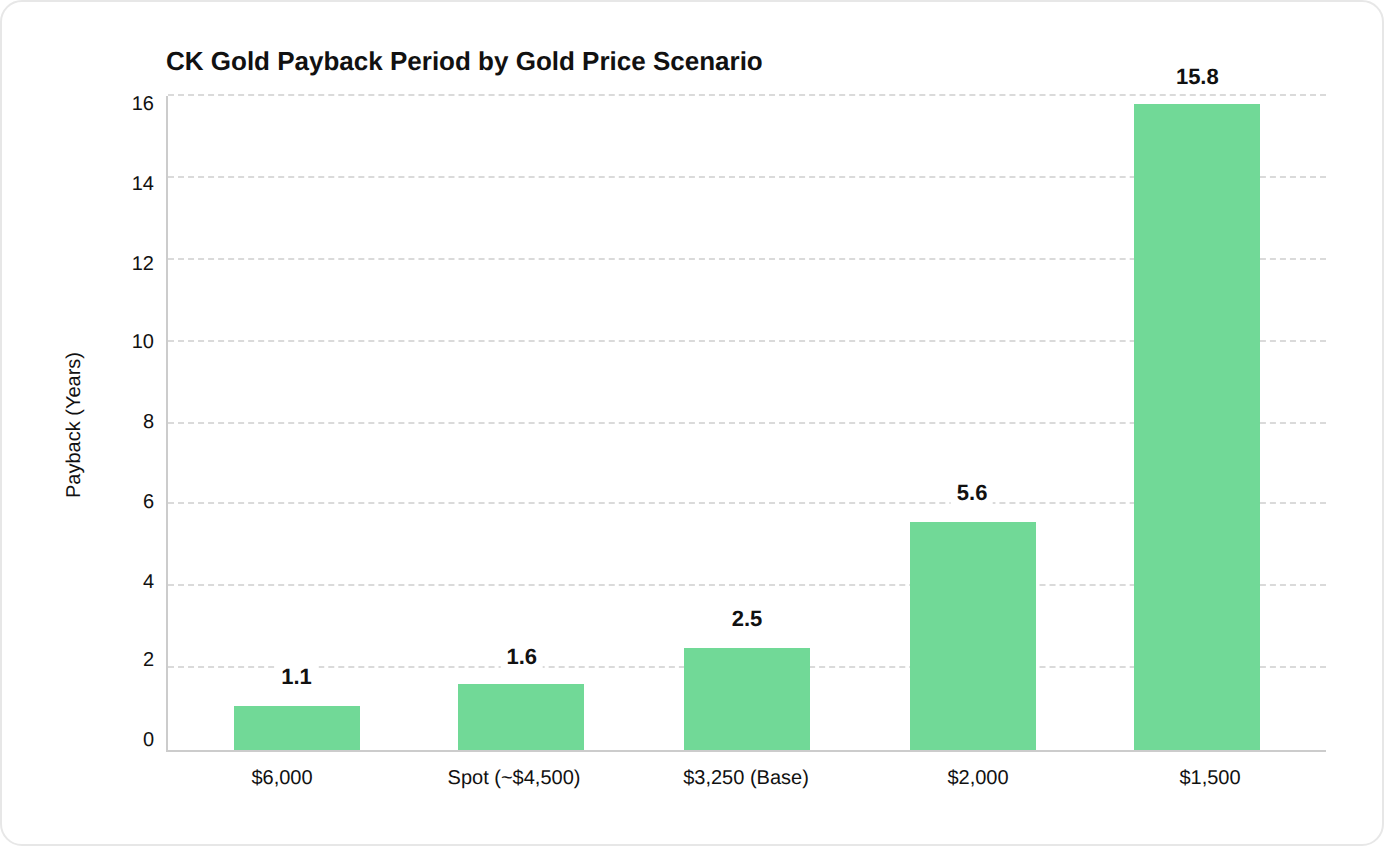
A shorter modeled payback at higher gold prices can plausibly widen the project's tolerance for financing costs, construction delays, or cost overruns, since capital is recovered faster and lenders face less exposure over time. A longer payback at lower prices leaves less room for any of those variables to move against the project before returns are affected. The company's own August 2026 update notes that at recent spot prices of approximately $4,500 per ounce of gold and $4.50 per pound of copper, after-tax NPV5% would be approximately $1.37 billion, with a higher IRR and a payback of approximately 1.6 years. That figure describes today's pricing environment, not a locked-in construction budget.
What Still Has to Be Proven
Permitting and the FS address engineering and regulatory risk. They do not address execution risk, which remains open across several dimensions. Financing has not closed, and its structure, cost, and any resulting dilution are undisclosed. Construction costs and schedule are modeled in the FS but not yet tested against actual contractor bids and procurement outcomes at scale. Commissioning and production ramp-up performance also remain unproven, including whether the plant achieves the FS's modeled life-of-mine average recovery rates of 71.5% for gold, 80.6% for copper, and 68.7% for silver. Each of these is a separate variable from the permitting and reserve questions that dominated CK Gold's story through 2024 and early 2025, and each will be resolved on its own timeline ahead of first production.
The Investment Thesis for U.S. Gold Corp.
- The feasibility study completed in March 2026 establishes a defined reserve base, engineering plan, and modeled economics for the CK Gold Project, reducing, though not eliminating, geological and metallurgical uncertainty in the investment case.
- Contractor and procurement work, including solicited equipment bids and initial mine access road construction, is already underway, with site preparation continuing alongside ongoing financing discussions.
- An 18- to 24-month build timeline is expected to support first production as early as late 2028, a comparatively near-term production horizon for a fully permitted junior developer.
- Feasibility study economics are sensitive to commodity prices, with the after-tax payback period at a base case of 2.5 years at $3,250 per ounce of gold, ranging from just over one year at $6,000 per ounce to 5.6 years at $2,000 per ounce.
- Management has disclosed active discussions with debt, equity, streaming, and offtake partners, though an earlier public comment from the company's Non-Independent Chairman expressed a preference to maximize debt and specifically avoid streaming, a preference the current shareholder update does not repeat.
- Execution risk, covering financing terms, actual construction cost and schedule performance, and commissioning outcomes against feasibility study assumptions, remains unresolved and will only be tested once construction begins.
Taken together, these points describe a project that has cleared its technical and regulatory hurdles and is now working through the operational steps, contracting, procurement, and site access, that typically precede a construction decision. What remains is whether financing terms, construction execution, and production ramp-up align with an FS that has not yet been tested against reality.
TL;DR
CK Gold's March 2026 FS has established the project's reserve base, engineering plan, and permitted status. Investor focus now shifts to execution: undisclosed financing terms, construction costs and schedule that have not yet been tested against real contractor bids, and production performance that will not be known until the plant is running. The terms of the eventual financing package, and how construction performs against the FS assumptions, are what to watch next, not the study's headline economics.
FAQs (AI-Generated)
Analyst's Notes





Subscribe to Our Channel






Stay Informed






















