




Gold Demand Holds as Higher Prices Expand Mine Supply Potential



Gold falls below $4,400 as Fed hike odds rise, while central-bank demand remains firm and higher prices make more ore economically mineable.
- Gold fell from a 3-month high near $4,540 per ounce to below $4,400 after the Bureau of Labor Statistics reported 162,000 US payroll additions in August, pushing Fed rate hike odds into the mid-50% range ahead of the September 15 and 16 meeting.
- China's central bank added 650,000 ounces of gold in August, extending its buying streak to 22 months with its largest monthly purchase since 2023 despite 3 separate Fed rate repricing episodes in 2026.
- Global gold-backed exchange-traded funds (ETFs) added $3 billion in July after 2 months of outflows, while higher gold prices can lower economic cut-off grades and make additional ore mineable, increasing supply potential as permitting and processing capacity determine how quickly that material reaches production.
- The September 10 and 11 inflation releases and September 15 and 16 Fed meeting will test whether gold's pullback stabilizes near its recent range or extends as rate hike expectations strengthen.
- The next 2 weeks of inflation data and the Fed's decision will show whether the pullback is a one-quarter pause or the start of a longer repricing.
Fed Hike Odds Push Gold Below $4,400 as Central-Bank Buying Continues
Gold fell from a 3-month high near $4,540 per ounce to below $4,400 after August payrolls strengthened expectations for tighter Fed policy. The Bureau of Labor Statistics (BLS) reported 162,000 US nonfarm payroll additions in August, nearly 3 times the roughly 56,000 consensus estimate. The surprise pushed the 10-year Treasury yield to roughly 4.79% and Fed rate hike odds into the mid-50% range ahead of the September 15 and 16 meeting. Higher yields increased the opportunity cost of holding non-yielding gold, while a US Dollar Index near 99 added further pressure to the metal.
China’s central bank added 650,000 ounces of gold to its reserves in August, extending its buying streak to 22 consecutive months with its largest monthly purchase since 2023. The buying streak has continued through 3 separate shifts in Fed rate expectations in 2026, indicating that official-sector demand has been less sensitive to short-term monetary policy repricing than gold’s market price.
Gold repriced within days of the August payroll release, while China’s central bank extended its buying streak to 22 consecutive months despite repeated shifts in Fed rate expectations. The September Fed decision will therefore test whether tighter rate expectations extend gold’s pullback without changing the longer-duration central-bank demand already visible in reserve purchases.
Fed Hike Risk Pressures Gold’s $4,300-$4,400 Range as Demand Stays Firm
The August Producer Price Index (PPI) is due September 10, followed by the Consumer Price Index (CPI) on September 11, giving markets their final inflation readings before the Fed meeting. A hotter-than-expected core CPI reading could strengthen Fed rate hike expectations and pressure gold toward the $4,300 to $4,400 range identified by Goldman Sachs Research under its rate hike scenario, which gold has already entered since the payrolls release.
Central-Bank Buying & ETF Inflows Outlast Fed Repricing
The World Gold Council's (WGC) 2026 Central Bank Gold Reserves Survey found 89% of respondents anticipating higher global gold reserves over the next 12 months, while a record 45% indicated that their own institution would increase holdings. According to the WGC's July 2026 gold ETF data, global gold-backed ETFs recorded a $3 billion inflow, ending 2 consecutive months of outflows and lifting total holdings to 4,068 tonnes.
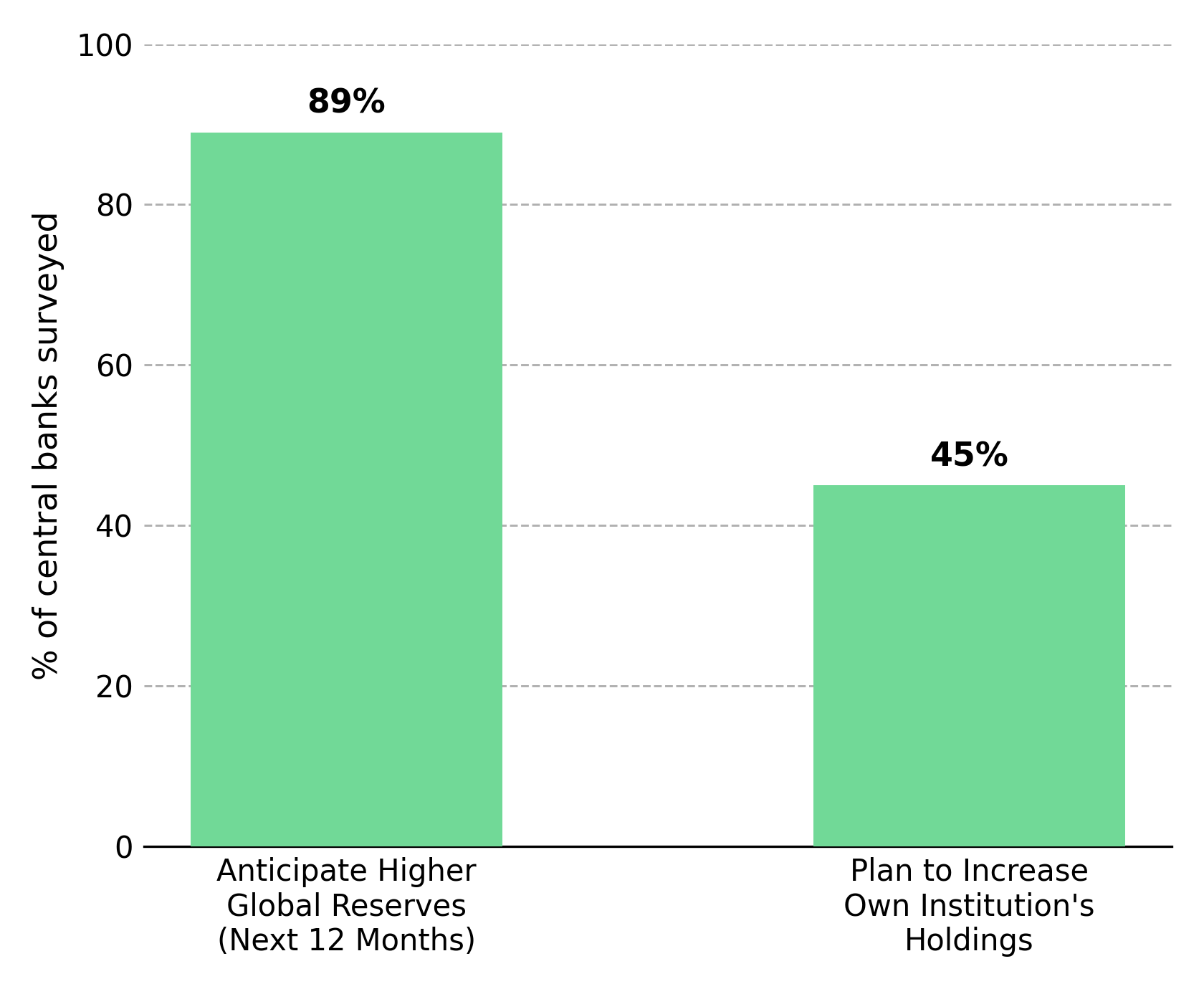
Both channels, official sector reserve allocation and Western investment flows, reset on a 12-month planning cycle, not a 2-day policy meeting. Neither has shown any measurable response to the specific probability shift in Fed hike odds that moved gold lower this week.
Higher Gold Prices Expand Mineable Ore and Supply Potential
Central-bank reserve decisions and gold-backed ETF flows operate on longer timelines than a 2-day Fed meeting, reducing the relevance of any single policy decision to the broader demand picture. On the supply side, higher gold prices can improve the economics of lower-grade material by increasing the value of recovered gold relative to mining and processing costs. This can lower economic cut-off grades and increase the amount of material available for mining. The resulting production response still depends on mine planning, permitting, mining capacity, and processing infrastructure.
Drilling Adds Reserves Beyond the Benefit of Higher Gold Prices
Integra Resources, a Nevada-based gold producer, increased proven and probable reserves at Florida Canyon by 74% to 1.191 million ounces in a technical report effective May 31, 2026, following an 18-month orebody model rebuild and 16,000 meters of post-acquisition drilling. The oxide-only reserve pit uses a $2,400 per ounce gold price assumption, about 46% below the mine's $4,426 per ounce realized gold price in its most recent reported quarter. Higher gold prices can make additional material economic, while Florida Canyon's reserve increase demonstrates how drilling, geological interpretation, mine design, and economic assumptions together determine reserve growth.
President and Chief Executive Officer George Salamis attributes the reserve growth to post-acquisition drilling funded by renewed investment in the asset:
“We mobilized drill rigs and drilled 16,000 meters to test whether this asset could grow from a resource and reserve perspective.”
Permitting Determines How Quickly Economic Ore Becomes Production
Higher gold prices can expand the amount of economically mineable material and strengthen the case for additional production. Permitting then provides the regulatory pathway for miners to advance expansions, development plans, and production growth, making approval timelines an important part of converting stronger mine economics into additional supply.
Serabi Gold, operates its Coringa mine under a 3-year Guia de Utilização license that expires January 29, 2027. Full-year production guidance above 53,000 ounces assumes receipt of its full mining license by the fourth quarter of 2026. Higher gold prices can improve the economics of available ore, while regulatory approvals determine how quickly the company can advance its production plan.
Mineros S.A. is advancing the Porvenir gold project in Nicaragua toward a construction decision targeted for early 2027. Its 2026 pre-feasibility study reports an after-tax NPV5% of $460 million and an after-tax IRR of 37.9%. Outstanding forest-management and water-related approvals remain part of the development schedule, illustrating how favorable commodity economics and project permitting operate on separate timelines.
Processing Capacity Supports Higher Gold Production
Once higher gold prices make additional ore economic, production growth depends on how efficiently miners can process that material. Higher permitted throughput, sufficient milling capacity, stronger recoveries, and investment in processing infrastructure allow more mined ore to be converted into saleable gold, increasing the production benefit of stronger mine economics.
West Red Lake Gold Mines stated that higher gold prices allow cut-off grades to decline and make more material available for mining. Underground mining exceeded 1,000 tonnes per day from mid-quarter, while continued mill ramp-up provides the pathway for that additional mined material to translate into higher gold output.
President and Chief Executive Officer Shane Williams explains how higher gold prices can expand the material available for mining:
“With the increasing gold price, cut-off grade can come down a lot more, which allows a lot more material, which allows us to switch to that long-hole mining.”
Higher gold prices can therefore expand the volume of economically mineable material, while increases in milling capacity and throughput determine how much of that material can be converted into additional gold production.
Tighter Equity Markets Favor Gold Projects With Funded Growth Plans
The source of growth capital can determine whether a producer advances expansion plans without relying on external equity financing. TRX Gold, a Tanzania-focused gold producer, generated $66.8 million of trailing 12-month earnings before interest, taxes, depreciation, and amortization (EBITDA) at a 58% margin through its most recent quarter-end. The company is using operating cash flow to advance a contracted 3,500-tonne-per-day semi-autogenous grinding and ball mill circuit at Buckreef without a new equity raise.
P2 Gold is advancing technical and development work at its Gabbs copper-gold project in Nevada ahead of a feasibility study now targeted for the first quarter of 2027. The 2025 preliminary economic assessment uses sulfide mill recoveries of 94.5% for gold and 79.9% for copper, while more recent Car Body metallurgical testing reported 95.6% gold recovery from oxide material after 73 days. The company has also entered into a definitive agreement to acquire 2,500 acre-feet per year of water rights, with the transfer subject to Nevada regulatory approval.
P2 Gold has already funded metallurgical testing and secured water rights ahead of feasibility. That reduces the amount of near-term project progress dependent on a new financing event.
Fed Repricing & Demand Data Will Test Whether Gold’s Pullback Extends
Three upcoming data points will test whether gold's pullback stabilizes near its recent range or extends through the next quarter. The first is whether September CPI and the Fed decision push rate hike odds above the current mid-50% range, which would increase pressure on gold, or reduce those odds and support stabilization. The second is whether China's central bank extends its 22-month gold buying streak in September, which would reinforce the continuity of official-sector demand, or records its first pause since the streak began. The third is whether the WGC's third-quarter ETF data show inflows extending beyond July's $3 billion increase, indicating broader fund demand rather than a one-month reversal of prior outflows.
A fourth near-term catalyst is the September 30 expiration of US fiscal year 2026 appropriations. Any increase in funding uncertainty could affect the dollar and safe-haven demand, adding a separate macro variable to gold's near-term price path.
The Investment Thesis for Gold
- Higher gold prices can lower economic cut-off grades and increase the amount of material available for profitable mining, expanding longer-term supply potential.
- Drilling, mine design, permitting, and processing capacity determine how much economically mineable material ultimately becomes reserves and production.
- Across the producers examined, stronger gold economics support expansion opportunities, while operating and regulatory timelines determine the speed of the supply response.
- Producers generating stronger operating cash flow at higher gold prices may have greater capacity to fund mine and processing investments without relying entirely on new equity.
- Upcoming inflation data and the Fed decision will test whether gold's pullback stabilizes or extends, while higher prices continue to support the economics of existing and potential mine supply.
A rate decision can move gold's price within a single trading session, but it cannot issue a Brazilian mining license, refurbish a Nevada autoclave, or increase a mill's permitted throughput. The companies examined here show how drilling, permitting, processing capacity, and funding determine the pace of mine development, while upcoming inflation data and the Fed decision will test whether gold's near-term pullback stabilizes or extends.
TL;DR
Gold fell below $4,400 after stronger August payrolls lifted Fed hike odds and Treasury yields, but longer-term demand indicators remain supportive. China extended its central-bank buying streak to 22 months, while global gold-backed ETFs returned to inflows. Higher gold prices can also lower economic cut-off grades and make additional ore mineable, increasing supply potential. Mine planning, permitting, and processing capacity determine how quickly that economic material becomes production.
FAQs (AI-Generated)
Analyst's Notes





Subscribe to Our Channel













Stay Informed






















