




Gold Extends Fourth Monthly Loss as Fed Hike Odds Hit 80%, Central Banks Keep Buying


Gold falls as Fed hike odds reach 80%, but record central bank buying signals resilient official-sector demand despite a fourth straight monthly decline.
- Spot gold fell 0.7% to $4,061.51 per ounce on June 29, putting it on track for a fourth consecutive monthly loss of 10.5%.
- The World Gold Council's 2026 Central Banks Gold Reserves Survey shows 89% of reserve managers expect global official-sector gold holdings to rise over the next 12 months.
- A record 45% of the 76 central banks surveyed plan to increase their gold holdings over the next 12 months.
- Traders price an 80% chance of a December Fed rate hike, with three hikes expected in 2026.
- The dollar index is on track for a 2.5% gain in June, its biggest monthly advance since July 2025, after Kevin Warsh's hawkish debut as Fed chair.
Gold Falls to $4,061 as Geopolitical Risk Premium Fades
Spot gold fell 0.7% to $4,061.51 per ounce on June 29 after Iran launched missiles and drones at US military sites before Iran and the US agreed to halt hostilities and resume talks over the Strait of Hormuz. US gold futures for August delivery fell 0.5% to $4,076.20.
Gold is on track for a fourth consecutive monthly loss of 10.5%, while the dollar index is on track for a 2.5% gain in June, its biggest monthly advance since July 2025. Spot silver fell 0.9% to $58.64 per ounce, while platinum gained 0.1% to $1,616.55 and palladium rose 1% to $1,221.29.
Fed Rate Hike Expectations Raise Gold's Opportunity Cost
Traders price an 80% chance of a December Fed rate hike, with three hikes expected in 2026, as higher oil prices raise inflation expectations and strengthen the case for tighter monetary policy. Tim Waterer, chief market analyst at KCM Trade, said gold fell because higher oil-driven inflation expectations increased the likelihood of tighter Fed policy, raising the opportunity cost of holding a non-yielding asset relative to Treasuries.
Pressure on gold remains despite the Gulf ceasefire because Kevin Warsh's hawkish debut as Fed chair reversed expectations for rate cuts and pushed Treasury yields higher. Lloyd Chan, senior currency analyst at MUFG Bank, said the dollar is likely to remain supported unless the Fed makes a clear dovish pivot or US economic data weakens. Fed policy expectations, rather than the truce, continue to weigh on gold prices.
Central Banks Continue Buying Despite Gold's Pullback
The World Gold Council's 2026 Central Banks Gold Reserves Survey shows 89% of reserve managers expect global official-sector gold holdings to rise over the next 12 months, while a record 45% of the 76 central banks surveyed plan to increase their gold holdings. Shaokai Fan, the WGC's Global Head of Central Banks, said fewer central banks now view gold as a legacy holding and more see it as an active strategic allocation.
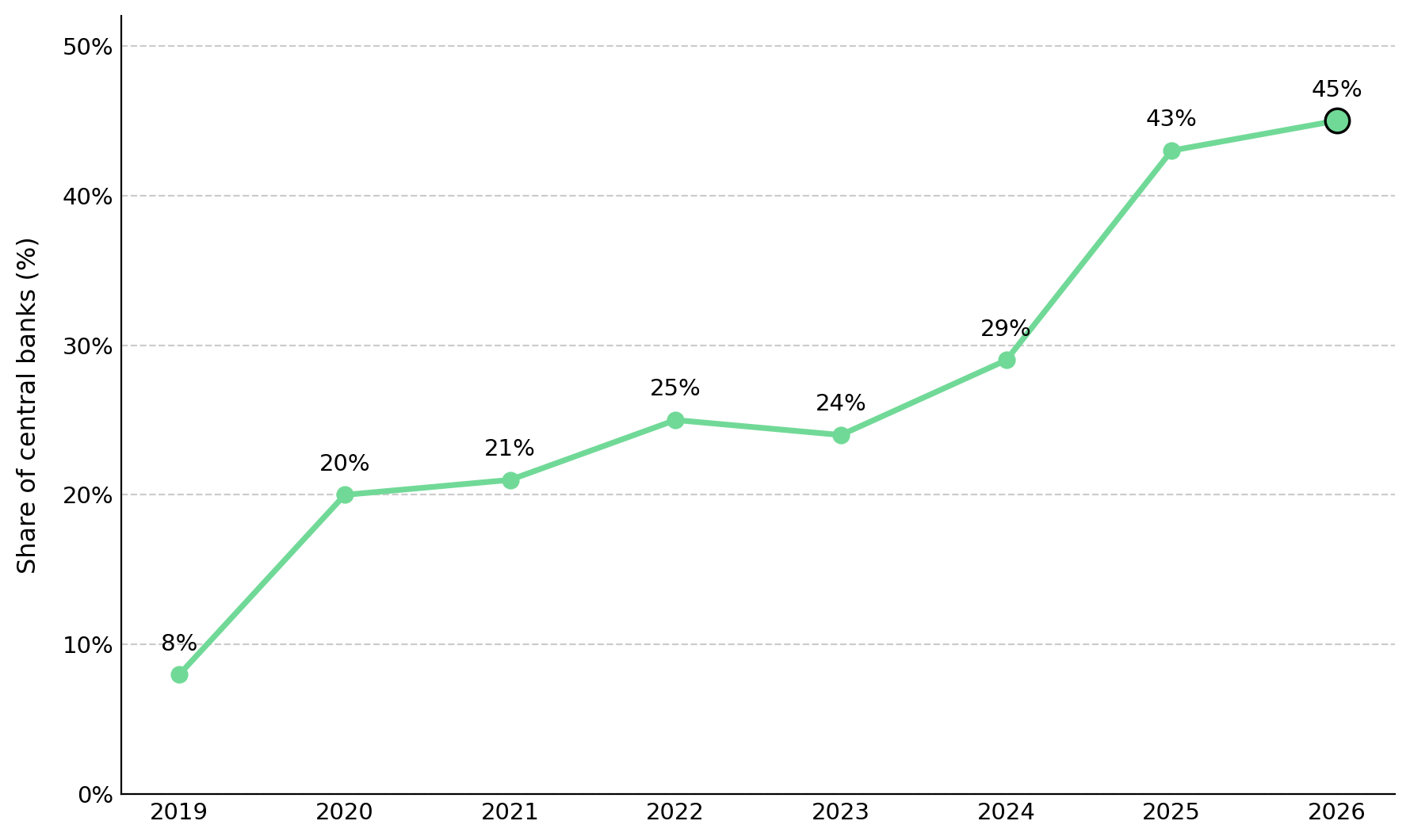
Most survey responses were submitted after the Middle East conflict began, indicating the results already reflect current geopolitical conditions. The survey shows central banks maintained plans to add gold even as the price fell to $4,061.51, indicating official-sector demand remained intact during the selloff.
Spot-Price Exposure Increases Margin Pressure on Gold Producers
Every dollar gold falls below $4,061.51 reduces realized revenue for producers selling at spot prices. Royalty and streaming companies are less exposed because their contracts are often based on trailing average prices. A fourth consecutive monthly decline of 10.5% increases margin pressure on spot-exposed producers relative to royalty and streaming companies. Whether central banks continue buying gold will determine if the current price decline reflects short-term market conditions or weaker long-term demand.
Central banks have not pulled back. Over the past 12 months, 9% increased domestic gold storage and 10% diversified overseas vaulting away from the Bank of England, which still holds 57% of reported overseas reserves. Those changes occurred even as gold recorded a fourth consecutive monthly loss.
Dollar Strength & Fed Expectations Set Gold's Next Direction
Gold remains under pressure as the dollar index holds near 101.34, just below its 13-month high, while traders price an 80% chance of a December Fed rate hike. Tim Waterer of KCM Trade said gold could return to $5,000 this year if the Gulf ceasefire holds, oil returns to pre-war levels, and the dollar weakens.
In the base case, gold remains under pressure if the Fed delivers its three expected rate hikes and the dollar maintains its 2.5% June gain. This week's US ADP employment report and nonfarm payrolls will shape Fed rate expectations. Strong data would reinforce expectations for additional rate hikes, while weaker data could support a dovish Fed and reduce support for the dollar.
Analyst's Notes





Subscribe to Our Channel



Stay Informed






















