Gold Falls as Oil Rallies, Testing Which Miners Can Absorb the Hit


Cash flow, debt and spending needs help assess whether mining shares offer value under weaker gold prices and higher fuel costs.
- Gold fell 1.1% to $4,095.75 an ounce on October 22 after touching its lowest since October 7, while Houthi attacks on Saudi Arabia lifted Brent to $110.11.
- September inflation reached 3.7%, versus 2.6% excluding food and energy, adding pressure to keep rates high; December Fed hike odds stood at 87% on October 22.
- The October 28 Fed decision and October 29 inflation data could strengthen gold’s recovery case if they reduce expectations for further rate hikes.
- At October 22 spot prices, the illustrative margin at the first-quarter 2026 90th-percentile cost level is about 32% below its first-quarter level, assuming unchanged costs and unhedged sales.
- Lower-cost producers retain larger margins at the same gold price, supporting a selective buying case where valuations also reflect debt and future spending.
Gulf Attacks Lift Brent Above $110
Spot gold fell 1.1% to $4,095.75 an ounce after touching its lowest since October 7, while December US gold futures dropped 0.9% to $4,112.10. Brent rose $1.29 to $110.11 a barrel after Houthi attacks on Saudi targets raised concerns about oil supplies.
Higher oil prices can lift inflation and interest-rate expectations, reducing gold’s appeal relative to assets that pay interest. Silver fell 3.3% to $56.06 and platinum dropped 2.1%, showing selling across precious metals. Lower-cost gold producers retain larger margins at the same gold price, providing more room to absorb the decline.
Fed Hike Bets Raise the Cost of Holding Gold
Attacks on Saudi oil infrastructure and regional shipping threatened supplies, adding upward pressure to oil prices. Brent averaged $116.80 a barrel in September, about 40% above July’s $83.40.
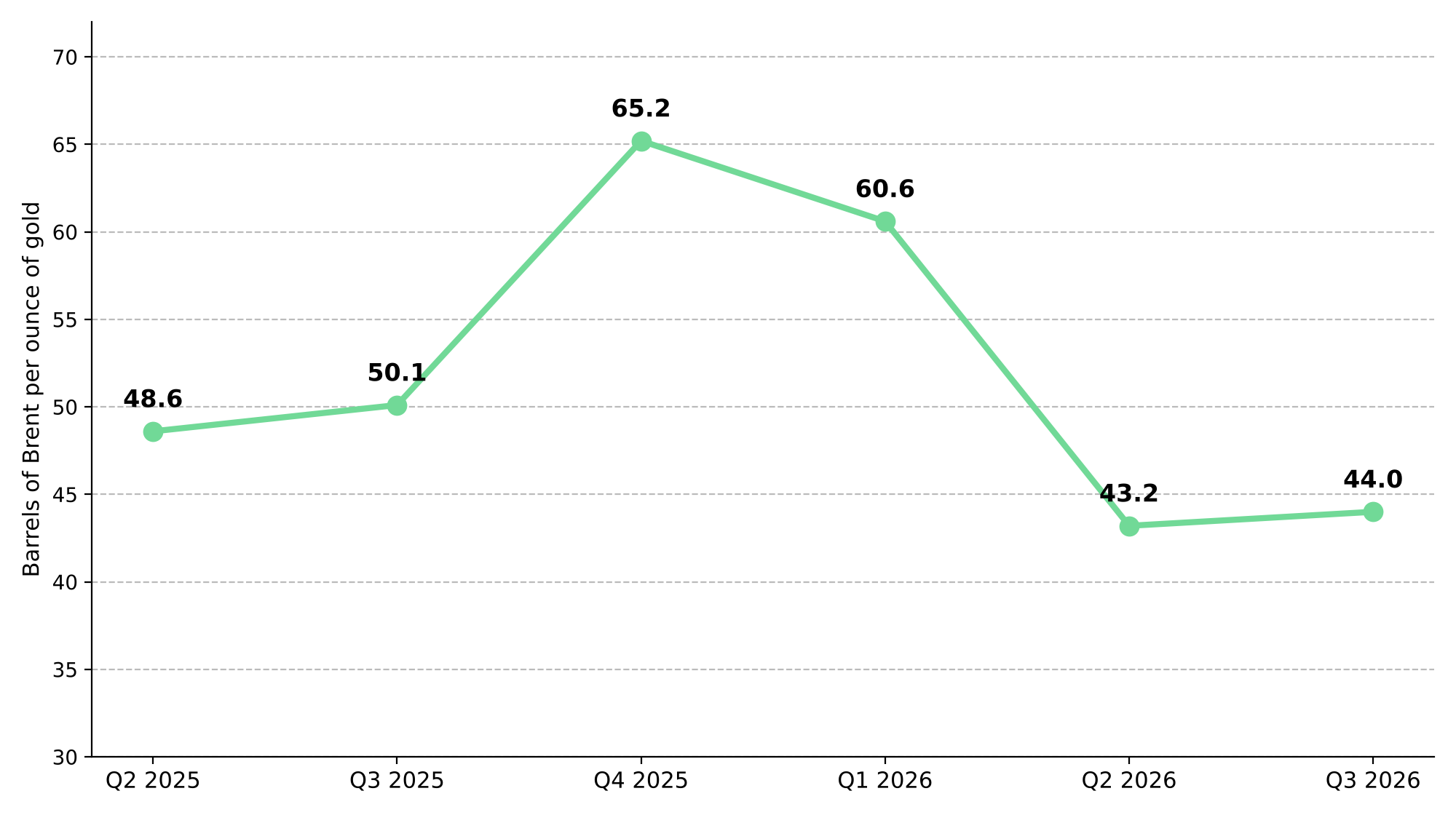
US consumer prices rose 3.7% year over year in September, versus 2.6% excluding food and energy; energy prices rose 5.2% from August. Markets priced an 87% chance of a December Fed hike from the current 3.75%-4.00% range. Kelvin Wong, Senior Market Analyst at OANDA, explains that higher expected interest rates reduce gold’s appeal because it pays no interest.
Softer Inflation Could Support a Gold Rebound
Gold remains vulnerable if inflation pushes interest rates above market forecasts. Michael Gapen, Chief US Economist at Morgan Stanley, warns that the Fed may need to raise rates more than forecast.
Higher-cost unhedged producers face larger percentage margin declines when gold falls, assuming unchanged costs. At $4,000 gold, the illustrative margin at the 90th-percentile cost level would fall to about $1,500 an ounce from $2,363 in the first quarter of 2026, assuming unchanged costs and unhedged sales. Wang Tao, Reuters Technical Analyst, is targeting $4,073; a break above $4,135 could open a recovery toward $4,150-$4,169.
The October 28 Fed decision and October 29 Personal Consumption Expenditures (PCE) inflation release could reset rate expectations and gold prices. A recovery would widen unhedged producers’ margins, while lower costs provide a larger buffer if gold remains weak.
Gold’s Decline Leaves Lower-Cost Producers With Larger Margins
First-quarter 2026 all-in sustaining costs (AISC) averaged $1,785 an ounce. Holding costs unchanged and assuming unhedged sales, gold at $4,095.75 leaves illustrative margins about 25% below the first-quarter average and 32% lower at the 90th-percentile cost level, following a 16% decline in gold’s price.
Higher oil prices can raise mining costs and pressure gold if they lift interest-rate expectations. Newmont’s 2026 cost sensitivity is about $11 an ounce for each $10 a barrel Brent move from a $70 base. At $110 Brent, this implies about $44 an ounce in higher costs, assuming a linear response.
Lower costs reduce the percentage hit to margins from falling gold prices. The contrarian buying case depends on whether a share’s valuation is supported by cash flow under lower gold prices and higher fuel costs, after capital spending and debt payments.
Rate-Sensitive Gold Pricing Shifts Value Toward Low-Cost Ounces
Gulf escalation can pressure gold when higher oil prices lift inflation and interest-rate expectations. Lower-cost producers retain larger margins at the same gold price, providing more room to fund operations through a downturn.
September’s record gold ETF holdings show that buying continued despite lower prices, supporting a demand case alongside the pressure from higher rates.
The contrarian opportunity depends on whether lower share prices offer upside under conservative gold and cost assumptions. Cash flow after capital spending and debt payments provides a stronger basis for selecting mining shares than assuming conflict guarantees a gold recovery.
Analyst's Notes





Subscribe to Our Channel







Stay Informed