




Gulf Strikes Push Brent to Five-Month Peak, Raising Export Revenue



Brent's nearly 4% weekly gain versus WTI's 0.8% decline highlights why pricing benchmarks and future supply matter for oil producer valuations.
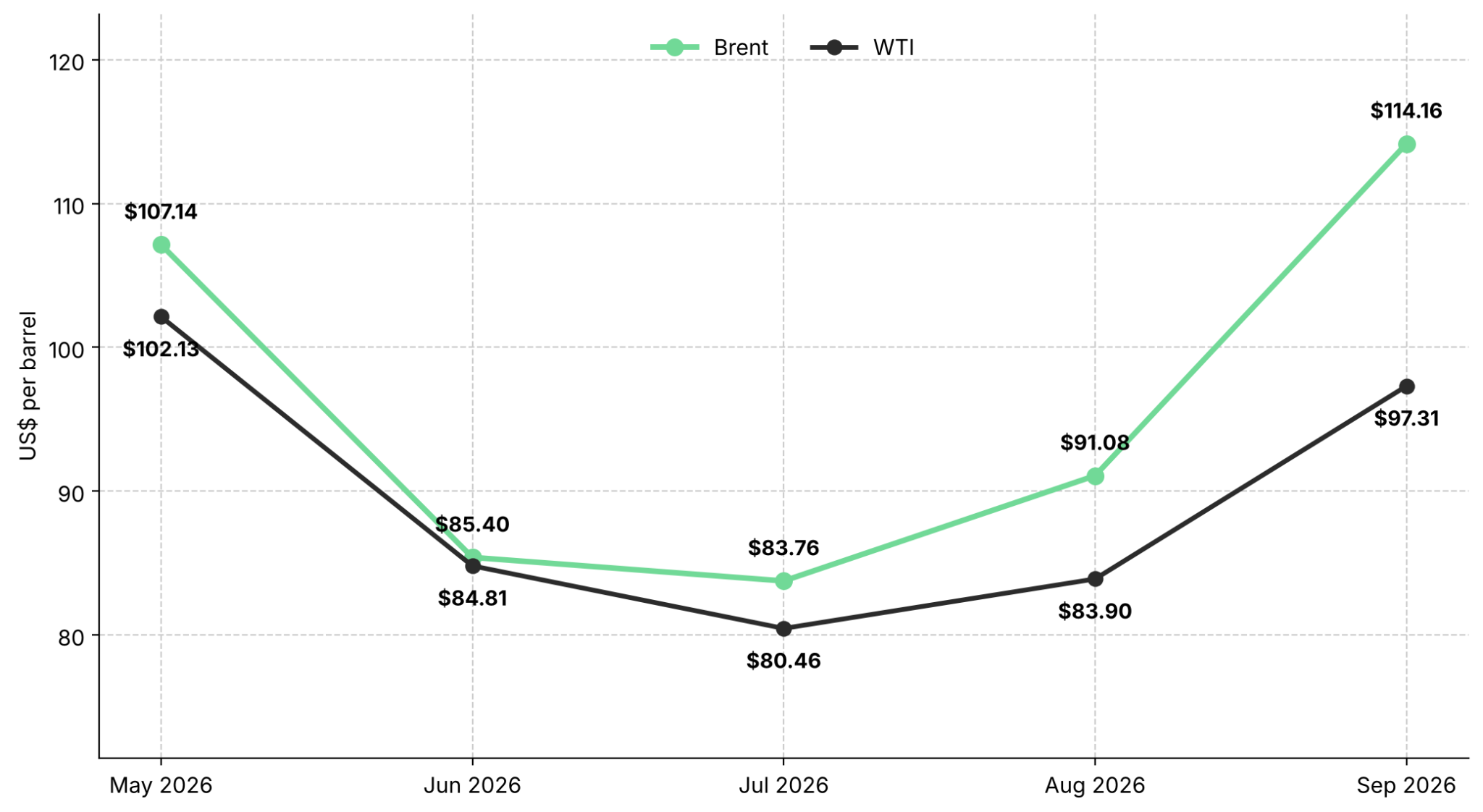
- Brent crude hit $114.72 a barrel on October 23, 2026, its highest since May 4, before trading at $113.96.
- Brent was on track for its third consecutive weekly gain of nearly 4%, while West Texas Intermediate (WTI) was down 0.8% for the week.
- Saudi Aramco evacuated its Dhahran headquarters near Bahrain on October 22, 2026, as Houthi strikes raised supply risks along the Persian Gulf.
- ING stated that its $80 fourth-quarter Brent average now looks unattainable, citing the risk of renewed Persian Gulf escalation.
- Reopening Libya's pipeline valve to Zawiya port could restore output from the Hamada and Tahara fields, reducing Brent's supply-risk premium.
Gulf Strikes Lift Brent Nearly 4% as WTI Falls 0.8%
Houthi strikes on Saudi energy assets lifted Brent crude futures $0.79, or 0.7%, to $113.96 a barrel, after reaching $114.72, their highest since May 4. WTI rose $1.10, or 1.1%, to $100.57.
Brent was on track for its third consecutive weekly gain of nearly 4%, while WTI was down 0.8%. Gulf supply risks supported Brent-linked crude over inland US barrels priced against WTI, favoring producers with Brent-linked sales.
Houthi Strikes Raise Oil Export Risks Amid Libyan Output Cuts
Saudi Aramco evacuated its Dhahran headquarters near Bahrain as Houthi attacks on Saudi energy assets escalated. The evacuation raised concerns that strikes could extend beyond previous Red Sea targets to the Persian Gulf, threatening oil exports and supporting Brent prices. Attacks had also hit an Aramco facility and an eastern airport, with casualties reported.
The Iran-aligned Houthis' conflict with the Saudi-led coalition threatens oil shipments through Bab el-Mandeb, a key Red Sea shipping route. Meanwhile, a closed pipeline valve to Libya's Zawiya port has cut output from the Hamada and Tahara fields, adding to supply risks that support Brent prices.
Escalation Risks Undermine $80 Brent Forecast
Brent-linked oil producers stand to benefit from higher prices if Gulf supply disruptions continue. Giovanni Staunovo, Analyst at UBS, said the market remained concerned about further escalation, linking undersupply to disrupted oil shipments and high shipping costs.
Linh Tran, Analyst at XS.com, indicated that continued strikes and delayed cargo arrivals could sustain current oil prices. However, if conditions at Dhahran normalize and Libya's Hamada and Tahara pipeline valve reopens, Brent's risk premium could decline toward $112.79. ING also considered its $80-a-barrel fourth-quarter Brent forecast unattainable ahead of the November US midterm elections.
Brent Premium Favors Export Revenue Over WTI Sales
Brent-linked oil producers benefited from the benchmark's nearly 4% weekly gain, while inland US producers selling against WTI faced a 0.8% decline, weighing on their realized revenue.
Russia lifted its diesel export restriction under an agreement between President Donald Trump and President Vladimir Putin aimed at lowering fuel prices, allowing shipments to global markets, including the US. LSEG tracked a Malta-flagged vessel carrying 40,000 metric tons of Russian diesel on a route to New York.
Reports differed on further carrier deployments to the Middle East, while political decisions on escalation remain beyond oil-price forecasts. If oil shipments normalize, positions based on further escalation could face losses as prices return to pre-attack levels.
How Could Supply Constraints Benefit Producers
Brent-linked export sales gained an advantage over WTI-priced volumes, making each oil holding's pricing benchmark a key factor in its valuation.
Despite Brent's recent rally, slower investment in new Gulf oil production could limit future supply, supporting seaborne crude prices and creating long-term revenue opportunities for Brent-linked producers.
Analyst's Notes





Subscribe to Our Channel





Stay Informed


