




Hycroft Mining Repositions to High-Grade Underground Strategy, Targets 2027 PEA


.webp)
Hycroft Mining: $200M cash, zero debt, high-grade Ag-Au discoveries transforming Nevada giant. Tripled drilling, PEA 2027, institutional backed. Trading at peer discount.
- Hycroft Mining secured $200 million in cash and eliminated all debt through institutional investment, with 85% ownership now held by blue-chip institutional investors attracted by high-grade silver discoveries at Vortex and Brimstone
- The company announced a 55% increase in resources in February 2026, driven by high-grade discoveries (multi-thousand gram silver intercepts), improved metallurgical recoveries, and expansion of existing resource areas
- Management is prioritising development of high-grade underground systems (Brimstone and Vortex) over the large low-grade deposit, aiming for faster production and superior economics in the current commodity price environment
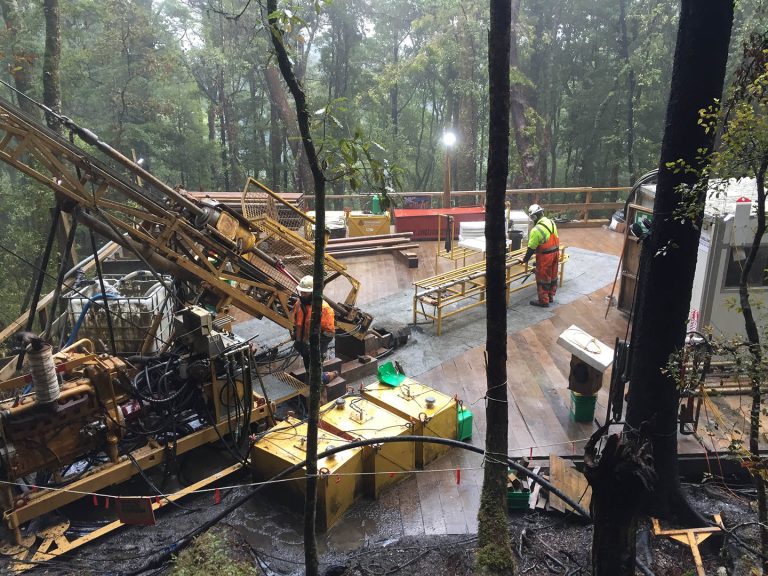
- Drilling meterage tripled to 24,000 meters in 2026 with four rigs deployed, targeting lateral and depth extensions of known systems plus regional exploration, with goal of delivering a PEA by early 2027
- As a brownfields project with existing permits for heap leach and milling, plus over $1 billion worth of infrastructure (processing facilities, power, water, lab), Hycroft has significant advantages over greenfield competitors despite trading at a 40-50% discount to peers
Hycroft Mining Holding Corporation (NASDAQ: HYMC) controls one of the world's largest precious metals deposits in Nevada, a jurisdiction long considered the premier mining destination in North America. In a March 2026 interview, President and CEO Diane Garrett outlined the company's dramatic transformation from a debt-burdened developer with a massive low-grade resource to a well-capitalised exploration story focused on high-grade underground potential. The strategic repositioning, driven by recent silver discoveries at the Vortex and Brimstone zones, has attracted substantial institutional capital and fundamentally altered the company's development trajectory.
Financial Restructuring: From Debt Burden to $200 Million War Chest
The most significant development at Hycroft over the past year has been a comprehensive balance sheet overhaul. The company inherited substantial debt from its predecessor that was accruing at approximately $1 million per month, with maturity scheduled for 2027. This debt overhang prevented institutional investors from taking meaningful equity positions despite growing interest in the asset.
"When you're a non-cash flowing developer, you shouldn't have debt on your balance sheet. Any institution wanting to take a position in the company, their equity would be at risk."
The solution came through a coordinated institutional investment that simultaneously retired all debt and provided substantial working capital. Combined with earlier private placements from Eric Sprott and Tribeca (Australia), the restructuring delivered $200 million in cash and eliminated debt entirely. The resulting shareholder base is now 85% institutional, dominated by what Garrett characterised as "the largest blue chip institutional investors around the globe."
This financial transformation provides Hycroft with a minimum three-year runway without needing to access capital markets, a critical advantage for advancing exploration and development work.
Resource Growth: 55% Increase & Metallurgical Improvements
In February 2026, Hycroft announced a 55% increase in its mineral resource, driven by multiple factors beyond just the high-grade discoveries. The resource update incorporated additional areas within the property, finalised metallurgical test work showing higher-than-anticipated recoveries, and the substantial new high-grade mineralisation at Vortex and Brimstone.
The current resource totals approximately 16.5 million ounces of gold and nearly 600 million ounces of silver in the large low-grade deposit. What makes Hycroft unusual is the revenue distribution: approximately 40% from silver and 60% from gold, an atypical split that Garrett attributes to multiple mineralising events at different times.
The high-grade systems at Brimstone have already been incorporated into a resource after just 14 months of drilling, demonstrating the geological continuity and grade consistency that has attracted institutional attention.
The Brimstone Discovery: Geology & Exploration Strategy
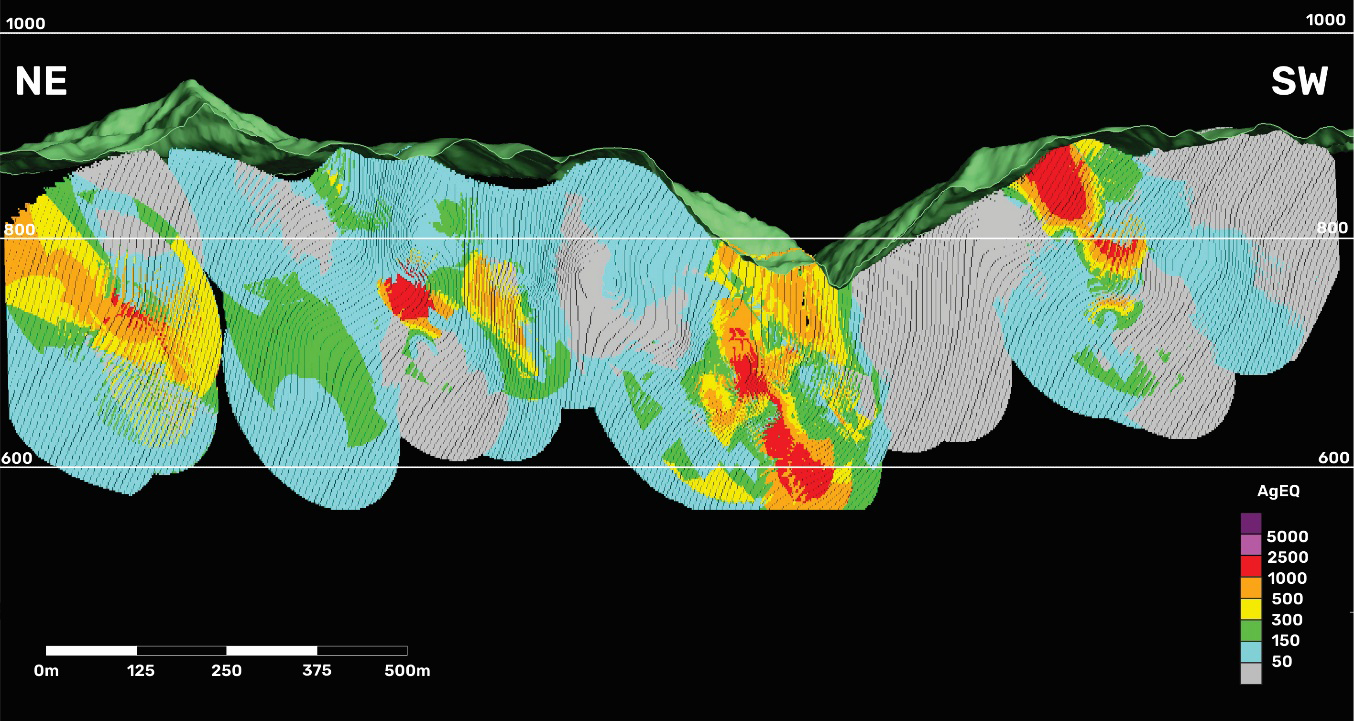
The Brimstone zone represents a departure from Hycroft's historical characterisation as purely a low-grade bulk tonnage target. Recent drilling returned intercepts exceeding 500 grams per tonne silver over 35 meters, with the system remaining open in all directions and at depth.
The recent drilling program at Brimstone had three primary objectives: step-out drilling to demonstrate system expansion, structural model confirmation, and testing a deep geophysical anomaly that could represent a high-grade feeder system. All three objectives were met, with particularly encouraging results from deep drilling that intersected strong grades 150 meters below previously known mineralisation.
"The geochemistry tells us we're still in the Brimstone system. We need to go deeper to find the boiling/feeder zone, but we are seeing indications that this is quite a large and at one time very powerful system that was bringing these metals into this area."
The geological model identifies a series of stacked veins controlled by fault structures and cross-cutting faults. The ore-bearing mineral is naumannite, the same mineral associated with the historic Midas mine (owned by Franco-Nevada), which produced from a series of steeply-dipping shoots. Hycroft is using a combination of geochemistry, structural mapping, and 360-degree televiewer imaging down drill holes to build a detailed 3D model of the system.
A key geological indicator supporting the depth potential is the presence of tetrahedrite crystals with chunky visible silver encountered at approximately 400 meters below surface. Tetrahedrite typically forms at 700 meters to one kilometer depth, suggesting a deep magmatic source is pushing mineralisation upward. This observation, combined with geophysical data showing a large magmatic source at depth, has prompted the company to continue drilling deeper.
Development Strategy: High-Grade First Approach
Hycroft's development strategy represents a significant departure from conventional thinking around large low-grade deposits. Rather than pursuing the construction of a large-scale operation to process the bulk tonnage resource, management is prioritising the high-grade systems for initial production.
The rationale is multifaceted. A low-grade deposit of Hycroft's scale represents a 40-50 year mine life, creating exposure to multiple commodity price cycles. At approximately 0.5 grams per tonne gold equivalent, the low-grade resource requires massive scale to achieve acceptable economics, but faces margin compression during bear markets. The high-grade discoveries fundamentally change this equation.
"Nobody thought there was high-grade at Hycroft. And so this is the game-changer and this is what's attracting the attention of the market and this is the focus of the institutions."
The planned approach envisions starting with a 3,500-5,000 tonne per day underground operation focused on Brimstone and Vortex. Brimstone can be accessed via open pit or underground, while Vortex sits deeper and will be an underground target. Importantly, the two zones can be connected by drift, allowing integrated mining operations.
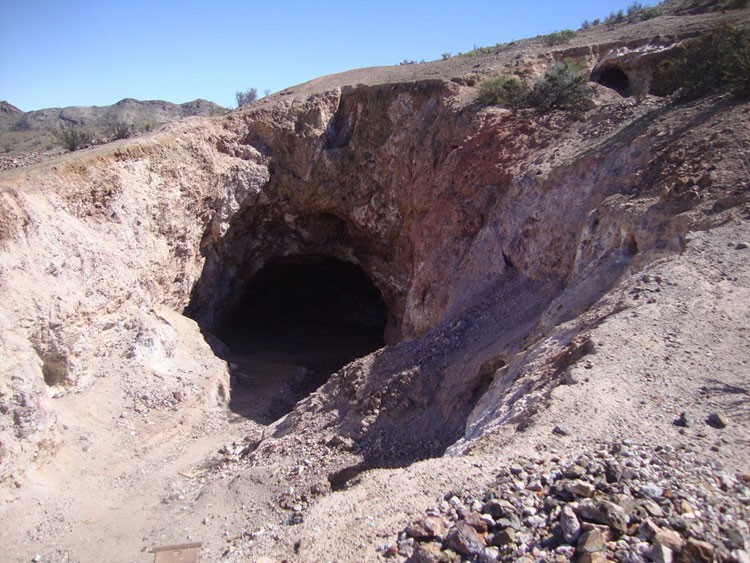
The company is evaluating installing an exploration decline from the bottom of the existing Brimstone pit. If built to production specifications, this could serve dual purposes: continued exploration of the deep system and eventual production infrastructure.
Interview with President & CEO, Diane R. Garrett
Processing Options & Revenue Optimisation
Hycroft has completed extensive metallurgical test work on pressure oxidation (POX), which works effectively on the mineralisation. The company is also evaluating roasting as an alternative processing route. While both technologies require similar capital and operating costs and deliver comparable recoveries, roasting offers a potential revenue advantage.
The high sulfur content at Hycroft requires neutralisation with lime under pressure oxidation, representing a cost center. Roasting would capture the sulfur to generate sulfuric acid for sale into the lithium, fertilizer, and copper industries, converting a cost center into a revenue stream. This would create a third revenue source alongside gold and silver. A decision between POX and roasting is expected by mid-2026.
For the smaller-scale high-grade operation, Hycroft has additional optionality: producing a high-quality concentrate for sale rather than building the complete backend processing plant. The property has an operational rail line running through it, potentially enabling concentrate shipment to other facilities in Nevada's mining-intensive landscape.
2026 Drilling Campaign & Timeline to PEA
The 2026 exploration program represents a significant escalation from previous efforts. The company drilled approximately 8,000 meters in late 2023-2024 with one rig, achieving an 85% success rate. The 2026 program triples drill meterage to 24,000 meters using four rigs (two currently operating, two more arriving within months).
The objective is to substantially expand the known high-grade systems and provide sufficient data for mine planning and economic assessment. The company targets delivering a preliminary economic assessment (PEA) on Vortex and Brimstone by early 2027, dependent on drilling results. A separate PEA on the large low-grade project, which was initiated before the high-grade discoveries, will also be released to provide the market with complete economic visibility.
Hycroft is also applying the geological understanding developed at Brimstone to other areas of its land package, where less than 10% has been explored. The company believes the high-grade mineralisation model is transferable and expects to identify additional systems across the district-scale property.
Valuation & Market Positioning
Despite the transformation in Hycroft's story, the company trades at what management characterises as a 40-50% discount to peer developers. At a March 2026 market capitalisation of ~$3 billion, Hycroft's valuation reflects significant in-situ ounces but may not fully capture several differentiating factors.
Most peer developers are greenfield projects with resources but limited infrastructure. Hycroft possesses permits for both heap leach and milling operations, two Merrill-Crowe processing facilities, a heap leach pad ready to receive ore, complete administrative buildings, an operational laboratory, and established power and water infrastructure. Management estimates this infrastructure would cost over $1 billion to replicate, providing a substantial advantage that should theoretically command a valuation premium.
Additionally, Hycroft's Nevada location offers jurisdictional advantages over projects in higher-risk geographies. As a brownfields project with extensive existing infrastructure and permits in hand, the company faces lower execution risk than greenfield peers.
The path to valuation rerating likely depends on demonstrating the scale and economics of the high-grade systems through continued drilling and the delivery of the PEA in 2027.
The Investment Thesis for Hycroft Mining
- High-Grade Discovery Potential: Recent drilling at Vortex and Brimstone has revealed multi-thousand gram silver intercepts in systems that remain open laterally and at depth, with geological indicators suggesting a large, deep feeder system that could substantially expand the known mineralisation
- Financial Strength Without Dilution Risk: $200 million cash balance with zero debt provides minimum 3-year runway, eliminating near-term financing risk and allowing management to focus entirely on value-creating exploration and development activities
- Institutional Validation: 85% ownership by blue-chip institutional investors who specifically entered to support high-grade development represents sophisticated capital validating the geological opportunity and strategic direction
- Brownfields Infrastructure Advantage: Over $1 billion of existing infrastructure (processing facilities, permits, power, water, rail access) significantly de-risks development and reduces capital requirements compared to greenfield peers, yet company trades at 40-50% discount to sector
- Multiple Pathways to Production: Optionality includes underground mining, open pit mining, concentrate production and sale, pressure oxidation, roasting with sulfuric acid revenue, and modular development approach, allowing optimisation based on market conditions and drilling results
- Nevada Jurisdiction Premium: Premier mining jurisdiction in USA with established regulatory framework, skilled labor availability, and existing mining service infrastructure reduces political, permitting, and operational risks
- Dual Asset Strategy: Large low-grade resource (16.5M oz Au eq.) provides long-term optionality and potential for eventual large-scale operation, while high-grade systems offer near-term production and cash flow generation
- District-Scale Exploration Upside: Less than 10% of land package explored, with geological model from Brimstone/Vortex transferable to regional targets, suggesting potential for additional high-grade discoveries that could extend mine life and improve overall economics
- Unique Gold-Silver Split: 60% gold / 40% silver revenue mix provides diversification and leverage to silver price appreciation, particularly attractive in current macro environment with silver supply constraints and industrial demand growth
- Clear Path to Value Realisation: Defined timeline to PEA delivery (early 2027), tripled drilling meterage in 2026, and focus on delineating mineable resources positions company for significant de-risking catalysts over 12-18 month horizon
The precious metals sector stands at an inflection point driven by monetary policy uncertainty, geopolitical fragmentation, and industrial electrification demand for silver. Hycroft Mining's transformation from a capital-constrained, debt-burdened low-grade developer to a well-funded high-grade exploration story positions the company to capture multiple macro tailwinds simultaneously. The 40% silver / 60% gold revenue split provides unique leverage to silver's dual role as both monetary metal and critical industrial input for solar, electronics, and EV applications.
With silver supply constrained by declining grades at major producers and limited new discoveries, high-grade systems like Brimstone and Vortex represent increasingly scarce assets. Nevada's jurisdiction offers stability amid broader concerns about resource nationalism and permitting challenges globally. As Garrett noted, institutions "were wanting to get exposure sooner rather than later" to these high-grade systems given "rising commodity markets on the near-term future," reflecting sophisticated capital's conviction that precious metals enter a sustained bull market requiring early positioning in quality development assets.
TL;DR
Hycroft Mining has undergone a comprehensive transformation, eliminating all debt and securing $200M in institutional capital to pursue high-grade silver-gold discoveries at Vortex and Brimstone that are redefining a previously low-grade Nevada asset. With 85% institutional ownership, aggressive 2026 drilling (24,000m across four rigs), and a clear path to PEA delivery by early 2027, the company is positioning for near-term underground production from high-grade systems while maintaining long-term optionality on the massive low-grade resource. Brownfields infrastructure advantages and Nevada jurisdiction reduce execution risk, yet the company trades at significant discount to greenfield peers, presenting potential rerating opportunity as high-grade scale is proven.
FAQs (AI Generated)
The debt (growing at $1M/month, due 2027) prevented institutional investment in the equity. Eliminating it unlocked $200M in capital from institutions specifically interested in funding high-grade exploration and development.
Instead of building a large-scale 40-50 year bulk tonnage operation vulnerable to commodity cycles, Hycroft will start with a smaller 3,500-5,000 tpd underground mine targeting high-grade zones for superior margins and faster production.
Hycroft has existing permits, $1B+ in infrastructure (processing, power, water, rail), and can access Brimstone via decline from existing pit. The property is brownfields in Nevada, not remote greenfield requiring all new infrastructure.
Most deposits are heavily weighted to one metal. The balanced split provides diversification and leverage to both metals, with silver offering additional industrial demand exposure beyond monetary premium, unusual for a gold-dominant project.
It remains a long-term asset. A PEA will be released showing full economics. High-grade zones will be mined first in early mine life, with bulk tonnage potentially incorporated later as operations scale and infrastructure is amortised.
Analyst's Notes





Subscribe to Our Channel



Stay Informed






















