




Integra Drills Beside the Florida Canyon Crusher First as Standard Mine Waits


Integra Resources is drilling Florida Canyon ground beside its crusher first, returning 1.30 g/t gold over 62.5 meters, while Standard Mine drilling moves back.
- Integra Resources is drilling ground beside Florida Canyon's pits, crusher and dumps first, and drilling at Standard Mine, 8 kilometers to the south, has moved to the end of 2026.
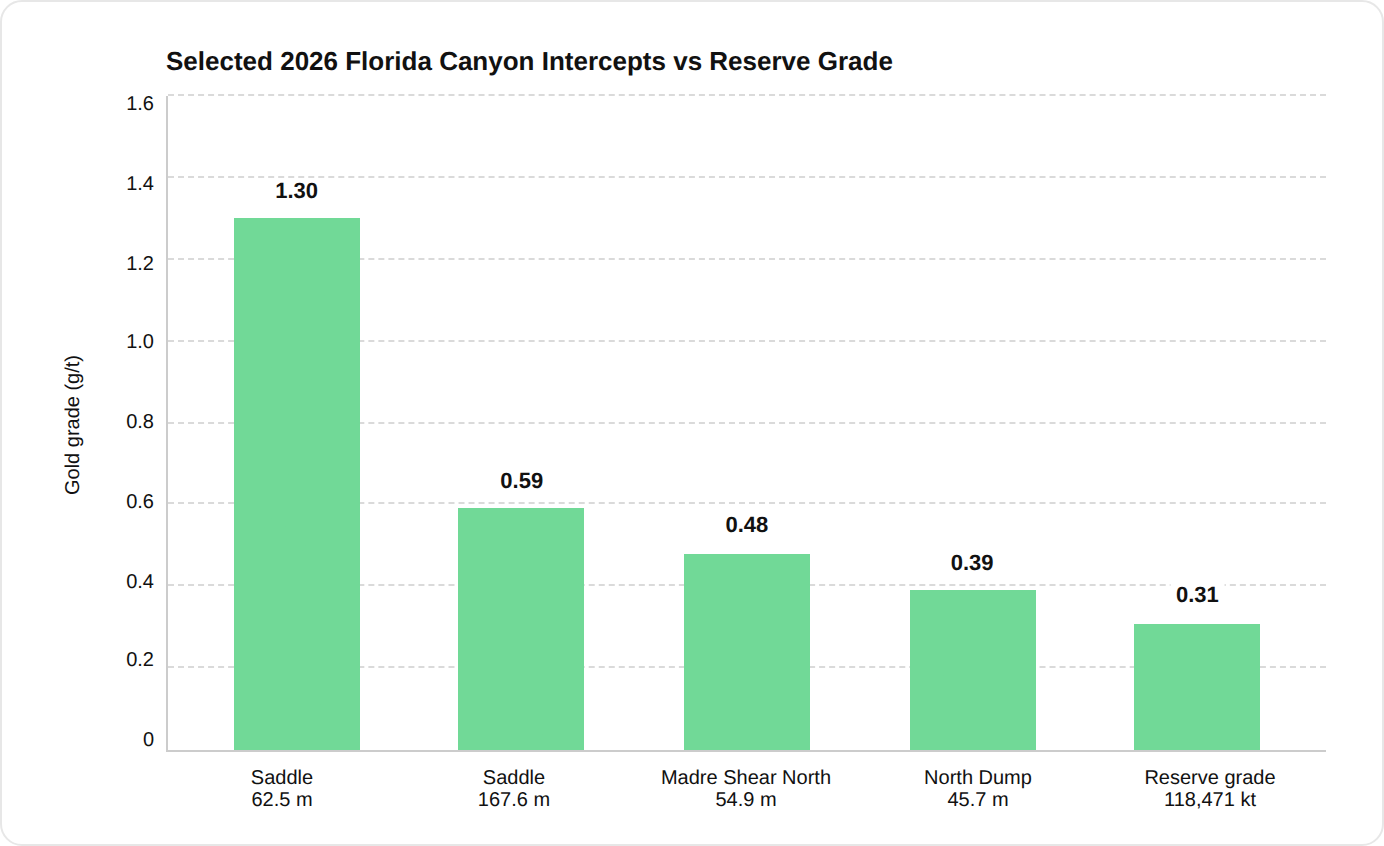
- The saddle between the Central and Radio Tower open pits returned 1.30 grams per tonne (g/t) gold over 62.5 meters (m), including 14.74 g/t over 1.5 m, and 0.59 g/t gold over 167.6 m.
- Madre Shear North, a new target beneath the North Dump, returned 0.48 g/t gold over 54.9 m, with another 2,000 m of drilling planned.
- Florida Canyon's reserves total 1,191,000 ounces of gold at 0.31 g/t, up 74% from 685,000 ounces.
- Integra is targeting 80,000 to 85,000 ounces of gold in 2027, and unit costs materially below $3,000 per ounce.
Integra Resources Corp. (TSXV: ITR | NYSE American: ITRG) is drilling the ground closest to its Florida Canyon crusher and heap leach pads first, and the 2026 results follow that order. The Nevada gold mine has completed 30,140 meters (m) of reverse circulation drilling this year against a 42,500 m Florida Canyon program, while drilling at Standard Mine, 8 kilometers (km) to the south, has moved from this summer to the end of 2026. The order reflects haulage economics at a low-grade heap leach operation.
Haulage Sets the Drill Order
Florida Canyon moves as much waste as ore. In the first half of 2026, the mine handled 7,425,000 tonnes of ore and 7,480,000 tonnes of waste, a strip ratio of 1.01, and processed ore at 0.22 grams per tonne (g/t) gold.
President and Chief Executive Officer of Integra Resources, George Salamis, assigns most of a heap leach operation's economics to logistics:
"I think two-thirds of that heap-leaching game is all about how you efficiently move ore or waste around a mine site."
Haulage capacity was the largest operating problem Integra worked through in 2026. The drill program applies the same test to exploration: ground that adds ounces without adding haul distance ranks first.
In the first half of 2026, cash cost was $2,463 per ounce sold and mine-site all-in sustaining cost (AISC) was $3,344, against a life-of-mine AISC of $2,331 in the mine plan. Guidance for 2026 is 70,000 to 75,000 ounces of gold at mine-site AISC of $3,300 to $3,500 per ounce sold. Integra states that site-level AISC falls in 2027 as the heavy sustaining capital investment begun in 2025 is completed, and Integra is targeting consistent production of approximately 82,000 ounces a year from 2027.
The Saddle Between the Pits Returns Surface Grade
The saddle between the Central and Radio Tower open pits produced the strongest holes in the results Integra reported on September 23, 2026. The best hole returned 1.30 g/t gold over 62.5 m, including 9.37 g/t over 1.5 m and 14.74 g/t over 1.5 m. Another returned 0.59 g/t gold over 167.6 m, and 2 more returned 0.84 g/t over 35.1 m and 0.83 g/t over 29.0 m.
Florida Canyon's reserve is reported at a cut-off grade of 0.14 to 0.15 g/t, and Integra designed the reserve pit at a gold price of $2,400 per ounce, against a spot price assumption of $4,200 per ounce from mid-2026 in the mine plan. Integra describes the saddle intervals as broad, near-surface, and consistent with existing mine grades. Integra says surface mineralization supports low-strip mining, and that the location next to existing open pits and infrastructure can provide future mining flexibility. The company plans additional holes north of these holes to test continuity.
Drill grades are not recovered grades. Reserve recoveries range from 43% to 67% depending on deposit and ore type, and the mine's gold recovery rate was 58.5% in the first half of 2026.
Madre Shear North & the North Dump
The North Dump was modeled into the mine plan in the NI 43-101 technical report dated July 28, 2026. Previous operators moved it as waste, so Integra states the mining cost was already incurred, and its location near processing reduces hauling distance. Holes drilled in the dump also returned 0.40 g/t gold over 36.6 m and 0.34 g/t over 54.9 m, and one hole contained 6.12 g/t over 1.5 m; Integra states these grades are consistent with or above current mining grades.
Below the dump lies the northern extension of the Madre Shear, a gold-bearing structure that previous operators mined only to the south. The best hole returned 0.48 g/t gold over 54.9 m, and 2 others returned 0.42 g/t over 9.1 m and 0.32 g/t over 6.1 m. Phase 1 totaled about 2,000 m on a 91 m by 47 m grid, and another 2,000 m is planned. The saddle and Madre Shear North results come from exploration targets within the mine footprint, and Integra says they could be included in future mine plans. Integra plans to reach the ground as portions of the North Dump are mined in future years. Heap leach amenability is subject to metallurgical testing, and Integra says the target could benefit from shorter haulage distances and lower capital requirements.
Selected 2026 intercepts from the saddle, Madre Shear North and the North Dump are set against the reserve grade.
Standard Mine Waits for Florida Canyon's Ground
Regional targets rank behind ground the trucks already reach. Integra had planned to begin drilling Standard Mine this summer, and Salamis explained why the work moved back:
"Every ounce that you find close to the crusher is worth far more than something that's 8 km away."
Standard Mine produced more than 220,000 ounces of gold between 2004 and 2015 and has had no recent drilling. Integra is targeting drilling there by the end of 2026, with 7,000 m planned. The 2026 program totals 50,000 m across Florida Canyon, Nevada North and DeLamar, the largest in company history.
Integra describes infrastructure-led drilling as the fastest path from discovery to production. The 2027 targets test the approach: annual production of 80,000 to 85,000 ounces and unit costs materially below $3,000 per ounce. Reserves of 1,191,000 ounces of gold, up 74% from 685,000 ounces, are the basis for that plan, and the drill program is designed to support future resource and reserve updates.
FAQs (AI-Generated)
Analyst's Notes





Subscribe to Our Channel


.jpg)
.jpg)

Stay Informed






















