




Integra Resources' Florida Canyon Drilling Highlights How 'Waste' Can Become Ore


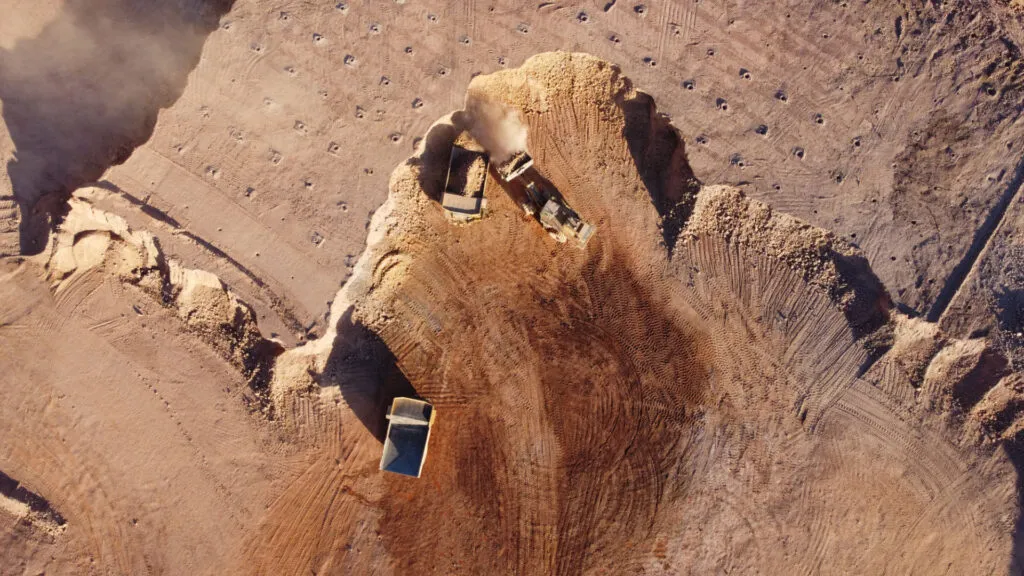
Integra Resources drilling shows ~67% of South Dump intercepts exceed cut-off, signalling potential reclassification of historical waste into ore.
- Integra Resources completed 16,009 metres of drilling at Florida Canyon, targeting historical dump material previously classified as waste and inter-pit saddle zones, returning intercepts including 138 metres at 0.32 grams per tonne (g/t) gold and 128 metres at 0.36 g/t gold.
- Historical mining operations in the late 1980s to mid-1990s used cut-off grades of 0.28 to 0.34 g/t gold at US$325 to US$450 per ounce gold prices, while current reserves use cut-off grades of 0.13 to 0.20 g/t gold based on a US$1,800 per ounce assumption.
- Approximately 67% of South Dump drill intercepts now exceed the current 0.11 g/t gold cut-off grade, demonstrating how material correctly classified as waste under one price regime becomes more valuable under another.
- Historical dump materials are situated approximately 1 to 3 kilometres from current processing infrastructure, and targeted material offers low strip ratios and amenability to heap leaching at processing costs of US$2.67 to US$4.97 per tonne.
- The third quarter 2026 technical report will determine whether historical dump material and inter-pit saddle zones are incorporated into mineral resource estimates and life-of-mine planning under National Instrument 43-101 standards.
What Has Happened
Integra Resources (TSXV:ITROTCQB:MLPMF) recently announced results from 16,009 metres of drilling completed during the 2025 growth drilling program at the Florida Canyon Mine in Nevada, targeting two opportunities: historical dump material previously classified as waste, and inter-pit saddle zones between existing open pits. Historical mining operations in the late 1980s to mid-1990s used cut-off grades of 0.28 to 0.34 grams per tonne (g/t) gold when the gold price was US$325 to US$450 per ounce. Current reserves use cut-off grades of 0.13 to 0.20 g/t gold based on a US$1,800 per ounce assumption. Drilling returned intercepts including 138 metres at 0.32 g/t gold from the Radio Tower Pit and 128 metres at 0.36 g/t gold from the C7 / Central Pit, with approximately 67% of South Dump intercepts exceeding the current 0.11 g/t gold cut-off grade.
The Economic Reclassification Mechanism
The fundamental mechanism driving the conversion of waste to ore at Florida Canyon is the relationship between commodity price, processing cost, and cut-off grade. Material below the historical thresholds of 0.28 to 0.34 g/t gold was classified as waste or low-grade backfill and deposited in surface dumps.
Economic viability is based on reference mining costs of US$2.74 per tonne for in-situ material and US$2.08 per tonne for mined fill and dumps, with oxide processing costs of US$4.97 per tonne for crushed material and US$2.67 per tonne for run-of-mine material. The gold price assumption used for current reserves (US$1,800 per ounce) is substantially higher than the historical range (US$325 to US$450 per ounce), and combined with these processing cost structures, has enabled the reclassification of previously uneconomic material into potential ore.
Infrastructure Proximity & Capital Efficiency
The targeted material is located within or directly adjacent to existing pits and near current infrastructure. According to the company, historical dump materials are situated approximately 1 kilometre from the South Dump and approximately 3 kilometres from the North Dump to the current processing infrastructure, significantly reducing haulage distances and capital requirements. The company describes this proximity as enhancing economic value relative to more distal gold mineralisation.
Drilling specifically targets saddle and ridge areas between active and historical pits, directly adjacent to future mining phases. Many of these inter-pit areas remain sparsely drilled and offer meaningful growth potential. The company characterises these zones as high-priority targets for resource growth and potential mine plan expansion, noting that mineralisation occurs at shallow depths consistent with low-strip mining scenarios.
The company states that the combination of consistency and thickness of gold mineralisation across multiple areas provides an opportunity to expand mineral resources in a capital-efficient manner while enhancing operational flexibility. The targeted material offers a low strip ratio and amenability to heap leaching, which the company expects to yield high-margin ounces.
Metallurgical & Processing Assumptions
Results from inter-pit drilling confirm broad intervals of gold mineralisation with consistent grades and strong heap leach potential. The material is described as suitable for conventional open-pit heap leaching, with processing assumptions factoring in oxide gold recoveries ranging from 45% to 64%, depending on the specific deposit and ore type.
The company states that historical dump material is expected to be amenable to heap leach processing, subject to ongoing metallurgical testing. Current mineral reserves already incorporate a stockpile of 1,934 thousand tonnes at an average grade of 0.19 g/t gold, as well as a Heap Leach Inventory of 3,548 thousand tonnes at 0.29 g/t gold.
Sector Context: Cut-off Grade Sensitivity
The Florida Canyon case illustrates a fundamental dynamic in open-pit heap leach operations: the sensitivity of resource classification to commodity price assumptions. This mechanism is not unique to Florida Canyon but represents a structural characteristic of low-grade oxide gold deposits globally.
The implication for operators with large historical dump inventories is direct: material that was correctly classified as waste under one price regime becomes more valuable under another. The value is latent in the deposit, unlocked by external price movement rather than internal operational improvement. Integra's case demonstrates this mechanism in practice, with approximately 67% of South Dump drill intercepts now exceeding the current mine cut-off grade.
What to Watch Next
The 2026 drilling program consists of 42,500 metres of reverse circulation (RC) and core drilling, with 33,500 metres focused on resource development at the Florida Canyon Mine and 9,000 metres focused on testing new gold targets identified around the Florida Canyon and Standard Mine areas. Portions of the program will support the updated Florida Canyon feasibility study and technical report, expected to be completed in the third quarter of 2026.
The updated technical report will provide visibility into whether the historical dump material and inter-pit saddle zones are incorporated into mineral resource estimates and life-of-mine planning scenarios. Investors should monitor whether the third quarter 2026 technical report includes tonnage and grade estimates for historical dump material, whether these estimates are classified as mineral resources under National Instrument 43-101 standards, and whether the life-of-mine plan incorporates this material into production schedules.
The metallurgical testing results for heap leach recovery characteristics will determine whether the oxide gold recoveries assumed in the economic analysis (45% to 64%, depending on deposit and ore type) are validated for the historical dump material specifically. The fundamental question for Florida Canyon is whether the volume of material converted from waste to ore under the US$1,800 per ounce gold price assumption justifies the capital allocation to the drill program and whether the resulting mine life extension translates into measurable near-term production increases.
FAQs (AI-generated)
It refers to material previously considered uneconomic becoming viable due to changes in gold price, costs, or processing methods. At Florida Canyon, lower cut-off grades allow more material to qualify as ore.
The 67% refers to drill intercepts at the South Dump exceeding the current cut-off grade, indicating a significant portion of sampled material could meet economic thresholds, though not all dump material is necessarily economic.
Higher gold prices (around US$1,800 per ounce versus US$325-450 per ounce historically) allow lower-grade material to be processed profitably, reducing the cut-off grade threshold.
Material located 1-3 km from processing facilities reduces haulage costs and capital requirements, improving the economic viability of lower-grade material.
The third quarter 2026 technical report for resource inclusion, mine plan integration, and metallurgical validation of heap leach recoveries for the targeted material.
Analyst's Notes





Subscribe to Our Channel





Stay Informed






















