Arc Mineral Royalties Builds Gold and Iron Ore Portfolio on Karri Capital Deal Flow


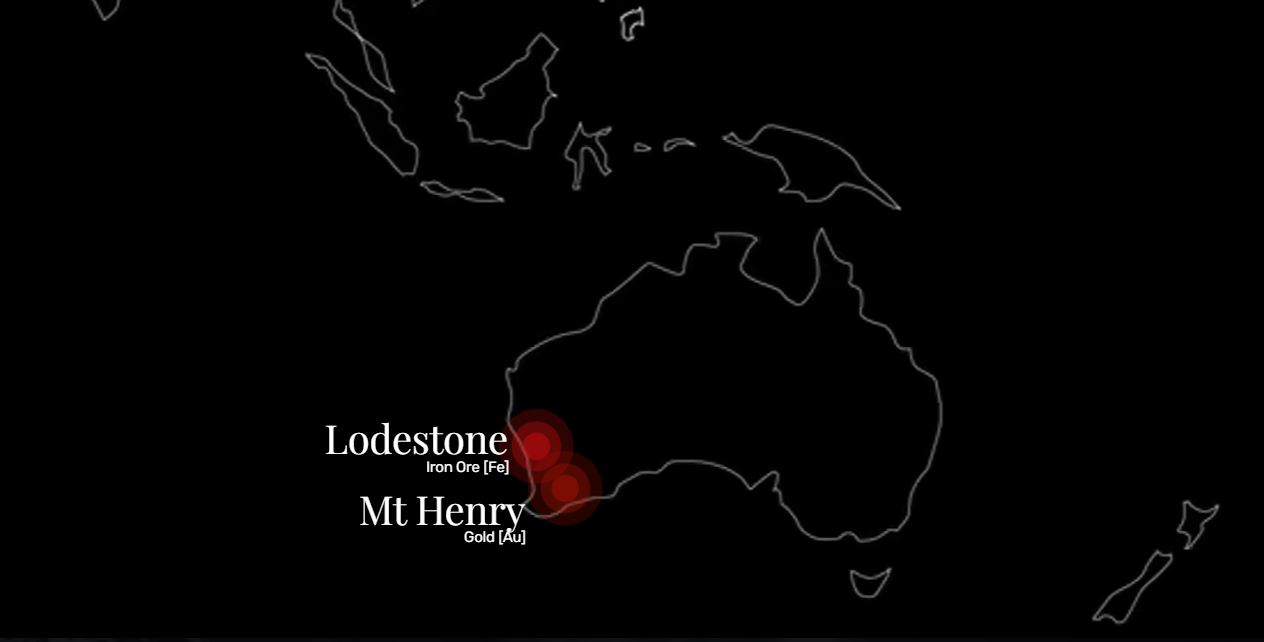
Arc Mineral Royalties (TSXV:ARO) uses Karri Capital deal flow to secure Mt Henry gold and Lodestone iron ore royalties at below-market cost.
- Arc Mineral Royalties is a two-month-old royalty company run by the team that built Trident Royalties into a roughly US$200 million cash takeover in about four years.
- Karri Capital Partners owns just under 25% of Arc and provides proprietary access to royalties on its projects, often on below-market or nominal terms.
- Arc's 1% NSR over Mt Henry sits on a resource of about 1.8Moz at 1.2 g/T gold that includes only around 41% of the current drill programme.
- Arc can buy a second 1% Mt Henry royalty for A$10 million once the resource crosses 2Moz, with the next update expected in H1 2027.
- The 0.5% Lodestone gross revenue royalty adds premium iron ore exposure at nominal cost, but neither asset generates revenue yet and first gold is not forecast before 2029.
Royalty companies sell investors a simple proposition. They offer exposure to commodity prices and exploration success without carrying the capital and operating costs that sink so many mine developers. The difficulty for a new entrant is cost of entry. Competition for quality royalties is intense, and early-stage vehicles typically fund growth through equity raises that dilute their first shareholders.
Arc Mineral Royalties (TSXV:ARO), listed for roughly two months, is attempting to solve that problem through its origination model rather than its balance sheet. Chief Executive Officer Adam Davidson explained how Arc pairs an experienced royalty team with proprietary access to royalties generated by Karri Capital Partners, an Australian mine-building group. The first two assets, a 1% net smelter return (NSR) royalty over the Mt Henry Gold Project and a 0.5% gross revenue royalty over the Lodestone Iron Ore Project, were both sourced this way. Lodestone was acquired for nominal consideration.
A Proven Team Returns With a Different Angle
Davidson's team took Trident Royalties from a shell company to a cash takeover of roughly US$200 million in about four years, completing 15 transactions along the way. According to Arc's corporate presentation, the share price rose 3.1 times from 16p to the 49p takeover price.
Repeating the Trident playbook was not the plan. Davidson said the team did not want to re-enter a competitive market simply to raise capital and bid for royalties again. The differentiating angle came from Karri Capital, whose team has been involved in around a dozen businesses, including Bellevue Gold, FireFly Metals and Andean Silver. Bellevue alone has grown into an ASX 200 gold producer valued at about A$2.3 billion, according to Arc's presentation.
Davidson explained the thinking behind the partnership.
"The genesis from their perspective was they looked back at all these projects and when they'd owned them in their entirety, they would have had an exceptionally valuable royalty portfolio. They were already looking at doing something to retain a royalty on on their next project, which is Mount Henry."
Karri was already planning to retain a royalty on its next project, Mt Henry, but needed a royalty management team. The former Trident team was looking for its next venture, and the two groups launched Arc together.
Interview with Adam Davidson, CEO of Arc Mineral Royalties
How the Karri Capital Pipeline Works
Davidson said Karri holds just under 25% of Arc. The firm runs a technically focused office of 40 to 50 people that Arc can draw on. When Karri takes on a project, the intention is to build royalty financing into the structure wherever possible, with Arc as the counterparty.
Mt Henry illustrates the approach. Karri was raising capital for Sinclair Gold to fund the project, and the royalty financing formed part of that process. Davidson said the royalty was acquired on terms well below market and was not shopped around to other royalty companies.
The arrangement is not exclusive. Davidson described a dual pipeline in which Arc also pursues royalties completely independent of Karri, much as the team did at Trident. He argued that below-market Karri deals let Arc pay market prices elsewhere while still meeting portfolio return targets.
Mt Henry: A Fast-Moving Cornerstone Asset
Mt Henry is a past-producing brownfields gold project in Western Australia with granted mining licences, grid power and highway access. Sinclair Gold (ASX:SGC) acquired it from Westgold in February 2026 and immediately began a 50,000-metre drill programme.
Drilling has already moved the resource. In September 2026, Sinclair Gold reported an interim JORC resource of 1.3 million ounces (Moz) at 1.2 g/T gold in the Measured and Indicated categories, plus 0.5Moz at 1.2 g/T Inferred, for a total of about 1.8Moz. Measured and Indicated ounces rose 58% and Inferred ounces rose more than fivefold compared with February 2026. Davidson said most of the increase came from drilling rather than changed assumptions. The estimate incorporated only around 41% of the planned metres.
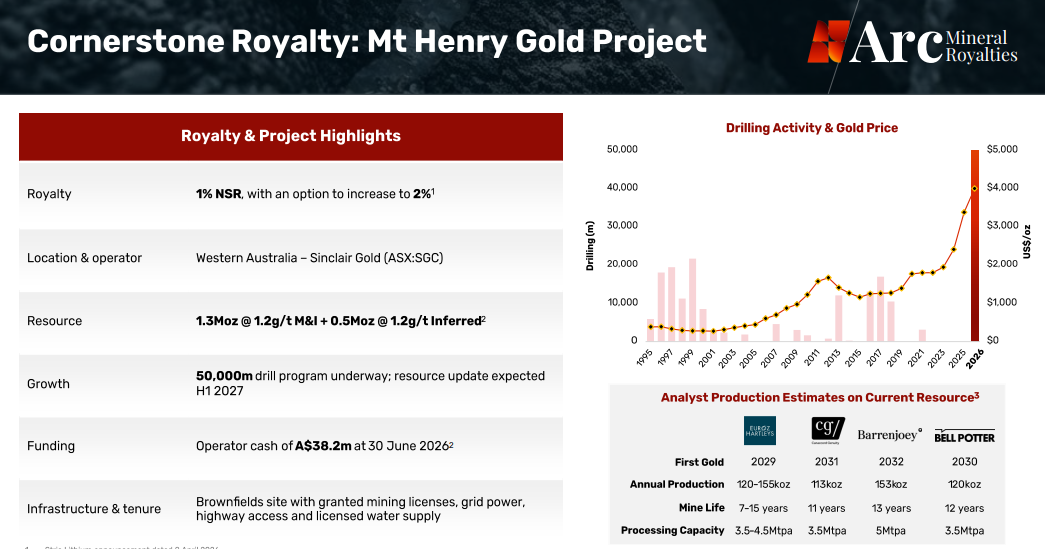
The next resource update is expected in the first half of 2027, and Sinclair Gold plans to announce its 2027 drill programme in December. Davidson said Arc's internal analysis points to around 2.5Moz to 3Moz after the current programme, which remains management's estimate rather than a published resource. The four brokers covering Sinclair Gold forecast first gold between 2029 and 2032. Davidson noted that Karri targets projects it can put into production within five years. Sinclair Gold held A$38.2 million in cash at 30 June 2026.
Arc paid A$5 million for its 1% NSR royalty. Once the resource crosses 2Moz, Arc can buy a further 1% for A$10 million. Davidson said Arc would need to raise capital to exercise the option but would not decline it. He estimated the existing royalty is worth tens of millions of dollars on the current resource, depending on gold-price and production assumptions.
Lodestone: Iron Ore Exposure for a Nominal Outlay
Arc announced on 27 October 2026 that it had taken delivery of a 0.5% gross revenue royalty over the Lodestone Iron Ore Project in Western Australia's Mid-West region. Killi Resources (ASX:KLI) holds 80% of the project owner, Yukon Resources, and is operator. The royalty arose from Karri's commercial involvement in the project, and Karri conveyed it straight to Arc.
Davidson framed the nominal-cost entry as a reason not to wait for Arc's next equity raise.
"Not only do we have the capital backing of [Karri] and their broader network, but we're getting royalties along the way at, as I said, nominal cost. So you get exposure to that without the dilution."
Lodestone hosts a JORC Inferred resource of 110 million tonnes at 33% Davis Tube Recovery, producing a concentrate grading 69% Fe. That resource covers only about 5km of a magnetite system mapped over roughly 25km of strike. Killi is running a 20,000-metre reverse circulation and diamond programme, and a second rig arrived in early October 2026. Killi's board is chaired by Neville Power, the former Chief Executive Officer of Fortescue, who oversaw that company's growth to about 170 million tonnes per annum. Managing Director Hamish Halliday leads the operating team.
The technical appeal is grind size. Conventional magnetite must be ground very finely, which Davidson said typically drives multi-billion-dollar capital costs. Initial testwork at Lodestone points to a much coarser grind. Davidson stressed that no study has been published, but offered an illustrative capex of $400-$500 million against $2-3 billion for a conventional operation.
The royalty structure also matters. Davidson said most iron ore royalties are calculated on a free-on-board (FOB) basis, which strips out shipping. A gross revenue royalty avoids that deduction. According to the release, the royalty deed carries no buybacks, caps or transfer restrictions. Arc is paying Karri a finder's fee of 345,732 shares at a deemed C$0.82 per share, subject to TSX Venture Exchange acceptance.
Capital Discipline & Funding the Next Step
Arc held about C$9 million in cash, unchanged by the Lodestone deal, and had a market capitalisation of about C$57 million at 21 October 2026, according to its presentation. Davidson said Arc's initial raise was capped at C$12 million by the TSX Venture Exchange at the time of its reverse takeover, with support from institutions that backed Trident.
Davidson pointed to Trident's debt path as a template, progressing from a credit-fund facility to a $40 million revolver with CIBC and BMO. He said those relationships, combined with below-market Karri deals, mean Arc does not need to rush into dilutive acquisitions.
Davidson also committed to quarterly shareholder updates and described Arc as a five-to-ten-year holding.
Investment Thesis for Arc Mineral Royalties
- Arc's management built Trident Royalties into a roughly US$200 million cash takeover in about four years, delivering a 3.1-times share price return.
- Karri Capital's project pipeline gives Arc proprietary access to royalties on below-market terms, as shown by the A$5 million Mt Henry deal and the nominal-cost Lodestone royalty.
- The Mt Henry 1% NSR royalty sits over a resource that has reached about 1.8Moz with less than half the current drill programme included.
- Investors should monitor the H1 2027 Mt Henry resource update, since crossing 2Moz triggers Arc's option to double its royalty for A$10 million.
- The Lodestone gross revenue royalty adds exposure to premium direct-reduction iron ore without cash outlay, although the project is at Inferred resource stage.
Macro Thematic Analysis
Two structural trends shape Arc's opportunity. The first is the royalty model's appeal in a high gold-price environment. Major royalty companies outperformed junior gold equities over the long term, reflecting leverage to commodity prices without exposure to cost overruns. That appeal has drawn heavy competition, so origination has become the key differentiator for new entrants. Royalties written into a project's financing early, before a broad auction, can carry far better economics than royalties bought on cash-flowing mines.
The second trend sits in steelmaking. As steelmakers pursue lower emissions, demand is shifting towards high-grade, low-impurity feed for direct-reduced iron and electric arc furnaces. Davidson framed Lodestone's place in that transition directly. The release notes that concentrate at 69% Fe typically commands a substantial premium over the 62% Fe benchmark. Many magnetite projects stall on capital intensity. A project that reaches premium specification at a coarse grind would address that constraint, which helps explain why Neville Power came out of retirement to chair Killi. For Arc Mineral Royalties, the trend offers optionality rather than the core thesis.
TL;DR
Arc Mineral Royalties is a two-month-old royalty company led by the team that built Trident Royalties into a ~US$200 million takeover. Its edge is proprietary access to royalties from Karri Capital Partners, which owns just under 25% of Arc. Arc paid A$5 million for a 1% NSR over Sinclair Gold's Mt Henry project, where the resource reached about 1.8Moz at 1.2 g/T in September 2026 with only 41% of drilling included. It can buy a further 1% for A$10 million once the resource passes 2Moz. Arc also took a 0.5% gross revenue royalty over Killi Resources' Lodestone iron ore project for nominal cost.
FAQ (AI-generated)
Analyst's Notes





Subscribe to Our Channel








Stay Informed