




Iron Ore's Four-Year Low Squeezes Long-Haul Producers Paying Spot Freight First


Iron ore hit a four-year low as China’s steel output fell, and producers paying spot freight on long voyages to China face the steepest margin squeeze.
- Singapore iron ore futures fell as much as 2.9% to $87.85 a ton on November 16, 2026, the lowest since November 2022, under three pressures: weaker Chinese steel demand, rising supply and a centralized state buyer.
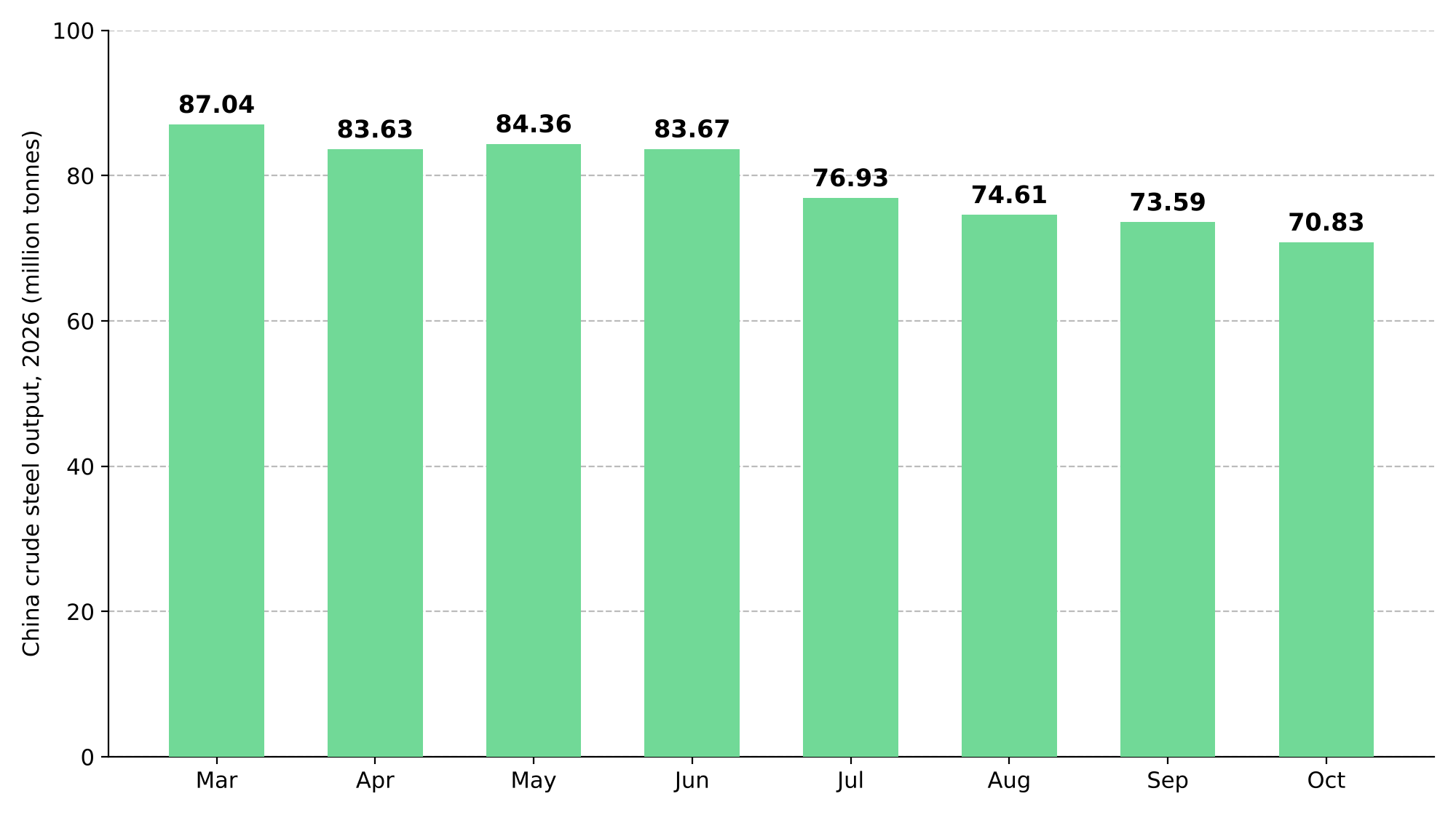
- China's pig iron output, the closest measure of ore use, fell 4.1% year on year to 63.07 million tonnes in October.
- Brazil-China capesize freight ran $21.92 a tonne above West Australia–China in early November, so a fall from $87.85 to $80 cuts a Brazil spot shipper's netback by 15.4%, against 10.8% from West Australia.
- Contracted freight shields some long-haul exporters, and quarterly filings report freight cover only after each quarter closes.
- A Brazil-West Australia freight spread below $10 a tonne, roughly the gap at September 2025 Brazil rates, cuts the long-haul disadvantage by more than half.
Weak Steel Demand, New Supply & a State Buyer Drive Iron Ore to a Four-Year Low
Singapore iron ore futures dropped as much as 2.9% to $87.85 a ton on November 16, 2026, and Dalian futures fell to 647.5 yuan, both the weakest since November 2022, Bloomberg reported. Ample global supply and elevated Chinese port stockpiles had already produced the lowest month-end close in four years in October, according to Bloomberg.
The price sits 21% below its May peak of $111.60, a fall steel demand alone does not explain. China's crude steel output was down 2.8% over January to October, and October's 1.6% annual decline came against a base that had already fallen 12.1% in October 2025, National Bureau of Statistics data show. Rising supply and a stronger buyer supply the rest of the pressure.
Rising Supply & Centralized Chinese Buying Pull Iron Ore Prices Lower
Pig iron output, which tracks ore consumption more closely than steel, fell 4.1% year on year to 63.07 million tonnes in October and 3.1% over January to October. Supply moved the other way. Macquarie estimates global supply will grow about 14 million tonnes in 2026 as Guinea's Simandou ramps up, offsetting cuts elsewhere, Mining Weekly reported.
China Mineral Resources Group (CMRG), which centralizes Chinese purchasing, barred steelmakers from buying specific products from Australia's largest producers during this year's contract talks. CMRG research manager Yilin Wang told a Xiamen conference that $80, not the $90 the market treats as support, is the more important threshold, Bloomberg reported. CMRG negotiates prices on behalf of Chinese mills, so its $80 view is a buyer's position. Australian mining executives meet Premier Li Qiang in Beijing on November 20.
Atlantic Vessel Shortage Lifts Freight & Cuts Long-Haul Iron Ore Netbacks First
Brazil freight is high because Atlantic ships are scarce: on November 6 the Brazil–China route was 48 vessels short over the next 40 days, while West Australia–China had about 37 spare, Cyprus Shipping News reported, and exporters report higher bunker fuel prices. Brazil–China rates reached $36.80 a tonne in early November against $14.88 from West Australia. One Quebec exporter paid $40.4 a dry tonne in freight and other costs in the September quarter and reported a negative cash margin.
After freight, and before mining costs and grade adjustments, a fall from $87.85 to $80 cuts West Australian netbacks from $72.97 to $65.12, down 10.8%, and Brazil spot netbacks from $51.05 to $43.20, down 15.4%. Both lose $7.85 a tonne, but the long-haul tonne loses more of a thinner cushion. The exposed cohort is long-haul producers without contracted freight, on delivered or free-on-board terms.
The three thresholds differ: UBS's $90 marks where up to 170 million tonnes turns loss-making, Mysteel's $83.02 is the cost of the costliest tenth of supply, and CMRG's $80 is the level it links to output cuts. CMRG contract talks, which one major Australian producer says must conclude by year-end, and December-quarter reports in January 2027 set the horizon. A Brazil–West Australia spread below $10 a tonne, reported daily by the Baltic Exchange, would weaken the long-haul squeeze.
Freight Contracts, Grade & Buyer Discounts Decide Iron Ore Producer Netbacks
One major Pilbara producer realized 82% of the Platts 61% index in the September quarter, reflecting lower-grade product and buyer terms, Kalkine reported. That discount, roughly $16 a tonne at today's price, offsets much of the Pilbara's $21.92 freight edge, while high-grade Atlantic ore earned a premium near $16 over the 61% index.
The test is freight cover. Brazil's largest exporter said spot rates on its China route rose $12 a tonne since the first quarter while its own freight cost rose $4.70, through contracts and forward freight agreements.
CMRG terms stay undisclosed, spot freight can move nearly $3 a tonne in a week, and producers with negative cash margins can fall further than iron ore. A retail portfolio of iron ore producers gains more from comparing freight cover, grade premiums and buyer discounts in quarterly filings than from positioning ahead of November 20, though filed figures trail current rates.
Delivered Cost Sets Iron Ore Margins in a Buyer's Market
Iron ore's slide rests on weaker Chinese steel demand, rising supply and a stronger state buyer. The producer with the lowest delivered cost per tonne, meaning mine cost plus freight net of grade premiums or buyer discounts, keeps its margin.
Pilbara sellers hold a freight advantage but face CMRG's pricing power; long-haul spot shippers face the Atlantic vessel shortage. Freight moves with the shipping cycle, while buyer discounts move with negotiations in Beijing.
Holders of iron ore equities in Sydney, London, Toronto and New York face a selection question rather than a sector exit, with delivered cost and freight cover as the dividing lines.
Analyst's Notes





Subscribe to Our Channel





Stay Informed


