




Fund Selling Drives Copper to Seven-Month Low as Premiums Hit Records


Fund selling drove copper’s steepest drop since April 2025, but record Chinese premiums signal scarce physical metal for LME-linked producers.
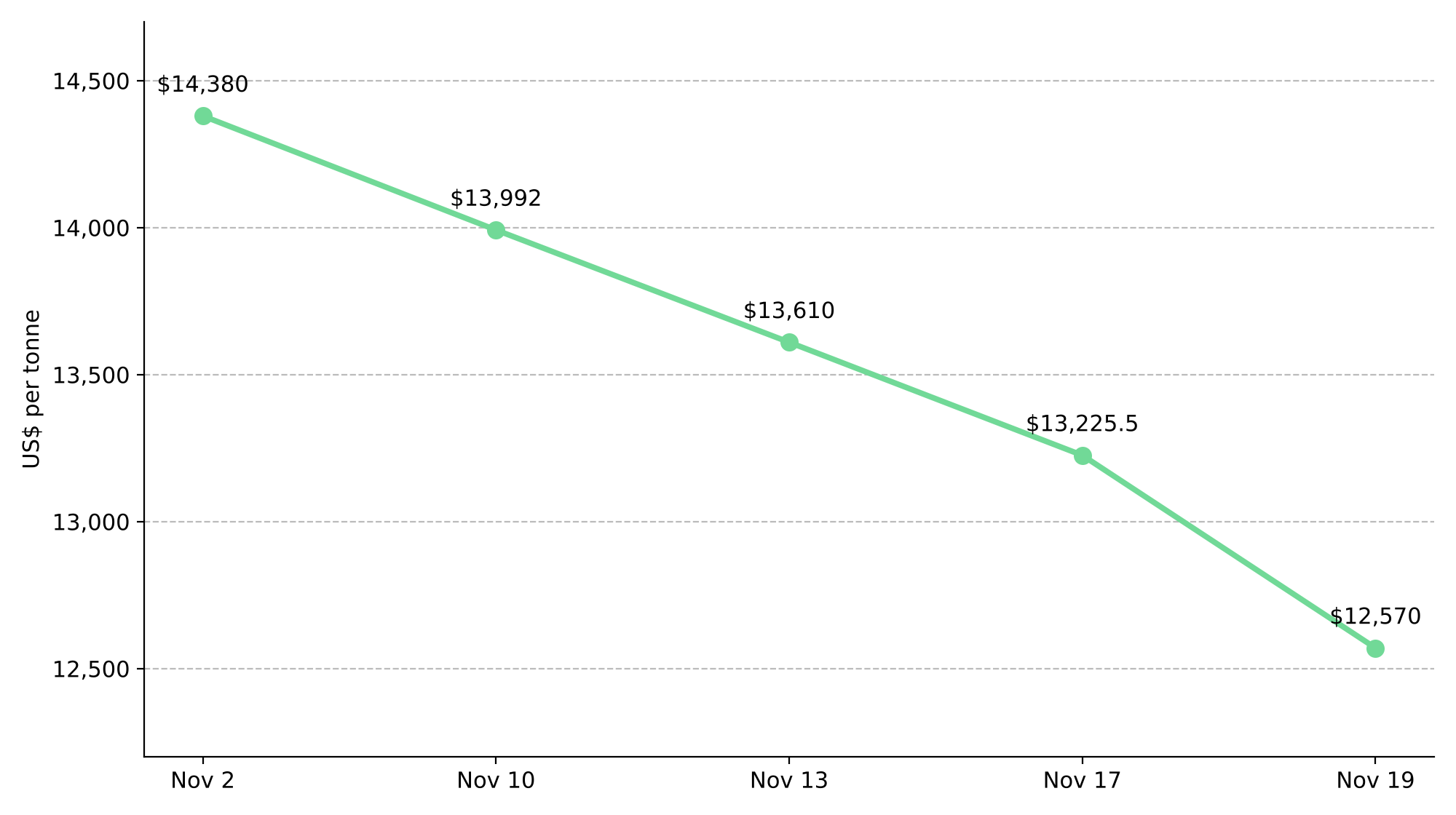
- LME three-month copper fell 5.5% to $12,502.50 per tonne on November 18, 2026, its lowest since April 7 and its largest one-day drop since April 2025.
- LME stocks held near 327,500 tonnes from November 13 to 19 while the cash price fell 7.6%, so the drop came from fund positioning, not new inventory.
- China's Yangshan import premium hit a record $500 per tonne on November 19, while Codelco's lower 2027 Asia offers show buyers pricing relief from January 2027.
- Fund selling and the December 8-9 Fed decision cannot be timed, and single-mine producer shares have fallen faster than the metal.
- A Yangshan premium back below $200 per tonne would signal the physical shortage has ended and remove support for LME-linked producers.
Fed Hike Bets and Fund Selling Push Copper to Its Worst Day Since 2025
Three-month copper on the London Metal Exchange (LME) fell 5.5% to $12,502.50 per tonne by 17:10 GMT on November 18, 2026, its lowest since April 7 and its largest one-day drop since April 2025, Reuters reported. COMEX copper slid 5.9% to $5.63 per pound. Speculators sold into a stronger dollar and rising odds of a December Fed hike, after US consumer prices rose 0.4% in October against a 0.3% forecast.
China's copper import premium reached a record $360 per tonne on November 18, and Shanghai Metals Market (SMM) assessed the Yangshan premium at $500 per tonne a day later. A falling benchmark alongside record delivery premiums places the cause in futures positioning, not surplus metal.
Fund Position Unwind Drives the Copper Price Drop
LME stocks rose from 293,775 tonnes on November 2 to 329,100 tonnes on November 13, then held near 327,500 tonnes through November 19, according to LME data published by Westmetall. Over that flat-stock stretch, the LME official cash price fell from $13,610 to $12,570 per tonne, a 7.6% drop with no added inventory. Goldman Sachs estimates net bullish positions across LME and COMEX fell from about 21% of open contracts at end-September to 9% in early November.
Two further forces extended the selling. AI-linked trades unwound, and Stanley Druckenmiller of Duquesne Family Office said on November 17 that he had turned bearish on copper. Fading odds of the proposed 15% US refined copper tariff narrowed the COMEX-LME spread to around parity, per SMM, removing the US price support. Shanghai Futures Exchange stocks fell about 18% in a week to 27,642 tonnes, placing the physical squeeze in Asia.
Record China Premiums Signal a Physical Copper Shortage Into 2027
US West Coast metal offered to China is not due until January 2027, and StoneX analyst Natalie Scott-Gray said premiums must rise further to pull more from those stocks. Cochilco forecasts 2026 Chilean output of 4.94 million tonnes, the lowest since 2003.
In the first scenario, US-held metal reaches Asia from January 2027, premiums fall toward Codelco's 2027 Asia offers of about $250-280 per tonne, down from $350 for 2026, and the LME price stays capped. In the second, Chilean output stays weak, Chinese buyers keep paying record premiums and funds rebuy, lifting the LME price back above the November 17 level of $13,144.
The December 8-9 Fed decision and 2027 contract settlements decide between the two, with the SMM Yangshan premium as the running signal. The horizon is January 2027. A Yangshan premium below $200 per tonne is the reversal trigger: it would show the physical shortage has ended, removing support for producers selling at LME-plus-premium prices.
Futures Selling Hits Copper Producer Shares Harder Than Physical Prices
Copper producers selling at LME-linked prices carry the most direct exposure, and the cohort spans listings in Sydney, Toronto, London and New York. Freeport-McMoRan fell 7% on November 18. Sandfire Resources fell 13% in the five sessions to November 16 against 8% for BHP, Forbes reported, as single-commodity producers dropped faster than diversified ones. European buyers face rising costs, with Codelco offering $350 per tonne for 2027 in Europe, up from $325.
The test that separates producers is whether higher premiums apply to steady volumes. BHP shows the trade-off: September-quarter copper output fell 19% to 400,700 tonnes, with Escondida down 23% and Copper South Australia down 16%. Producers with steady output and spot sales into Asia capture the premium; those with falling volumes or fixed-premium contracts do not.
The point at which fund selling stops cannot be known in advance, and the Fed decision and contract settlements arrive only in December. A retail portfolio holding single-mine copper producers can manage exposure through position size but cannot time the bottom; such shares fall faster than the metal, and capital can be lost.
Physical Copper Scarcity Outlasts a Fund-Driven Price Sell-Off
The November 18 sell-off was a positioning event. Funds cut exposure while physical buyers in China paid the highest premiums on record, and Chile, the largest producer, is heading for its weakest year since 2003.
For copper producers, value has moved from the benchmark price to physical delivery. Producers with reliable tonnes into Asia capture premiums the LME price no longer reflects, while equity markets have priced the whole cohort off futures. The long-horizon read runs against the headline: lower prices that deter new mine finance thin a supply pipeline already strained by Chile's decline, which favors producers delivering now.
For portfolios holding copper producers in Sydney, Toronto, London or New York, the sell-off is a reason to reposition toward steady-output producers, not to exit the metal.
Analyst's Notes





Subscribe to Our Channel





Stay Informed


