Japan’s Shrinking Yttrium Stockpiles Put a Premium on Non-Chinese Processors


A 128-fold yttrium price gap reflects restricted access, not production costs, making processing agreements and competitive costs key to project valuations.
- Japan is months from exhausting its yttrium supply and has asked the US to press Beijing to loosen rare earth export controls.
- Yttrium oxide was assessed at $1,150/kg outside China versus $9/kg inside China, a 128-fold price gap that could benefit non-Chinese suppliers with separation capacity.
- China’s April 2025 yttrium export controls remain in force, unaffected by the suspension of separate October 2025 measures until November 10, 2026, supporting demand for non-Chinese yttrium supply.
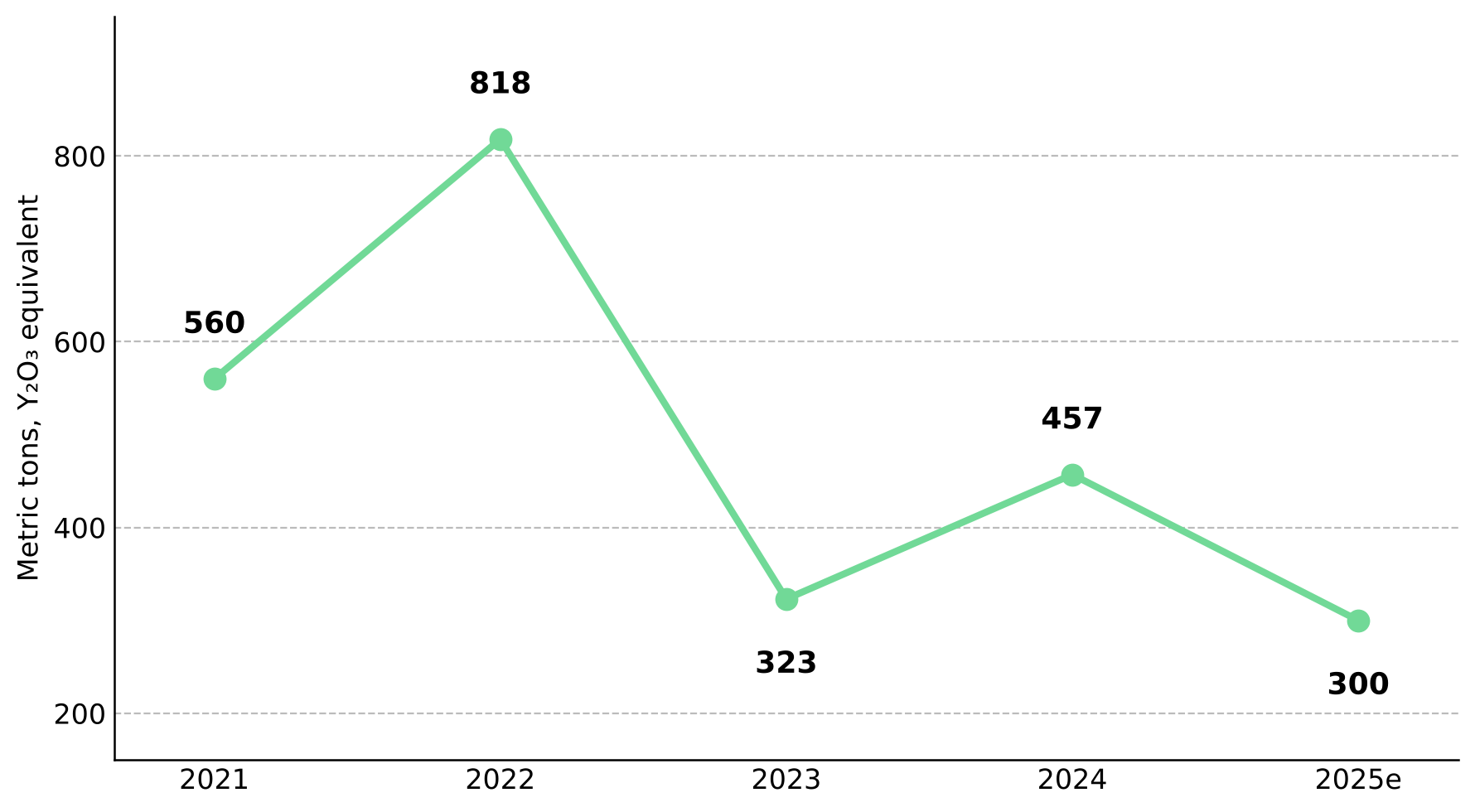
- US yttrium imports fell to an estimated 300 tons in 2025, their lowest in five years and 63% below the 2022 peak of 818 tons.
- Chinese yttrium exports above the 2025 average of roughly 133 tons per month could narrow the ex-China price premium, increasing the importance of competitive processing costs for non-Chinese projects.
China's Export Curbs Support 128-Fold Yttrium Price Gap
Japan could exhaust its yttrium stockpiles within months, prompting requests for the US government and major US companies to press China to loosen export controls and prevent manufacturing shortages. Yttrium oxide is assessed at $1,150/kg outside China versus $9/kg domestically, a 128-fold price gap.
China's export licensing requirements have disrupted yttrium shipments, tightening overseas supply and contributing to higher prices outside China. Non-Chinese producers able to supply yttrium oxide at competitive costs could benefit from demand for alternative sources.
Rare Earth Suspension Leaves Yttrium Licensing Intact
Western manufacturers depend heavily on Chinese yttrium separation plants, leaving supply exposed to export restrictions. China produced 270,000 of the 390,000 tons of rare earth oxides mined globally in 2025, a 69% share, and processed another 22,000 tons mined in Myanmar. China also exported roughly 1,600 tons of yttrium compounds and metal, with Japan its largest destination, while US imports fell to an estimated 300 tons.
China imposed export licensing requirements on yttrium metals, oxides, alloys, and compounds in April 2025. Separate controls covering five other rare earths were suspended until November 10, 2026, but yttrium was excluded, leaving Japanese manufacturers without a confirmed date for unrestricted supply.
Long Timelines Leave Japan Facing Yttrium Shortages
Yttrium coatings used in engine components and semiconductor manufacturing lack ready substitutes, making stockpile depletion a direct production risk. New separation plants outside China take years to commission, leaving little time to replace Japan's near-term supply. Gracelin Baskaran, Head of the Critical Minerals Security Program at the Center for Strategic and International Studies, warned that Japan would have to endure near-term shortages.
Price Reversal Risk Favors Low-Cost Rare Earth Projects
Non-Chinese rare earth projects with recoverable yttrium resources and viable processing routes could benefit from higher overseas prices and attract financing interest. However, the $1,150/kg overseas assessment is not a guaranteed long-term selling price, and increased Chinese exports could narrow the premium, favoring projects with competitive costs.
China's commerce ministry does not announce yttrium export licensing decisions in advance, leaving overseas buyers uncertain about shipment volumes and delivery schedules. This uncertainty could give suppliers with reliable delivery commitments an advantage in securing long-term contracts.
What Drives Yttrium Project Valuations
Unlike the suspended rare earth measures, China's yttrium export controls have no scheduled end, leaving Japanese manufacturers dependent on Chinese licensing approvals and encouraging longer-term supply agreements outside China.
China's export restrictions have made yttrium processing access a key factor in project valuations, alongside resource size. Non-Chinese heavy rare earth developers with secured separation routes could command higher valuations by offering a clearer path to commercial production.
Since China introduced yttrium export controls in April 2025, Japanese and Western buyers have faced greater pressure to secure long-term supply agreements that could help finance processing projects outside China.
Analyst's Notes





Subscribe to Our Channel






Stay Informed