Permit Delays Push Capital to Brownfield & Restarts


With new mines taking over 16 years to reach production, capital is shifting to restarts whose existing permits and infrastructure bring cash flow years sooner.
- Major mines entering production between 2010 and 2019 took more than 16 years on average to move from discovery to first production, raising the value of assets able to produce sooner.
- Existing shafts, mills, power connections and approvals at past-producing mines cut restart capital well below the cost of a new build.
- Prior environmental authorizations in Mexico and coordinated federal reviews under FAST-41 in Idaho are compressing permitting windows for past-producing projects.
- Targeted spending at inherited sites, from shaft upgrades to mill tie-ins, lifts output at operating mines running below capacity.
- Partner funding and royalty finance bring cash flow forward while reducing the equity each project must raise.
Long Development Timelines Reward Assets Closer to Cash Flow
A mineral deposit creates shareholder value only once it produces cash, and the length of the wait decides how much of the value original shareholders keep. The International Energy Agency (IEA) found major mines entering production between 2010 and 2019 took more than 16 years, on average, from discovery to first production. Long lead times keep new supply slow to respond to higher metal prices, and capital is moving toward projects able to add output sooner.
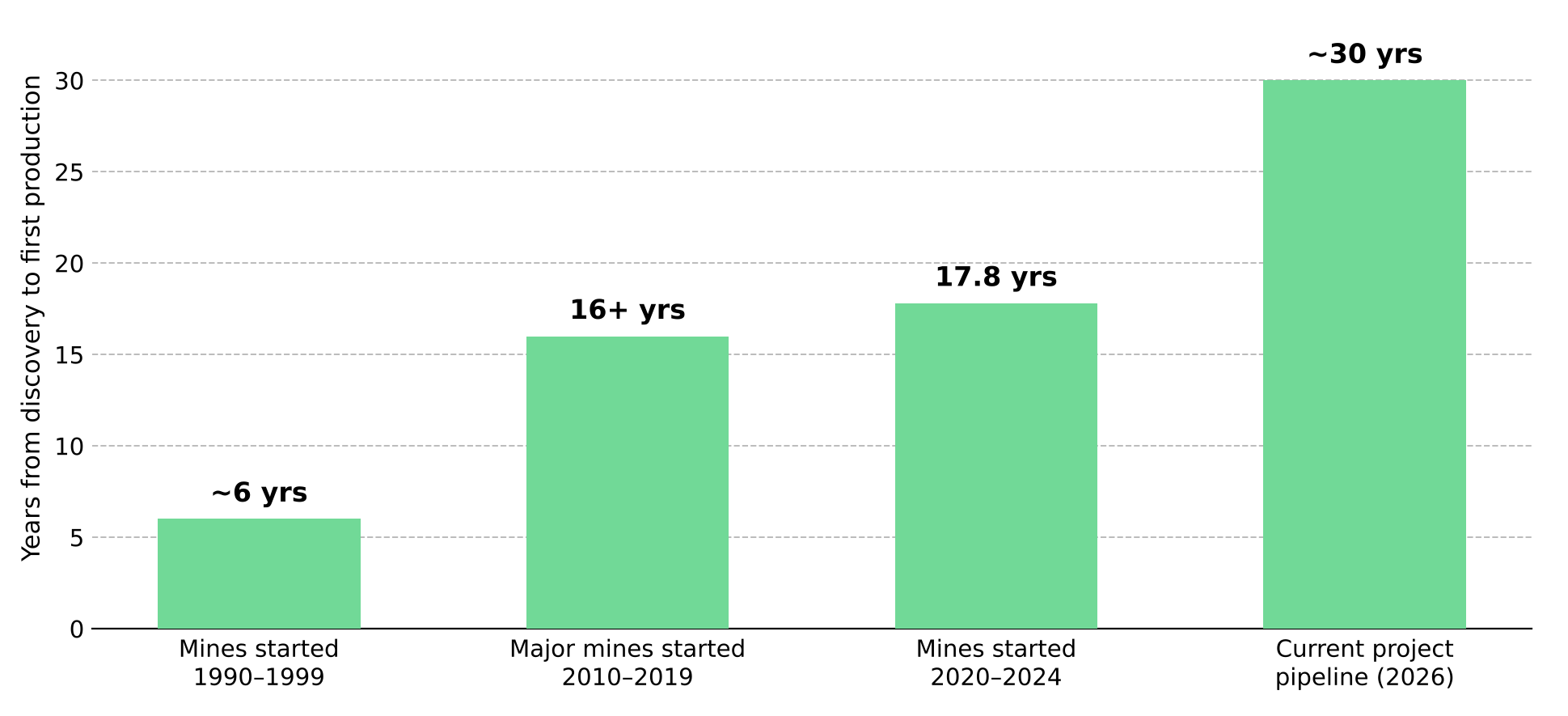
Brownfield assets are previously developed mining sites which carry shafts, processing plants, roads, power connections and environmental approvals into a new operating plan. Measured on remaining time and expenditure from today, a restart often sits years ahead of a new discovery, positioning junior mining companies holding such assets to deliver earlier cash flow to equity.
How Existing Infrastructure Shortens Route to Production
Shafts, declines, mills, leach pads and grid connections already in place remove years of construction. Their value rests on usable capacity and condition rather than historical cost.
Selkirk Copper is targeting a restart at the past-producing Minto copper mine in Yukon in the second half of 2028. Its 2026 preliminary economic assessment (PEA) estimates C$186 million in initial capital and an after-tax NPV of C$494 million at a 7% discount rate, using US$5 per pound copper, US$3,600 per ounce gold and US$50 per ounce silver. Colin Joudrie, Chief Executive Officer, explains the capital advantage:
"We're not building from the ground up. We're leveraging over $330 million of above-ground investment by prior operators."
Prior Approvals & Coordinated Reviews Compress Permitting Windows
Permitting windows set the longest lead time on most mine projects. Sites with standing authorizations or coordinated federal reviews start the sequence closer to production.
GR Silver Mining holds all major permits at the past-producing Plomosas mine, where IMMSA, a Grupo Mexico subsidiary, mined more than 2.5 million tonnes of ore between 1986 and 2000. On May 21, 2026, SEMARNAT, Mexico's environmental regulator, ruled no new Environmental Impact Authorization is required, advancing a planned bulk-sample test-mining program with 21 underground areas. Eric Zaunscherb, President and Chief Executive Officer, connects schedule gains to the larger San Marcial project:
"If we can cut the timeline down by a year or two at San Marcial, that has a massive impact on the NPV in a positive sense, to the benefit of the shareholder and the stakeholder in general."
Coordinated Federal Reviews Set Firmer Timelines
Integra Resources funds development from its producing Florida Canyon gold mine in Nevada, guiding 70,000 to 75,000 ounces for 2026. Its DeLamar project in Idaho entered the FAST-41 program in January 2026 on a 15-month federal permitting schedule, with a Record of Decision targeted for the second half of 2027. George Salamis, President and Chief Executive Officer, describes the pace of federal engagement:
"We're past the midpoint of our FAST-41 track… The response times from the federal regulators are far faster than they ever were."
Targeted Capital Turns Inherited Sites to Production Growth
The restart advantage extends to operating mines running below capacity. Past owners often leave shafts, mills and permits underused, and modest, targeted capital restores output faster and at lower cost than new construction.
Americas Gold & Silver upgraded the shaft at its Galena complex in Idaho in two phases. Management describes hoisting capacity rising from about 650 tons per day when current management took over in late 2024, to more than 1,400 tons per day after approximately $7 million of capital, with a third on-site mill now being tied in and most of the build-out funded from operating cash flow.
Pre-Funded Capacity Turns Permits Into Immediate Growth
enCore Energy produces uranium in South Texas by in-situ recovery (ISR), dissolving uranium underground with oxygenated groundwater and pumping it to surface. Its next output is pre-funded: the Upper Spring Creek satellite plant and first wellfield are built and expensed, ready to feed the standby Rosita plant, while Alta Mesa Wellfield 3 Extension permits are anticipated in the fourth quarter of 2026.
Flexible Deal Structures Bring Cash Flow Forward
Partner funding and royalty finance reduce the upfront capital a project needs. Cash flow can start before a full processing complex is built.
Gunnison Copper declared commercial production at Johnson Camp in Arizona in September 2026, after record August output of 1,304,448 pounds of copper cathode. Nuton, a Rio Tinto venture, fully funds the operation, which produces finished cathode on site and is ramping toward nameplate capacity of up to 25 million pounds annually. Craig Hallworth, President and Chief Executive Officer, sets out when full mine cash flow reverts to Gunnison:
"Up until mid-2030, any profits from the mine have to go towards repaying the investment, which is over $200 million so far from Nuton. The earlier we fully repay that investment, that's when all the cash flows of the mine accrue to us."
Summit Royalties holds a 1% net smelter return royalty on the producing Madsen gold mine in Ontario and a 4% gold stream on Copperstone in Arizona, where operator Mining Americas is targeting first gold in mid-2027. Summit pays 25% of spot per streamed ounce and has secured up to US$50 million in credit, funding acquisitions without new equity. Drew Clark, President and Chief Executive Officer, outlines the revenue growth ahead:
"Our revenues are doubling next year and they're doubling again… By 2028, when these things are fully ramped, we're going to be absolutely shooting the lights out in terms of revenue, especially on a cash flow per share basis."
The Investment Thesis for Brownfields & Restarts
- Remaining time to cash flow, rather than resource size, sets restart value, ranking permitted projects with funded work programs ahead of larger deposits still awaiting approval.
- Restart capital measured against the value of infrastructure already on site is a sharper screen than headline NPV, since prior operators' sunk investment lowers the capital a new owner must raise.
- Projects inside formal fast-track review programs carry firmer decision dates than those in standard permitting queues, narrowing the timing risk priced into the shares.
- Producers holding idle shafts, mills or pre-built wellfields offer the cheapest growth in the sector, adding output with modest capital or a single permit instead of new construction.
- Partner-funded restarts can reach production early while equity cash flow waits for repayment, making the repayment date as important as the commercial production date.
- Royalties and streams on restarted mines turn operator schedule gains into revenue growth without exposure to construction or refurbishment costs.
Development timelines exceeding a decade shift the advantage toward mines already built, permitted or partly funded. Capital rewards remaining time to cash flow rather than historical spending, and the clearest gains sit where approvals are in hand, infrastructure needs targeted rather than wholesale investment, and funding arrives through partners or royalty finance instead of repeated equity raises. As more restarts reach production, operating results, permit decisions and partner repayment dates become the milestones separating a schedule advantage already reflected in share prices from one still building into value.
TL;DR
Major mines now take more than 16 years on average to move from discovery to first production, and permitting delays are stretching lead times further. Capital is responding by favoring past-producing and brownfield assets, where existing shafts, mills, power connections and approvals cut restart capital well below the cost of a new build. Prior environmental authorizations and federal fast-track reviews are compressing permitting windows. Producers with idle shafts, mills or pre-built wellfields add output with modest capital or a single permit. Partner funding and royalty finance bring cash flow forward and limit dilution. Permit decisions, first production and partner repayment dates now decide how much of a schedule advantage reaches shareholders.
FAQs (AI-Generated)
Analyst's Notes





Subscribe to Our Channel
















Stay Informed