Undervalued? Mont Royal’s Ashram: A C$2.03 Billion NPV the Market Hasn’t Priced In


Mont Royal's Ashram rare earths project carries a C$2.03B NPV and C$18/kg AISC, as a First Nations-led MOU targets the road access needed for a rerate.
- Mont Royal's PEA for Ashram outlines a C$2.03 billion post-tax NPV against initial capital of around C$1.23 billion, which Managing Director Nick Holthouse argues the market has not priced in.
- The 204 million tonne resource supports a 30-year mine plan using only around 25% of the deposit, with Holthouse estimating more than 120 years of mining at current throughput.
- Simple flotation produces a 30% to 36% TREO concentrate at a conservatively assumed 63% recovery, supporting an AISC of around C$18 per kilogram.
- The PEA already includes road construction costs, and a First Nations-led MOU expected within three to six months could unlock provincial and federal infrastructure support.
- Trade-off studies on product type, throughput and power will shape a PFS now expected to begin next year, with financing, offtake and permitting still outstanding.
Nick Holthouse, Managing Director of Mont Royal Resources (ASX:MRZ, TSXV:MRZL), argues that the market has yet to price in the scale and quality of the company's Ashram rare earths project in northern Québec. His case rests on a large resource, simple metallurgy and a preliminary economic assessment (PEA) outlining a post-tax net present value (NPV) of C$2.03 billion. Holthouse contends that the market is instead focused on Ashram's remote location and the cost of the road needed to reach it. He sees an infrastructure agreement led by First Nations groups as the catalyst that could close that gap.
Scale and Basket: Where Ashram Sits Among Global Peers
Holthouse describes Ashram as one of the key North American rare earth assets still to come to market. The deposit hosts a resource of 204 million tonnes. On contained total rare earth oxide (TREO), the company's peer comparison places it alongside better-known names such as Lynas Rare Earths and MP Materials. The PEA's 30-year mine plan draws on only around 25% of that resource. At the current throughput rate, Holthouse estimates the full resource would support more than 120 years of mining.
The composition of the resource matters as much as its size. Holthouse highlights a strong proportion of neodymium-praseodymium (NdPr), the elements central to permanent magnets, which makes up around 21% of recovered TREO. The basket also includes dysprosium-terbium (DyTb) and yttrium. He notes that yttrium has become an oxide actively sought by industry as geopolitics reshape supply. The PEA outlines average annual output of around 17,500 tonnes of TREO, including roughly 4,000 tonnes of NdPr, 100 tonnes of DyTb and 230 tonnes of yttrium.
Mining is straightforward. Ashram is a large carbonatite body with a strip ratio of around 4:1, which Holthouse expects to be considerably lower in the early years. He describes the operation as closer to a quarrying exercise than a conventional hard rock mine. More than $50 million has been spent on drilling to date. He also sees potential for a near-term resource upgrade from a database review and a zone that was previously discounted.
Metallurgy: The Hurdle Most Rare Earth Projects Fail
Holthouse says the metallurgy was one of the main reasons he was drawn to the project. Many rare earth deposits contain complex minerals that need complicated processing flow sheets or fail to recover at all.
"Most [rare earth] projects unfortunately don't work. It's just the way mother nature has played the story out... But the thing that really attracted me to [Ashram] aside from the scale and the basket is the fact that the metallurgy works extremely well."
Ashram produces a concentrate through a simple flotation process. The PEA uses what Holthouse calls conservative assumptions of a 30% TREO concentrate at 63% recovery. Test work has produced concentrate grades of between 30% and 36%. Each tonne processed is expected to yield around 12 kilograms of TREO. Fluorspar currently reports to tailings, and the company is testing whether it can be recovered as a saleable concentrate. Holthouse wants that potential by-product included in the prefeasibility study (PFS).
Why the Market May Be Mispricing Mont Royal
The core of the Undervalued? case is a simple comparison of NPV against market capitalisation. Holthouse argues that on this measure Mont Royal sits well below its North American peers and probably at the bottom of the global peer group.
Holthouse acknowledges that peer comparisons can flatter. Asked which peer offers the fairest comparison once infrastructure, funding and study confidence are accounted for, he points to Defense Metals' Wicheeda project in British Columbia. Wicheeda has a similar style of mineralisation, a similar flow sheet and a similar capital cost profile. It also produces a comparable basket. Holthouse notes that Wicheeda is further advanced, at prefeasibility stage, but has a much smaller resource and a mine life of around 16 to 17 years.
Initial capital costs in the PEA total around C$1.23 billion. Holthouse concedes that hard rock rare earth projects come with sticker shock, but argues the figure sits in the expected range for a project of this size. The PEA was completed largely by Canadian consultants under the NI 43-101 disclosure standard. It carries an all-in sustaining cost (AISC) of around C$18 per kilogram, which Holthouse attributes to the volume of metal recovered from every tonne processed. He believes the figure compares well with other hard rock producers and sees further room to improve it.
He also lists positives he believes the market has not yet priced. These include the geology, the scale of the resource, the metallurgy, the simple mining and strong support from both Québec's provincial government and the federal government.
Infrastructure: The Discount the Market Is Applying
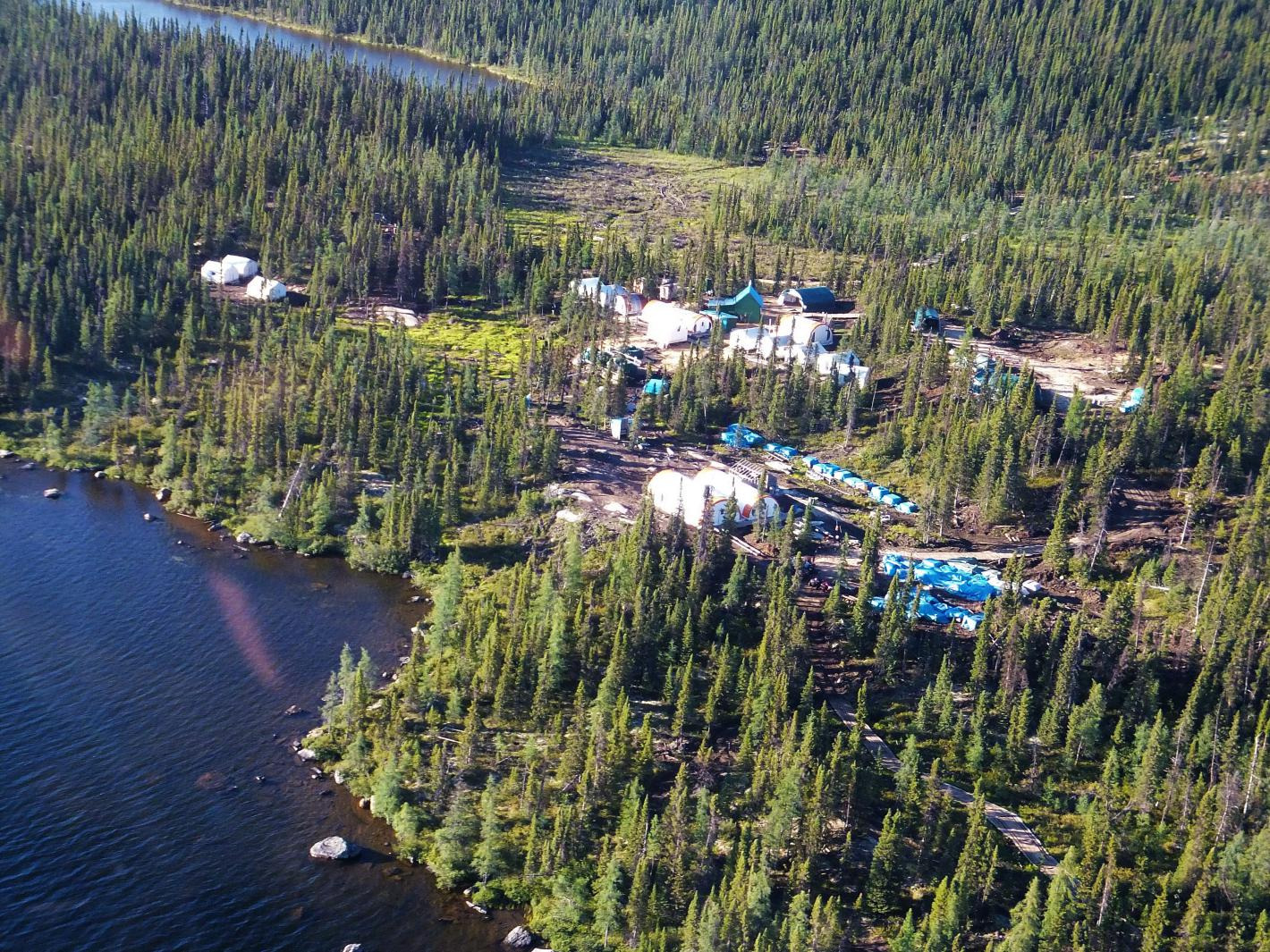
Holthouse is open about the project's main challenge. Ashram sits in a remote part of Québec, around 130 kilometres south of Kuujjuaq, without road or rail access. He considers this the largest issue the project faces. He argues, however, that the market is building in too much of a discount for it, because the PEA already carries the cost of building access.
"The cost of that road has been built into the current [PEA] metrics. So the project does actually carry the cost of constructing a road."
The route to shared infrastructure runs through First Nations groups. A consortium led by First Nations groups has begun consultation across its territories, with Mont Royal participating as a subordinate partner. Holthouse expects that process to progress towards a memorandum of understanding (MOU) over the next three to six months. He describes an MOU as a launch point for provincial and federal support for infrastructure in a district that hosts several other potential resource projects. Mont Royal was also recently invited onto the prospectus for Prime Minister Carney's investment forum, which Holthouse views as a sign of growing visibility at government level.
Interview with Nick Holthouse, Managing Director of Mont Royal Resources
Trade-Offs Before the Prefeasibility Study
Mont Royal is not moving straight into a PFS. Holthouse says the PEA has revealed several opportunities that the company is testing first through trade-off studies. One is whether the planned hydrometallurgical plant at Saguenay should produce a mixed rare earth oxide instead of a mixed rare earth carbonate, which he sees as offering technical and commercial advantages. Another is scale. Holthouse believes the project may still be too big and is testing whether reducing throughput creates an inflection point in capital cost. Site power is expensive, and the company is in discussions with First Nations groups about joint venture arrangements for power generation.
Downstream, Mont Royal intends to stop at the mixed carbonate or oxide stage. It is seeking a partner for separation and further processing, where Holthouse says margins are thin and technical demands are high. Environmental baseline and permitting work is due to begin in the coming months. The site camp is scheduled to reopen at the end of the coming winter. Holthouse expects the PFS to start next year once the trade-offs are complete.
On execution, Altris Engineering is the study manager. Several of its team worked on the build and commissioning of Lynas Rare Earths' Mount Weld flotation plant in Western Australia. Holthouse has managed much of the work himself with a small team so far. He plans to add in-house metallurgical expertise and a project manager over the next six months.
Conclusion
Western governments are working to secure magnet metal supply chains outside China, and rare earth projects in stable jurisdictions are receiving more policy attention. Holthouse highlights NdPr, DyTb and yttrium as the metals most in demand. He points to geopolitics as the driver of rising interest in yttrium specifically. Ashram's location gives it potential reach into Canada, the US, Europe and Southeast Asia.
Holthouse's view on where value sits along the supply chain shapes Mont Royal's strategy.
"Going further downstream into separation, metallisation, alloying, and then potentially magnets, very slim margins, very high tech... You really realise most of the value of these projects... in those first two or three steps where we're playing."
This positions Mont Royal as an upstream supplier of a mixed rare earth product rather than a vertically integrated magnet producer. That approach limits the technical risk the company takes on and points to separation partners as the natural route to market. It also means Ashram's commercial case depends on access to separation capacity outside China, which is still being built in North America and Europe. Holthouse reports that industry interest has increased since the PEA, though offtake discussions remain early. Many potential strategic partners want to see a PFS before they engage.
TL;DR
Mont Royal Resources Managing Director Nick Holthouse argues that the Ashram rare earths project in Québec is undervalued, with a market capitalisation far below the PEA's C$2.03 billion post-tax NPV. Ashram hosts a 204 million tonne resource, simple flotation metallurgy producing a 30% to 36% TREO concentrate and an AISC of around C$18 per kilogram. The main discount is remoteness, although road costs are already included in the PEA. A First Nations-led MOU expected within three to six months could unlock government infrastructure support. Trade-off studies on product type, throughput and power are under way, with the PFS expected to begin next year. Financing, offtake and permitting remain outstanding.
FAQs (AI Generated)
Analyst's Notes





Subscribe to Our Channel





Stay Informed