




DPM Metals Builds a Fully Funded Case for Re-Rating Through Balkan Discoveries


.jpg)
DPM Metals CEO David Rae on Čoka Rakita, Vareš, $760M cash and why the Balkan gold producer trades at a discount to peers despite 11 years of meeting guidance.
- DPM Metals has met production guidance for 11 consecutive years and expects to extend that record to 12 in 2026.
- The Adriatic acquisition replaced Ada Tepe's ounces, and DPM lifted Vareš development rates from about 75% of target to full target within six weeks.
- Čoka Rakita is scheduled to start construction early next year and produce about 190,000 ounces a year at a $644 an ounce AISC from mid-2029.
- Cash of around $760 million, rising to about $800 million by quarter-end per Rae, leaves the growth pipeline fully funded.
- Rae attributes the valuation discount to perception of the Balkans and to the time needed to advance four high value assets through resource estimates and studies.
DPM Metals Inc. (TSX:DPM) has spent the past two years turning itself into a different company. The Toronto-headquartered producer now concentrates on gold, silver and copper production in Bulgaria, Serbia and Bosnia and Herzegovina, having moved away from assets it no longer regarded as core. President and CEO David Rae described a business that has replaced the ounces from its closed Ada Tepe mine, integrated a major acquisition and assembled four high-value growth projects within its existing footprint. His central argument is that the market has yet to reflect this progress. Rae contends that DPM's valuation gap to peers owes more to unfamiliarity with the Balkans than to any shortfall in execution, and that a sequence of studies and resource estimates over the next two years is designed to close it.
From Portfolio Clean-Up to Focused Producer
Ada Tepe illustrates the operating model DPM wants investors to extrapolate. The Bulgarian mine started in 2019, producing roughly 100,000 ounces a year at an all-in sustaining cost (AISC) of about $500 an ounce, according to Rae. Last mining took place in April and last processing in July. The company is now closing the site and recovering its metallurgical process equipment for the next key project in Serbia. Rae called it "a small asset", and its short life made replacement a priority. DPM completed its purchase of Adriatic Metals on September 2025, gaining the Vareš silver-gold mine in Bosnia and Herzegovina. Rae said DPM has since taken Vareš to its full production capability and that its local leadership is now largely made up of Bosnians, which was not the case a year ago.
Proven Operational Consistency at Vareš
DPM's pitch rests heavily on consistency. The company has met its production guidance for 11 consecutive years and expects to make it 12 this year. Vareš provided a real-time test of whether that capability travels. Rae explained that the previous owner had struggled with decline development, which is needed to open working places and sustain a steady production rate with controlled dilution. DPM moved its Chelopech team, which had been preparing for Čoka Rakita, into Vareš. Within six weeks, according to Rae, the same Vareš crews were operating at target development rates, compared with roughly 75% of target before. He framed this as proof that DPM's techniques are transferable. Vareš reached commercial production in August and is on track to reach 850,000 tonnes a year by year-end. In the second quarter of 2026, it produced 35,185 gold equivalent ounces (GEO) at an AISC of $563 per GEO sold.
Advancing the Čoka Rakita Pipeline
Existing operations are expected to produce just under 400,000 GEO at full production, according to Rae. The next step change is Čoka Rakita in Serbia, which DPM discovered in 2023. Rae said the project should be online by the middle of 2029, producing roughly 190,000 ounces a year at an AISC of $644 an ounce. Construction is scheduled to begin early next year. As a gold project, it will tilt the portfolio towards precious metals and lower the blended cost base. The feasibility study cited in the company presentation outlines an after-tax net present value (NPV) at a 5% discount rate of $782 million and an internal rate of return (IRR) of 36% at $1,900 an ounce gold, on initial capital of $448 million.
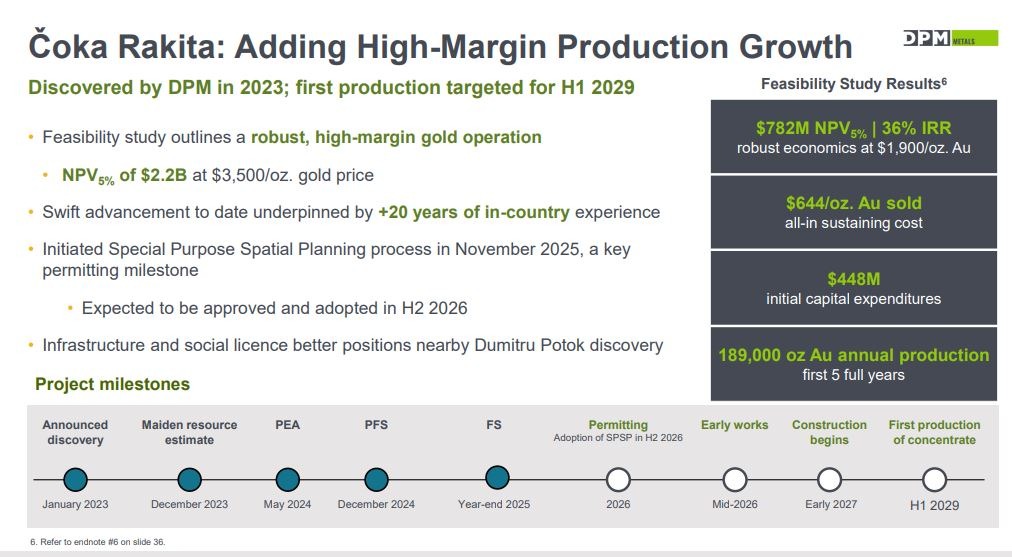
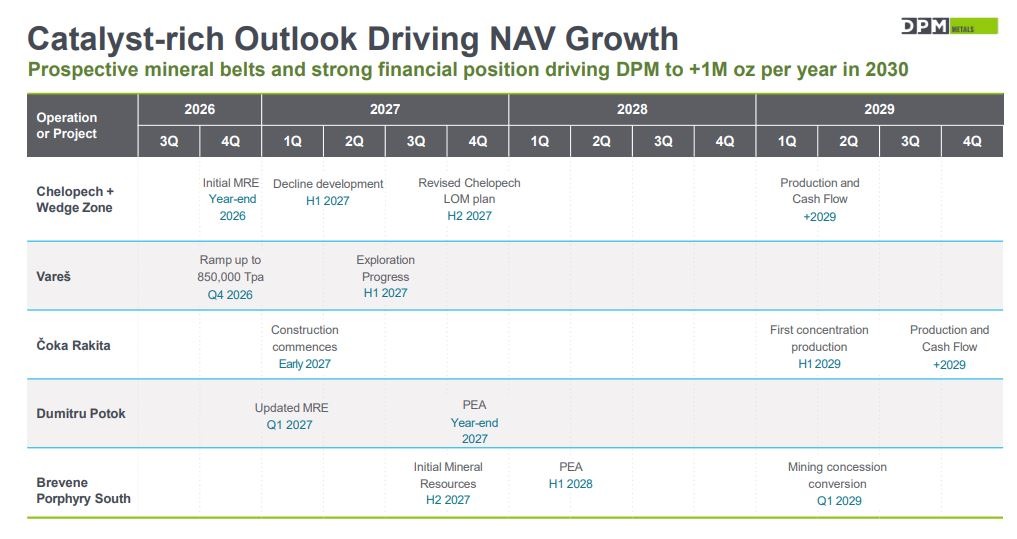
Behind Čoka Rakita sit three further opportunities. The Wedge Zone at Chelopech is due an initial resource estimate by year-end. Dumitru Potok in Serbia's Rakita Camp is working towards a preliminary economic assessment (PEA). Brevene Porphyry South, adjacent to Chelopech, is what Rae described as a much bigger asset that "materially changes the whole picture" over the longer term. Rae said the four new assets carry potential for a 300% increase in growth over the next few years, all within jurisdictions where DPM already operates.
Financial Strength Driving Shareholder Returns
The financial position gives DPM unusual room to manoeuvre. Rae said the company held $800 million in cash before the Adriatic transaction, which cost a little over $400 million, and then repaid around $200 million of debt. Since then it has returned $121 million in cash to shareholders, plus roughly $17 million in dividends. Cash stood at around $760 million at the end of the last quarter and Rae expects it to be back at about $800 million by the end of the current one. The presentation adds an undrawn $400 million credit facility, taking total liquidity to $1.2 billion. That leaves the constraint on growth as time and people rather than money.
"We're a fully funded growth story, and our exploration team is doing an amazing job at challenging our ability to do that."
Rae was clear that spending faster would not solve the timing problem. Each new discovery pulls technical resources into another round of drilling and study work before its value can be shown to the market.
Interview with David Rae, President & CEO of DPM Metals
Why the Market Still Applies a Discount
During the interview, it was noted that DPM trades at a trailing price-to-earnings ratio roughly 36% below its peers and an enterprise value to EBITDA multiple of about 13 times, against around 20 times for peers. Rae attributed part of that gap to perception of the region.
"Traditionally, it's been people not quite sure of what to make about a company being in the Balkans, particularly Bulgaria. If you stand back and look, we've had a track record of consistent production in the Balkans. We've got 11 years of meeting guidance and we're well on our way to 12."
He also pointed to the lag between discovery and recognition. DPM is finding ounces for around $16 an ounce in the ground at the Rakita Camp, according to Rae. However, the market typically credits that value only once a project has been shown to have scale, mineability and the right margins. An acquisition like Adriatic can flow through to the share price quickly. Organic discoveries must work through resource estimates and economic studies first. The share price has already responded to some of this work. Rae said it traded at around C$12.50 at the start of the re-rating, reached about C$40 early this year and touched roughly C$70 before settling near C$60.
Workforce Integration Cultivating Community Trust
Rae placed social licence and people at the centre of DPM's approach. Local teams are built to operate with minimal reliance on the Toronto corporate centre. The chief operating officer comes from close to Chelopech, and other core staff are drawn from the countries in which DPM operates. Community programmes began with basics such as youth education, meals, water quality and local infrastructure. Over the past six or seven years, DPM has also supported new local businesses unconnected to its mines, so that the community's economy can outlast any single operation. Rae said around 170 people had started viable businesses against roughly 290 positions at the mine. He added that DPM speeds up access to EU funding in Bulgaria by combining company support with bank backing for business cases. On talent, Rae acknowledged that the integration workload has stretched the team and that DPM will need to bring in people from outside. The number of drilling contractors supporting its work has risen from one to four, with a fifth being sought.
The Investment Thesis for DPM Metals
- DPM has met production guidance for 11 consecutive years, giving investors an unusually long record against which to judge future targets.
- Čoka Rakita offers a defined, gold-weighted growth step of roughly 190,000 ounces a year at a $644 an ounce AISC, with first production targeted for mid-2029.
- A cash balance of around $760 million, with Rae expecting about $800 million by quarter-end, means the growth pipeline is fully funded without equity dilution.
- The company's own valuation argument depends on converting discoveries into resource estimates and PEAs, so investors should monitor the year-end 2026 Wedge Zone resource estimate as the nearest catalyst.
- The pace of re-rating may be limited by people and contractor capacity rather than capital, making execution of hiring and integration a key risk.
- Jurisdictional perception remains the main reason cited for the valuation discount, and closing it relies on continued delivery rather than any single event.
Macro Thematic Analysis
The DPM story sits at the intersection of two broader trends. The first is the growing strategic weight attached to European supply of critical metals. Bulgaria's EU membership gives DPM regulatory clarity, and Rae noted that the company has not yet used several policy tools that may become available to it there. Its new Bulgarian assets include copper and molybdenum, both of which carry importance for European industrial supply chains. That positions DPM as one of relatively few listed Western producers with a meaningful, growing footprint in south-eastern Europe.
The second trend is the market's continuing reliance on jurisdictional shorthand. Investors tend to favour familiar mining regions, and companies outside them often carry a discount regardless of their operating history. Rae compared the Balkans with other regions, such as parts of Africa and Mongolia, where producers have had to argue the case for their jurisdiction. He framed Serbia in particular as a place where results depend on conduct.
"If you have a look in terms of what's going on in Serbia, us and others, I think this is a great place to be, particularly if you work effectively with the communities and you're very clear that you meet the standards in the country."
Bosnia and Herzegovina is at an earlier stage. Rae said investors are already asking when DPM might expand there, and his answer was to consolidate Vareš first. Relationships with governments and communities, once established, tend to open further opportunities. For investors, the relevant question is whether a decade of consistent delivery in the region, combined with a strong balance sheet, can shift perception faster than it has historically.
TL;DR:
DPM Metals has replaced Ada Tepe's ounces through the September 2025 Adriatic acquisition, and CEO David Rae says Vareš is now at full production capability. Existing operations are expected to deliver just under 400,000 GEO at full production. Čoka Rakita in Serbia begins construction early next year, targeting about 190,000 ounces a year at a $644 an ounce AISC from mid-2029. With around $760 million in cash, the pipeline is fully funded. Rae attributes the valuation discount to perception of the Balkans and the time needed to advance three further discoveries through studies.
FAQs (AI Generated)
Analyst's Notes





Subscribe to Our Channel




.jpg)


Stay Informed






















