




Mine Disruptions Test Whether The 46.3 Million-Ounce Silver Deficit Can Close



Silver’s 46.3 million-ounce deficit persists as Mexico, Peru and Chile disruptions expose a slow mine-supply response despite higher prices.
- Silver trades between $63.90 and $67.60 per ounce as of September 4, 2026, roughly 45% below its January 29 nominal high near $121.70, while September Fed rate-hike pricing has moved to about 50%.
- The Silver Institute's World Silver Survey 2026 puts the market deficit at 46.3 million ounces, its sixth consecutive annual shortfall, while registered COMEX inventory fell to 99.31 million ounces as of September 1, 2026.
- Three unrelated mine disruptions across Mexico, Peru and Chile in August removed a combined 1.1 million ounces of production, equivalent to roughly 2.4% of the annual deficit, with none caused by the silver price.
- Higher producer throughput, a development project targeting first production in 2027 and an explorer still defining its resource show why new silver supply cannot close a 46.3 million ounce deficit on a quarterly timeline.
- The August CPI report on September 11 and the September 16 FOMC decision are the main scheduled near-term price catalysts, but neither changes the 46.3 million ounce supply-demand deficit.
Fed Rate Risk & Oil Shock Pressure Silver Despite Six-Year Supply Deficit
Silver is trading between $63.90 and $67.60 per ounce as of September 4, 2026, roughly 45% below its January 29 nominal all-time high near $121.70.
Fed Chair Kevin Warsh's Jackson Hole remarks kept further tightening on the table, while New York Fed President John Williams argued that inflation could moderate as tariff effects fade, leaving the September rate decision sensitive to incoming inflation and labor data. CME FedWatch puts the probability of a September rate hike near 50%, down from roughly 62% earlier in the week. The August jobs report, due September 4, is the final employment reading before the September 15–16 FOMC meeting, with consensus near 58,000 jobs added and 4.1% unemployment; a stronger print would support the case for another rate hike, while a weaker print would reduce it.
Renewed US-Iran military activity around the Strait of Hormuz has pushed Brent crude above $94 a barrel and Treasury yields higher, adding inflation pressure that could keep Fed policy tighter and raise the opportunity cost of holding non-yielding silver. Higher rate expectations can pressure silver’s near-term price, while a sixth consecutive annual supply deficit limits the physical market's ability to rebuild available metal.
Mine Disruptions & Byproduct Economics Keep Silver Supply From Closing the Deficit
August mine disruptions show why silver's 46.3 million ounce deficit cannot be assessed through price alone. Three unrelated disruptions in Mexico, Peru and Chile reduced silver production for reasons unrelated to the silver price.
Three-Country Disruptions Cut 1.1 Million Ounces but Explain Just 2.4% of the Deficit
In Mexico, Endeavour Silver's Terronera mine was halted by an Ejido community blockade from August 12 to August 23, 2026, before resuming operations. In Peru, the National Institute of Statistics and Informatics (INEI) reported that silver production fell 9.0% year on year in June 2026. Separately, the unresolved REINFO formalization process could disrupt output from informal and small-scale mining operations through the rest of 2026.
In Chile, Antofagasta cut its 2026 copper production guidance on August 13 after severe weather shut Los Pelambres, reducing output from a copper operation that also produces silver as a byproduct. Combined, the production impacts across Mexico, Peru and Chile represent an estimated 1.1 million ounce reduction in silver output, equivalent to about 2.4% of the 46.3 million ounce deficit reported in the Silver Institute's World Silver Survey 2026.
Community relations in Mexico, zinc and lead grades in Peru, and severe weather in Chile drove the production losses, rather than changes in the silver price. Because much of global silver output is produced as a byproduct of copper, lead and zinc mining, higher silver prices alone cannot quickly bring additional supply to market.
Higher Galena Output Offers Alternative Supply
At Americas Gold & Silver's Galena mine in Idaho, which was not affected by the August disruptions in Mexico, Peru, and Chile, higher throughput provides a potential source of alternative silver supply. A modernized hoisting system increased sustained capacity from 42 to 85 metric tons per hour, while long-hole stoping raised mining rates from about 50 metric tons per shift in 2024 to as much as 200 metric tons per shift.
Oliver Turner, Executive Vice President of Corporate Development at Americas Gold & Silver, links the company’s operating performance to broader silver-market supply constraints:
"Seventy percent of silver is a byproduct from other mines, a significant portion of that being copper mines. Copper mines are now constrained because of sulfuric acid supply due to the Strait of Hormuz. So you don't have a highly responsive supply of silver. You can't just turn on more silver supply when the world needs it."
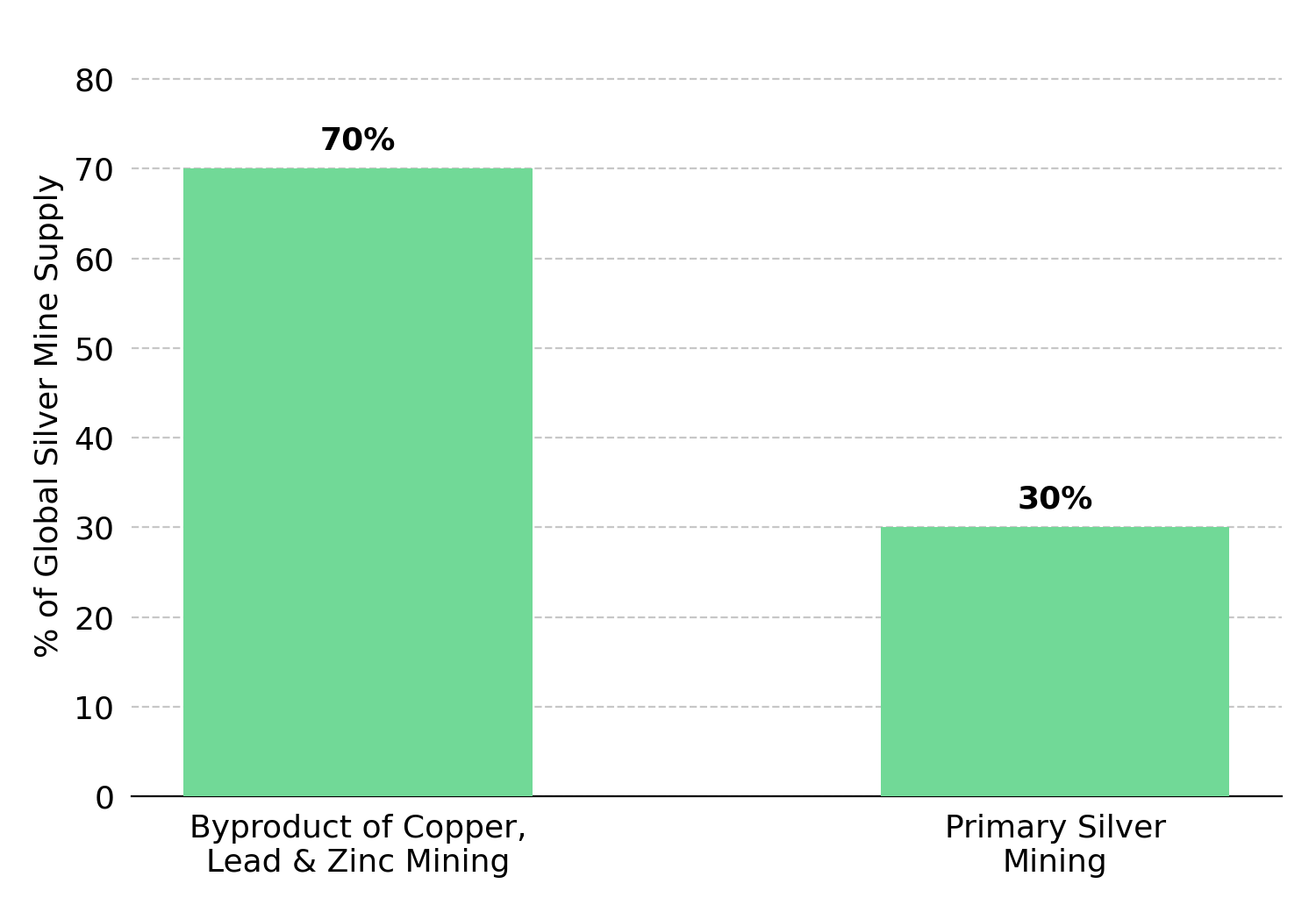
Roughly 70% of global silver output is produced as a byproduct of other metals, while additional primary-mine ounces still depend on operating capacity and costs. Higher silver prices therefore cannot quickly generate enough alternative supply to offset disruptions and close the 46.3 million-ounce deficit.
Permitting Keeps New Silver Supply Targeted for 2027
Vizsla Silver's November 2025 Panuco feasibility study reports a post-tax NPV at a 5% discount rate of US$1.8 billion and an IRR of 111% under its base-case commodity-price assumptions. The company reports US$457 million of total financing capacity against initial capital expenditure of US$238.7 million, a US$218.3 million difference that shifts the near-term project focus toward permitting and construction timing rather than the headline capital requirement.
Panuco's Manifestación de Impacto Ambiental (MIA) environmental permit was submitted in February 2025, with approval targeted for the second half of 2026 and a construction decision planned upon permit receipt. First silver production remains targeted for the second half of 2027. Once in operation, the feasibility study targets average annual payable production of 17.4 million silver-equivalent ounces over the 9.4-year mine life, including 10.13 million ounces of silver per year.
High-Grade Exploration Drilling Supports Long-Term Resource Upside
GR Silver Mining, an exploration-stage company, is advancing its San Marcial and Plomosas assets in Sinaloa, Mexico. The Plomosas Project's 2023 mineral resource estimate contains 97 million silver-equivalent ounces in the indicated category and 53 million ounces inferred, with San Marcial accounting for 65 million indicated and 20 million inferred silver-equivalent ounces.
Step-out drilling at San Marcial has extended high-grade mineralization at least 150 meters southeast of the 2023 resource boundary, including a headline intercept of 45.1 meters true width grading 1,623 grams per tonne silver, with an internal high-grade core of 8.25 meters at 8,579 grams per tonne silver. Because this mineralization extends beyond the existing resource boundary, successful conversion into a future resource estimate could add ounces to the project's defined silver inventory.
Faster Mine Supply or Deeper Solar Thrifting Would Narrow Silver’s Multi-Year Deficit
The mine-supply constraints outlined above are unlikely to determine silver's price before the September FOMC meeting, when inflation data and rate expectations will remain the more immediate catalysts. The August CPI report, due September 11, is the final inflation reading before the September 15–16 FOMC meeting, which will include updated economic projections and the Fed's rate-path estimates. A hotter-than-forecast core CPI reading could raise September hike expectations and pressure silver through higher yields, while a softer reading could strengthen the case for holding rates steady. Either outcome could change silver's near-term price without altering the underlying 46.3 million ounce supply-demand deficit. Registered COMEX inventory stood at 99.31 million ounces as of September 1, providing one observable measure of immediately deliverable exchange stocks. In Peru, the unresolved REINFO formalization process remains a separate supply risk through the rest of 2026.
The condition that would break the multi-year reading of this deficit is specific and worth stating plainly: if mine supply proves more responsive to price than the past 6 years suggest, or if solar-sector thrifting accelerates beyond the Silver Institute's forecast 19% decline in 2026 photovoltaic silver demand, the deficit could narrow faster than the evidence in this piece currently supports.
The Investment Thesis for Silver
- Silver is entering a sixth consecutive annual deficit at 46.3 million ounces in 2026 even as the Silver Institute forecasts a 19% decline in photovoltaic silver demand, indicating that weaker solar demand alone is insufficient to close the supply gap.
- Roughly 70% of global silver output is produced as a byproduct of copper, lead and zinc mining, so base-metal economics and disruptions such as weather, community disputes and ore-grade changes can reduce silver supply regardless of the silver price.
- At the producer stage, the key investment test is whether higher throughput can add meaningful silver supply while lowering unit costs, because production growth that remains high-cost offers less leverage to a persistent market deficit.
- At the developer stage, permitting, construction and ramp-up timelines can matter more than available financing, because even well-funded projects cannot contribute new silver supply until those milestones are cleared.
- At the exploration stage, value depends on converting drilling success into larger defined resources and eventually into economic studies, making resource growth the first step toward future mine supply rather than an immediate response to the current deficit.
- Inflation data and Fed decisions can move silver's near-term price, but closing a sixth consecutive annual deficit depends on how quickly mine supply, permitting and new project development can add physical ounces.
Silver’s sixth consecutive annual deficit reinforces an investment thesis built less on short-term price momentum and more on the market’s limited ability to add new supply quickly. Mine disruptions can tighten an already constrained market, but the larger issue is structural: much of global silver production depends on other metals, existing producers must expand economically, developers must clear permitting and construction milestones, and explorers require years to convert resources into operating mines. Near-term prices can still move sharply with inflation data, interest-rate expectations and broader macro conditions, but sustained exposure to silver increasingly depends on identifying assets capable of adding economically viable ounces before the supply deficit materially narrows.
TL;DR
Silver faces a 46.3 million ounce deficit in 2026, its sixth consecutive annual shortfall, while disruptions across Mexico, Peru and Chile removed an estimated 1.1 million ounces for reasons unrelated to silver prices. Roughly 70% of global silver output is produced as a byproduct of other metals, limiting how quickly higher prices can trigger new supply. Producer cost pressures, permitting timelines and exploration-stage development further slow the response. Near-term prices remain sensitive to CPI data and Fed decisions, but closing the deficit depends on mine supply, project execution and whether solar-sector thrifting reduces demand faster than current forecasts.
FAQs (AI-Generated)
Analyst's Notes





Subscribe to Our Channel








.png)
Stay Informed






