




Nickel Headed to $20,000 as Indonesia Limits Production, EV Demand Surges



Nickel strengthens on Indonesian supply discipline & robust EV demand. Canada Nickel advances Crawford with Auramet appointment, targets 2026 construction start.
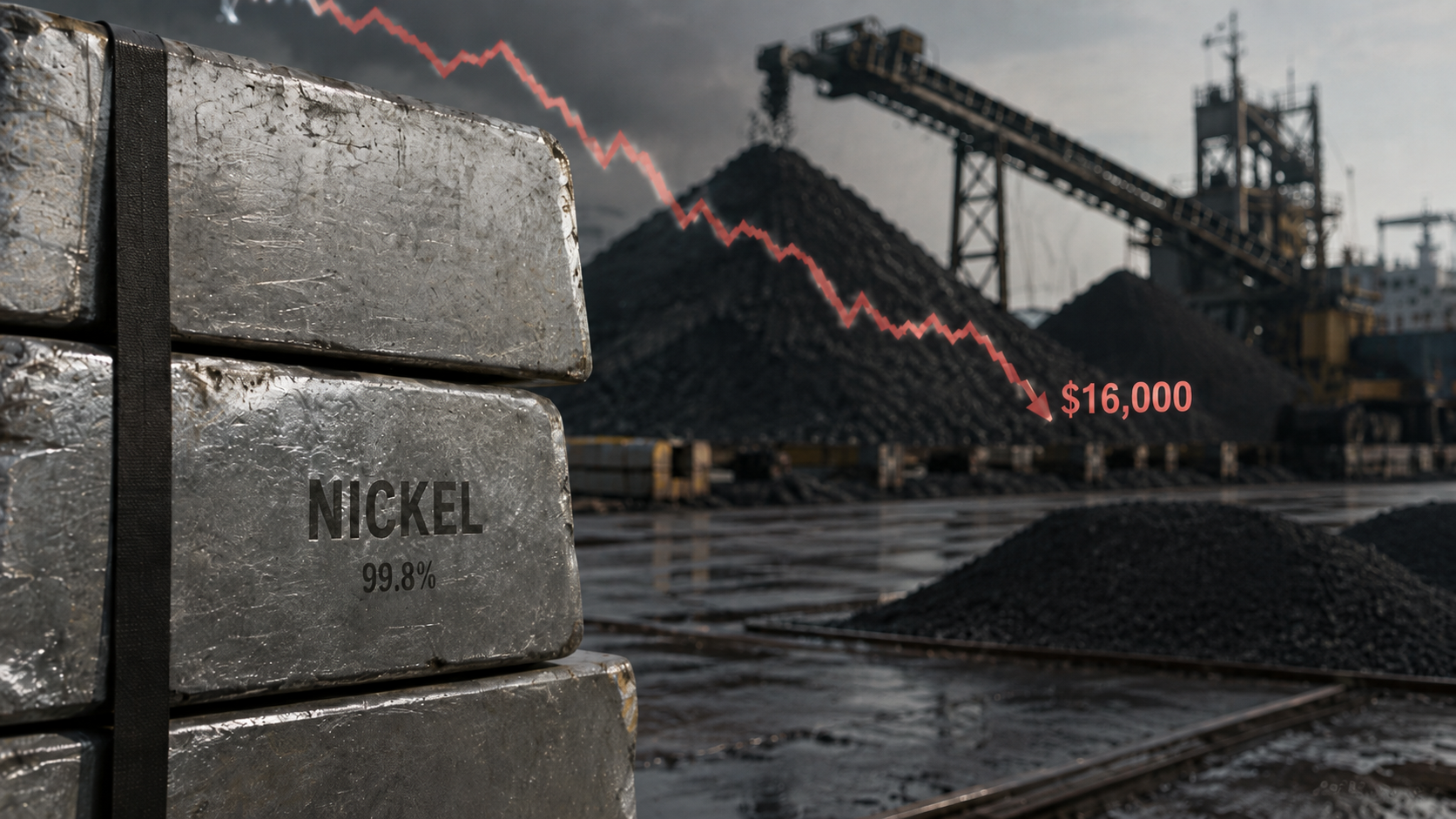
- Nickel prices bounced between $16,500-$18,500/ton in January after briefly exceeding $19,000, supported by Indonesia's commitment to flat-to-down ore production targets of 250-260 million tons for 2026
- EV demand remains robust with 20% underlying growth continuing; Europe up 30%, China up 17%, rest of world up 48% as lithium supply chain inventory destocking phase concludes
- Analysts remain cautious on nickel, requiring proof of Indonesian production discipline, while demand forecasts show 6-7% annual growth versus historical 4-5% driven by EV market expansion
The opening months of 2026 have delivered exceptional volatility across commodity markets, with precious metals experiencing unprecedented price swings while base metals like nickel establish new trading ranges supported by fundamental supply-side developments. In a detailed discussion, Canada Nickel CEO Mark Selby provided investors with insights into market dynamics, supply chain developments, and project advancement timelines that have significant implications for nickel-exposed equities and the broader battery metals sector.
Precious Metals Volatility Dominates January Trading
January 2026 proved to be a historically volatile period for precious metals investors. Gold prices surged into the mid-$5,000 per ounce range before surrendering nearly $1,000 of those gains within days. Silver experienced even more dramatic percentage swings during the same period. Selby characterised the price action as a "massive face rip" followed by an equally dramatic selloff, noting that the volatility extended to base metals, though to a lesser degree.
The extreme volatility caught many retail investors off guard. Selby recounted advising a prospective buyer to space out purchases rather than making a large single investment on the eve of the major selloff, potentially saving thousands of dollars in immediate losses. While gold has since recovered some ground, the episode underscores the challenge of timing entries in markets experiencing such pronounced technical movements.
Despite refusing to forecast gold prices directly, calling it "the world's oldest Ponzi scheme" that market participants simply accept, Selby acknowledged the unprecedented fiscal dynamics at play. He noted never expecting to see a US government "actively trying to wipe out the US currency as a store of value," leaving open the possibility of $10,000 gold at some point within the next two years while emphasising the speculative nature of such projections.
Nickel Market Establishes New Trading Range
Nickel prices demonstrated significant strength in late December and early January, briefly exceeding $19,000 per ton on the London Metal Exchange before settling into a $16,500-$18,500 range where prices spent most of January. The move was supported by fundamental developments rather than purely speculative positioning, providing greater confidence in price sustainability.
Multiple nickel-related products reached three-year highs during this period. Prices for nickel ore, nickel pig iron, and stainless steel all moved higher in concert with LME nickel, contradicting analyst narratives suggesting oversupply and excessive inventory throughout the supply chain. This correlated movement across the nickel value chain provides evidence of genuine tightening fundamentals rather than isolated financial positioning.
The Indonesian government announced a 2026 ore production target of 250-260 million tons, representing flat-to-down supply compared to 2025 levels. This commitment to supply discipline represents the critical variable in near-term price direction. Selby expects nickel to move toward $20,000 per ton within the next month as hard production data confirms Indonesian adherence to stated targets, with the market likely moving comfortably into that range once production discipline is verified.
Analyst Positioning and Market Sentiment
The analyst community's response to recent price action follows a predictable pattern. Many analysts entered 2026 with bearish forecasts that included modest disclaimers about potential Indonesian supply management, but generally assumed continued production growth. As prices moved higher, analysts adjusted forecasts upward to approximately current price levels, representing roughly 20% increases from prior projections.
Selby described the typical analyst response cycle: when forecasts prove incorrect, analysts move projections to current price levels if they are brave, then continue chasing prices higher as momentum persists. The concerning signal emerges when analysts begin forecasting significantly above or below current prices, which often precedes directional changes. During gold's spike, major banks substantially raised long-term gold forecasts just before the selloff, illustrating this dynamic.
For nickel specifically, analysts remain skeptical about Indonesian commitments despite that country's track record of following through on stated policies over the past eight years. Selby characterised nickel as a "show me story" for the remainder of 2026, requiring either continued price support in nickel pig iron and stainless steel or hard production data confirming year-over-year flat output before the analyst community embraces a bullish thesis. The persistent disconnect between analyst demand forecasts and actual market growth remains notable, with Shanghai Metals Market projecting 6% demand growth for 2026 while the market has delivered approximately 7% annual growth throughout the current decade.
Interview with Mark Selby, CEO, Canada Nickel Company
Indonesian Supply Management Strategy
Indonesia's approach to supply management represents a calculated strategy balancing multiple economic objectives. The government seeks to allow prices to rise sufficiently to support domestic industry and maximise royalty revenues while avoiding price levels that would incentivise significant new production capacity or restarts of idled operations globally.
Selby outlined the Indonesian strategy: allowing prices to reach the $20,000 per ton range, observing market response, then permitting further increases toward $22,000 per ton while monitoring sentiment and new project announcements. He believes Indonesia has considerable latitude below these levels before triggering meaningful supply responses from Western producers or reactivation of mothballed capacity.
Two significant factors motivate Indonesian discipline. First, higher nickel prices directly improve the country's current account and trade balance in meaningful ways given the scale of Indonesian nickel exports. Second, Indonesia implemented a tiered royalty structure where higher nickel prices trigger higher royalty rates, directly increasing government revenues at a time when Indonesia faces serious budget deficit challenges. The combination of improved balance of payments and increased tax revenues creates substantial incentive for continued supply discipline.
The demand side supports this strategy. At 6-7% annual demand growth on a 3.5 million ton market, approximately 200,000 tons of new annual supply is required. Selby characterised this as equivalent to seven Crawford projects (phase one) worth of new capacity needed annually just to meet demand growth, underscoring the challenge of bringing sufficient new supply online even with supportive pricing.
Electric Vehicle Market Dynamics
Contrary to bearish narratives that emerged during 2024, underlying EV demand has maintained approximately 20% annual growth for the past four to five years. Regional variations in 2025 data reflect subsidy program timing rather than fundamental demand shifts. Europe posted 30% growth, rebounding from a weak prior year caused by subsidy pull-forwards. China grew 17% while the rest of the world category surged 48%, driven by Chinese EV exports to developing markets. US and Canada experienced declines related to subsidy reductions, representing temporary rather than structural headwinds.
Looking forward, Selby expects 15-20% sustained growth through the remainder of the decade. A critical development involves the lithium supply chain finally working through excess inventory built during the 2021-2022 price spike when lithium reached 9-10 times historical levels. Panic buying and inventory building throughout the supply chain created a substantial overhang that required years to clear. Only in the second half of 2025 did active buying resume, reflected in higher lithium prices and improved payabilities for nickel-cobalt battery materials.
The European battery industry, which experienced uncertainty following 2024's difficult market conditions, has returned to the market aggressively to secure supply, driven partly by geopolitical considerations around supply chain resilience. Selby anticipates 2026 will prove an interesting year for battery materials with solid underlying growth continuing. The nickel market has sustained 6-7% annual growth while still working through destocking, suggesting potential for continued strength as supply chains normalise.
Long-Term Structural Considerations
Beyond near-term cyclical factors, longer-term structural dynamics favor sustained higher nickel prices. Indonesia faces genuine grade constraints in its ore deposits toward the end of the decade. The fortuitous discovery of multi-million ton nickel resources by Inco in the 1960s and 1970s, which remained undeveloped until Chinese companies deployed $40 billion in investment during the 2000s, represents a non-repeatable windfall that has supplied much of the world's nickel growth.
Few significant new nickel districts have been discovered globally in recent decades, partly reflecting successful Chinese efforts to discourage exploration spending that might create competing supply sources. This makes deposits like Canada Nickel's Timmins Nickel District particularly valuable as one of the few locations capable of delivering large volumes in coming years.
If nickel demand reverts to historical 4-5% annual growth rates by the 2030s after the current 6-7% period driven by EV adoption, markets will still require several hundred thousand tons of new supply annually. This persistent need for new capacity, combined with limited new district discoveries and Indonesian grade constraints, supports expectations for nickel prices in the low $20,000s per ton range through the remainder of the decade.
Exploration and Development Updates
Talon Metals continues generating exceptional drill results from its project, with recent intercepts including 9 meters grading nearly 10% nickel, 12% copper, and approximately two-thirds of an ounce of PGMs. These represent some of the most spectacular base metal intervals observed globally, comparable only to a handful of world-class deposits. Key questions remain regarding the extent of mineralisation, potential for discovering similar pods elsewhere, and whether higher-grade zones exist closer to surface, as current intersections occur approximately 800 meters depth.
NexMetals advanced its Botswana project with drilling connecting zones and extending them at depth, delivering 32 meters grading 1.5% nickel and 1.5% copper, consistent with higher-grade zones historically identified. The project awaits pre-feasibility and feasibility studies to determine overall economics.
In a significant development for the broader nickel market, The Metals Company submitted its application through DeepGreen to begin commercial recovery of polymetallic nodules from the seafloor. While this represents a potential nickel and cobalt source, the technology will have a disproportionately larger impact on manganese markets. No commercial mining has occurred at these depths previously, with operations requiring technology capable of withstanding extreme pressures. The technical challenges and environmental considerations surrounding deep-sea mining remain substantial.
Canada Nickel Corporate Developments
Canada Nickel announced two significant milestones for the Crawford project. The company appointed Ausenco as lead engineer, focusing on the process plant and related infrastructure. Ausenco brings an established track record in similar projects, providing credibility to the engineering program as Canada Nickel advances toward construction.
The company also secured an expanded bridge financing facility from Auramet, paying out an existing facility due within days while establishing new interim financing. Auramet has been a supportive partner through multiple financing rounds, with bridge facilities typically carrying Canada Nickel to major announcements and funding milestones. This structure allows the company to maintain full-speed development and detail engineering work while finalising discussions with government partners and potential project partners.
The expanded bridge facility ensures Canada Nickel remains well-funded as it works toward targeted construction commencement by year-end 2026. Management characterised ongoing discussions with both provincial and federal government as advancing, though specific timelines were not disclosed. The ability to continue detail engineering work during these discussions prevents project delays while partnership structures are finalised.
In an industry anecdote, Trafigura won a $600 million lawsuit against a counterparty who sold containers purportedly containing nickel that proved to be empty, representing a significant embarrassment for one of the world's leading commodity trading firms and illustrating the risks inherent in physical commodity trading.
Key Takeaways
The nickel market enters 2026 with increasingly constructive fundamentals despite lingering analyst skepticism. Indonesian supply discipline, if maintained as indicated by government targets, should support prices moving toward $20,000 per ton in the near term with potential for higher levels as grade constraints emerge later in the decade. EV demand continues growing at approximately 20% annually as supply chain destocking concludes, while stainless steel demand adds consistent baseline consumption. The limited pipeline of new nickel districts globally, combined with the substantial annual supply additions required to meet 4-7% demand growth, creates favorable conditions for developers advancing large-scale, long-life assets. Canada Nickel's appointment of Ausenco as lead engineer and expanded bridge financing positions the Crawford project for potential construction start by year-end 2026, subject to finalising government partnerships.
TL;DR: Executive Summary
Nickel fundamentals strengthen as Indonesia commits to flat 2026 production (250-260M tons) while demand maintains 6-7% annual growth, supporting price targets of $20,000+/ton. EV markets show robust 20% underlying growth with supply chain destocking complete. Canada Nickel advances Crawford toward year-end 2026 construction start with Ausenco appointment as lead engineer and expanded Auramet bridge financing, positioned to capitalise on structural nickel deficit emerging from limited new supply sources and Indonesian grade constraints by decade-end.
FAQ's (AI Generated)
Indonesia aims to balance higher royalty revenues and improved trade balance against preventing prices from rising so high they incentivise significant new global production or capacity restarts, maximising economic benefits through disciplined supply management.
Prices need to reach well above $20,000/ton into the $22,000/ton range before triggering meaningful new project development or restarts of idled capacity, providing Indonesia latitude to manage supply while maximising revenues.
At 6-7% demand growth on a 3.5 million ton market, approximately 200,000 tons of new annual supply is required - equivalent to seven Crawford phase-one projects - highlighting the challenge of meeting growth.
Management targets construction commencement by end of 2026, following completion of government partnership discussions. Ausenco has been appointed lead engineer with expanded Auramet bridge financing ensuring funding through development milestones.
Analysts have been burned by Indonesia over the past six to seven years and remain hesitant to forecast based on Indonesian supply discipline, requiring hard production data confirmation before embracing bullish scenarios.
Analyst's Notes





Subscribe to Our Channel







Stay Informed


