




Nickel Near $16,800 as Indonesia Tests a New Pricing Benchmark



Nickel holds near $16,800 as Indonesia’s planned exchange tests whether its 67% supply share can influence global reference pricing.
- Nickel traded at $16,806.38 per tonne on August 18, 2026, up 0.34% on the day, down 0.61% over the past month, and 11.60% above a year earlier.
- On August 18, 2026, a presidential spokesperson said Indonesia's planned commodity exchange will likely include nickel, palm oil and coal, with a January 1 launch targeted to establish domestic reference prices.
- Indonesia produced an estimated 2.6 million tonnes of nickel in 2025, about 67% of the 3.9 million-tonne global total, giving the country outsized influence over supply and reference pricing.
- By September 17, 2026, the Financial Services Authority (FSA) will issue rules for phasing trades onto the exchange, a key test of whether it can influence nickel reference pricing.
- Indonesia requires tin exports to trade through a domestic exchange, while its 2023 palm oil bourse remains lightly traded, making mandatory participation the key test for nickel.
Higher Indonesian Nickel Quotas Pressure Prices & Shift Attention to Pricing Policy
Nickel traded at $16,806.38 per tonne, up 0.34% on the session but near its lowest level since early July. Reports that Indonesia may further relax supplementary Work Plan and Budget (RKAB) nickel ore quotas raised expectations of higher supply, pressuring prices.
Nickel prices are reacting to higher Indonesian supply, while the planned exchange could influence reference pricing but has received less attention. Separately, the Common Cents Act cleared the Senate after passing the House and would let the Treasury test cheaper five-cent coin production. Five-cent coins contain about 25% nickel, but their nickel use is negligible against a 3.9 million-tonne global market. The legislation therefore addresses Mint production costs, not nickel supply.
Indonesia Supplies 67% of Nickel & Seeks Greater Control Over Reference Pricing
Indonesia produced an estimated 2.6 million tonnes of nickel in 2025, about 67% of the 3.9 million-tonne global total, and holds 62 million tonnes of more than 140 million tonnes of global reserves, giving its pricing policy influence across much of global supply. President Prabowo Subianto is targeting a January 1, 2027 launch for the commodity exchange to establish reference prices for major exports, with nickel likely to be included.
President Prabowo Subianto told parliament that buyers unwilling to pay Indonesia's prices could choose not to buy, signaling an effort to gain greater control over commodity pricing. Nanan Soekarna, Chairperson of the Indonesian Nickel Miners Association, said the plan recognizes that a major commodity supplier should have greater influence over the prices it receives.
Low Exchange Liquidity Could Keep LME as the Nickel Pricing Benchmark
The January launch alone will not determine whether the exchange can influence nickel pricing; adoption and trading volume will. Indonesia's 2023 palm oil exchange remains lightly traded, showing that a reference price needs enough buyers and trading volume to gain acceptance.
Base case: FSA rules due September 17 phase trades onto the exchange but leave participation voluntary, limiting trading volume after the targeted January 1, 2027 launch and keeping London Metal Exchange (LME) pricing as the reference for physical contracts through 2027.
Bull case: Rules requiring Indonesian exports to use exchange-referenced pricing lift realized prices toward pyrometallurgical break-even, raising the global nickel cost floor.
Mine Closures Outside Indonesia Reduce Supply Options Despite the Nickel Surplus
Australian nickel mine production fell 54% to 45,000 tonnes in 2025 as low prices pushed mines into care and maintenance, while Philippine output fell 24% to 270,000 tonnes. Canada and New Caledonia each produced 140,000 tonnes, leaving both well below Philippine output.
Supply cuts outside Indonesia have not eliminated the global nickel surplus. The surplus widened to 189,000 tonnes through the first nine months of 2025 from 107,000 tonnes a year earlier, keeping pressure on prices. The annual average LME nickel cash price fell an estimated 11% in 2025.
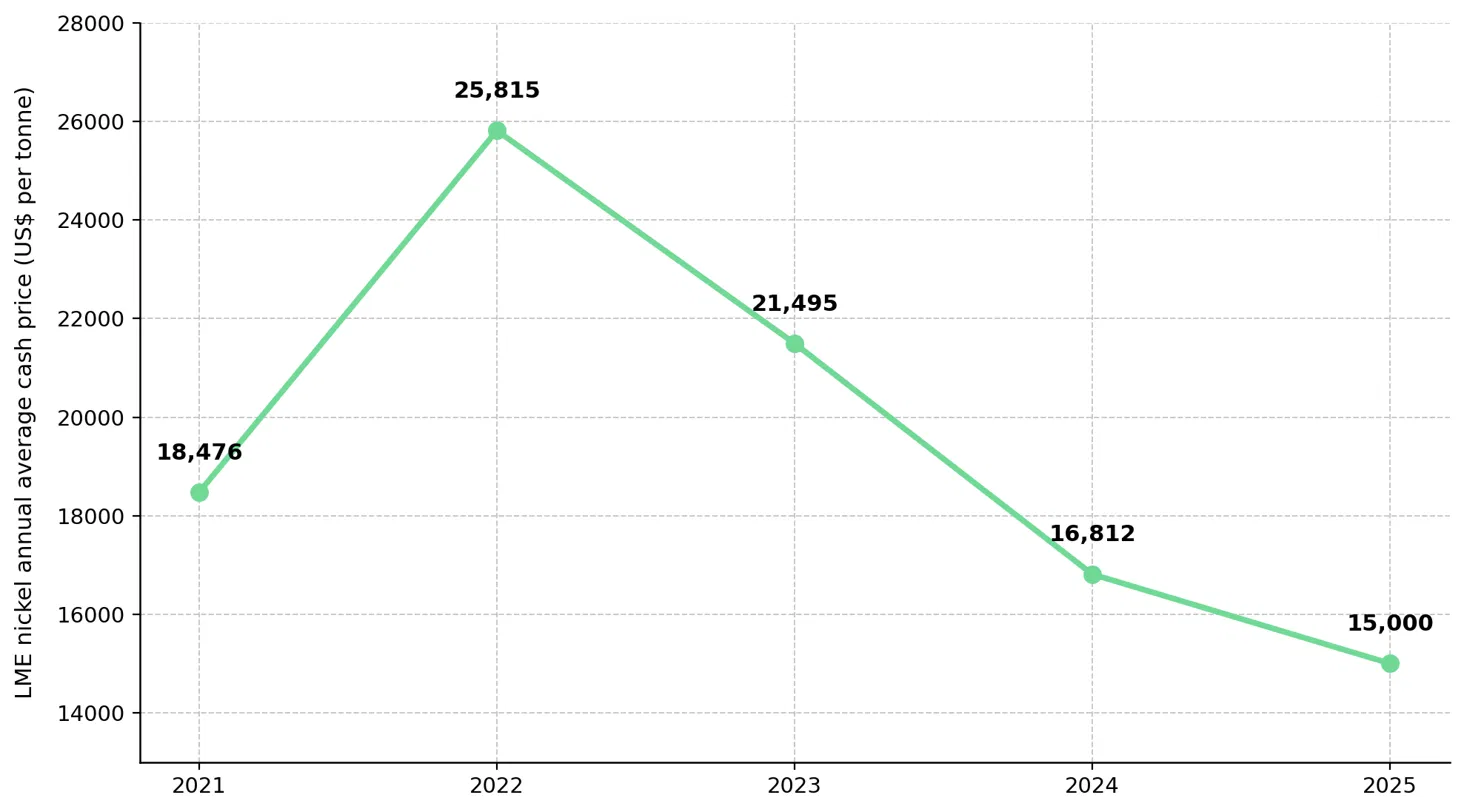
It remains unclear whether Indonesia will use the exchange to raise realized prices or primarily reduce gaps between reported and actual export values. If the exchange raises Indonesian realized prices, development-stage nickel projects in Canada, Australia and the US could become more competitive as the global cost floor rises.
What Can Shift Nickel Pricing Benchmark
Nickel remains near $16,800 as reports of higher Indonesian ore quotas raise supply expectations, while the LME remains the physical reference. For now, quota decisions are the immediate price driver, while cost-curve position determines producer margins.
Indonesia provides two precedents for what comes next. Tin exports must trade through a domestic exchange, while trading on the 2023 palm oil bourse remains limited. Mandatory participation would make tin the closer precedent for nickel, while voluntary participation would increase the risk of another low-liquidity market.
Analyst's Notes





Subscribe to Our Channel
.png)






Stay Informed


