




Canada Nickel's Crawford Funding: What Each Layer Must Clear Before 2027


.png)
Canada Nickel's US$2.5 billion Crawford nickel funding plan: how tax credits, Samsung SDI, EDC debt and government programs convert before the 2027 build decision.
- Canada Nickel's US$2.5 billion funding plan for Crawford combines US$1.0 billion of equity and US$1.5 billion of debt, and the project has now received its federal decision statement.
- Refundable investment tax credits of about US$600 million constitute the largest equity layer, and the company has mandated that a Scandinavian bank provide a bridge facility so the credits can fund construction upfront.
- Samsung SDI holds a US$100 million option to acquire 10% of Crawford, valuing the project at US$1 billion, with exercise bringing life-of-mine (LOM) nickel offtake.
- Export Development Canada has issued a US$500 million letter of intent (LOI) as Mandated Lead Arranger, and Canada Nickel is working toward a term sheet.
- Management is targeting financing outcomes in October or November 2026, ahead of a construction decision targeted for mid-2027 and first production targeted for 2029.
From Identified Sources to Usable Project Capital
Canada Nickel Company (TSXV: CNC | OTCQB: CNIKF) has received the federal decision statement for its Crawford Nickel-Cobalt Sulfide Project near Timmins, Ontario. Management describes it as the main yes/no permit for the project. The remaining provincial and federal permits require technical data that meets set requirements. Crawford is the first mining project to complete the Impact Assessment Act process from start to finish since that legislation came into effect in 2019.
With the permit in hand, attention moves to how the financing package is assembled. Canada Nickel's plan totals US$2.5 billion, split 40% equity. The components exist today in different legal and commercial forms: a statutory tax credit, a contractual option, a bank-led sale or offtake process, a group of government program envelopes, and an export credit agency letter of intent (LOI). Each needs its own event before it becomes usable capital, and the composition and timing of those events will determine how much conventional equity Canada Nickel ultimately needs to raise.
The scale of the plan is large relative to the company. Canada Nickel reported a market capitalization of C$1.36, with C$56 million in debt as of April 30, 2026. Front-end engineering and design work places Crawford's after-tax net present value (NPV8%) at US$2.8 billion, with an internal rate of return (IRR) of 17.6%.
The US$600M Tax-Credit Layer & Its Bridge Facility
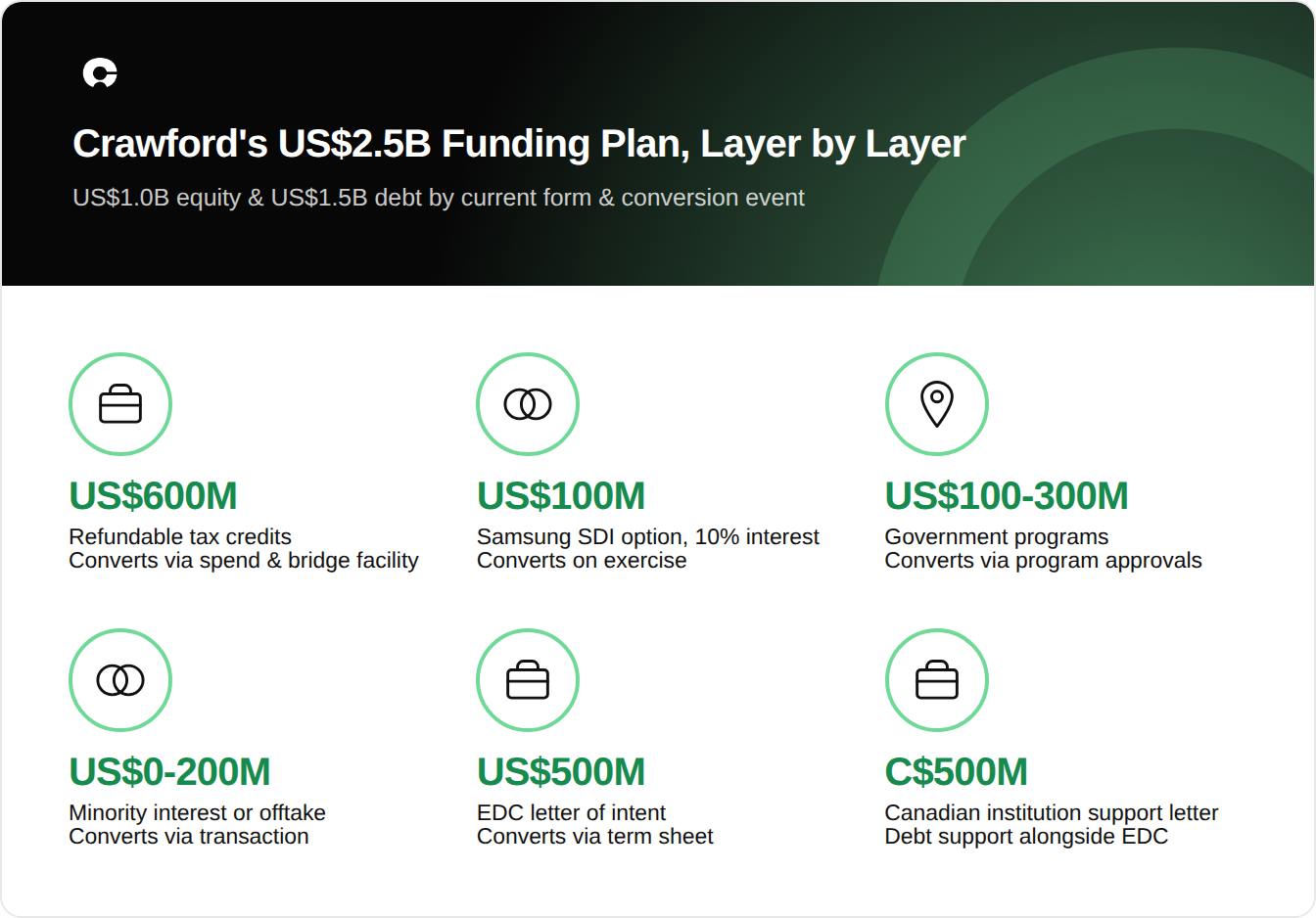
Refundable investment tax credits (ITCs) of about US$600 million in equity requirement. They come from Canada's Clean Technology Manufacturing and carbon capture, utilization, and storage credit programs. Under the carbon capture credit, qualifying spend earns a 50% credit between 2022 and 2035 and a 25% credit between 2036 and 2040. Canada Nickel is seeking eligibility for capital costs incurred for its proprietary IPT Carbonation process, which is designed to store 1.5 million tonnes of carbon dioxide per year once fully ramped up.
ITCs are earned on capital already spent, which creates a timing gap for a project that needs the money during construction. Canada Nickel has signed a mandate with a leading Scandinavian bank to provide a bridge facility against the credits, so they can be drawn ahead of the spending that generates them.
Chief Executive Officer of Canada Nickel, Mark Selby, explained why the company went to the Scandinavian market for that structure:
"One thing that's different about the Scandinavian market than what's in North America is they have a very active debt financing market in natural resources. And so we've signed a mandate with them to basically provide a bridge facility which allows us to use those investment tax credits that come after we've built stuff, to use them upfront to build the project."
This layer therefore has 2 conversion steps: qualifying spend that establishes the credit, and a closed bridge facility that brings the cash forward. Canada Nickel has grouped ITC receipt with the Export Development Canada (EDC) mandate and government program approvals in the full financing package it targeted for year-end 2026. If the bridge closes on that schedule, the largest single equity layer will fund construction without issuing new shares.
Samsung SDI's Option & the Minority Interest Process
Samsung SDI, a 6.5% shareholder and tier-1 battery manufacturer, holds an option to acquire a 10% direct interest in Crawford for US$100 million, valuing the project at US$1 billion. Exercise also delivers 10% of life-of-mine (LOM) nickel offtake plus a further 20% of nickel offtake for 15 years. The conversion event for this layer is a single act of exercise. Canada Nickel describes the anchor offtake as directly supporting debt capacity for lenders.
A second project-level layer is in progress with Scotiabank and Deutsche Bank. Canada Nickel is working with the 2 banks to raise a further US$100-200 million, either by selling another 10% to 20% of the project through structure of take financing. Canada Nickle lists this layer at US$100-200 million, a range that starts at US$0, so the funding plan does not depend on it to close.
Both layers exchange asset-level interest or future production for capital at the project, and the parent company's share count stays unchanged when they convert. The trade-off is ownership. Exercise of the Samsung option and a completed minority sale together would reduce Canada Nickel's direct interest in Crawford, in exchange for equity that does not dilute existing shareholders at the corporate level.
Government Program Envelopes & Crawford's Shortlist Position
The third equity layer is US$100-300 million from government programs. Domestic sources include the Canadian Minerals Infrastructure Fund, the Canada Growth Fund, the Critical Minerals Sovereign Fund, the First & Last Mile Fund and the Ontario Critical Mineral Processing Fund. International sources include Infravia (France), the German Resource Fund, JOGMEC (Japan) and Korea. Conversion here comes through individual program approvals.
Crawford's standing within these programs is defined by 2 designations. It is 1 of 5 mining projects with the federal Major Projects Office and the earliest-stage project in that group, and, according to management, the others were already permitted with feasibility work completed before entry. Provincially, it is 1 of 3 projects in Ontario's One Project, One Process framework.
Selby linked those designations to the order in which government capital is likely to be deployed:
"The fact that we're 1 of 5 at the federal level and 1 of 3 at the provincial level should give investors some comfort that when that capital starts getting deployed, we're on a very short list for that capital to come."
Management has acknowledged that government processes have taken longer than the company would like. Receipt of the federal decision statement also moves Crawford higher on the list for offshore financing opportunities.
The Debt Layer: From Letter of Intent to Term Sheet
The US$1.5 billion debt layer is built around EDC, which has issued a US$500 million LOI in its role as Mandated Lead Arranger. A leading Canadian financial institution has provided a C$500 million support letter, with the balance to be sourced from global export credit agencies and private lenders.
Selby described where the debt layer stands today:
"We've got the letter of intent from Export Development Canada. We're working down the path now to get to a term sheet with them, and we'll have a bunch of other global export credit agencies who we've been in regular dialogue with for the past 4 years to have them come in. So the debt is largely looked after. Still a lot of work to do, but there's visibility on getting that all together."
For EDC, conversion is a term sheet. Its arranger role is the basis on which Canada Nickel is seeking participation from other export credit agencies. The debt and equity layers are also connected: Canada Nickel describes Samsung SDI's anchor offtake as supporting lender confidence, which ties the option to the debt process.
What the Conversion Mix Means for Common Equity
The next stage of engineering is funded. Canada Nickel closed an upsized C$21.0 million non-brokered private placement on August 28, 2026, at C$1.50 per unit. Management says the capital gets detailed engineering underway, allows the placement of long-lead item orders, and sets the company up for financing initiatives targeted to bear fruit in October or November 2026. The construction decision is targeted for mid-2027, with groundbreaking by the end of 2027 and first production in 2029. Construction must start in a fourth-quarter window or wait until the following year's fourth quarter, so the timing of financing directly feeds into the build schedule.
Canada Nickel describes its government support as non-dilutive. Each of the 4 equity layers in its plan is a source other than new parent-company shares: the ITCs, the Samsung option, government programs and the minority interest process. Conventional equity would need to cover any shortfall between converted capital and the US$1.0 billion equity requirement. Layers that convert at the upper end of their ranges reduce that residual, and layers that convert at the lower end widen it.
The conversion events to monitor are an EDC term sheet, the close of the ITC bridge facility, government program approvals, a Scotiabank and Deutsche Bank transaction, and exercise of the Samsung option. Canada Nickel reported a market capitalization of C$ 327 million, or C$ 2.8 billion. The mix of those outcomes, and whether they land in the October to November 2026 window management has targeted, will shape the equity requirement Canada Nickel brings to its 2027 construction decision.
The Investment Thesis for Canada Nickel
- Canada Nickel has received the federal decision statement for Crawford, the first mining project to complete the Impact Assessment Act process from start to finish since 2019.
- Canada Nickel's US$2.5 billion funding plan for Crawford combines US$1.0 billion in equity and US$1.5 billion in debt.
- Refundable investment tax credits of about US$600 million are the largest equity layer, and a mandated Scandinavian bank bridge facility is designed to make them available during construction.
- Samsung SDI's US$100 million option to acquire 10% of Crawford values the project at US$1 billion and brings life-of-mine nickel offtake that supports lender confidence.
- Export Development Canada has issued a US$500 million letter of intent as Mandated Lead Arranger, and Canada Nickel is working toward a term sheet.
- Management is targeting financing outcomes in October or November 2026 ahead of a construction decision targeted for mid-2027.
Canada Nickel has identified a source for each part of Crawford's funding requirement, and each source now needs a specific event to become usable capital. The order and scale of those conversions will set how much conventional equity the company needs before construction begins.
TL;DR
Canada Nickel's US$2.5 billion Crawford funding has its sources identified, including about US$600 million of refundable ITCs and a US$500 million EDC LOI. Each layer now needs its own conversion event: a bridge facility, an option exercise, program approvals, a minority transaction or a term sheet. With an NPV8% of US$2.8 billion against a C$327 million market capitalization, the mix and timing of those conversions will determine how much conventional equity the company needs ahead of the mid-2027 construction decision.
FAQs (AI-Generated)
Analyst's Notes





Subscribe to Our Channel



Stay Informed


