




Oil Gains 4% on Blockade Threat as 17.4 Million-Barrel Build Caps Further Upside



US blockade risk lifts oil 4%, but a 17.4 million-barrel crude build and $65.39 WTI forecast signal lower mining fuel costs.
- Brent rose 1.03% to $87.97 a barrel and West Texas Intermediate (WTI) gained $0.91 to $82.16 on August 14, 2026, after the US threatened an indefinite naval blockade of Iran, putting both benchmarks on track for weekly gains near 4%.
- US commercial crude inventories rose 17.4 million barrels to 424.4 million in the week ending August 7, 2026, the largest weekly increase in more than three and a half years, but remained about 2% below the five-year average.
- New York Harbor ultra-low sulfur diesel fell from $4.161 a gallon on July 31, 2026, to $3.910 on August 7, while retail on-highway diesel dropped $0.091 to $5.257 on August 10, supporting mining margins despite crude’s weekly gain.
- The US Energy Information Administration (EIA) base case published August 11, 2026, puts WTI at $74 in the fourth quarter of 2026 and $65.39 in 2027, with the 2027 forecast $4.61 below the $70 assumption used in major gold and copper cost guidance.
- Distillate stocks of 107.1 million barrels, 12% below the five-year average, and refinery utilization of 96.2% leave little supply capacity before the August 19, 2026 EIA report, where a further draw would renew diesel cost pressure on mine budgets.
17.4 Million-Barrel Crude Build Expands US Supply Cushion & Limits Price Risk
Oil prices rose after the US threatened an indefinite naval blockade of Iran, with Brent futures up 1.03% to $87.97 a barrel and WTI futures up $0.91 to $82.16. Both benchmarks had fallen more than 2% in the prior session but remained on track for weekly gains near 4%.
US commercial crude inventories rose 17.4 million barrels to 424.4 million, the largest weekly increase in more than three and a half years, increasing the supply cushion against blockade risk. WTI spot settled at $79.77, down $6.39 from the prior week.
Trade Flows Expand US Inventories & Hormuz Attacks Threaten Regional Exports
The inventory build reflected trade flows, as US crude imports rose 1.14 million barrels per day to 7.3 million while exports fell 627,000 barrels per day to 3.058 million. Refineries processed 17.179 million barrels per day at 96.2% capacity, showing the build did not reflect weaker refinery demand, while domestic production rose 478,000 barrels per day year over year to 13.805 million.
US plans for economic isolation and an indefinite naval blockade threaten Iranian exports but do not directly reduce US crude supply. The UAE said Iran attacked two Abu Dhabi National Oil Company vessels in the Strait of Hormuz, which carried 20% of the world’s oil before the conflict, raising the risk of wider export disruption.
Lower Demand Forecasts Limit Crude Upside & 2027 Production Restarts Reduce Mine Fuel Costs
The Organization of the Petroleum Exporting Countries (OPEC) and International Energy Agency (IEA) both cut oil demand growth forecasts, but blockade risk kept oil prices on track for weekly gains near 4%.
Susan Bell, Senior Vice President of Rystad Energy’s, said geopolitical risk prevented the 17.4 million-barrel inventory build from causing a sharper oil-price decline.
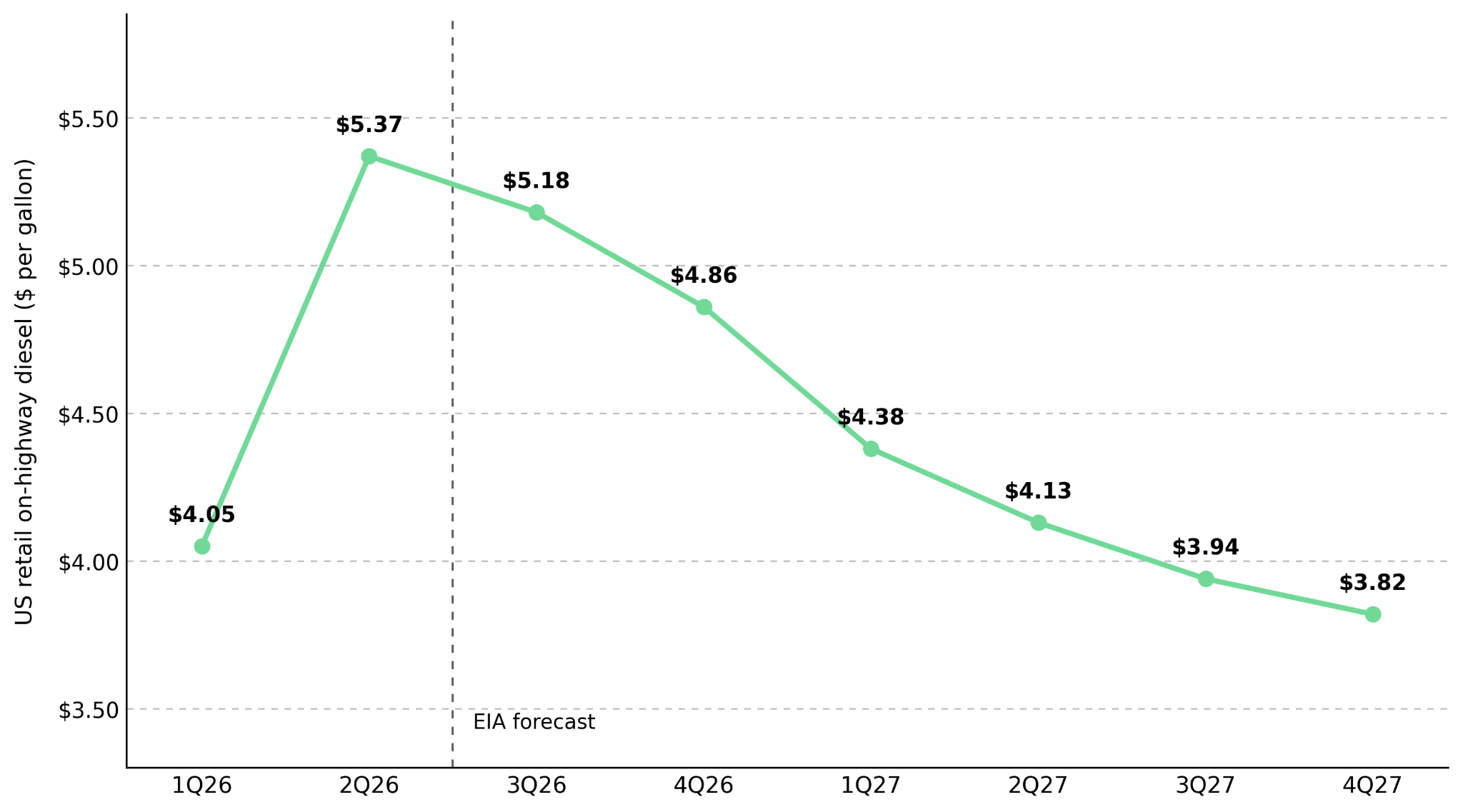
The EIA Short-Term Energy Outlook assumes Hormuz constraints through August, with Brent averaging $85.21 in the third quarter of 2026 before falling to $78 in the fourth quarter as WTI reaches $74 and retail diesel declines from $5.18 to $4.86 a gallon. The outlook also assumes most shut-in production restarts in the first quarter of 2027, lowering average WTI to $65.39 and retail diesel to $4.07 a gallon and supporting mining margins.
$10 WTI Increase Adds $12/oz to Gold AISC & $0.04/lb to Copper Costs
Diesel prices directly affect mine operating costs, with on-highway diesel averaging $6.033 a gallon in the West Coast district and $5.044 in the Gulf Coast district, a $0.989 spread, while California reached $6.618. Open-pit mines using diesel haul trucks absorb this regional spread in their cost per ton mined.
Barrick Mining’s second-quarter results show its 2026 cost guidance assumes WTI at $70 a barrel, with each $10 change shifting gold all-in sustaining costs (AISC) by $12 an ounce and copper costs by $0.04 a pound. The company reported quarterly gold AISC of $1,866 an ounce, up 11% year over year, while higher fuel costs contributed to cost of sales of $1,993 an ounce.
The blockade’s duration remains uncertain, and the EIA assumes severe restrictions through August 2026 before flows increase gradually in September. Position sizing should compare the $70 WTI assumption used in major gold and copper cost guidance with WTI at $82.16, not Brent at $87.97. Without a disclosed fuel sensitivity, the effect on mine margins cannot be quantified, increasing valuation uncertainty.
107.1 Million-Barrel Distillate Stocks Leave Mining Margins Exposed
New York Harbor ultra-low sulfur diesel fell from $4.161 to $3.910 a gallon, while retail on-highway diesel dropped $0.091 to $5.257, reducing fuel-cost pressure on mines.
Distillate stocks of 107.1 million barrels, 12% below the five-year average, and refinery utilization of 96.2% leave little spare capacity to accelerate inventory rebuilding. A further draw in the next EIA report could lift diesel prices and raise gold and copper AISC.
Use the EIA Weekly Petroleum Status Report to compare distillate stocks with 107.1 million barrels and New York Harbor ultra-low sulfur diesel with $3.910 a gallon. Lower diesel prices continue to support mine margins while New York Harbor diesel remains below $4.161, but five consecutive closes above that level should trigger a reassessment of fuel-cost assumptions for diesel-intensive producers.
Analyst's Notes





Subscribe to Our Channel






Stay Informed


