




Tudor Gold's Perfectstorm Drilling: What 6 Porphyry Holes Settled & What Stays Open


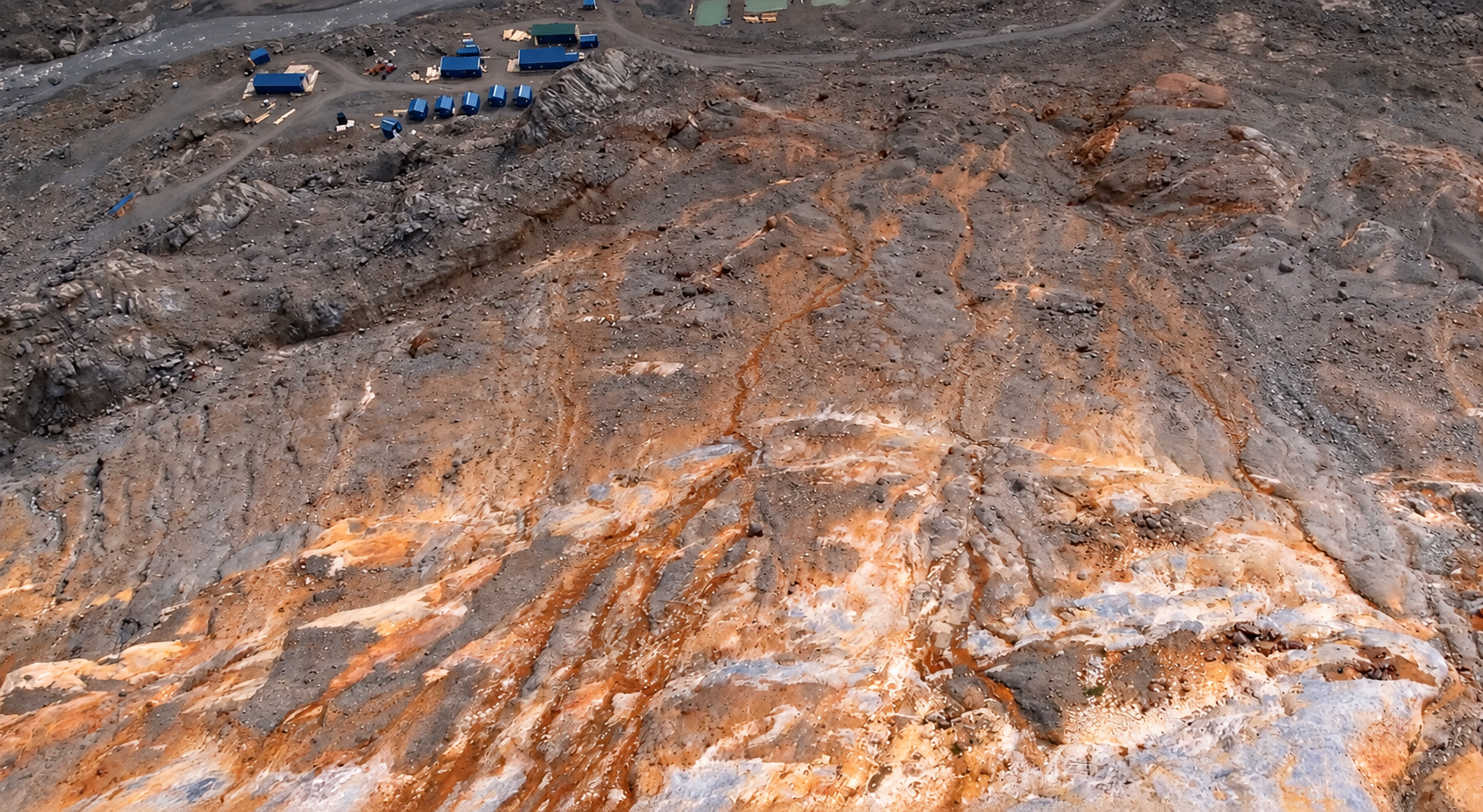
Tudor Gold's Perfectstorm drilling at Treaty Creek shows repeatable porphyry & gold intervals; orientation, true widths & continuity are still open.
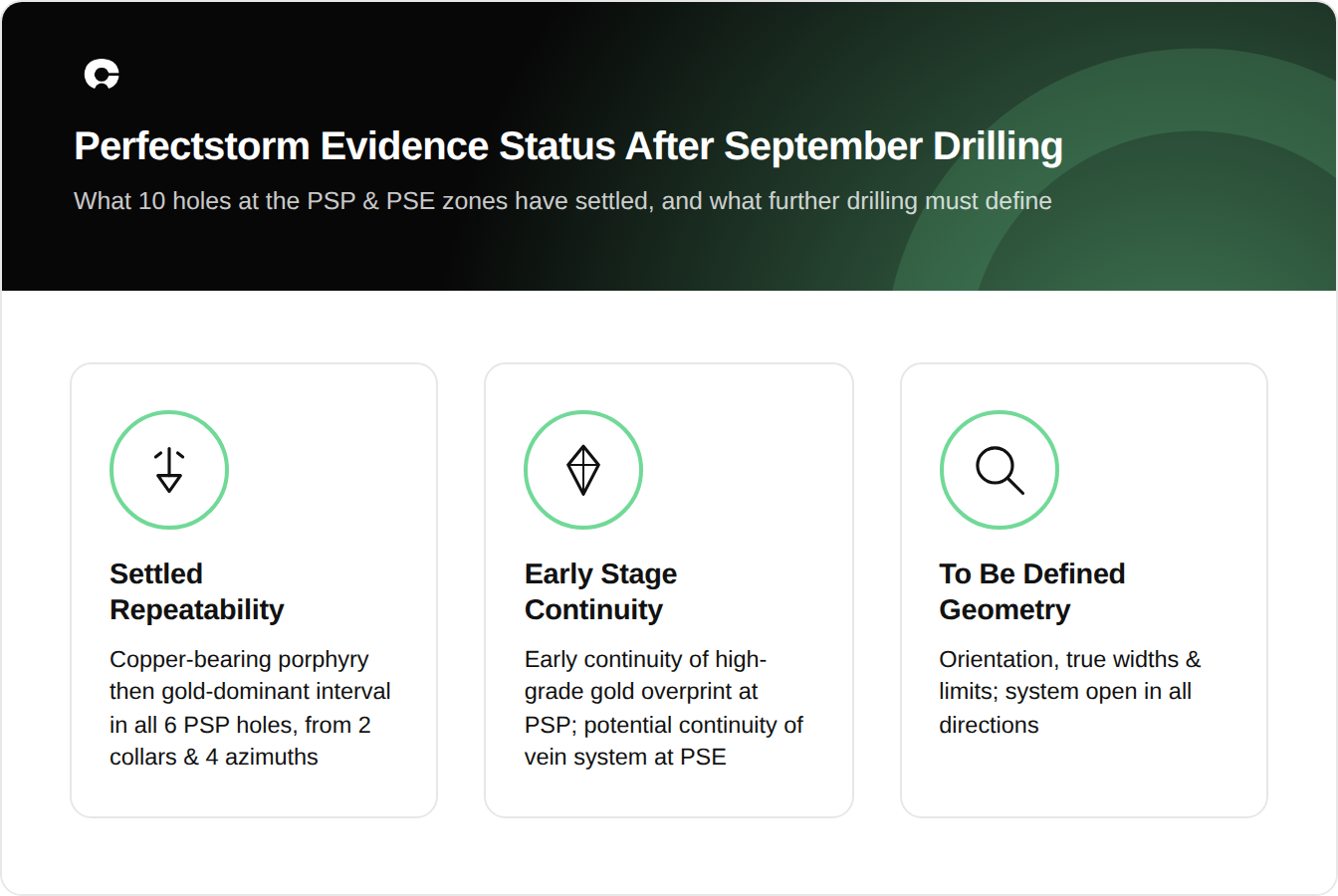
- All 6 holes drilled into the Perfectstorm porphyry zone at Treaty Creek cut a copper-bearing porphyry interval followed downhole by a gold-dominant interval, a sequence that held across 2 collars and 4 drilling azimuths.
- Gold was assayed by PhotonAssay at a laboratory independent of the company, with blanks, certified standards, and duplicates each inserted every 20 samples.
- Orientation and true widths have not been determined, so every reported interval is a drilled length, not a measured thickness.
- Tudor Gold describes continuity as early for the high-grade gold overprint in the porphyry zone and as a potential feature of the near-surface epithermal zone.
- The 4 follow-up holes testing surface samples of up to 13.54 grams per tonne of gold, 1.2 kilometers northwest of current drilling, are awaiting assay results, with 2 drills still active at Perfectstorm.
What Has Happened
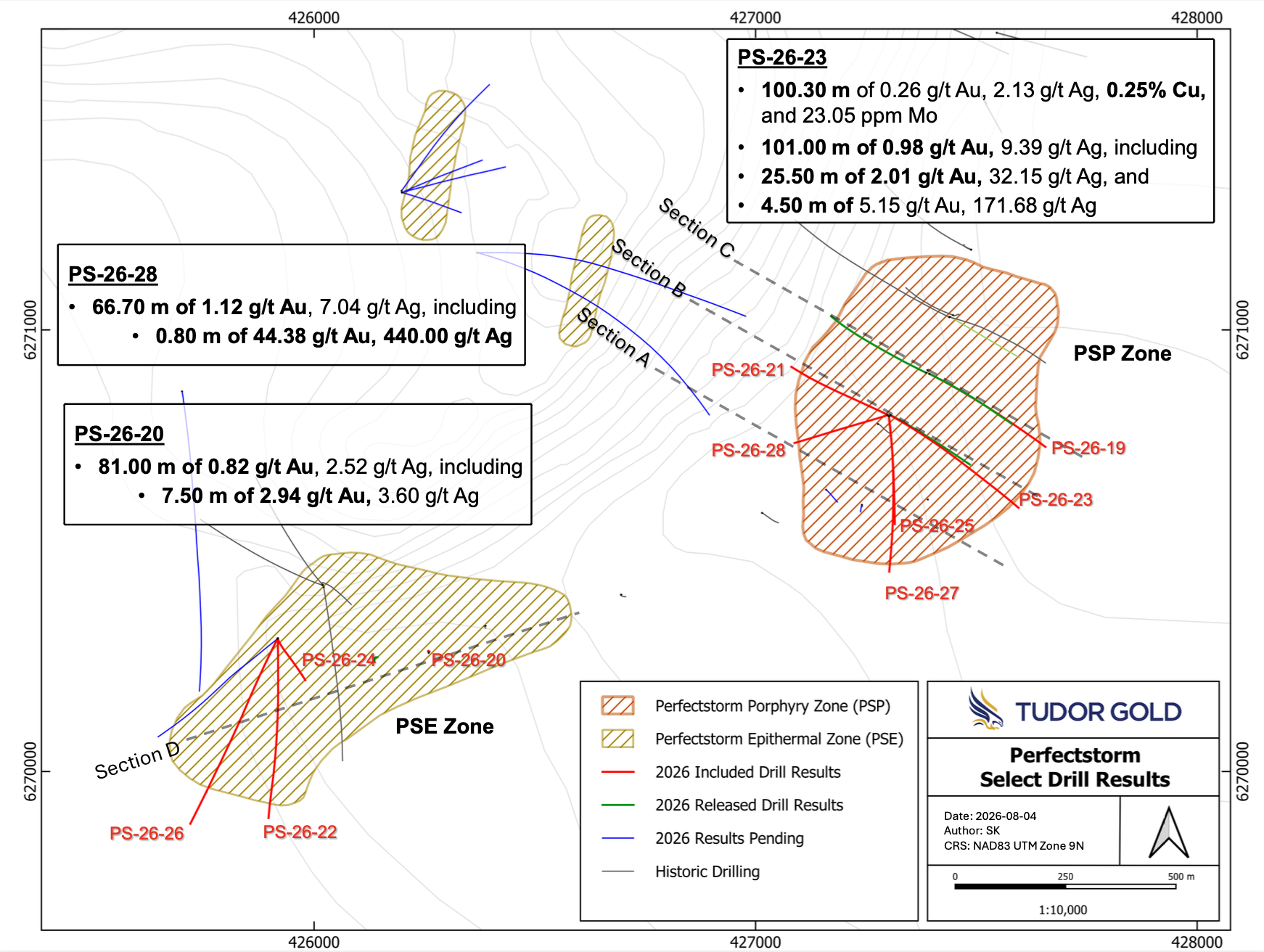
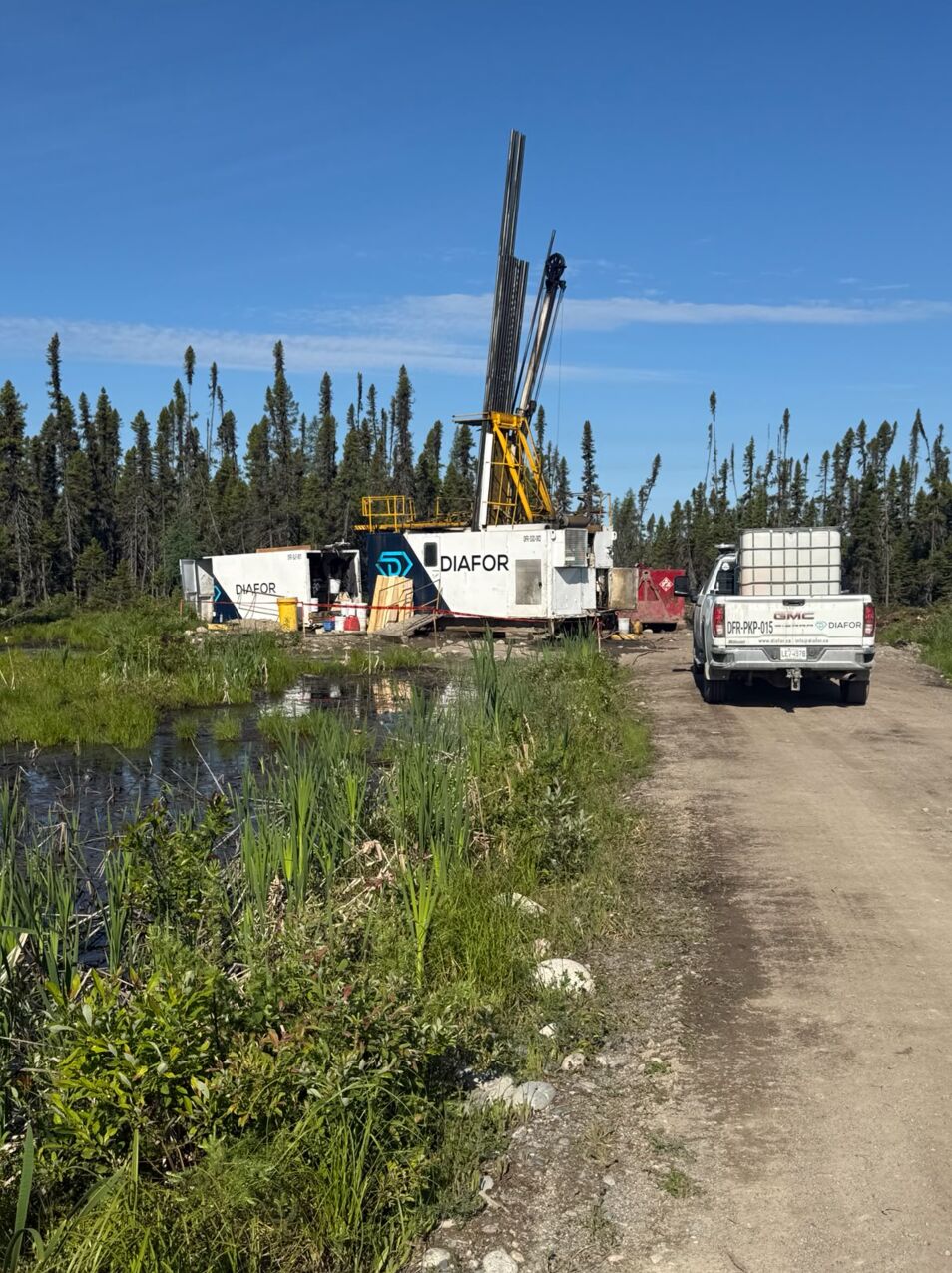
Tudor Gold Corp. (TSXV: TUD | Frankfurt: H56) reported assays on September 17, 2026, from 10 holes at the Perfectstorm Zone of its 80%-owned Treaty Creek Project in British Columbia's Golden Triangle. Of those, 6 tested the copper-gold-silver-molybdenum Perfectstorm Porphyry Zone (PSP Zone), and 4 tested the Perfectstorm Epithermal Zone (PSE Zone), a gold-dominant vein system about 550 meters to the southwest.
A 10-hole program does not answer every question about a discovery at this stage. It answers some firmly and leaves others to the 2 drills still working the zone.
What the Drilling Has Settled
Every PSP hole intersected a copper-bearing porphyry interval hosted in potassic-altered diorite, with drilled lengths ranging from 22.50 to 100.30 meters and copper grades of 0.14% to 0.29%. Every PSP hole then continued downhole into a gold-dominant interval. The longest porphyry intercept, 100.30 meters of 0.25% copper, 0.26 grams per tonne gold and 23.05 parts per million molybdenum from 166.50 meters, was followed in the same hole by 101.00 meters of 0.98 grams per tonne gold and 9.39 grams per tonne silver from 293.50 meters. A second hole followed 96.10 meters of 0.19% copper with 41.90 meters of 1.07 grams per tonne gold from 369.10 meters. A hole from a separate collar followed 89.65 meters of 0.26% copper with 22.50 meters of 0.89 grams per tonne gold from 279.00 meters.
The second settled point is that the sequence does not depend on a single drilling direction. Of the 6 PSP holes, 5 were collared from a single pad and drilled at azimuths of 115°, 170°, 250° and 295°, at dips of -45° to -60°. The sixth was drilled from a second collar to the northeast. The pair of holes drilled in opposite directions from the shared pad, at 115° and 295°, both intersected the porphyry-then-gold order.
The third settled point is the assay basis. HQ and NQ core was sawn in half and typically sampled at 1.5-meter intervals, prepared at MSA Labs in Terrace, British Columbia, and assayed at its laboratory in Langley, British Columbia. Gold was measured by PhotonAssay; other elements by 4-acid digestion followed by inductively coupled plasma mass spectrometry; and samples above 10 parts per million gold were analyzed to extinction. Tudor Gold personnel inserted blanks, certified standards, and duplicates every 20 samples, and MSA Labs, whose quality system complies with ISO 17025 and ISO 9001, is independent of the company.
What Remains to Be Defined
Geometry is the largest open item. All reported intervals are drilled intercept lengths, and Tudor Gold states that true widths have not been determined because the mineralized body remains open in all directions. Further drilling is required to establish the orientation of the mineralized body and its true widths. A 101.00-meter drilled interval does not yet convert into a known thickness, since the angle between the holes and the mineralized body is unknown.
Continuity is the second open item, and the company grades it carefully. In the PSP Zone, Tudor Gold describes continued higher-grade intercepts as demonstrating early continuity of a high-grade, gold-dominant overprint on the porphyry. In the PSE Zone, a near-vertical hole intersected 81.00 meters of 0.82 grams per tonne gold and 2.52 grams per tonne silver from 78.00 meters downhole. A further 3 holes from a shared collar to the west cut several higher-grade gold-dominant intervals that the company says confirm "the potential continuity" of the vein-hosted system. Both terms mark continuity as the next feature to be demonstrated by drilling.
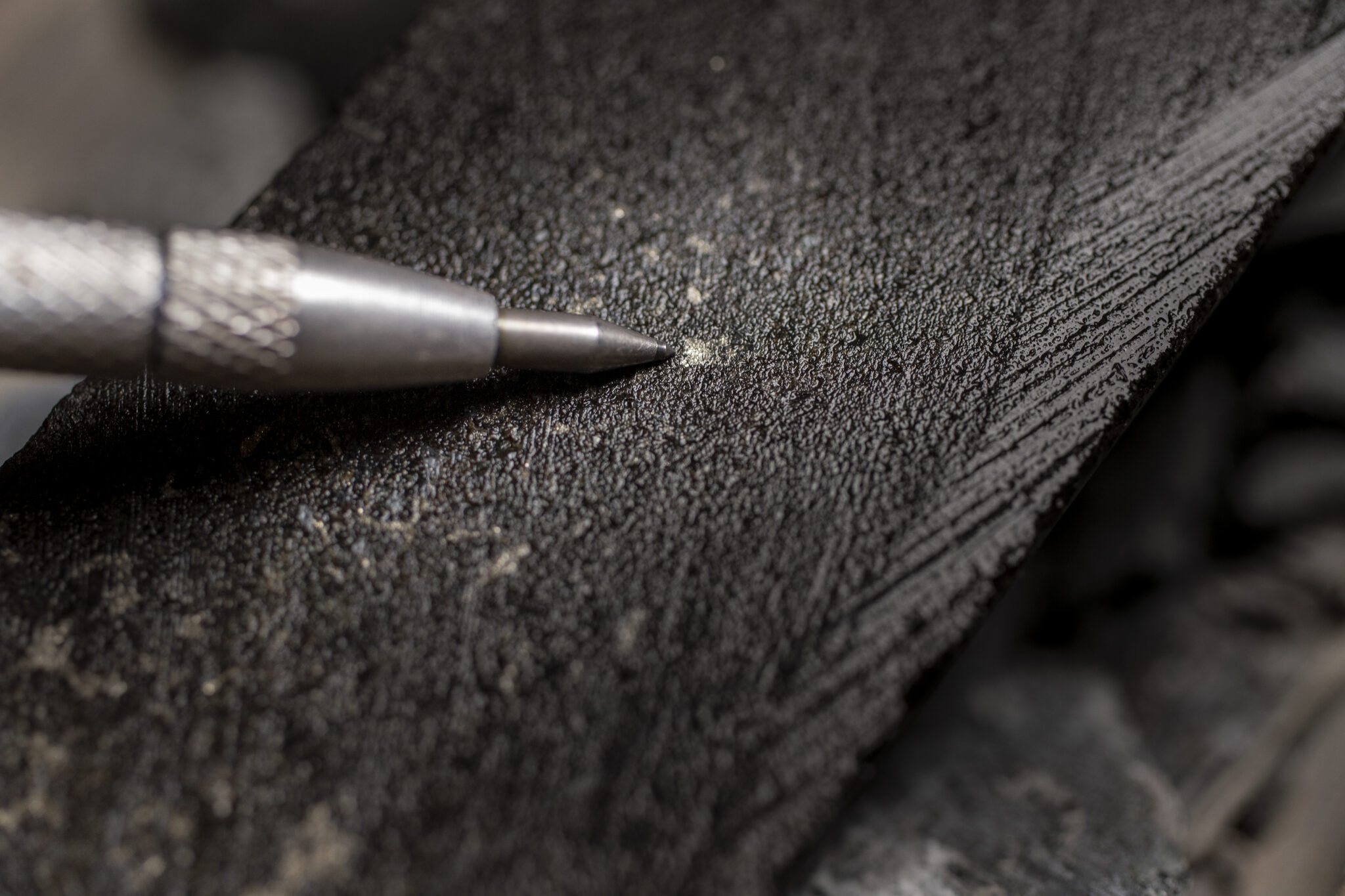
Grade distribution is the third. All assays are reported uncut. One hole's 66.70 meters of 1.12 grams per tonne gold includes 0.80 meters of 44.38 grams per tonne gold and 440.00 grams per tonne silver. The 101.00-meter gold interval described above includes 4.50 meters of 5.15 grams per tonne gold and 171.68 grams per tonne silver. With uncut values and undetermined widths, the balance between narrow, high-grade zones and broader, lower-grade gold across the system remains to be defined by further drilling.
Tudor Gold's Working Interpretation
The company's own reading of the results is geological. Tudor Gold describes the PSP Zone as a recently discovered copper-gold-silver-molybdenum porphyry and states that the porphyry intrusion lies between higher-grade intervals of gold-dominant mineralization, an arrangement it compares with that of the neighboring Goldstorm Deposit. In the PSE Zone, the company describes the broad near-surface intercept as gold-dominant epithermal vein-hosted mineralization that adds to the volume of the previously identified system.
That interpretation is still a working model, and the open items above are the tests it faces. A pair of holes gives an early indication of how the model handles variation. One returned 11.50 meters of 3.51 grams per tonne gold from 173.00 meters, above its porphyry interval, as well as 66.70 meters of 1.12 grams per tonne gold below it. The other returned 2 separate gold-dominant intervals below its porphyry interval: 17.50 meters at 1.13 grams per tonne gold from 290.00 meters, and 32.00 meters at 0.89 grams per tonne gold from 411.00 meters.
Broader Context
Perfectstorm is one of several discoveries at Treaty Creek outside the Goldstorm Deposit, alongside the CBS and Eureka zones. Goldstorm hosts Indicated Mineral Resources of 24.9 million ounces of gold, 148.7 million ounces of silver and 3.048 billion pounds of copper, per an NI 43-101 technical report dated November 30, 2025. A preliminary economic assessment (PEA) on underground production at Goldstorm is underway, and Tudor Gold has filed a permit application for an underground ramp to drill the high-grade SC-1 Zone.
The PSP Zone lies about 1 kilometer southwest of Goldstorm at its closest point and 4 kilometers northeast of Seabridge Gold's Iron Cap Deposit. It is on the northeast-southwest Sulphurets corridor, which hosts multiple porphyry deposits and prospects. The 17,913-hectare Treaty Creek Project borders Seabridge Gold's KSM property to the southwest and Newmont Corporation's Brucejack Mine property to the southeast.
What to Watch Next
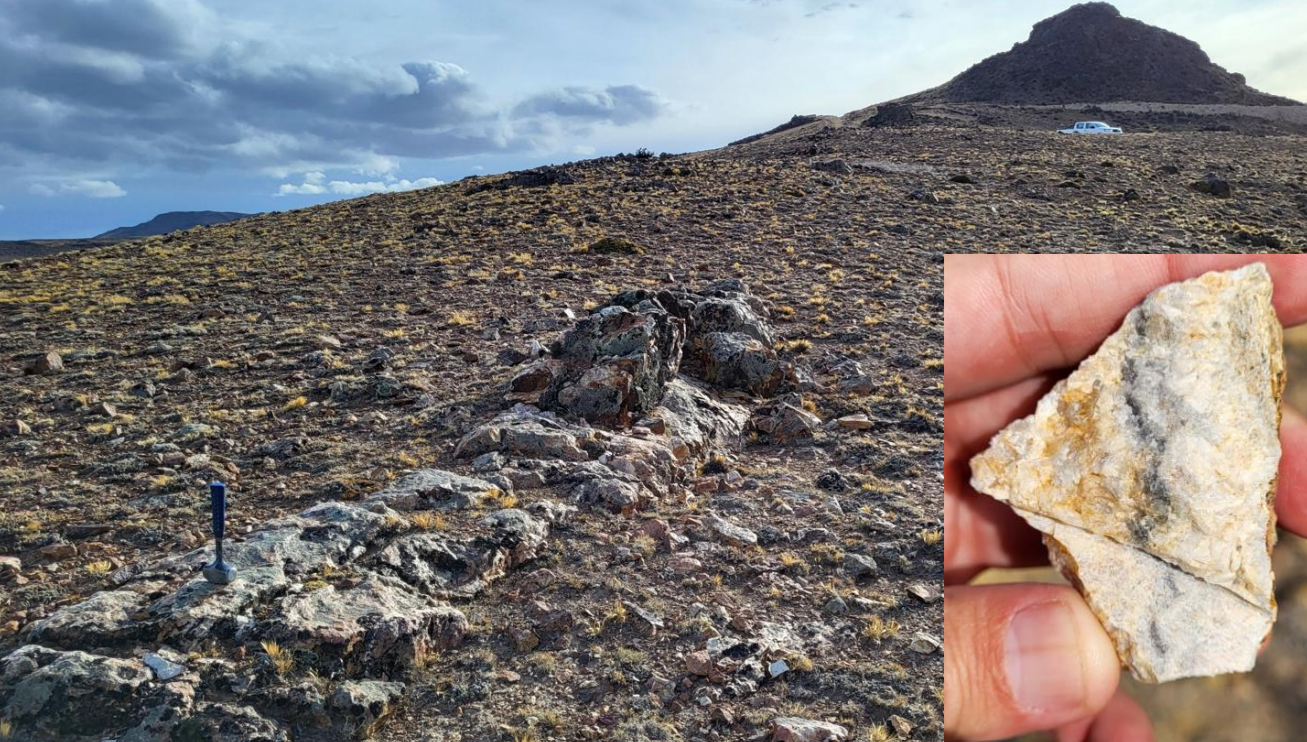
One set of pending results comes from outside the current drill pattern. Surface sampling 1.2 kilometers northwest of current Perfectstorm drilling returned up to 13.54 grams per tonne gold, and Tudor Gold has drilled 4 near-surface holes to follow up, with results to be reported on receipt. Further 2026 holes at Perfectstorm, including holes in 2 target areas north of the PSE Zone, also have results pending.
The 2 drills active at Perfectstorm focus on priority target areas identified by recent results, and each new result can be evaluated against the open items. Holes from new collars, at new angles, will bear on orientation and true width, while holes drilled between existing intercepts will test continuity. Step-outs beyond the current footprint, including the 4 northwest follow-up holes, will bear on the limits of a system Tudor Gold describes as open in all directions.
FAQs (AI-Generated)
Analyst's Notes





Subscribe to Our Channel




Stay Informed






















