2027 Delineation Drilling Is ATHA's Stated Path to a Potential 12-Month Re-Rating


ATHA Energy ties a potential 12-month re-rating to delineation drilling at Angilak in 2027, with no discovery or financing built into that view.
- Management links a potential re-rating within 12 months to the execution of drill programs at Angilak.
- ATHA raised C$63 million in the first quarter of 2026, enough for a 24-month runway.
- The 2026 program expanded Eastern Limb strike length from 1.45 kilometers (km) to 3.4 km.
- ATHA plans to move into a delineation phase in 2027.
- ATHA's enterprise value was C$349.5 million on October 5, 2026.
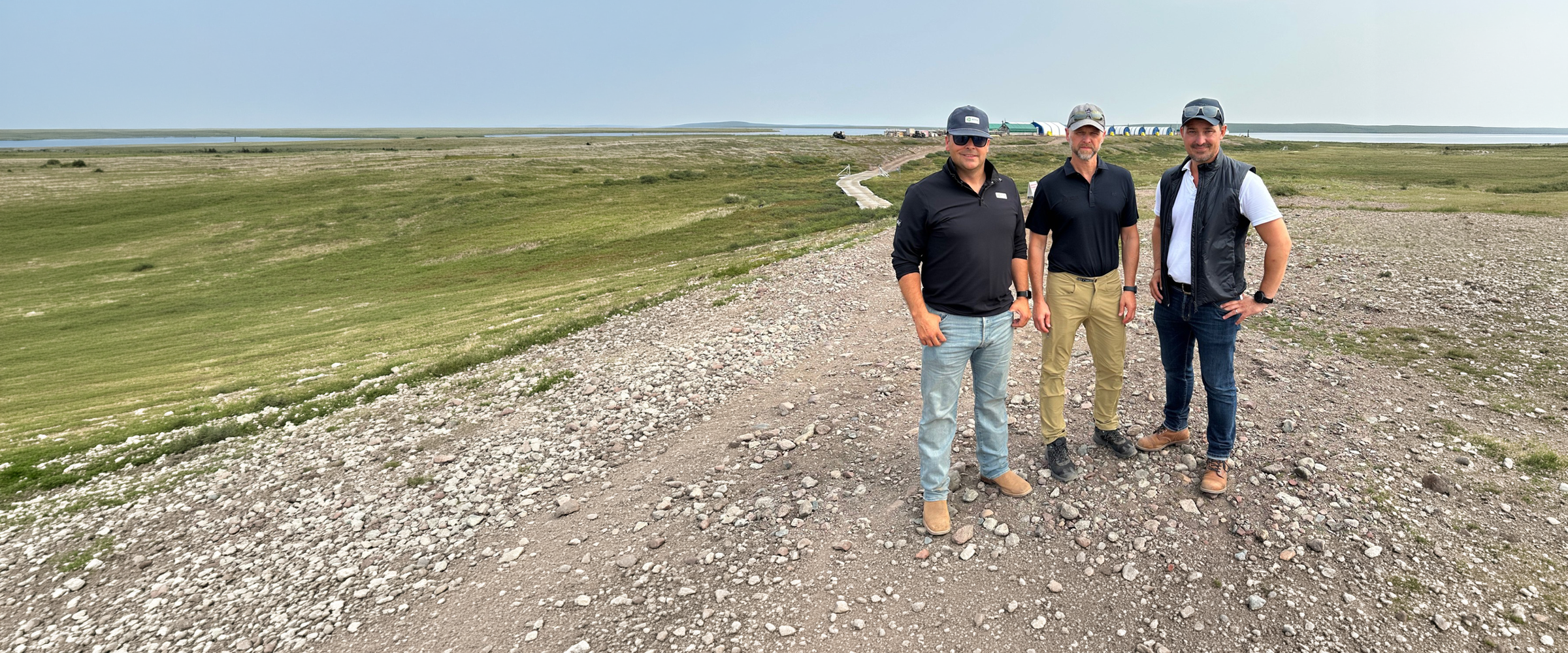
ATHA Energy (TSXV: SASK | FRA: X5U | OTCQX: SASKF) has completed drilling that has outlined continuity at its 100%-owned Angilak Uranium Project in Nunavut, and its next stage at Angilak is delineation in 2027. Management ties the company's chance of a re-rating over the next 12 months to that drilling. ATHA has no known mineral resources at Angilak yet.
A Re-Rating Case Built on Drilling
ATHA's 12-month re-rating case requires no new financing, according to management. The company raised C$63 million in the first quarter of 2026 to scale up its work at Angilak, and the raised funds provide a 24-month runway.
Chief Executive Officer of ATHA Energy, Troy Boisjoli, lists what a re-rating within the next 12 months would and would not depend on:
"The opportunity for us to re-rate within the next 12 months, materially re-rate, in line with more mature peers. Importantly, it is not predicated on a discovery, and it's not predicated on a financing. It's predicated on us continuing to execute drill programs and work."
ATHA's move to delineation in 2027 falls inside that 12-month window.
The raise followed the 2024 transactions that brought the Angilak Uranium Project into ATHA, after which the company set out to address discovery risk. It made discoveries across 2024, 2025, and 2026, and in 2026 it moved on to building out continuity at the RIB area.
From Continuity to Delineation in 2027
The 2026 Angilak Exploration Program has concluded, connecting the RIB North and RIB East discoveries. Mineralized strike length on the Eastern Limb of the Mineralized RIB Corridor grew from 1.45 kilometers (km) to 3.4 km, with 21 of 23 diamond drill holes intersecting uranium mineralization along the corridor. Holes in the RIB North area were spaced 150 to 300 meters apart, with continuous mineralization along the trend. The 2026 work followed up the 2025 program, when 4 discoveries (RIB North, RIB East, RIB West, and RIB South) were identified across a 12-km strike, with every hole drilled intersecting mineralization.
Boisjoli dates the move from continuity work to the next phase:
"We're then moving into a delineation phase in 2027 to underwrite ourselves with asset growth and resource growth."
Continuity of mineralization leads to delineation in ATHA's plan, and delineation is the phase the company links to resource growth. The 2026 results are preliminary radioactivity readings, and assay samples from the 2026 holes have been submitted for laboratory analysis. The Eastern Limb remains open and unconstrained for potential future northeast step-outs.
Where ATHA Sits Among Uranium Peers
As of October 5, 2026, ATHA had 353.1 million basic shares outstanding at a share price of C$1.01, a basic market capitalization of C$357.0 million, and an enterprise value of C$349.5 million. Enterprise value is market capitalization adjusted for debt and cash, a common yardstick for comparing explorers. Management benchmarks ATHA against resource-stage Canadian peers on enterprise value per pound of uranium. Beyond the basic shares, ATHA had 27.6 million options, 3.4 million restricted share units, and 18.1 million warrants outstanding, and a convertible debenture equal to 10.5% of its capital on a partially diluted basis.
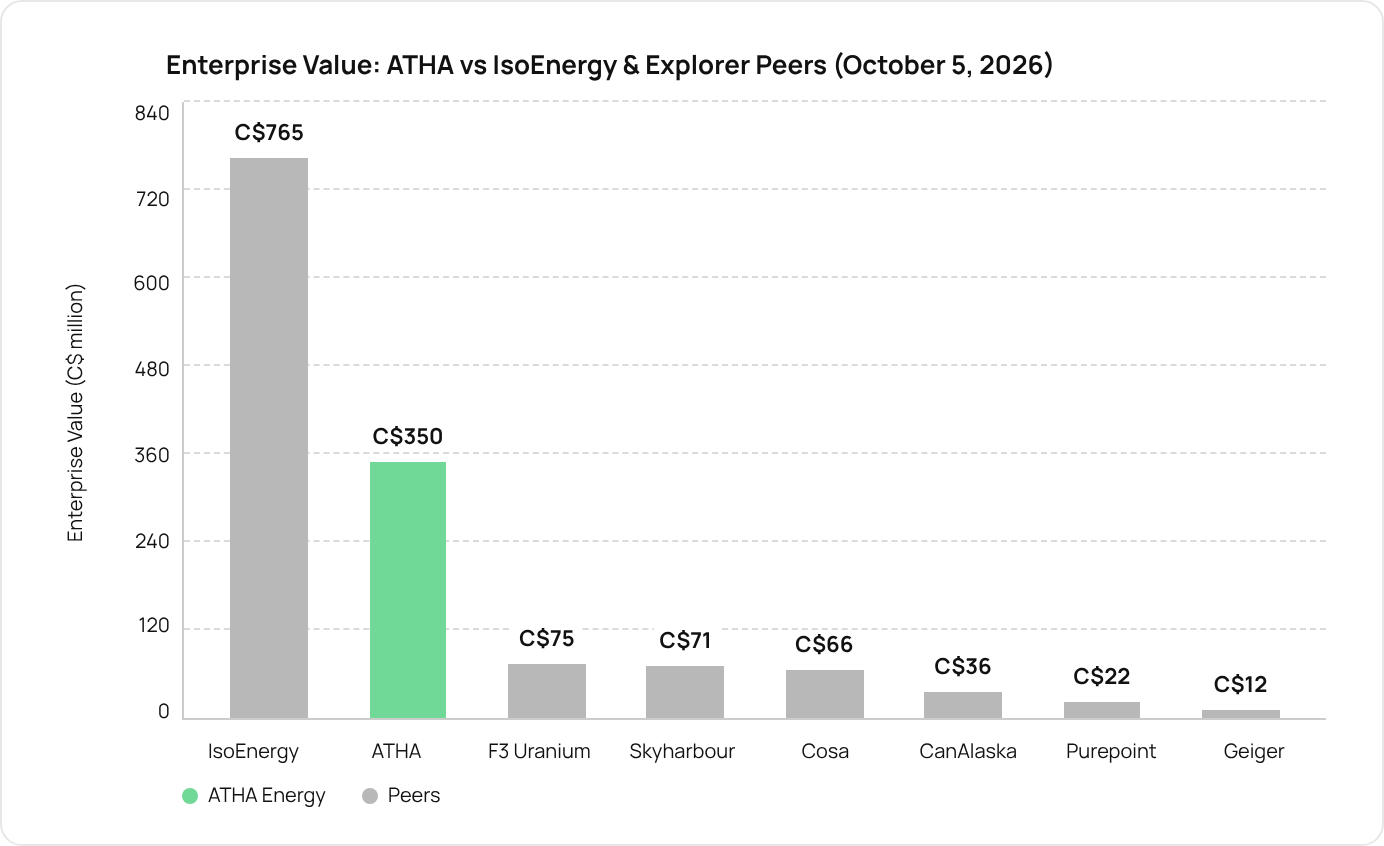
At C$350 million in its October 5, 2026 peer comparison, ATHA's enterprise value is above every other explorer in the group and below every developer. The developers are NexGen at C$8,539 million, Paladin at C$4,229 million, Denison Mines at C$3,617 million, and IsoEnergy at C$765 million.
The explorers start at C$75 million for F3 Uranium and C$71 million for Skyharbour, then C$66 million for Cosa, C$36 million for CanAlaska, C$22 million for Purepoint Uranium, and C$12 million for Geiger Energy.
A Team That Has Taken a Project to Feasibility
ATHA's team brings experience from discovery through to production at McArthur River, Cigar Lake, Eagle Point, and Arrow, among the largest uranium mines and deposits in Canada. ATHA places its own projects at the concept, exploration, and discovery stages, while the team's earlier work spans feasibility, development, startup, and depletion.
Boisjoli came up through Cameco, where he was chief geologist at an operating mine, before joining NexGen Energy, where the job covered both people and project:
"Built that team, led the development of that project from maiden resource through to feasibility."
At Angilak, the 2027 delineation program comes before any maiden resource.
What Delineation Has to Deliver
As of October 7, 2026, ATHA planned to release preliminary results from the Lac 50 Deposit Corridor, where 2026 drilling tested a 4-km step-out to the northwest of the Lac 50 Deposit Model. The Lac 50 Exploration Target Model has a conceptual exploration target of 60.8 million to 98.2 million pounds at an average grade range of 0.37% to 0.48%. The target is conceptual in nature, and it is uncertain if further exploration will result in it being delineated as a mineral resource. ATHA enters 2027 with 3.4 km of continuity outlined on the Eastern Limb and the C$63 million raise carried into a 24-month runway.
FAQs (AI-Generated)
Analyst's Notes





Subscribe to Our Channel





Stay Informed