




Chile's Copper Output Falls Short of Growth Expectations, Testing Future Copper Supply


Chile's slowing copper production highlights longer-term supply risks as declining ore grades shift investment toward new copper districts.
- Chile's largest private copper producer reported first-half output down 9.5% year over year, while the country's largest state producer indicated future production is likely to remain near current levels rather than reach its long-standing growth target.
- A winter storm disrupted operations across Chile's copper belt this month, but rising capital intensity and declining ore grades point to a multi-year constraint on Chilean copper production.
- A pending Cochilco audit into Codelco's 2025 production reporting adds a governance risk that could influence how the market interprets Chile's recent production data.
- Exploration and development capital is shifting toward copper projects in Quebec, the Vicuña district, the Yukon, and South Australia as producers seek new sources of future supply.
- Projects positioned to offset slower Chilean supply growth fall into three categories: extension drilling near existing infrastructure, new porphyry discoveries in emerging districts, and past-producing assets advancing toward restart, each offering different development timelines and execution risks.
Weaker Chilean Output Raises the Risk of a Copper Production Plateau
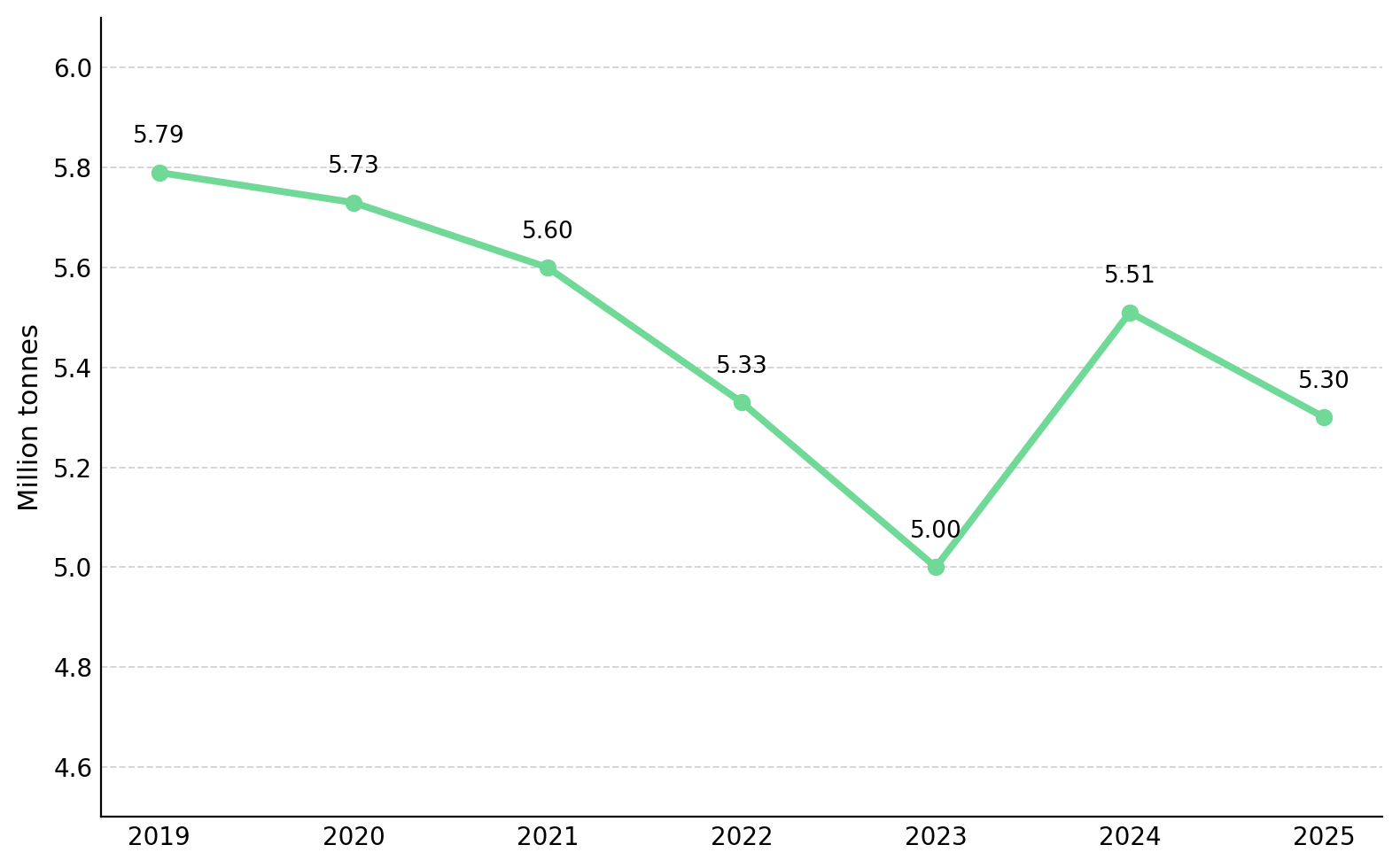
Two of Chile's largest copper producers reported weaker-than-expected production updates within days of each other in July 2026. Antofagasta, Chile's largest private copper producer, reported first-half 2026 copper output down 9.5% year over year. Around the same time, Codelco's chairman told a congressional committee that production is likely to remain near its 2025 level of 1.33 million tonnes rather than reaching the company's long-standing target of 1.7 million tonnes by 2030, strengthening the case that Chile's copper production growth is slowing.
The production updates coincided with an atmospheric river storm that disrupted operations across Chile's copper belt. Codelco estimated the storm reduced output at its El Teniente underground mine by approximately $7.5 million per day. While weather disrupted near-term production, rising capital requirements and declining ore grades were already increasing the cost of replacing output from Chile's aging deposits and will continue to do so long after the storm passes.
The key question is whether the recent production data reflects a temporary weather disruption or indicates that Chile, which supplies roughly one-quarter of global mined copper, has reached a production plateau driven by aging deposits and declining ore grades. If production growth is slowing for geological rather than weather-related reasons, replacing Chilean supply becomes more capital-intensive and increasingly dependent on new mining districts.
Declining Ore Grades Constrain Chile's Copper Supply Beyond Weather Disruptions
Chile's largest copper deposits are aging porphyry systems, where declining ore grades are increasing the cost of maintaining production. Miners must move and process more rock to produce the same amount of copper, raising operating costs and sustaining capital requirements. Global sulfuric acid shortages have further increased processing costs for Chile's oxide ores, reinforcing the pressure on project economics. Separately, Cochilco's pending audit of Codelco's 2025 production introduces a governance risk after questions over the reporting of approximately 20,000 tonnes of copper.

Marimaca Copper reported July 2026 step-out drilling results from the Pampa Medina prospect, located 28 kilometers east of its Marimaca Oxide Deposit in Chile's Antofagasta Region. The drilling extended a high-grade bornite-chalcocite zone with intercepts including 6.11% copper and 24.0 grams per tonne silver over narrow widths. The program also intersected copper mineralization in basement metasediments for the first time, expanding the exploration target beyond the known mineralized zone. Hayden Locke, Chief Executive Officer of Marimaca Copper, outlines the limited pipeline of scalable copper projects:
"In the copper space, there aren't any juniors with significant-scale development assets that can come into production. We don't see too many peers in the copper space. They're either too small in terms of production, or they're far too big to finance."
Fitzroy Minerals reported additional drilling results from its Buen Retiro project near Copiapó, Chile, and expanded its 2026 drill program to approximately 22,000 meters. The company reported near-surface intercepts of 59.0 meters grading 1.73% copper, with a higher-grade core of 12.0 meters at 5.39% copper. The company is also evaluating a lower-capital development route by producing a copper sulfate concentrate at the project site and trucking it to an existing third-party electrowinning plant, rather than constructing a standalone processing facility. Management said the approach could reduce capital expenditure and shorten permitting timelines compared with developing a conventional heap leach and solvent extraction-electrowinning operation. Merlin Marr-Johnson, President and Chief Executive Officer of Fitzroy Minerals, explains Chile's constrained copper supply outlook and pricing:
"BHP's reports say Escondida is going to spend approximately $5 billion, and the production profile in 2030 is likely to be 1 million tonnes per annum, down 20%, maybe even 30%, from where they are today. BHP also says there's going to be zero growth from Chile from 2031 to 2040. All of this goes to show that copper prices have to materially re-rate."
Chile's Supply Constraints Shift Copper Exploration Beyond Mature Mining Districts
As production growth slows at Chile's established copper operations, exploration and development capital is shifting toward projects in Quebec's Abitibi Greenstone Belt, the Vicuña district spanning Argentina and Chile, South Australia's copper provinces, and the Yukon's Minto-Carmacks Belt. The shift reflects the need to identify new sources of copper supply as expansion opportunities at mature mining districts become more limited. Global copper production remains concentrated in a small number of mature mining districts, prompting major producers to invest in new jurisdictions to replace reserves and support future production growth. Recent investments by major mining companies into junior explorers highlight that trend, with capital increasingly directed toward new discoveries rather than expansions at existing operations.
Abitibi Metals reported a 2026 mineral resource estimate for its B26 polymetallic deposit in Quebec, increasing resource tonnage by 124% since 2023. The updated resource totals 25.3 million tonnes, comprising 13.0 million tonnes of Indicated resources at 2.1% copper-equivalent (CuEq) and 12.4 million tonnes of Inferred resources at 2.2% CuEq. The company also acquired its joint-venture partner's remaining interest to consolidate 100% ownership of the deposit and is funding an 80,000-metre drill program across 2026 and 2027. Jon Deluce, Founder and Chief Executive Officer of Abitibi Metals, highlights growing demand for quality copper development projects:
"Quebec is a very sought-after jurisdiction. A lot of the multi-million-ounce-equivalent developers have been taken over over the last two years, and I don't think this M&A will stop. There are very few multi-million-ounce developers available in the market, and producers are printing record levels of cash flow while they're still behind the eight ball on replenishing exploration and development targets."
Mogotes Metals signed a binding term sheet with Rio Tinto in July 2026 covering its Filo Sur project in the Vicuña district. The Filo Sur project lies immediately along strike from BHP and Lundin Mining's Filo del Sol discovery, while drilling at the Albor target returned an intercept of 180.0 meters grading 0.98% CuEq. Under the agreement, Rio Tinto will acquire an initial equity interest through a private placement and receive a period of exclusivity over the project. The transaction brings one of the world's largest mining companies into the project during the exploration stage. Allen Sabet, Chief Executive Officer of Mogotes Metals, emphasizes the scarcity of world-class copper discoveries attracting interest:
"There have been no other large discoveries like Filo in the last 30 years. When you start to clip into something like that, it attracts interest regardless of whether you want it or not."
Restart Projects & New Discoveries Expand Future Copper Supply
Beyond new discoveries, existing projects with permits, processing infrastructure, and established mine sites offer another source of incremental copper supply. These assets can often return to production more quickly than greenfield developments because much of the required infrastructure and permitting is already in place. Byproduct credits from gold, silver, and molybdenum can further reduce net copper production costs, improving project economics as operating costs continue to rise across Chile's mature mining districts.
Selkirk Copper reported progress on its Phase 2 drill program at the past-producing Minto project in Yukon, Canada, as it advances the project toward a restart decision. The project includes an existing 4,100-tonne-per-day mill and underground infrastructure from its previous operation. The company also eliminated a legacy precious-metals stream and concentrate offtake through bankruptcy proceedings, improving the project's expected cash flow. It has completed 27,300 meters of its planned 50,000-meter Phase 2 drill program and expects to complete an updated mineral resource estimate and a Preliminary Economic Assessment (PEA) this month.
Cobra Resources reported drilling results from its Manna Hill project in South Australia's Nackara Arc and exercised its option to acquire the project in July 2026. The four-hole diamond drill program intersected bornite-rich mineralization associated with porphyry diorite and monzonite intrusions. The company also identified a correlation between the mineralization and an inversion-modelled magnetic anomaly, providing a geophysical target that can be tested across the remainder of the license.
Production Guidance, Audit Results, & Output Trends Will Test Chile's Copper Outlook
Three measurable indicators over the next two quarters will determine whether Chile has entered a production plateau or is simply recovering from a one-quarter weather disruption. The first is the outcome of Cochilco's pending audit of Codelco's 2025 production, due in September 2026. The second is whether Chile's major state-owned and private producers continue lowering production expectations relative to their previous multi-year targets after storm-related disruptions have passed. The third is whether additional Chilean producers reduce production guidance during the next reporting cycle. Similar revisions across multiple companies would support the broader trend indicated by BHP's capital-intensity data and Cochilco's industry analysis rather than company-specific operational issues.
Even if this quarter's storm-related production shortfall proves temporary, the ore-grade decline and rising cost pressures identified by Cochilco and BHP are unlikely to reverse within a single quarter. The next two quarters should clarify whether Chile is returning to its previous production trajectory or entering a period of slower supply growth. Against that backdrop, exploration, restart, and development projects across multiple jurisdictions will become increasingly important to global copper supply as producers seek new sources of future production.
The Investment Thesis for Copper
- Weather disruptions may prove temporary, but declining ore grades at incumbent producers are a multi-year constraint on production growth.
- Development-stage projects that expand high-grade resources near existing infrastructure can advance toward production more quickly than greenfield discoveries requiring new permitting and processing facilities.
- Restart projects with existing permits, mills, and tailings infrastructure can reach a construction decision without the multi-year permitting process required for a greenfield development.
- Byproduct credits from gold, silver, or molybdenum improve project economics independently of the copper price by reducing net production costs, providing a buffer as producers across the industry report rising costs.
- Investments and technical alliances by major diversified miners increasingly support junior explorers advancing projects in emerging copper districts beyond mature mining regions.
- Projects spanning Chile, Quebec, the Vicuña district, the Yukon, and South Australia diversify exposure to permitting, regulatory, and geological risks across multiple mining jurisdictions.
Chile's weak production this quarter is a data point rather than a verdict because, while weather-related disruptions are likely to prove temporary, the ore-grade decline and rising cost pressures identified by Cochilco and BHP will not reverse within a single quarter. The September audit, next quarter's production guidance, and whether additional producers revise their outlooks lower will provide the clearest evidence of whether Chile's production slowdown is becoming more persistent. At the same time, exploration, restart, and development projects outside Chile's mature mining districts are expanding the pipeline of future supply. Whether those projects can offset slower production growth at incumbent operations, rather than this quarter's production figures alone, will determine whether Chile's supply constraints evolve into a broader ceiling on global copper supply.
TL;DR
Chile's recent production slowdown may have been amplified by severe winter weather, but declining ore grades, rising capital intensity, and governance risks suggest broader constraints on future copper supply. As mature Chilean deposits become more expensive to sustain, exploration and development capital is increasingly flowing toward emerging copper districts and restart projects in other jurisdictions. The next two quarters, particularly Cochilco's audit and updated production guidance from major producers, will determine whether Chile returns to its previous growth trajectory or enters a period of slower supply growth with implications for the global copper market.
FAQs (AI-Generated)
Analyst's Notes





Subscribe to Our Channel















Stay Informed


