




Selkirk Copper's First Minto Economics Since 2021 Rest on a Built Mine


Selkirk Copper's first Minto economics since 2021 are targeted for completion this month, and the brownfield base gives the study greater confidence in feasibility.
- Selkirk Copper Mines is targeting completion of an updated Mineral Resource Estimate (MRE) and Preliminary Economic Assessment (PEA) in the second half of July 2026, its first economics on the Minto project since 2021.
- The PEA defines a 12- to 15-year restart processing 4,100 tonnes of ore per day for roughly 30,000 tonnes of copper equivalent a year.
- Management characterises the study as closer to a prefeasibility study than a standard PEA, with vendor quotes, built-out owner rosters and a historical database behind the numbers.
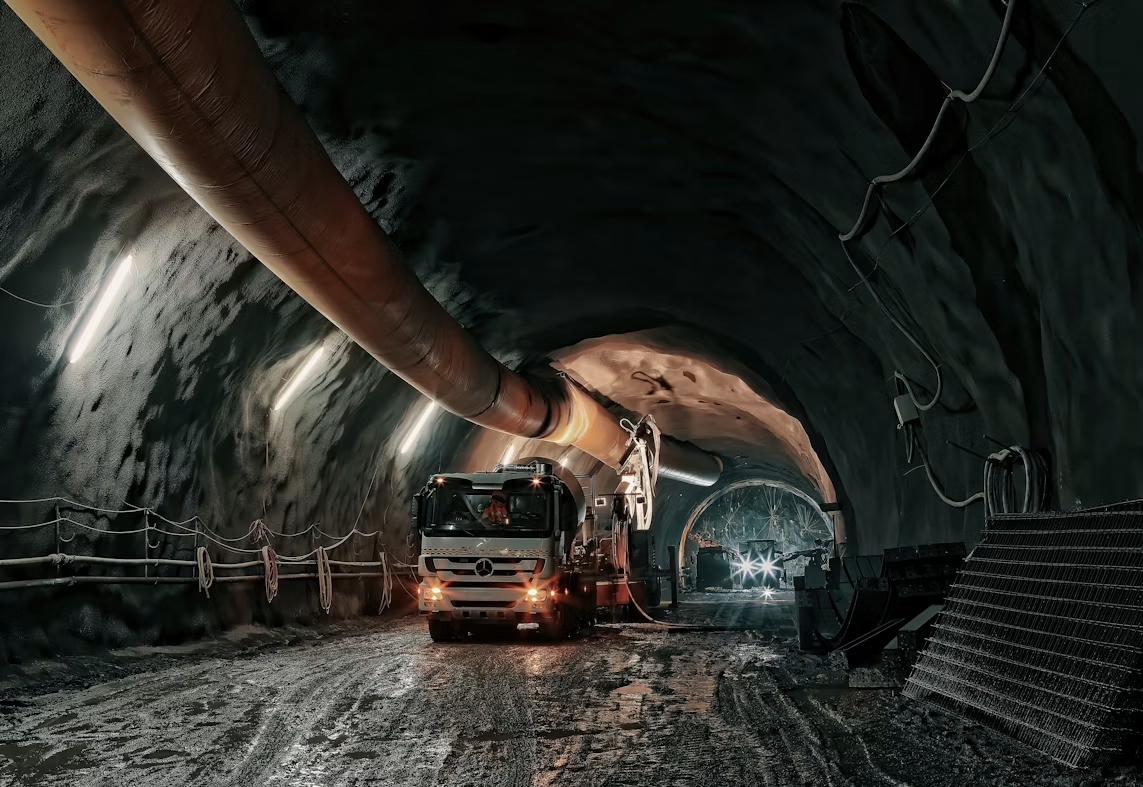
- The existing mill, 400-person camp, grid power, and road access mean most restart engineering is edge work rather than a new build.
- A Feasibility Study (FS) is targeted to start in the third quarter of 2026, with amended permits targeted for October 2026 and a restart decision targeted for mid-2027.
Selkirk Copper Mines (TSX-V: SCMI | OTCQB: SKRKF | FRA: IO20) is weeks away from putting the first set of numbers on its Minto copper-gold-silver restart in central Yukon since 2021. An updated Mineral Resource Estimate (MRE) and Preliminary Economic Assessment (PEA) are targeted for completion in the second half of July 2026, and management's argument, set out in a July 2, 2026, interview, is that the study should be read as carrying more weight than the word "preliminary" in its name suggests. The reason is the asset itself: Minto is a built mine, with a plant, a camp, and grid power already on the ground, which removes much of the engineering guesswork a first-pass study normally leaves open.
The First Minto Economics Since 2021
The July study is the first economic read on Minto since 2021, and it frames a specific restart. The PEA targets a 12- to 15-year mine life processing 4,100 tonnes of ore per day, roughly 1.5 million tonnes a year, to produce about 30,000 tonnes of copper equivalent annually in concentrate. The output averages 18,000 to 22,000 tonnes of copper, 25,000 ounces of gold, and 250,000 ounces of silver per year over the mine life.
The economics are modelled on planning prices of US$4.60 per pound of copper, US$3,300 per ounce of gold, and US$40 per ounce of silver, with an operating cost target near the middle of the cost curve at about US$3 per pound of copper net of byproduct credits. Those inputs set the base case that the market will measure the restart against when the numbers land this month.
The Existing Infrastructure Behind the Restart
What separates Minto from a greenfield project is that most of the plant does not need to be built. The site includes a 4,100-tonne-per-day processing plant, a 400-person full-rotation camp, water treatment facilities, road and barge access, grid power, mobile equipment, and existing open-pit and underground workings. The incremental engineering is focused on additions at the edge, such as a new 3-stage crushing circuit, rather than on a mill or a flotation circuit.
That distinction removes the items that commonly stall developers at this stage. Selkirk does not need to design new roads or power lines, or procure transformers that can run to 36-month lead times, because those are already in place.
President and Chief Executive Officer of Selkirk Copper Mines, M. Colin Joudrie, is direct about how little of the plant has to be built:
"The majority of our engineering work is really focused on modest things. We're not designing a mill or a flotation circuit, it's already there, physically on the ground, and we're doing most of our engineering design work around the edges."
A Study Built on Ground-Up Cost Data
The confidence Selkirk places in the study comes from the quality of its inputs. It draws on actual vendor quotes for some of the equipment and fully built-out rosters for the owner's team, down to individual roles and rotation schedules, alongside a historical database that already characterises the rock's strength and durability, the drill-and-blast requirements, and the metallurgy. Those are the questions a conventional PEA typically estimates, which is why management frames this one as closer to a prefeasibility study (PFS).
Joudrie frames the study's confidence level plainly:
"We've got really good ground-up information on operating costs, and our owner costs are well-informed. It's almost PFS, and maybe even beyond that by modern parlance."
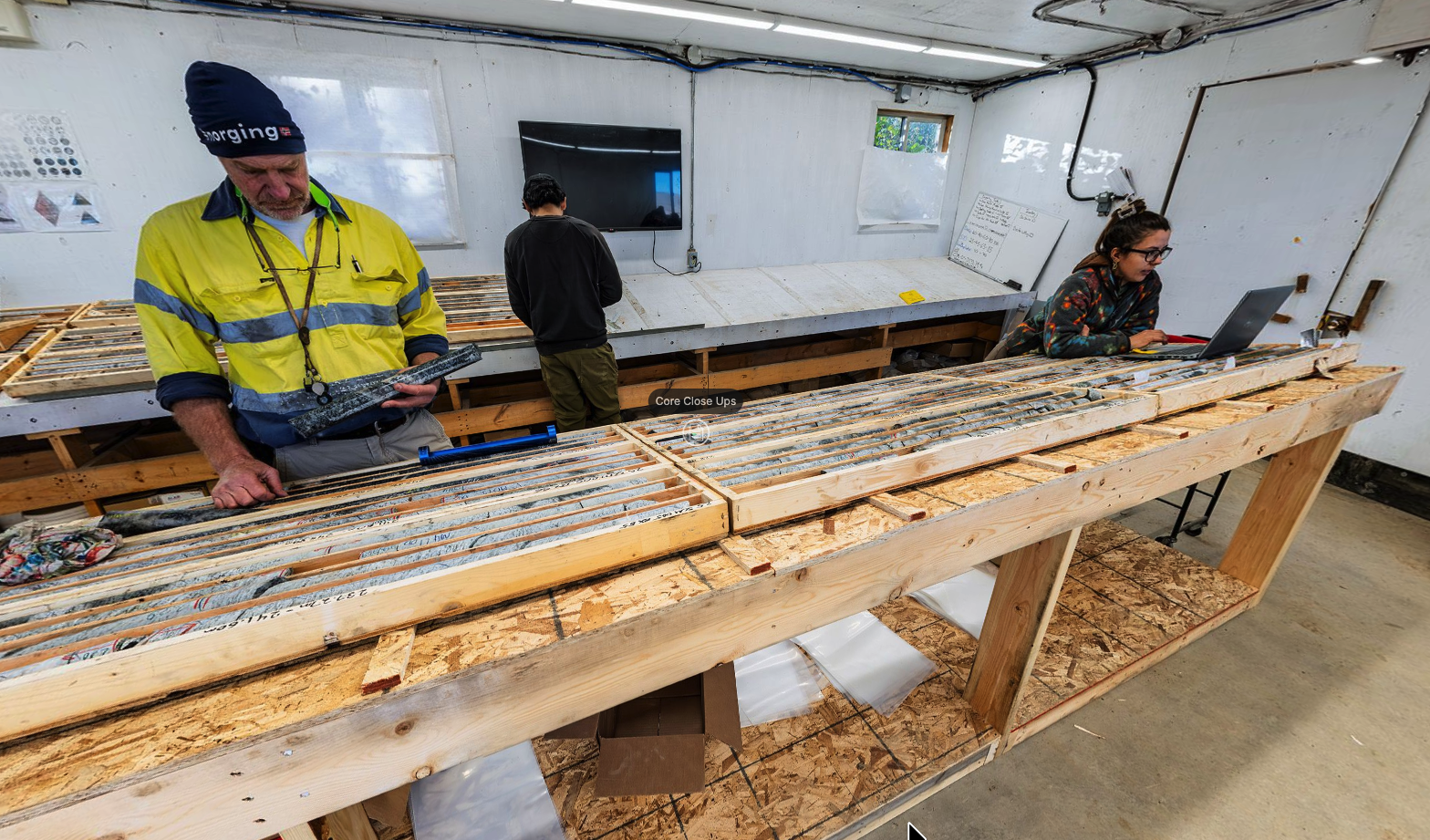
That rigour extends to who is doing the work: the Trade-Off and PEA engineering is being run by Hatch Ltd. and SRK Consulting, both with prior experience at Minto. The resource beneath the study is not new either. The April 2025 MRE holds 12.58 million tonnes indicated at 1.20% copper, 0.46 grammes per tonne gold and 4.27 grammes per tonne silver, plus 23.65 million tonnes inferred at 1.05% copper, 0.39 grammes per tonne gold and 3.90 grammes per tonne silver. A completed 52,288-metre Phase 1 programme hit economic-grade mineralisation in 87% of 175 holes, and the 50,000-metre Phase 2 programme reached 27,300 metres across 104 holes by the end of June, ahead of schedule, adding infill, geotechnical, and geometallurgical data toward feasibility-level mine plans before it concludes in late August or early September.
The Path to a Bankable Feasibility Study
The PEA and MRE feed directly into the next stage. A Feasibility Study (FS) is targeted to begin in the third quarter of 2026, in late August or early September, and to be completed in mid-2027, the same point at which Selkirk is targeting a Final Investment Decision (FID) and, after mill commissioning in the first quarter of 2028, first production in mid-2028.
With the physical questions largely settled, the open item is permitting. Selkirk is reviewing and amending the existing permits against the full 12- to 15-year mine life, targeting submission in October 2026 alongside a restart direction to the Yukon Government and the Selkirk First Nation, the company's controlling shareholder. That approach reflects a deliberate break from the prior operator, which built shorter mine plans around grade and left permit assumptions to be tested in production. Joudrie is precise on where the remaining risk sits:
"They don't have to be as concerned about whether the rock is okay, whether the metallurgy is actually real; those questions are satisfied already. Now it's just about whether we can get the right men and women on the ground at the right time, and whether the permits come in a timely fashion."
The study will show the economics, and the permit file is what turns them into a decision Selkirk can act on.
The Near-Term Sequence
The next few weeks bring the two documents that reset the baseline: the updated MRE and the PEA, both targeted for the second half of July 2026. Each step builds on the one before it, and the PEA is the first point at which the reconfigured asset meets published numbers.
FAQs (AI-Generated)
Analyst's Notes





Subscribe to Our Channel



%20(1).png)


Stay Informed


