




Abitibi Metals' B26 Resource Is Built on US$2,500 Gold While Spot Trades Near US$4,400


Abitibi Metals' B26 resource uses a US$2,500 gold and US$4.50 copper deck, well below spot, and a first-quarter 2027 PEA could reprice the deposit.
- B26 hosts a combined 25.3 million tonnes of resource at over 2.1% copper equivalent in Quebec's Selbaie Mining Camp, up 124% since the 2023 option.
- The resource grades are calculated on a conservative price deck of US$2,500 gold and US$4.50 copper, below prevailing metal prices.
- At spot prices of US$4,400 gold and US$6.30 copper on June 15, 2026, the copper-equivalent grade rises to 2.4% in the indicated category and 2.5% in the inferred category.
- B26 carries an enterprise-value-to-in-situ ratio of 1.1%, against 17% for advanced volcanogenic massive sulphide (VMS) developer Foran Mining and 4% for FireFly Metals.
- A Preliminary Economic Assessment (PEA) and an updated resource are targeted for the first quarter of 2027, funded by a treasury of about C$45 million.
The B26 Resource & Its Grade Base
Abitibi Metals (CSE: AMQ | OTCQB: AMQFF | FSE: FW0) controls the B26 deposit, a polymetallic volcanogenic massive sulphide (VMS) system in the Selbaie Mining Camp of northwestern Quebec, 7 kilometres southeast of the formerly producing Selbaie Mine. The January 2026 resource estimate totals 25.3 million tonnes, split between 12.96 million tonnes indicated at 2.08% copper equivalent and 12.34 million tonnes inferred at 2.20% copper equivalent. The indicated tonnes grade 1.19% copper, 1.16% zinc, 0.44 grams per tonne gold, and 30.8 grams per tonne silver, while the inferred tonnes grade 1.60% copper, 0.16% zinc, 0.68 grams per tonne gold, and 8.1 grams per tonne silver.
Grade holds through the cut-off range rather than depending on a single threshold. Lowering the cut-off by 20% expands the resource to 15.73 million tonnes indicated at 1.88% copper equivalent and 14.50 million tonnes inferred at 2.01% copper equivalent, while raising it by 20% concentrates the resource to 10.80 million tonnes at 2.27% copper equivalent and 10.09 million tonnes at 2.44% copper equivalent. The underground cut-off is set at an in-situ value of US$100 per tonne, equivalent to 1.03% copper, 3.50% zinc, 1.38 grams per tonne gold, or 143.9 grams per tonne silver after recoveries.
The resource has grown 124% since Abitibi optioned the project in 2023. That expansion lifted contained copper by 40%, contained gold by 22%, contained silver by 21%, and contained zinc by 9%, broadening the multi-metal base across which any move in metal prices flows through to value.
The Conservative Price Deck Behind the Resource
The copper-equivalent grades that headline the resource are a function of the metal prices used to calculate them, and the B26 estimate uses a deck well below current prices. The January 2026 estimate applies US$4.50 per pound of copper, US$2,500 per ounce of gold, US$1.35 per pound of zinc, US$30 per ounce of silver, and US$0.85 per pound of lead. Those assumptions produce the base-case grades of 2.08% copper equivalent in the indicated category and 2.20% copper equivalent in the inferred category.
The equivalency also incorporates metallurgical recoveries of 98.3% copper, 96.1% zinc, 90.0% gold, and 72.1% silver, so the reported grades already reflect the proportion of metal expected to be recovered in the concentrate. With recoveries fixed, the price deck is the variable that most directly moves the copper-equivalent figure. A deck set below spot compresses the grade the market sees relative to the metal actually in the ground.
President and Chief Executive Officer of Abitibi Metals, Jon Deluce, is direct about the pricing behind the estimate:
"We still see a significant amount of growth potential there, from the combined 25 million tonnes today up to a targeted 40 to 45 million tonnes, with our resource in February being done at very conservative commodity prices, including US$2,500 gold."
That resource work priced gold at US$2,500 per ounce, a level the market moved well beyond in the months that followed.
The Gap Between the Deck & Spot Metals
The distance between the resource deck and traded prices is wide. At market close on June 15, 2026, spot prices stood at US$6.30 per pound of copper, US$4,400 per ounce of gold, US$1.30 per pound of zinc, US$70 per ounce of silver, and US$0.90 per pound of lead. Gold at spot is US$4,400 per ounce, compared with US$2,500 in the deck, and copper is US$6.30 per pound, compared with US$4.50.
Recalculated at those spot prices, the same tonnes carry a higher copper-equivalent grade of 2.4% in the indicated category and 2.5% in the inferred category, compared with the base case of 2.08% and 2.20%. The tonnage does not change, but the market price grade rises because the metal mix is worth more per tonne.
With copper trading at US$6.30 and gold at US$4,400, a deposit whose value scales with both carries more in-the-ground value than its deck-based grade reports. The persistence of that pricing determines how far the spot-based grade holds above the base case. The gap exists in the current resource at today's prices, before a single additional metre is drilled.
In-Situ Value & Peer Valuation Context
Valued against the metal in the ground, B26 trades at a fraction of comparable developers. The July 2026 corporate presentation places the deposit's in-situ value at C$11.9 billion against an enterprise value of C$129 million, an enterprise-value-to-in-situ ratio of 1.1%, or C$0.10 per pound of copper equivalent.
Advanced VMS developers carry far higher ratios on the same measure. The same presentation places Foran Mining at an enterprise value of C$2,944 million against an in-situ value of C$17.8 billion, a 17% enterprise-value-to-in-situ ratio, or C$1.46 per pound of copper equivalent, and FireFly Metals at a 4% ratio, or C$0.34 per pound of copper equivalent.
Eldorado Gold acquired Foran, whose McIlvenna Bay is a comparable long-life polymetallic VMS asset that reached a Feasibility Study in February 2022. B26's 1.1% ratio reflects its earlier stage, ahead of an economic study that would test how the deposit reprices as it advances.
The Funded Programme & Development Team
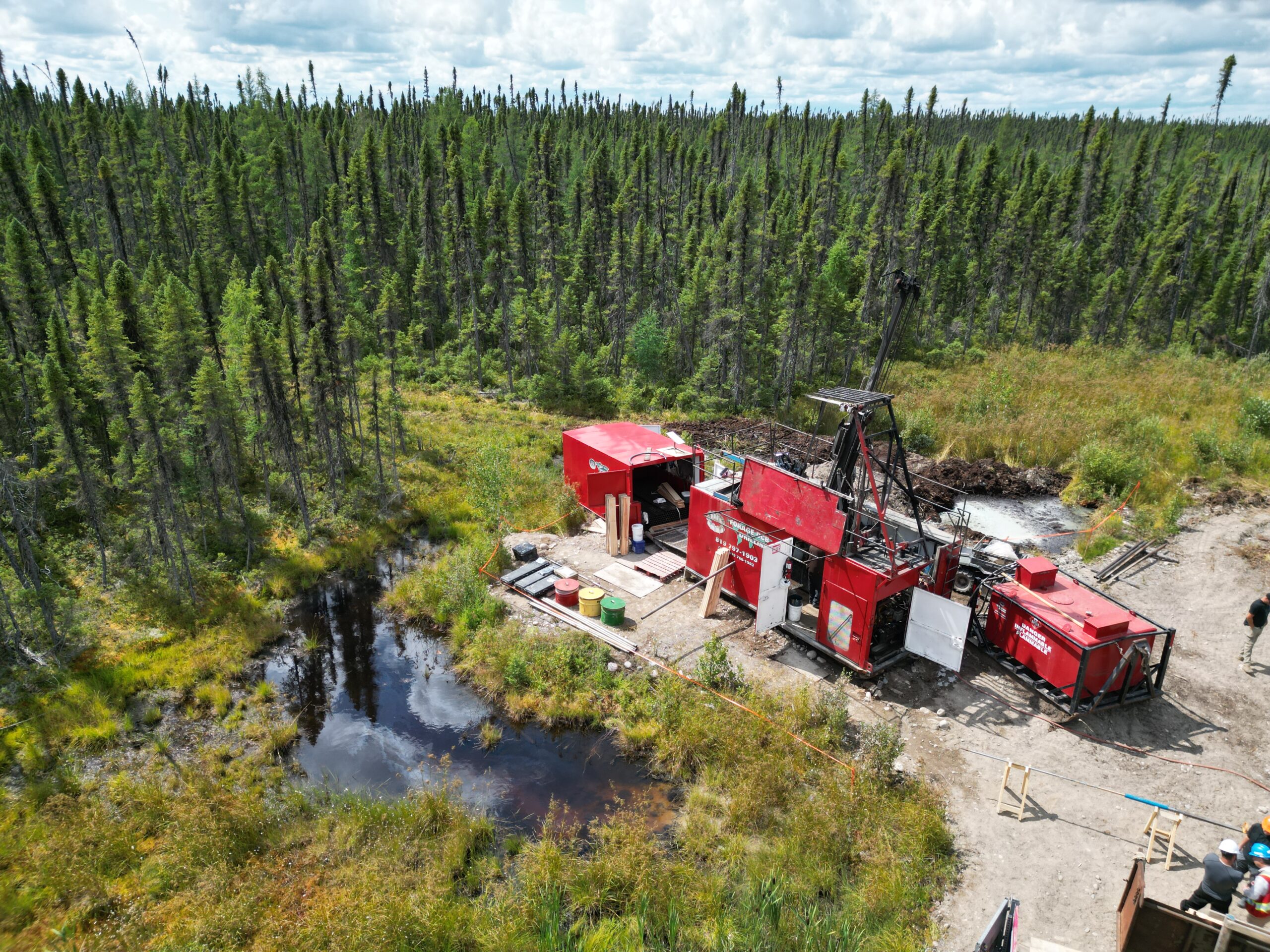
The programme to develop the resource into an economic study is fully funded, and the deposit remains open. Abitibi holds a treasury of about C$45 million following a financing of more than C$30 million that brought Discovery Silver on as a strategic investor. That capital supports an 80,000-metre drill programme across 2026 and 2027, the largest in the company's history, with 3 drill rigs turning.
Deluce frames the funding position this way:
"We have C$45 million in the treasury and a world-class shareholder base, fully funded within our plans at B26 and then some, out to 2028."
Ownership is now consolidated. Abitibi holds 100% of B26 after acquiring SOQUEM Inc.'s remaining 20% interest for an initial consideration of about C$7 million, with SOQUEM retaining a 1% net smelter return (NSR) royalty and Abitibi securing a 10-year right of first refusal (ROFR) on the adjacent Wagosic and Carheil properties. Former Chief Operating Officer of Foran Mining, Dave Bernier, joined to lead development, social, and permitting work.
The resource can still grow because the deposit is open laterally and at depth, with its limits not yet defined. Recent drilling traced the western down-plunge and more than doubled the 1.5% grade modelled in that area, while an April step-out at depth of 150 metres returned 2.71% copper equivalent over 7 metres within a broader 1.8% copper equivalent over 15 metres. A magnetotelluric survey and downhole geophysics on extensional holes are targeting deeper feeder structures ahead of the next resource update.
The First-Quarter 2027 PEA & Resource Update
The mechanism that converts the price-deck gap and near-surface economics into a published figure is dated. A Preliminary Economic Assessment (PEA) and an updated resource estimate are targeted for the first quarter of 2027, with stage-two metallurgical testing and geotechnical results feeding the study. The PEA addresses near-surface economics and early payback, while the resource update addresses the deposit's potential size.
Deluce is precise on what the assessment will rest on:
"This will be supported through a PEA in 2027. We believe that we're already at a critical mass level, given the size of B26, the continuity, the tonnes per vertical metre, and the distribution of grade, but our goal is to deliver something that is really world class."
Beyond the study, the SOQUEM agreement sets a feasibility study within 3 years of closing, a construction decision within 5 years, and a joint technical committee is conducting metallurgical work on blended B26 and Wagosic material. Management is targeting resource growth to 40 to 45 million tonnes. A PEA priced closer to prevailing metals would carry the deck-to-spot gap directly into the deposit's first economic figures.
The Investment Thesis for Abitibi Metals
- Abitibi Metals controls a 25.3 million tonne polymetallic resource at over 2.1% copper equivalent in a stable Quebec mining camp with existing regional infrastructure.
- The reported resource grades are calculated using a conservative price deck of US$2,500 per ounce for gold and US$4.50 per pound for copper, which sits well below prevailing metal prices.
- At June 2026 spot prices, the copper-equivalent grade rises to 2.4% in the indicated category and 2.5% in the inferred category without any change in tonnage.
- The deposit trades at an enterprise-value-to-in-situ ratio of 1.1%, far below the 17% carried by advanced volcanogenic massive sulphide developer Foran Mining and the 4% carried by FireFly Metals.
- A fully funded 80,000-metre drill programme and a treasury of about C$45 million will carry the company to a Preliminary Economic Assessment and an updated resource without a dilutive raise.
- The first-quarter 2027 Preliminary Economic Assessment is the near-term mechanism to reprice the deposit against current metals, rather than the conservative deck.
The investment case rests on a repricing that does not depend on exploration success. The metal is already defined at grades struck on a deck that current prices have left behind, the programme to convert and expand it is funded, and the study that would translate the gap into economic terms is scheduled for the first quarter of 2027. Execution risk lies in the proportion of the resource still in the inferred category and in the study's ability to deliver on schedule, but the value lever is the distance between a US$2,500 gold deck and a market trading near US$4,400.
TL;DR
Abitibi Metals' B26 is a 25.3 million-tonne copper-gold volcanogenic massive sulphide deposit in Quebec, whose reported grades are calculated using a conservative price deck of US$2,500 per ounce for gold and US$4.50 per pound for copper. In June 2026, spot prices are near US$4,400 per ounce for gold and US$6.30 per pound for copper; the same tonnes carry a copper-equivalent grade of 2.4% indicated and 2.5% inferred, and the deposit trades at a 1.1% enterprise-value-to-in-situ ratio against 17% for peer Foran Mining and 4% for FireFly Metals. A treasury of about C$45 million fully funds the 80,000-metre drill programme and the studies. The first-quarter 2027 PEA and updated resource are the dated catalysts that can reprice the deposit against current metals.
FAQs (AI-Generated)
Analyst's Notes





Subscribe to Our Channel




Stay Informed






















