




South African Producers Commit Nearly $1 Billion Despite US & China Flagging PGM Supply Risk


South African producers commit nearly $1 billion to PGM supply despite US and China flagging concentration risk as platinum deficits sustain investment.
- The US Department of Commerce concluded that imports of processed critical minerals, including platinum, palladium, rhodium, ruthenium and iridium, threaten US national security. No tariff or import quota had been announced as of the July 13, 2026 negotiating deadline, leaving the policy outcome unresolved.
- China's 15th Five-Year Plan designated PGMs as priority materials because the country remains dependent on imports concentrated in South Africa and Russia.
- Approximately $927 million has been committed to redevelop a South African platinum mine, targeting annual production of 350,000 to 400,000 ounces of PGMs once fully operational.
- Realized PGM basket prices rose 85% year over year to $2,801 per ounce in the first half of 2026, strengthening cash flow available for reinvestment in South African supply.
- Large PGM resources outside South Africa and Russia remain scarce, with a 2.2 million-ounce Brazilian project highlighting the limited pipeline of alternative supply.
US National Security Finding Elevates PGM Supply Concentration, Leaving Trade Policy Risk Unresolved
The US Department of Commerce concluded that imports of processed critical minerals, including platinum, palladium, rhodium, ruthenium and iridium, threaten US national security. Proclamation 11001, signed on January 14, 2026, directed the Department of Commerce and the US Trade Representative (USTR) to negotiate critical minerals trade agreements with partner nations and report progress within 180 days. Instead of imposing an immediate tariff, the proclamation authorized future measures, including import quotas or minimum import prices, depending on the outcome of those negotiations.
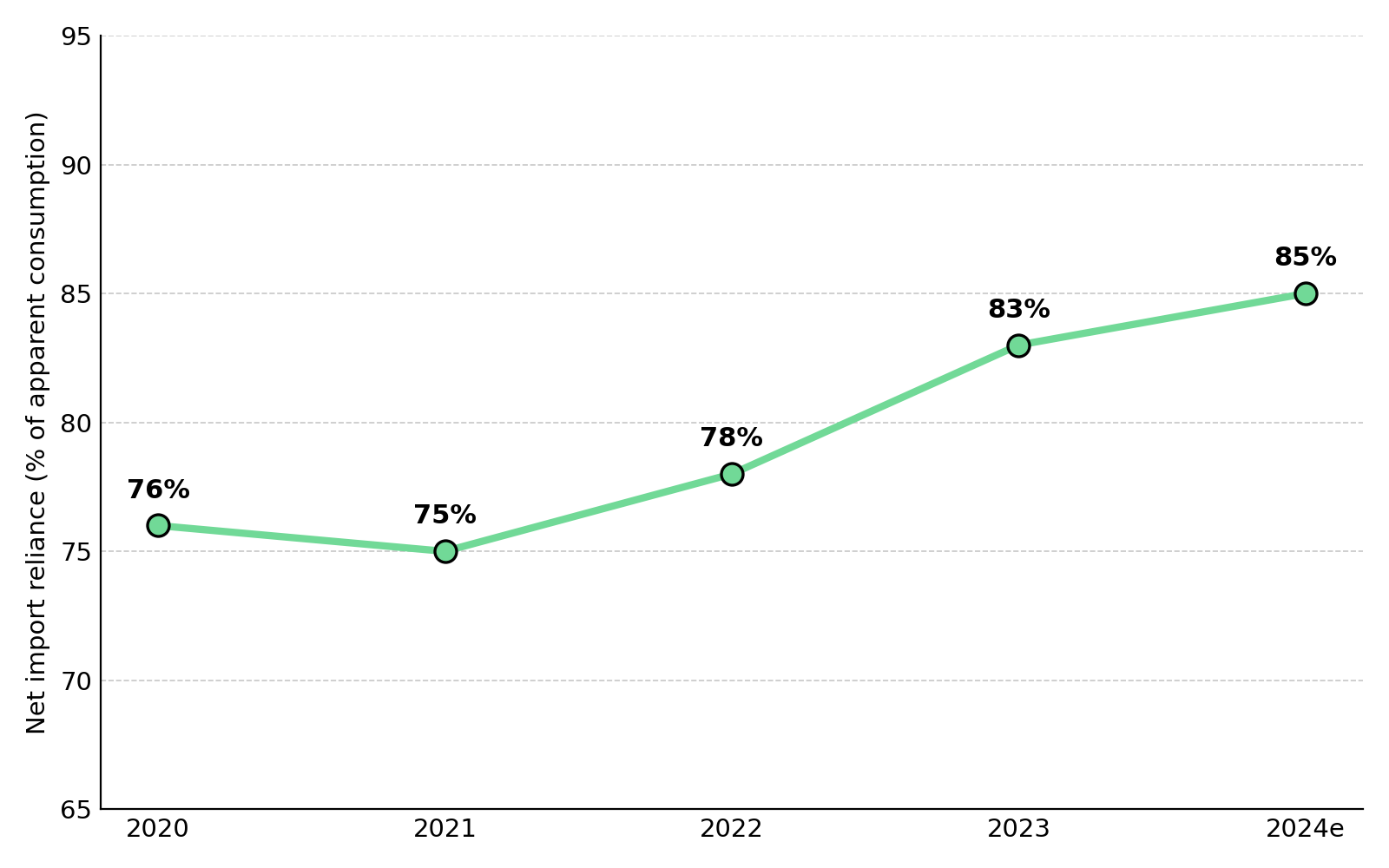
The 180-day negotiation period ended on July 13, 2026, with no public tariff decision, import quota, or negotiated agreement announced. For a commodity complex where one country accounts for most global mine supply, an unresolved national security finding remains a policy risk. PGM equities and physical metal therefore remain exposed to a US policy decision that could alter market pricing if new trade measures are announced.
China's Five-Year Plan Identifies PGM Import Dependence, Reinforcing Supply Concentration Risk
China's 15th Five-Year Plan identifies the same PGM supply concentration risk from the perspective of import security. The plan designates PGMs as critical materials because of their role in hydrogen fuel cells, advanced electronics, artificial intelligence infrastructure, and emissions-control systems. China has limited domestic PGM resources and remains heavily dependent on imports from South Africa and Russia, the same two countries identified in the US national security finding. China and the US have independently identified concentrated PGM supply as a policy vulnerability through separate policy frameworks. Together, the two assessments reinforce the view that concentrated PGM supply has become a growing concern for both major consuming markets and policymakers.
Platinum Deficit Drives South African Reinvestment, Reinforcing Concentrated Future Supply
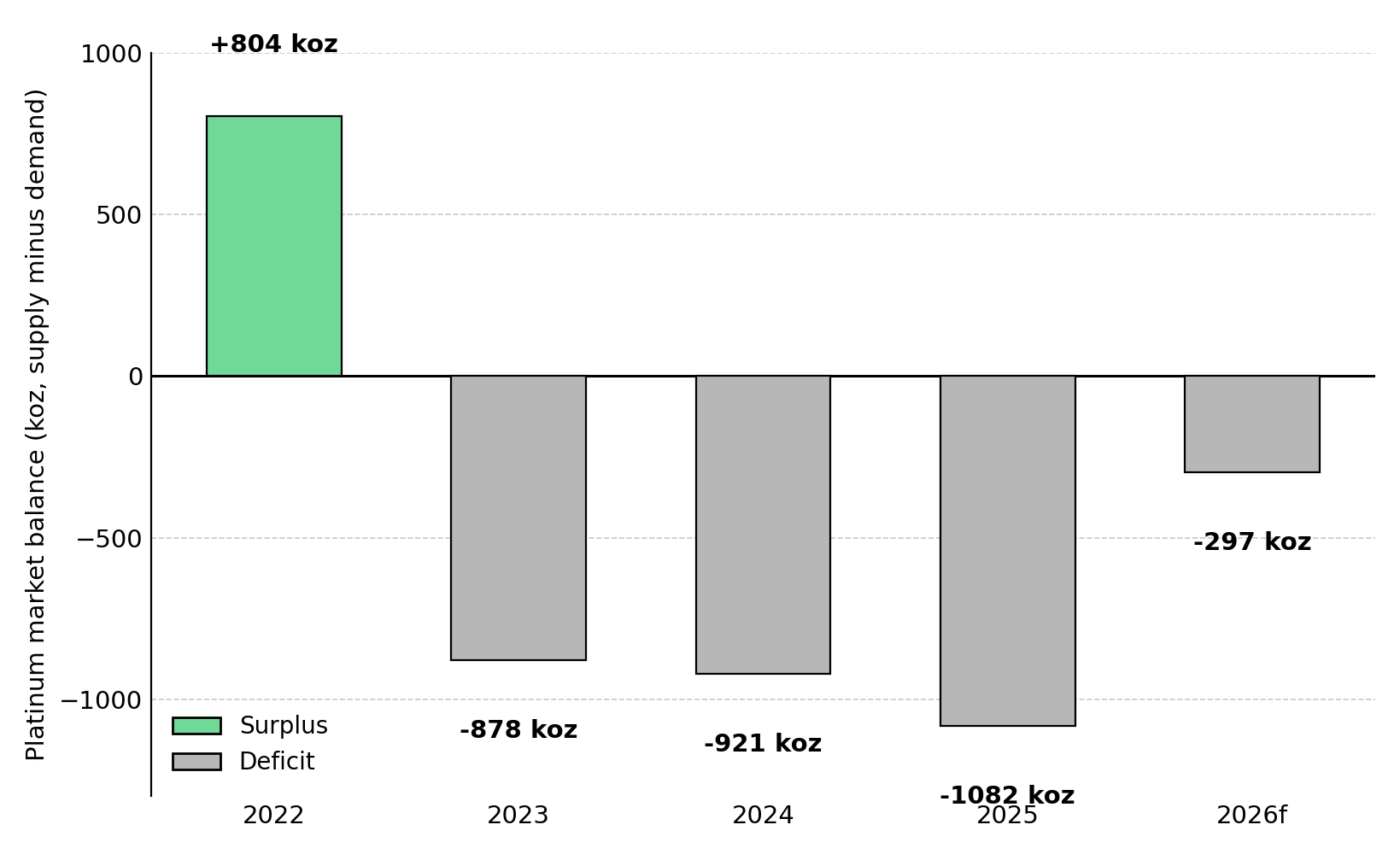
The World Platinum Investment Council (WPIC) forecasts a fourth consecutive annual platinum deficit in 2026, with above-ground stock cover falling to roughly three months of demand by year-end. The projected deficit continues to support investment in South African PGM production despite policy concerns over concentrated supply in both the US and China. South Africa remains the only jurisdiction capable of adding meaningful new PGM supply on a timeline relevant to reducing that deficit, and two recent disclosures show producers allocating capital accordingly.
African Rainbow Minerals approved approximately $927 million to redevelop the Bokoni platinum mine in South Africa, targeting annual production of 350,000 to 400,000 ounces of PGMs once the mine is fully operational. The investment follows a period in which weak prices, rising operating costs, and power constraints drove mine closures, production cuts, and project deferrals across the sector. A near-$1 billion capital commitment in South Africa suggests current PGM prices support investment in new supply despite the concentration risks identified by both the US and China.
Valterra Platinum, the world's largest integrated PGM producer, reported first-half 2026 headline earnings up more than 1,388% year over year, driven by an 18% increase in PGM sales volumes and an 85% increase in the US dollar PGM basket price to $2,801 per ounce. Own-mined production increased 13% in the second quarter, and the company is targeting full-year 2026 group PGM production of 3.0 million to 3.4 million ounces. Higher earnings increase the cash flow available to reinvest in mine production as platinum deficits persist. Separately, Valterra and Umicore's Metal Deposition Solutions (MDS) unit announced a multi-year platinum electroplating partnership targeting the electronics connector market, where platinum is positioned as a durable, lower-cost alternative to gold across an industrial gold demand base exceeding 9.5 million ounces annually.
Industrial Demand Growth Expands Platinum Use, Increasing Dependence on Concentrated Supply
Platinum demand is expanding beyond automotive catalysts into electronics, hydrogen technologies, artificial intelligence infrastructure, and industrial gold substitution, consistent with the applications identified in China's 15th Five-Year Plan. Rather than reducing concentration risk, a broader demand base increases the number of end markets dependent on platinum supply from South Africa and Russia, where alternative large-scale sources remain limited.
The expansion of platinum demand also increases the importance of both the US national security finding and China's 15th Five-Year Plan designation. Since the US national security finding was issued in January 2026, platinum has continued gaining industrial applications, including electroplating for electronic connectors. If platinum captures even a modest share of the 9.5 million-ounce industrial gold demand base, unresolved US trade policy becomes more consequential because new demand would be layered onto a production base that remains highly concentrated.
Limited PGM Development Pipeline Outside South Africa & Russia Restricts Alternative Supply Growth
South Africa holds approximately 90% of global PGE reserves, while only two major greenfield PGE mines are nearing production worldwide. Brazil illustrates how early the search for alternative supply remains. Exploration executives estimate that only about 30% of the country's landmass has been mapped to a high-resolution geological standard, leaving most of a continental-scale land package unexplored using modern methods. The supply concentration identified by both the US and China is unlikely to change rapidly because few jurisdictions possess comparable PGE resources capable of supporting large-scale new production.
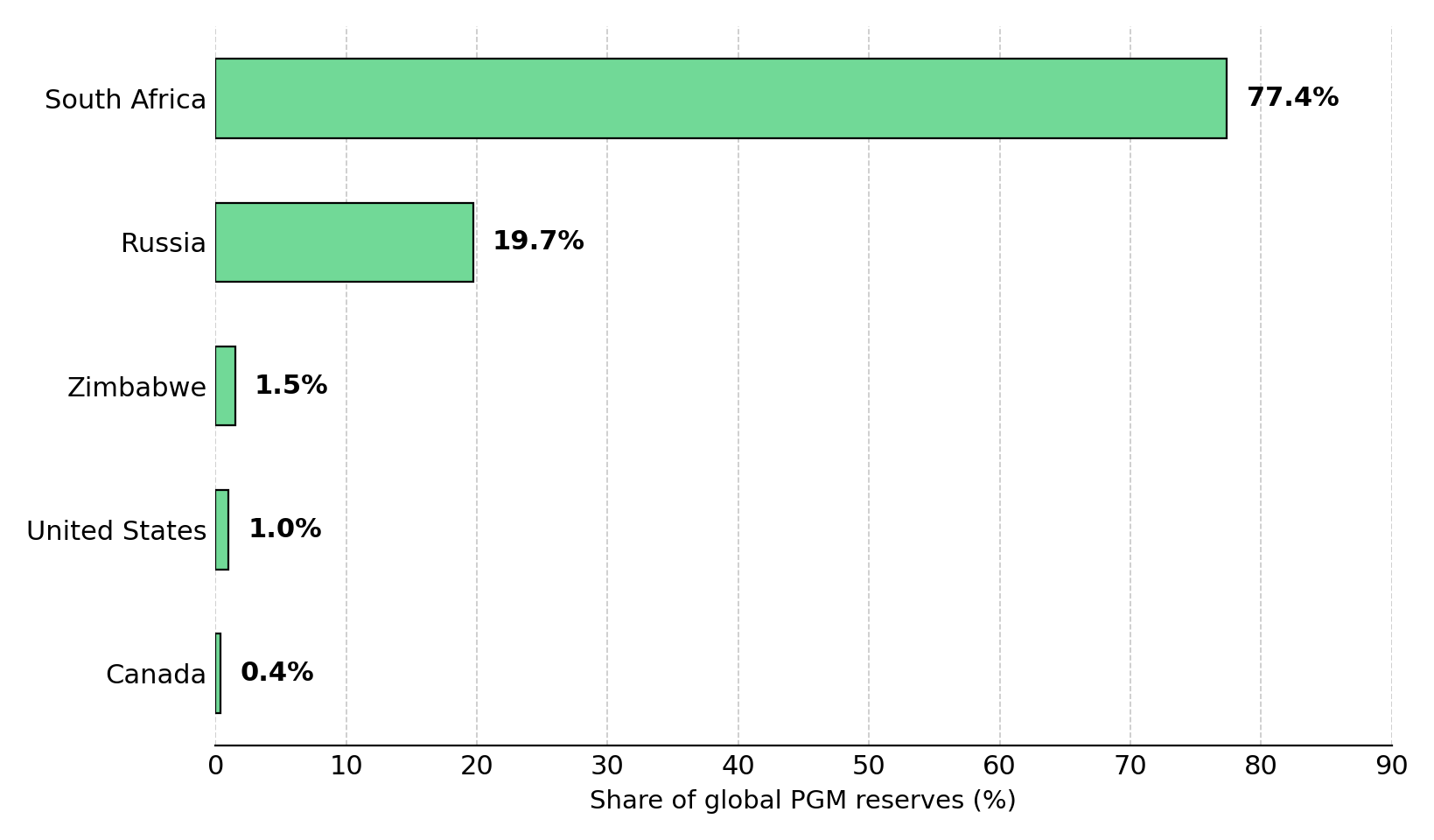
The pipeline of non-South African, non-Russian PGE development assets remains remarkably small. Stillwater Critical Minerals, Bravo Mining, Platinum Group Metals, and Generation Mining collectively represent much of the credible alternative supply pipeline outside the dominant producing regions, yet even the most advanced projects remain at the Inferred Resource, Preliminary Economic Assessment (PEA), Definitive Feasibility Study (DFS), or Feasibility Study stage. Brazil further illustrates how early the search for new supply remains. Exploration executives estimate that only about 30% of the country's landmass has been mapped to a high-resolution geological standard, leaving most of a continental-scale land package unexplored using modern methods. The supply concentration identified by both the US and China is therefore unlikely to change rapidly because few jurisdictions possess comparable PGE resources capable of supporting large-scale new production.
ValOre Metals' Pedra Branca project in Ceará State, Brazil, hosts an Inferred Resource of 2.2 million ounces of combined platinum, palladium and gold equivalent (2PGE+Au) at an average grade of 1.08 g/t across 63.3 million tonnes, according to an Independent Technical Report effective March 8, 2022. A Preliminary Economic Assessment (PEA) is targeted for Q4 2026, and no economic study, capital cost estimate, or production schedule has yet been published. With a market capitalization of approximately CAD$26 million as of July 1, 2026, the company provides exposure to a strategically located PGM resource outside the dominant producing regions rather than near-term production. Future exploration results, resource growth, and the completion of technical and economic studies will determine whether the project can progress toward development.
Thiago Diniz, Vice President of Exploration at ValOre Metals, discusses global PGM supply concentration beyond traditional producing regions:
"Palladium and platinum are well known and produced only in certain regions of the globe. Being able to advance a project outside of that small space is actually an opportunity, and an opportunity for the ones seeking geopolitical diversification as well."
Upcoming Policy Decisions & Market Signals Will Shape the PGM Supply Outlook
Several upcoming developments will determine whether current policy concerns and market fundamentals translate into higher PGM prices or renewed investment uncertainty. Any Section 232 tariff, import quota, or other trade measure affecting PGMs following the July 13, 2026 negotiating deadline would convert an unresolved national security finding into a defined policy outcome. The next WPIC Platinum Quarterly, scheduled for September 9, 2026, will indicate whether the projected market deficit supporting South African capital investment is widening, narrowing, or remaining intact. Additional capital allocation decisions by South African producers, including new mine investments, expansions, or asset sales, will provide further evidence of whether current PGM prices continue to justify long-term investment in concentrated global supply.
A Section 232 outcome that concludes no PGM-specific trade measures are warranted would reduce the policy rationale supporting a geographic supply premium. A second consecutive quarterly platinum surplus under WPIC's methodology would challenge the deficit that currently supports continued capital investment in South African production. Likewise, a monetization event, such as an offtake agreement, joint venture, or investment, involving Pedra Branca or another PGM project outside the dominant producing regions would provide the first meaningful evidence of whether the market assigns additional value to geographic diversification.
The Investment Thesis for PGMs
- Supply concentration in South Africa and Russia has evolved from an accepted feature of the global PGM market into an explicit policy concern, recognized independently by both the US and China.
- Recent capital commitments indicate that producers are expanding within the existing supply base rather than diversifying it, because South Africa remains the only jurisdiction capable of adding meaningful PGM supply over the near term.
- New industrial demand from electronics, hydrogen technologies, and AI infrastructure is expanding platinum consumption without changing the geographic concentration of mine supply, increasing more industries' exposure to production concentrated in South Africa and Russia.
- The pool of credible development-stage PGM assets outside the dominant producing regions remains small, limiting the number of projects capable of diversifying future global supply.
- The available opportunities range from established South African producers with immediate exposure to PGM prices and operating cash flow to early-stage developers seeking to expand supply outside the dominant producing regions. Each offers a different balance between near-term production exposure and longer-term development potential.
- Project economics, jurisdictional quality, permitting certainty, and disciplined capital allocation will determine which producers and developers are best positioned to benefit if concentrated PGM supply becomes an increasingly important competitive advantage.
Although the US and China have independently concluded that concentrated PGM supply in South Africa and Russia represents a policy risk, capital continues to flow into that same concentrated supply base. A near-$1 billion mine redevelopment and the reinvestment of record producer earnings reflect the same constraint: South Africa remains the only jurisdiction capable of adding meaningful PGM supply over the near term because few credible alternatives exist at comparable scale. As a result, South African producers and early-stage developers outside the dominant producing regions provide different forms of exposure to the same theme, with one offering immediate production and cash flow while the other represents the potential for future supply diversification. Which approach ultimately proves more resilient will depend on future policy decisions, market fundamentals, and whether capital continues to reinforce the existing supply base or begins to support credible alternatives elsewhere.
TL;DR
South African producers are increasing investment in platinum group metals despite the US and China identifying concentrated PGM supply as a policy risk. A nearly $1 billion mine redevelopment, stronger producer earnings, persistent platinum deficits, and expanding industrial demand continue to support investment in South African production because few alternative supply sources exist. With limited development projects outside South Africa and Russia, future PGM prices and investment opportunities will depend on policy decisions, platinum market balances, and whether new projects can diversify global supply.
FAQs (AI-Generated)
Analyst's Notes





Subscribe to Our Channel








Stay Informed


