




Limited Platinum Mine Development Since 2019 Highlights Opportunity in New Regions



Limited platinum mine development since 2019, flat supply, and low stocks raise the importance of projects in new regions.
- World Platinum Investment Council (WPIC) forecasts North American refined platinum production at 201 thousand ounces (koz) in 2026, down 48% from 390 koz in 2016 after a 20% decline in 2025.
- US Geological Survey (USGS) reported that countries outside South Africa, Russia, Zimbabwe, Canada, and the US collectively produced 3,900 kilograms of platinum in 2025, or 2.3% of the 170,000-kilogram world total, leaving 97.7% of mine production concentrated in five countries.
- WPIC reports that the first greenfield platinum mine commissioned since 2019 is in South Africa and is targeting approximately 200 koz of annual production after a three-year ramp-up, adding supply within the dominant producing country rather than broadening the geographic base.
- Zimbabwe suspended exports of all raw minerals on February 25, 2026, preventing unprocessed shipments from the world’s third-largest platinum-producing country and making mineral exports dependent on in-country processing.
- WPIC forecasts global mine supply at 5,551 koz in 2026, 0.2% below 5,561 koz in 2025, even though higher PGM prices over the prior 12 months improved mine economics and reduced downside risk from weak margins.
Limited Project Pipeline Keeps Platinum Mine Supply Flat Despite Higher Prices
WPIC forecasts platinum mine supply at 5,551 koz in 2026, compared with 5,561 koz in 2025 and 5,568 koz in 2022, leaving output effectively unchanged across the five-year period. WPIC states that higher platinum group metals (PGM) prices over the prior 12 months improved mine economics and reduced downside risk from weak margins. However, public company guidance cited by WPIC indicates stable 2026 output, showing that miners have not increased supply in response to higher prices.
WPIC data show refined platinum production falling 9.7% from 6,145 koz in 2016 to a forecast 5,551 koz in 2026, alongside a fourth consecutive annual deficit of 297 koz. USGS separately estimates that world platinum mine production fell 5% from 179,000 kilograms in 2024 to 170,000 kilograms in 2025 and attributes a 9% decline in South African PGM output to lower palladium prices, higher deep-level mining costs, and electricity disruptions. These datasets show that platinum output has declined across both refined production and mine production measures despite four consecutive market deficits.
Nickel Byproduct Decline Cuts North American Platinum Output 48%, Lifting US Import Reliance
North American refined platinum production is forecast to fall 48% from 390 koz in 2016 to 201 koz in 2026, after output declined 20% to 212 koz in 2025. USGS estimates that US platinum mine production fell 55% from 4,020 kilograms in 2021 to 1,800 kilograms in 2025, while palladium output declined 55% from 13,700 to 6,200 kilograms. Combined platinum and palladium output at one Montana producer fell 40% in 2025 because one operation remained on care and maintenance. Mine employment also declined 49% from 1,600 people in 2021 to an estimated 810 in 2025, showing that the contraction extended from production to the workforce.
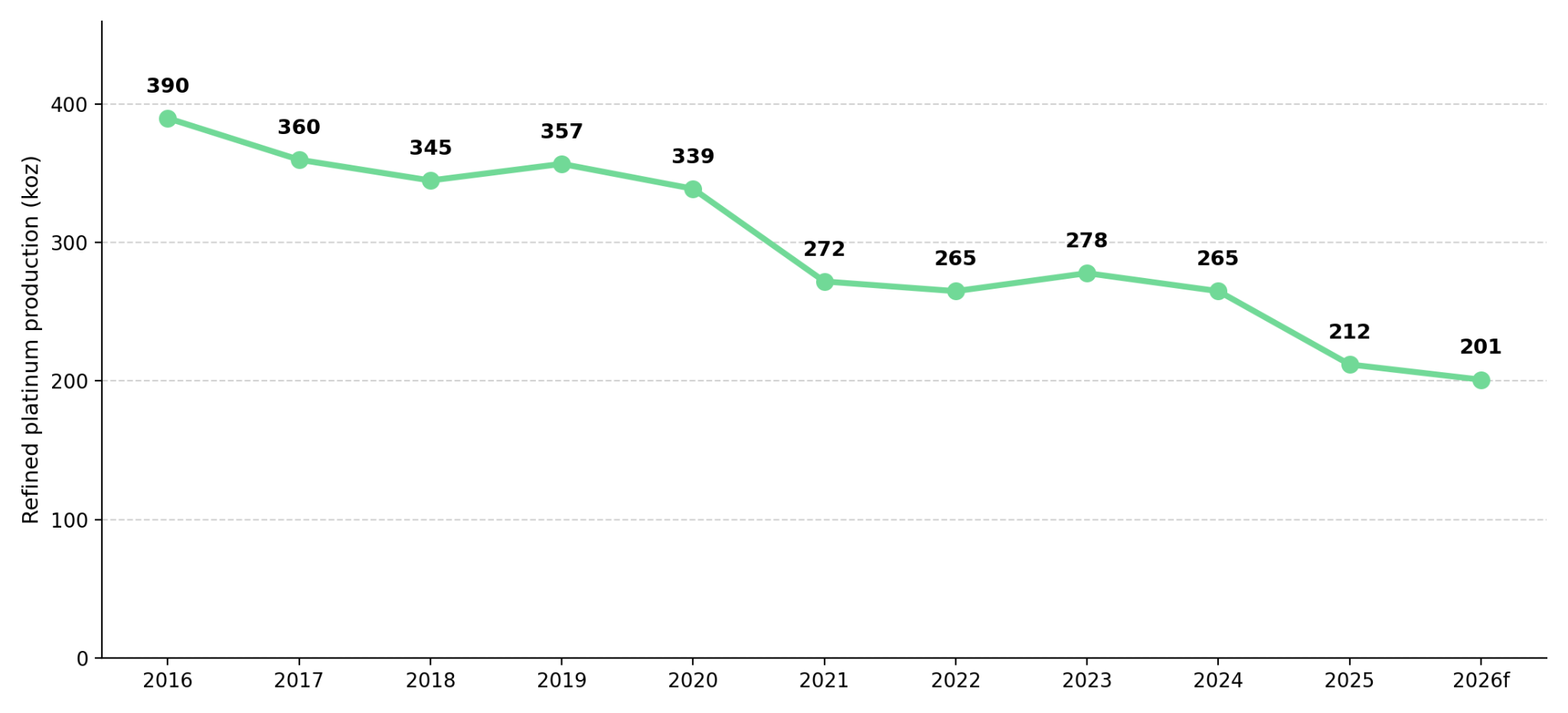
Lower byproduct output from nickel mining is driving the forecast decline in North American platinum production in 2026. Platinum recovered as a nickel byproduct depends on nickel mine economics and production plans, so higher platinum prices alone cannot generate additional supply unless nickel production also rises.
US net import reliance for platinum rose to 89% in 2025 from 75% of apparent consumption in 2021, while imports reached an estimated 99,000 kilograms. South Africa supplied 49% of US platinum imports between 2021 and 2024, concentrating nearly half of imported supply in the world’s largest platinum-producing country.
Five Countries Supply 97.7% of Platinum as Zimbabwe Export Ban Restricts Diversification
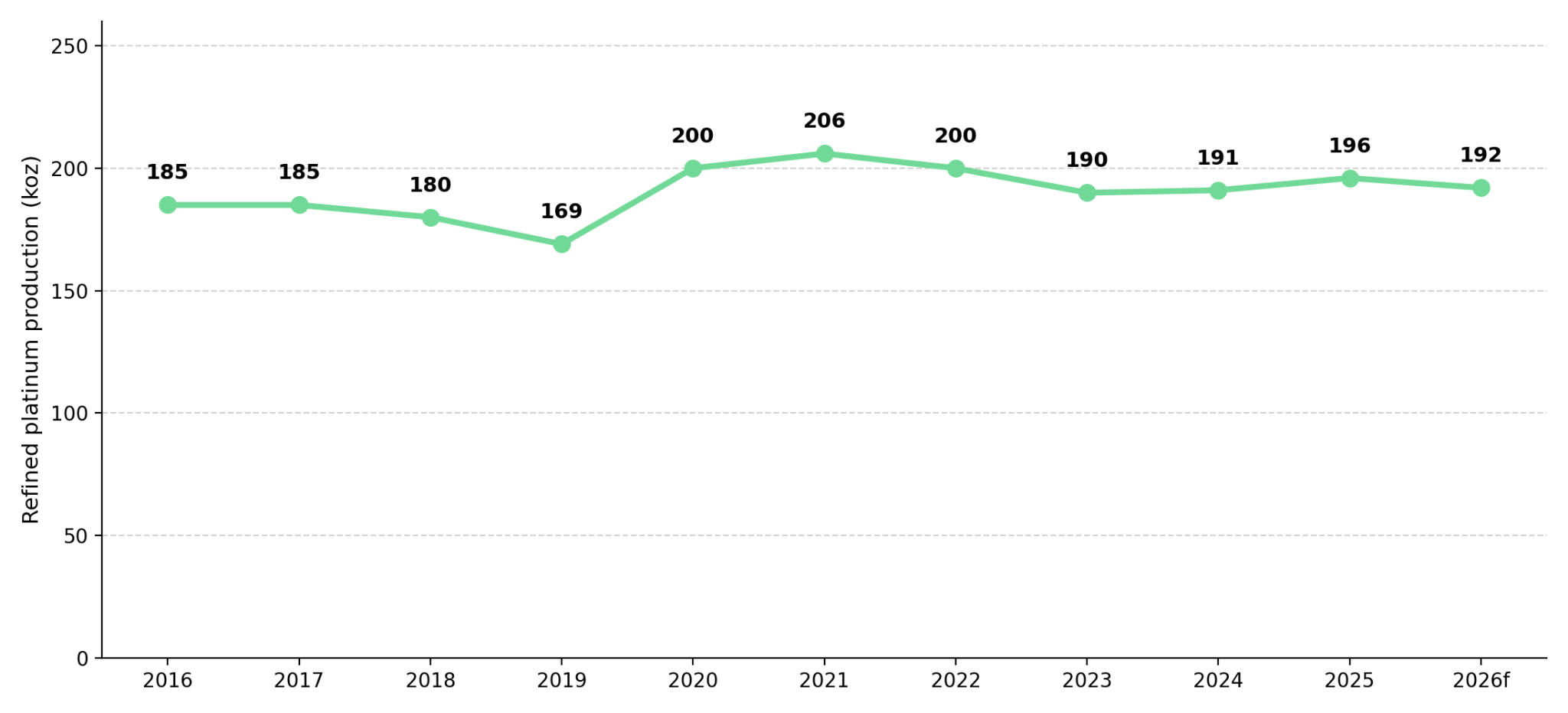
South Africa, Russia, Zimbabwe, Canada, and the US accounted for 97.7% of global platinum mine production in 2025, leaving all other countries at a combined 3,900 kilograms, or 2.3% of the 170,000-kilogram world total. Separate regional data show that refined production outside South Africa, Zimbabwe, Russia, and North America is forecast at 192 koz in 2026, only 4% above 185 koz in 2016 after remaining between 169 koz and 200 koz from 2019 through 2024. Together, the datasets show that alternative producing regions have added only 7 koz of refined output over the decade and accounted for just 2.3% of world mine production in 2025.
Zimbabwe, the world’s third-largest platinum-producing country, suspended exports of all raw minerals on February 25, 2026, including material already in transit, with the restriction remaining in force until further notice. Polite Kambamura, Minister of Mines and Mining Development for the Government of Zimbabwe, said the measure was intended to move more mineral processing inside the country. The indefinite suspension prevents unprocessed mineral shipments and makes platinum buyers more dependent on Zimbabwe’s domestic processing capacity before material can be exported.
One New Mine Since 2019 Keeps Platinum Concentrated, Raising Need for New Supply
Platreef in South Africa is the first greenfield platinum mine commissioned since Styldrift in 2019, keeping the only new capacity added in seven years within the dominant producing country. Exploration-stage projects in other jurisdictions therefore represent potential sources of future platinum supply as they advance toward economic assessment.
ValOre Metals is targeting a resource update in the third quarter of 2026 and delivery of a preliminary economic assessment (PEA) in the fourth quarter for its 100%-owned Pedra Branca project in Ceará, Brazil. The update is planned to incorporate more than 6,000 meters drilled across five new zones in 2023 that remain outside the current 2.2-million-ounce inferred platinum, palladium, and gold resource, creating potential to expand the defined resource base. Ongoing development studies, seven near-surface resource zones, and paved-highway access to Fortaleza’s international deep-water port support the project’s progression toward development.
Nick Smart, Chief Executive Officer of ValOre Metals, explains why concentrated PGM supply could drive diversification:
"When you've got such a concentration within South Africa and Russia and Zimbabwe, I think there's going to be a realization of that and a desire to diversify some of where those metals are coming from. And we've seen that in the world across a number of critical metals, and PGEs are critical metals."
83% Reserve Concentration and Three-Month Stocks Leave Platinum Exposed to Supply Disruptions
World PGM reserves exceed 76 million kilograms, with South Africa holding 63 million kilograms, or about 83%, and Russia approximately 11 million kilograms. Zimbabwe holds 1.3 million kilograms, the US 590,000 kilograms, and Canada 310,000 kilograms, while world PGM resources exceed 100 million kilograms and the largest concentrations of resources and reserves remain in South Africa’s Bushveld Complex. Because this concentration reflects the location of known mineral deposits, capital can develop projects elsewhere but cannot quickly shift the underlying resource base across jurisdictions.
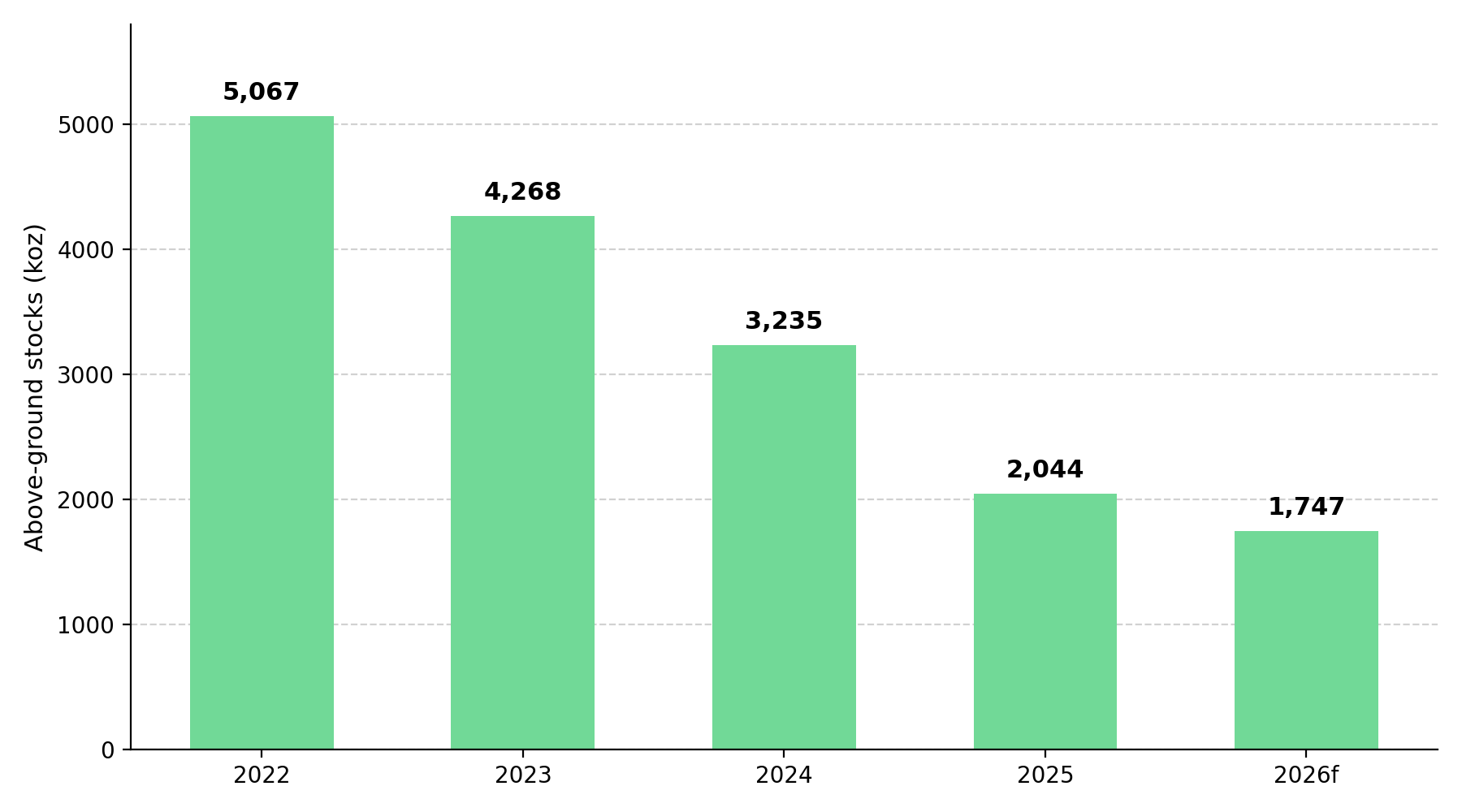
Above-ground platinum stocks are forecast to fall 66% from 5,067 koz at the end of 2022 to 1,747 koz by the end of 2026, leaving less than three months of global demand cover. Four consecutive annual deficits have reduced this buffer, and rebuilding it would require several annual surpluses while the market remains forecast to record a 297 koz deficit in 2026. Recycled supply is forecast to rise 9% to 1,826 koz in 2026, providing all supply growth while mine production remains effectively flat at 5,551 koz.
With South Africa, Russia, Zimbabwe, Canada, and the US accounting for 97.7% of platinum mine production in 2025, and above-ground stocks forecast to cover less than three months of demand by the end of 2026, a disruption in any major producing region would leave limited replacement supply or inventory to offset the loss. Projects outside these five countries can broaden the supply base only by advancing through economic studies, permitting, financing, construction, and ramp-up into commercial production.
The Investment Thesis for Platinum Group Metals
- Global platinum mine supply is forecast at 5,551 koz in 2026, 0.3% below 5,568 koz in 2022 despite improved mine economics from higher PGM prices, showing that higher prices alone have not overcome the limited project pipeline and multi-year development timelines.
- Countries outside the five largest platinum producers collectively supplied 3,900 kilograms in 2025, or 2.3% of the 170,000-kilogram world total, leaving 97.7% of mine production concentrated in five countries and limiting diversification through existing supply.
- North American refined platinum production is forecast to fall 48% from 390 koz in 2016 to 201 koz in 2026 as nickel byproduct output declines, showing that regional supply depends on nickel economics and production plans rather than platinum prices alone.
- Only one greenfield platinum mine has been commissioned since 2019, and it is targeting approximately 200 koz of annual production in South Africa, keeping new greenfield capacity within the dominant producing country rather than broadening the geographic supply base.
- Established producers provide direct exposure to current platinum prices through existing output, while developers and explorers offer exposure to future supply diversification as economic studies, permitting, financing, construction, and ramp-up advance projects toward production.
- Exploration-stage projects can create value through successful drilling, resource expansion, and economic studies, while access to financing determines whether those results can advance toward development and how much dilution existing shareholders may face.
Platinum supply remains concentrated in a small number of established producing regions, while the limited development pipeline restricts how quickly higher prices can bring new production to market. Existing producers provide direct exposure to current prices, while developers and explorers represent potential sources of future production and geographic diversification. Pre-production opportunities should be assessed through resource growth, economic studies, permitting progress, and funding capacity because these milestones determine whether discoveries can advance into operating mines. The platinum thesis therefore depends less on near-term price forecasts than on which projects can progress toward commercial production.
TL;DR
Platinum mine supply remains effectively flat despite higher prices and four consecutive market deficits. Five countries produced 97.7% of global platinum in 2025, while North American refined output is forecast to fall 48% from 2016 levels as nickel byproduct production declines. Only one greenfield platinum mine has been commissioned since 2019, and it is in South Africa, limiting geographic diversification. Above-ground stocks are forecast to cover less than three months of demand by the end of 2026. This combination increases the importance of existing producers and pre-production projects in new regions, provided drilling, economic studies, permitting, financing, and construction can advance them toward commercial production.
FAQs (AI-Generated)
Analyst's Notes





Subscribe to Our Channel




.png)






Stay Informed


