




The Mine That Thinks Like Infrastructure: Why Pension Funds Are Backing Atlas Salt's $590 Million Build



Atlas Salt raises $25M, advancing the only new North American salt mine toward a $590M build. Lowest-cost producer. Pension fund backing. Supply gap, not demand risk.
- Atlas Salt has raised $25 million over the past year ($15M in June 2026 plus $9M in October 2025), shifting the Great Atlantic Salt project from planning into active early works, site preparation, and engineering procurement.
- The $590 million project on the west coast of Newfoundland targets a well-documented de-icing salt supply shortage across the Northeast US, Midwest, Ontario, Quebec, and Atlantic Canada - with Atlas positioned as the only new mine in development in the sector.
- The capital stack is structured around ~60% senior secured debt , supplemented by subordinate lending, export credit agency support (EDC Canada and a Swedish ECA through Sandvik's $80M+ equipment commitment), and an equity "down payment" of approximately 30 - 40%.
- Salt is sold on annual contracts to roughly 10,000 customers (cities, municipalities, and state agencies), is not deeply seasonal, and Atlas does not rely on a single long-term off-take agreement - instead positioning through distributors such as Scott Wood Industries to capture maximum market pricing.
- The project's infrastructure-like cash flow profile - grounded in 60 years of salt market stability and requiring no ongoing reserve replenishment - has attracted major Canadian pension funds as institutional investors, with management already discussing future dividends, buybacks, and rapid debt repayment.
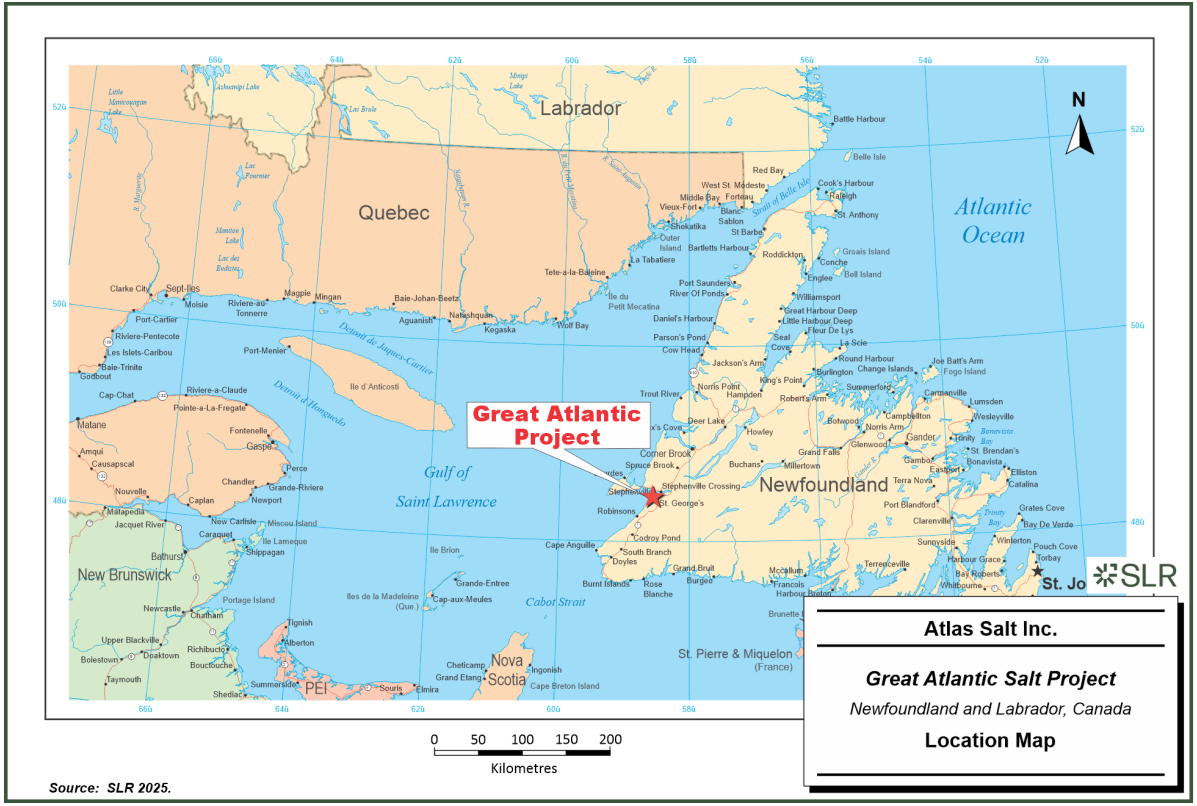
Atlas Salt is a Canadian mineral development company whose flagship asset, the Great Atlantic Salt Project, sits on the west coast of Newfoundland. The company is developing what would be a new domestic source of de-icing road salt for the northeastern United States, Midwest, Ontario, Quebec, and Atlantic Canada - a region that faces a genuine and well-documented supply deficit. In a June 2026 interview, CEO Nolan Peterson updated investors on a recently completed $15 million equity raise, the status of the broader project financing process, the competitive dynamics of the salt market, and the company's 12-month operational outlook. The conversation marked a clear transition: Atlas Salt is no longer an exploration or feasibility story. It is now in execution mode.
A Capital Raise That Changes the Trajectory
Atlas Salt closed a $15 million financing at C$1.20 per share with no warrants - a structurally clean deal that the company had not planned when it entered institutional marketing meetings in Montreal led by Ventum Capital Markets. The raise was demand-driven. Investor interest from the prior months - including a smaller flow-through offering that was five to six times oversubscribed - translated into institutional appetite for a broader position in the company.
Combined with the $9 million raised in October 2025, Atlas has now secured $25 million in equity capital over approximately 12 months. When Peterson joined the company a year ago, the share price was 36 to 37 cents and daily trading volume was below 1,000 shares. The company was, in his words, "capital starved." The share price at the time of the interview was well above the $1.20 offering price.
The proceeds are being directed toward early-site works - including site clearing, ground preparation, geotechnical studies, grid tie-ins to Newfoundland Hydro, and the advancement of engineering with key project partners. Work that would otherwise have been sequenced later in the project timeline is now being pulled forward, allowing the company to enter its main financing process with more de-risked project assets.
The Capital Stack: Structuring a $590 Million Build
The total project capital expenditure is approximately $590 million, which includes inflation provisions over the build period. The base non-inflation figure is approximately $540–545 million. Structuring the financing for a project of this scale is the central task management is currently executing.
Peterson described the financing architecture using a direct analogy: "The project financing is like the mortgage and we also have to bring a down payment component." The senior secured debt layer is targeted at roughly 60%, or $360–400 million, which Atlas is pursuing through a process led by Endeavour, a specialist firm that structures lender packages for mining projects. The company opened its data room to primary lenders approximately six weeks before the interview.
Beyond the senior secured layer, the company has had conversations with subordinate lenders who have expressed willingness to commit $50-100 million once senior terms are established. Government-linked credit agencies represent another significant potential contributor: EDC (Export Development Canada) may support the project given its role in promoting Canadian commodity exports, and the Swedish Export Credit Agency is a potential participant given Sandvik's role as the mining equipment provider - an $80 million-plus commitment already in place.
When the senior debt, subordinate debt, and government agency layers are in place, the remaining equity "plug" could be reduced to approximately $100 million or less, which Atlas expects to fill through a combination of institutional equity and strategic interest from companies already active in the salt sector - including Compass Minerals, Stone Canyon (which owns Morton and Windsor Salt), American Rock Salt, and Cargill.
Project Economics and Inflation Exposure
The largest single cost item in the build is the development of two parallel horizontal drifts, each extending approximately 1.5 kilometres underground. This represents roughly $150 million in direct costs and has no byproduct revenue to offset it during development. Port upgrades account for another $60–70 million.
Despite the scale of the build, Peterson expressed limited concern about inflationary cost pressure. The project is designed to run primarily on regulated Newfoundland electricity rather than diesel, labour costs on the island's west coast are lower than in high-demand mining jurisdictions, and many workers are motivated to return to their home communities rather than travel for higher wages elsewhere. The $590 million figure already incorporates an inflation buffer above the base estimate.
Fixed-price commitments are advancing with key partners. Continental Conveyors is engaged on the conveyor system, Hatch serves as the integrated project delivery engineer, and Sandvik has committed to the underground mining equipment package. Final price lock-in is expected as capital is secured and construction draws closer.
Interview with Nolan Peterson, CEO, Atlas Salt
The Salt Market: Demand, Seasonality, and Supply Dynamics
A common assumption about road salt - that demand is highly seasonal and disappears in warmer months - is only partially accurate. While winter creates demand spikes, municipalities and government agencies actively replenish stockpiles through spring and summer. In Peterson's framing, it is a year-round market with seasonal amplitude, not a business that effectively ceases outside of winter.
The customer base is unusually diffuse. Approximately 10,000 buyers - cities, counties, state and provincial agencies - procure salt through annual tenders. This structure means that the industry does not operate on the long-term off-take contracts common in other commodity sectors. Distributors like Scotwood Industries, Atlas's primary distribution partner, cannot themselves commit to multi-year supply arrangements on behalf of their end customers.
Peterson argued this dynamic is actually favourable:
"We know that if and when this mine is built, those cash flows are - nothing's ever 100% certain - but as close as you can get in the mining industry, near certainty."
Annual pricing also gives Atlas the flexibility to capture prevailing market rates rather than being locked into contracts struck when conditions may have been less favourable.
Competitive Position: The Only New Mine in Development
Atlas Salt's competitive positioning benefits from a structural feature that distinguishes it from virtually every other commodity in the mining development universe. Peterson was explicit on this point: "We're the only project development company looking to put a salt mine into operations." There is no pipeline of competing new projects that could flood the market simultaneously.
The company also expects to be the lowest-cost producer among North American suppliers, given the nature of the deposit and access to regulated electricity. This cost advantage gives Atlas significant pricing flexibility: it can undercut existing producers if necessary without sacrificing meaningful margin, while higher-cost competitors face pressure on viability. Peterson noted that at least four existing North American mines are expected to close within the next five to ten years regardless of whether Atlas comes into production - a factor that further tightens the supply outlook.
Infrastructure Asset, Not a Traditional Mine
One of the more distinctive aspects of the Atlas Salt investment proposition is how the company positions the asset relative to other mining investments. In traditional mining - Peterson used gold as the reference point - companies must constantly replenish reserves, fund exploration, or acquire new assets simply to maintain production. Cash flows generated from one mine are effectively recycled into finding the next.
Salt deposits do not behave this way. The Great Atlantic resource base is large enough that production, over time, effectively adds to the reserve rather than depleting it in a way that creates a reinvestment imperative. This has attracted a class of investor not typically found on mining share registers: pension funds. Atlas brought in two major Canadian pension funds in the most recent financing round, and one in the round before that. These investors are drawn to long-duration, stable cash flows - the profile more commonly associated with infrastructure or utilities.
The company has begun introducing capital return scenarios - dividends, share buybacks, and rapid debt repayment - into its investor communications. The 60-year performance track record of the North American salt market provides the empirical basis for these projections:
"It's been the case for 60 years that the salt market has performed. So, you have 60 years of historical performance to refer to, and from that you can infer the next 30 years."
Milestones and the 12-Month Outlook
Over the next 12 months, Atlas Salt's primary deliverable is not a single announcement but a sequence of de-risking milestones: completing lender due diligence, receiving initial letters of support from primary lenders, building out the broader lending syndicate, and negotiating final terms. Concurrently, site works and engineering procurement will continue on the ground in Newfoundland.
Peterson was clear that the early-works capital now in hand has effectively decoupled those activities from the main financing timeline - reducing the critical path dependency and giving the company a more advanced project to present to prospective lenders and equity partners when the larger raise is required.
"Every dollar, every task that's completed on the project is one less risk in the way of building it. The project is the most valuable the day the last dollar has been spent."
The Investment Thesis for Atlas Salt
- Supply gap, not demand risk: North America faces a structural de-icing salt shortage driven by aging domestic mines and constrained imports - Atlas is not creating a market, it is filling one.
- Only new mine in development: No competing greenfield salt projects exist in the pipeline, removing the typical commodity-cycle risk of oversupply from new entrants.
- Lowest-cost producer: Access to regulated Newfoundland electricity, lower labour costs, and a high-grade deposit position Atlas at the lower end of the North American cost curve.
- Infrastructure-like cash flows: Unlike most mining assets, the salt deposit does not require reserve replenishment - cash flows, once generated, are available for debt repayment, dividends, or buybacks without the reinvestment pressure typical of extractive industries.
- Institutional validation: Major Canadian pension funds have participated in recent rounds, a signal of confidence in the long-duration cash flow profile that is unusual in junior mining.
- Diversified capital stack: A multi-source financing approach (senior debt, subordinate debt, export credit agencies, strategic equity) reduces dependency on any single lender or investor class.
- Permitted and advancing: Environmental assessment and permitting are complete - a significant de-risking milestone that many development-stage peers have not reached.
- Sandvik equipment commitment: An $80M+ equipment commitment from Sandvik, with potential Swedish export credit backing, anchors the equipment procurement and reduces procurement risk.
- 60-year market track record: Salt price and demand stability across six decades provides an unusually long empirical basis for cash flow projections - a rarity in resource-sector investment.
- Management execution: Share price has risen from 36 cents to well above $1.20 in approximately 12 months under current leadership, with institutional access substantially improved.
Macro Thematic Analysis
The North American de-icing salt market sits at the intersection of two durable structural forces: aging domestic supply infrastructure and the non-negotiable nature of winter road safety spending. Unlike discretionary commodities, road salt procurement by municipalities and state governments is essentially inelastic - it is a public safety expenditure backed by government budgets. At the same time, existing domestic salt mines face end-of-life timelines, and foreign supply - primarily from Egypt and Chile - faces logistical and geopolitical constraints that limit its reliability as a substitute. Atlas Salt is positioned to enter this market as the only new domestic producer at a moment when supply contraction and stable demand are converging. The macro case for the project is, in essence, a supply story rather than a demand story.
"Our market is established less by demand, but more by lack of supply."
TL;DR - Executive Summary
Atlas Salt has secured $25 million in equity financing and a full project permit for the Great Atlantic Salt project, a $590 million de-icing salt mine on Newfoundland's west coast that would be the only new domestic salt mine entering the North American market. The company is assembling a multi-layer capital stack targeting ~60% senior secured debt, supplemented by subordinate lending, export credit agencies, and strategic equity. With an infrastructure-like cash flow profile, a 60-year track record in the salt market, and no competing new projects in development, Atlas is positioned as both a supply solution to a structural deficit and a long-duration income asset for institutional investors.
FAQs (AI Generated)
Analyst's Notes





Subscribe to Our Channel






Stay Informed


