




Thunder Gold: One of Ontario's Lowest Strip-Ratio Gold Project Eyes 5 Million Ounces by Year-End


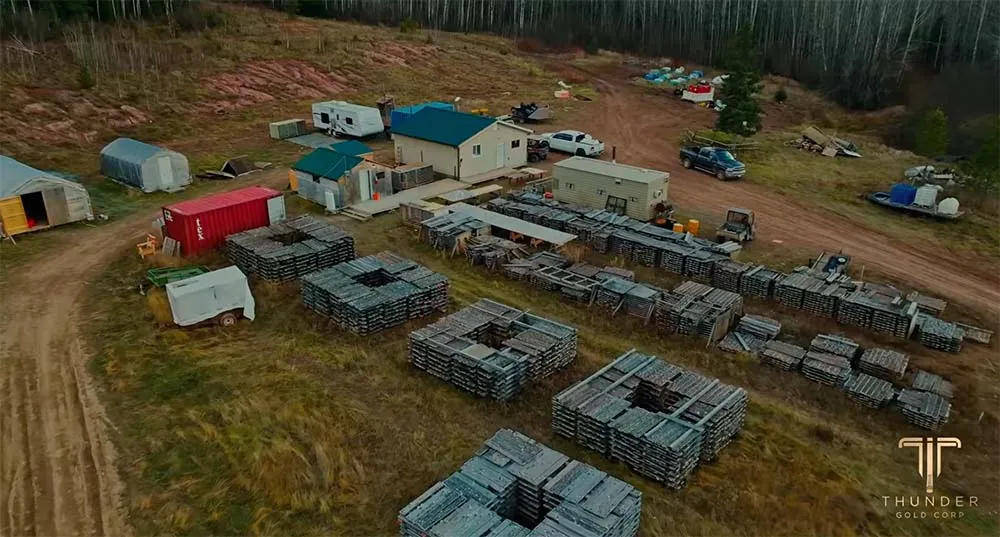
Thunder Gold's 3.5Moz Tower Mountain project targets 5Moz + PEA by year-end, with low strip ratio, tier-one Ontario location, and three untested contacts offering 12Moz upside.
- Thunder Gold Corp (TSXV:TGOL) has a maiden resource estimate of 3.5 million ounces at its Tower Mountain gold project in Ontario, comprising 3 million inferred and 500,000 indicated ounces, with a year-end target of 5 million ounces accompanied by a preliminary economic assessment.
- The deposit is interpreted as an intrusion-related gold system with exceptional geological consistency, with 180 of 190 drill holes averaging 0.33 to 0.37 g/t across full hole lengths regardless of depth or rock type, a characteristic CEO Wes Hansen describes as the most well-behaved data set he has encountered in 45 years of practice.
- Tower Mountain sits 40 kilometres from Thunder Bay with paved highway, rail, and power infrastructure within 3 kilometres of the resource pit, a logistical profile that materially reduces capital requirements compared to remote northern development projects.
- Three unexplored contacts on the north, east, and south sides of the intrusive body carry matching geophysical signatures to the known western contact resource, suggesting potential for the project to grow toward 12 million ounces - a scale that would place it among Canada's generational gold assets.
- With approximately $5 million in treasury, a cost-disciplined management team directing 66 cents of every dollar raised into drilling, and $8 million in built-in warrant financing, Thunder Gold is positioned to execute an infill and expansion program that could significantly re-rate the stock relative to comparable advanced development assets.
Thunder Gold Corp (TSXV: TGOL) is advancing one of Ontario's larger undeveloped gold projects, with a recently published resource estimate and an aggressive infill and expansion drilling program planned for the year ahead.
Thunder Gold Corp's Tower Mountain gold project, located 40 kilometres from Thunder Bay in northwestern Ontario, has attracted growing attention following the release of a maiden resource estimate totalling 3.5 million ounces. The deposit comprising 3 million ounces in the inferred category and 500,000 ounces indicated sits in a jurisdiction ranked second in Canada by the Fraser Institute, with existing road, rail, and utility infrastructure in close proximity. President and CEO Wes Hansen, a geologist with 45 years of experience across open-pit and underground operations in Canada, Nevada, and Russia, joined the company after reviewing its data set and concluding it represented one of the most consistent and compelling large-tonnage gold opportunities he had encountered in his career.
The company is now focused on converting that resource into a more investable asset through infill drilling, pit expansion, and a preliminary economic assessment with a five million ounce total resource target set for the end of the year.
Consistency as a Value Driver
The Tower Mountain project is situated in a Canadian Archean greenstone belt, but its geological character diverges from the narrow, high-grade vein systems that typify most Ontario gold deposits. Hansen interprets the mineralization as intrusion-related, with gold distributed through a large disseminated pyrite cloud extending approximately 500 metres in radius around a central intrusive body.
Of the 190 drill holes completed on the property (representing 47,000 metres of drilling), roughly half of which was completed under current management, 180 returned average grades of 0.33 to 0.37 g/t over the full length of the hole, from collar to bottom, regardless of depth, rock type, or distance from the intrusive core.
"It's like the most well-behaved data set I've looked at in 45 years," Hansen said. "As far as I'm concerned, this is all about how you engineer it."
That predictability is central to Hansen's investment case. In low-grade, large-tonnage open-pit mining, the ability to consistently meet production targets is a core determinant of economic viability. Projects that deliver predictable grades reduce operational risk, improve financing conditions, and support the kind of long-duration mine plans that attract senior and mid-tier producers looking to replace depleting reserves.
The deposit's current resource sits within a pit shell carrying a 1.8:1 strip ratio, among the lowest for large-tonnage Canadian gold projects, and mineralization begins at surface, eliminating pre-stripping complexity in early mine planning.
Interview with Wes Hanson, President & CEO of Thunder Gold Corp.
Location and Infrastructure
Tower Mountain's proximity to Thunder Bay provides infrastructure advantages that distinguish it from many Canadian development-stage gold projects. Paved highway access, rail connections, and power infrastructure are all within three kilometres of the defined resource pit. The project is accessible year-round, and future employees could commute daily from Thunder Bay that is approximately 40 minutes away.
This profile places Tower Mountain in a different cost and permitting category from remote northern projects, where infrastructure construction can represent a substantial proportion of capital expenditure. Hansen draws comparisons to Detour Lake, Troilus, First Mining Gold's Springpole project, and Artemis Gold's Blackwater project in British Columbia, a peer group of large-tonnage, long-life open-pit deposits that have either been acquired, financed, or advanced to production in recent years.
Ontario's regulatory environment adds further appeal. The province has been working to streamline mine permitting, and Hansen noted that broader political momentum in Canada toward reducing project development timelines could benefit Tower Mountain's path toward a formal economic study.
Resource Growth: The Exploration Upside
The current 3.5 million ounce resource covers the western contact of the intrusive body. The remaining three contacts: north, east, and south, represent approximately 7,000 metres of unexplored strike length with no drill holes to date. Geophysical surveys over these areas show anomalies that closely mirror the signature associated with the known western contact mineralization.
Hansen is direct about the scale of potential this implies.
"If I've got three and a half million there and I've got a pretty good chance I'm going to find at least three and a half million at one of the other three locations," he said. "My own personal feeling is I'm going to find three and a half million to the north, three and a half million to the east, three and a half million to the south."
That scenario would produce a total resource of more than 12 million ounces, a scale that would shift Tower Mountain into the category of generational, multi-decade assets. While exploration results remain to be tested, the geophysical basis for the hypothesis appears methodologically grounded.
Additionally, Hansen notes that intrusion-related deposits typically express low-grade, disseminated mineralization near surface, transitioning to sheeted vein systems at depth with grades in the two to three gram per ton range. If that structural model holds at Tower Mountain, deeper drilling could define higher-grade zones that materially improve the economics of the project and attract a different category of development capital.
Capital Allocation and Near-Term Milestones
Thunder Gold recently closed a financing that brought total treasury to approximately $5 million, approximately 60% of which is flow-through capital designated for exploration spending. The company also has 80 million warrants outstanding at an exercise price of 10 cents, with an early trigger at 20 cents representing a built-in $8 million financing mechanism that management expects to be exercised during the current year.
The near-term program has three priorities: first, infill drilling to convert the existing inferred resource to the indicated category. Second, targeted expansion drilling immediately adjacent to and below the current pit shell to grow the resource within the defined western contact. Third, delivery of a preliminary economic assessment alongside a five million ounce total resource estimate by year end.
Hansen noted that the company has been cost-disciplined with limited overhead and a focused conference strategy. The approach reflects a view that drill results, not marketing activity, are the primary value driver at this stage of development.
Positioning for Mid-Tier Acquisition Interest
The timing of Tower Mountain's development coincides with a gold price environment that has materially improved the economics of lower-grade deposits. At sustained gold prices above $5,000 per ounce, projects that were marginal at $1,500 carry substantially improved internal rates of return, and the strategic calculus for mid-tier and senior producers seeking reserve replacement has shifted accordingly.
"These smaller producers that are in the 100 to 500,000 ounce a year of production — they have more cash than they've ever had at any stage in their development and dwindling reserves. And they're going to be looking for projects that give them security for 20 years or more."
Hansen's thesis is that smaller producers generating strong cash flow at current gold prices will increasingly look to acquire development-stage assets with long mine lives. Tower Mountain, an open-pit project with low strip ratio, surface mineralization, existing infrastructure access, and a clear path to five million ounces, fits that acquisition profile.
The Investment Thesis for Thunder Gold
- Resource conversion optionality: Conversion of inferred to indicated ounces through infill drilling is the highest near-term value lever, with per-ounce valuations potentially tripling or quadrupling on category reclassification alone.
- Low-cost infrastructure access: Paved highway, rail, and power within 3 km of the pit, combined with daily commute distance from Thunder Bay, substantially reduce capital intensity relative to remote Canadian projects.
- Exploration upside at limited incremental cost: Three unexplored contacts with matching geophysical signatures offer potential to multiply the resource base without requiring greenfield exploration risk.
- Strip ratio advantage: A 1.8:1 strip ratio is among the lowest for large-tonnage Canadian open-pit gold projects, supporting competitive operating cost assumptions in early economic modelling.
- Built-in financing mechanism: 80 million warrants at 10 cents provide $8 million in potential treasury upside without additional dilutive equity raises, contingent on share price performance.
- Acquisition target profile: The project's scale, jurisdiction, infrastructure, and low-grade consistency match the criteria mid-tier producers typically apply when evaluating reserve replacement acquisitions.
- PEA catalyst: Delivery of a preliminary economic assessment alongside a five million ounce resource by year end provides a concrete near-term re-rating catalyst for investors.
The Large-Tonnage Gold Opportunity in a $5,000+ Price Environment
The sustained rise in gold prices has fundamentally altered the economic viability of large-tonnage, lower-grade open-pit deposits, a category that was frequently dismissed during the extended period of sub-$2,000 gold. Projects carrying grades in the 0.4 to 0.6 g/t range, once considered borderline or marginal, now generate materially improved operating margins and internal rates of return that meet institutional investment thresholds.
This shift has created a structural supply gap at the mid-tier and senior producer level. The pipeline of large, permitted, development-ready gold projects has thinned considerably over the past decade as exploration capital contracted and project acquisition activity absorbed the most advanced assets. Producers generating record cash flows at today's gold prices face an accelerating reserve replacement problem and fewer obvious targets to address it.
The response is already visible in deal activity. Projects in the five to fifteen million ounce range, located in stable jurisdictions with existing infrastructure, have attracted acquisition interest and premium valuations. The set reflects a well-understood playbook: build a large-tonnage resource in a tier-one jurisdiction, demonstrate economic viability through a credible PEA, and position the asset for acquisition or joint venture by a producer seeking long-duration mine life.
For exploration and development companies operating in this space, the current environment rewards exactly the qualities Thunder Gold's Tower Mountain appears to possess: predictable grade distribution, infrastructure proximity, low strip ratios, and a clear path to resource growth. The macro tailwind is real, but execution remains the differentiating variable.
TL;DR
Thunder Gold Corp holds a 3.5 million ounce gold resource 40 km from Thunder Bay, Ontario, with one of the lowest strip ratios in Canada at 1.8:1, exceptional drill hole consistency across 47,000 metres of historical and current drilling, and three untested intrusive contacts that could push the total resource toward 12 million ounces. Management is targeting 5 million ounces and a PEA by year-end using $5 million in treasury, with an additional $8 million in warrant financing expected to follow. At current per-ounce market valuations of $10–20, the stock trades at a significant discount to comparable advanced development peers, and infill drilling converting inferred to indicated ounces is the clearest near-term catalyst for re-rating.
Frequently Asked Questions (FAQs) AI-Generated
Tower Mountain is an early-stage development project with a maiden resource estimate of 3.5 million ounces, comprising 3 million inferred and 500,000 indicated ounces. The company is working toward a preliminary economic assessment alongside a 5 million ounce resource target by the end of the current year. No production decision has been made, and the project has not yet reached feasibility study stage.
Grade must be evaluated alongside strip ratio, infrastructure access, and deposit geometry. Tower Mountain's 1.8:1 strip ratio is among the lowest for large-tonnage Canadian open-pit projects, and its mineralization begins at surface. At sustained gold prices above $3,000 per ounce, the economics of deposits in this grade range have materially improved, and the deposit's high geological consistency reduces the operational variability that tends to erode margins at low-grade mines.
Resource category classification directly affects how the market values ounces in the ground. Inferred ounces typically trade at $10–20 per ounce in market capitalization terms, while indicated ounces can command $50–60 per ounce or more. Converting the existing inferred base through infill drilling — without discovering a single new ounce — could therefore produce a significant re-rating of the company's market capitalization.
The current 3.5 million ounce resource covers only the western contact of the central intrusive body. The north, east, and south contacts represent approximately 7,000 metres of unexplored strike length, all showing geophysical signatures consistent with the known mineralized western contact. If those contacts host comparable mineralization, the total resource could reach 12 million ounces. Additionally, intrusion-related deposits often transition to higher-grade sheeted vein systems at depth, which could further improve project economics.
Management identifies mid-tier gold producers in the 100,000 to 500,000 ounce per year production range as the most probable strategic interest. These companies are generating significant cash flow at current gold prices but face declining reserve bases and are actively seeking long-life, development-ready assets in stable jurisdictions. Tower Mountain's combination of scale, infrastructure access, low strip ratio, and Ontario jurisdiction makes it a credible fit for that acquisition mandate.
Analyst's Notes





Subscribe to Our Channel









.jpg)



Stay Informed






















