




TRX Gold Adds Second Major Index Nod as Quarterly Results Strengthen the Balance Sheet


TRX Gold joins the MVIS Global Junior Gold Miners Index as record quarterly production, stronger earnings, and liquidity support Buckreef project expansion plans
- TRX Gold was added to the MVIS® Global Junior Gold Miners Index effective September 21, 2026, following its March 2026 inclusion in the S&P/TSX Global Mining Index.
- Third-quarter 2026 gold production increased 58% year over year (YoY) to 7,426 ounces, while throughput rose 16% to 1,690 tonnes per day.
- Quarterly revenue reached $32.8 million, and adjusted earnings before interest, taxes, depreciation, and amortization (EBITDA) totaled $20.7 million, supported by higher production and an average realized gold price of approximately $4,703 per ounce.
- TRX Gold held $26.8 million in cash and had access to $40 million in supplemental liquidity as of May 31, 2026, supporting its processing plant expansion.
- As of July 10, 2026, TRX Gold traded below peer averages on estimated 2027 EBITDA and net asset value (NAV) multiples, but above peers on an enterprise value (EV) per-ounce basis.
Index Addition Raises the Question of Whether the Market Will Follow
TRX Gold Corporation (TSX: TRX | NYSE American: TRX) has been added to the MVIS® Global Junior Gold Miners Index (MVGDXJ) following the third quarter 2026 index rebalance, announced September 11, 2026, with the new composition taking effect September 21, 2026. The more interesting question isn't that the index added TRX Gold, but whether the market will follow. The company just posted record throughput and production, along with record net income and adjusted earnings before interest, taxes, depreciation, and amortization (EBITDA), at its Buckreef Gold Project in Tanzania. As of the last available data point, it still traded at a discount to peers on two of three valuation measures, and no post-announcement multiples yet exist to assess whether that has changed.
Fixed September Rebalance Timeline Sets the Effective Date
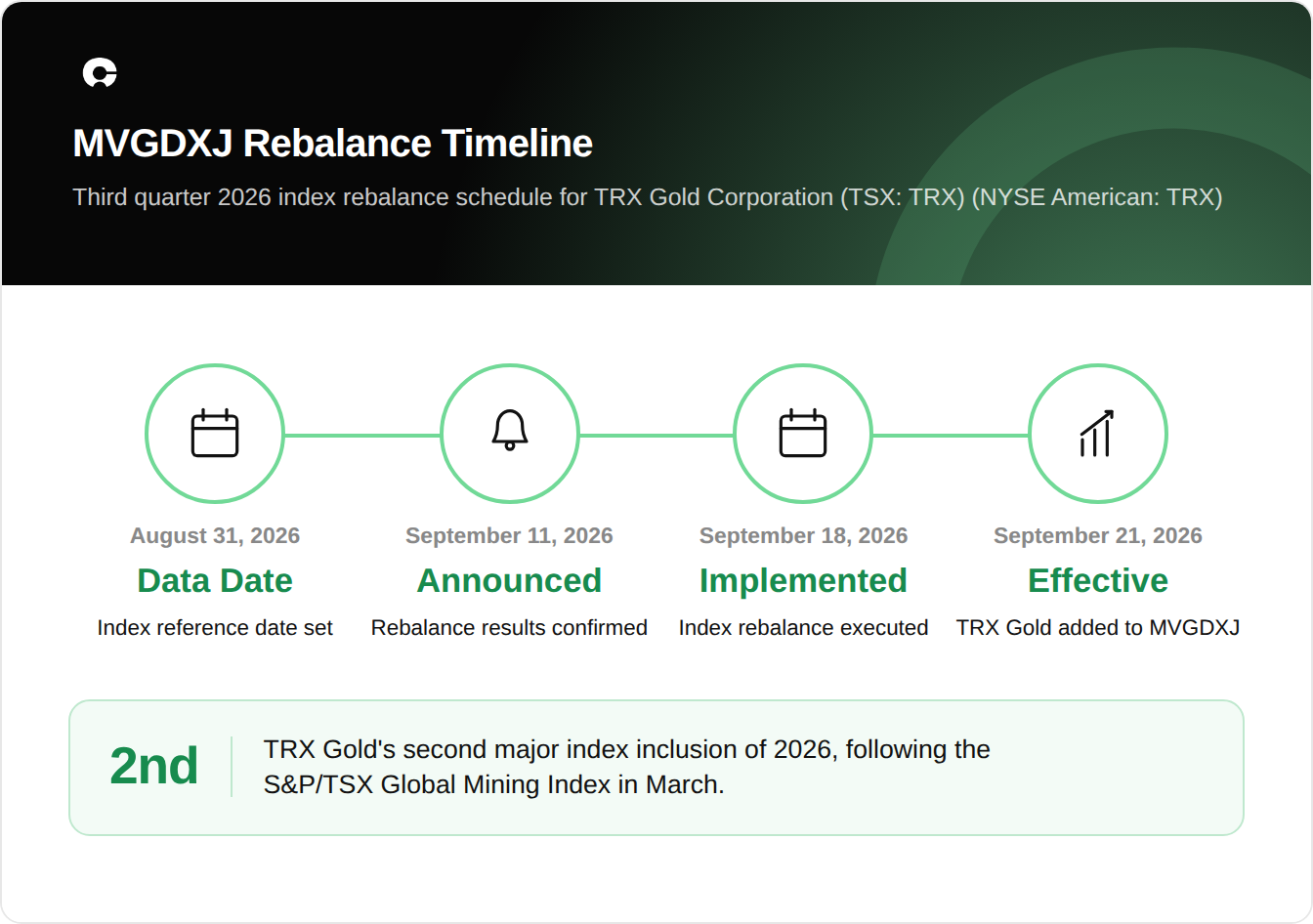
The third quarter 2026 rebalance follows a fixed schedule set by the index provider: the index data and reference date was August 31, 2026, the rebalance announcement came September 11, 2026, implementation occurs September 18, 2026, and the new composition, including TRX Gold, becomes effective September 21, 2026, the next trading day after implementation. MVGDXJ requires constituents to derive at least 50% of their revenue or hold at least 50% of their mineral resources from gold or silver mining. That threshold functions less as a badge and more as a gatekeeping test: passing it is what makes TRX Gold visible to the index-tracking capital that doesn't do its own bottom-up screening.
Mullowney Ties MVGDXJ Inclusion to Potential GDXJ ETF Exposure
According to CEO of TRX Gold, Stephen Mullowney, the MVGDXJ addition follows the company's earlier addition to the S&P/TSX Global Mining Index, announced on March 28, and reflects that TRX Gold has now met the criteria for a second major index within the same year.
Mullowney described MVGDXJ as "an important benchmark requirement for many large investment funds," and tied the addition to the possibility of inclusion in the VanEck Junior Gold Miners ETF (GDXJ®), which seeks to replicate, as closely as possible, before fees and expenses, the price and yield performance of MVGDXJ. The distinction that matters for investors is that meeting MVGDXJ's criteria is what makes GDXJ inclusion possible, not a confirmation that it will happen or how much capital would follow if it did.
Buckreef Quarter Supplies the Operating Evidence, With a Caveat on the Price Base

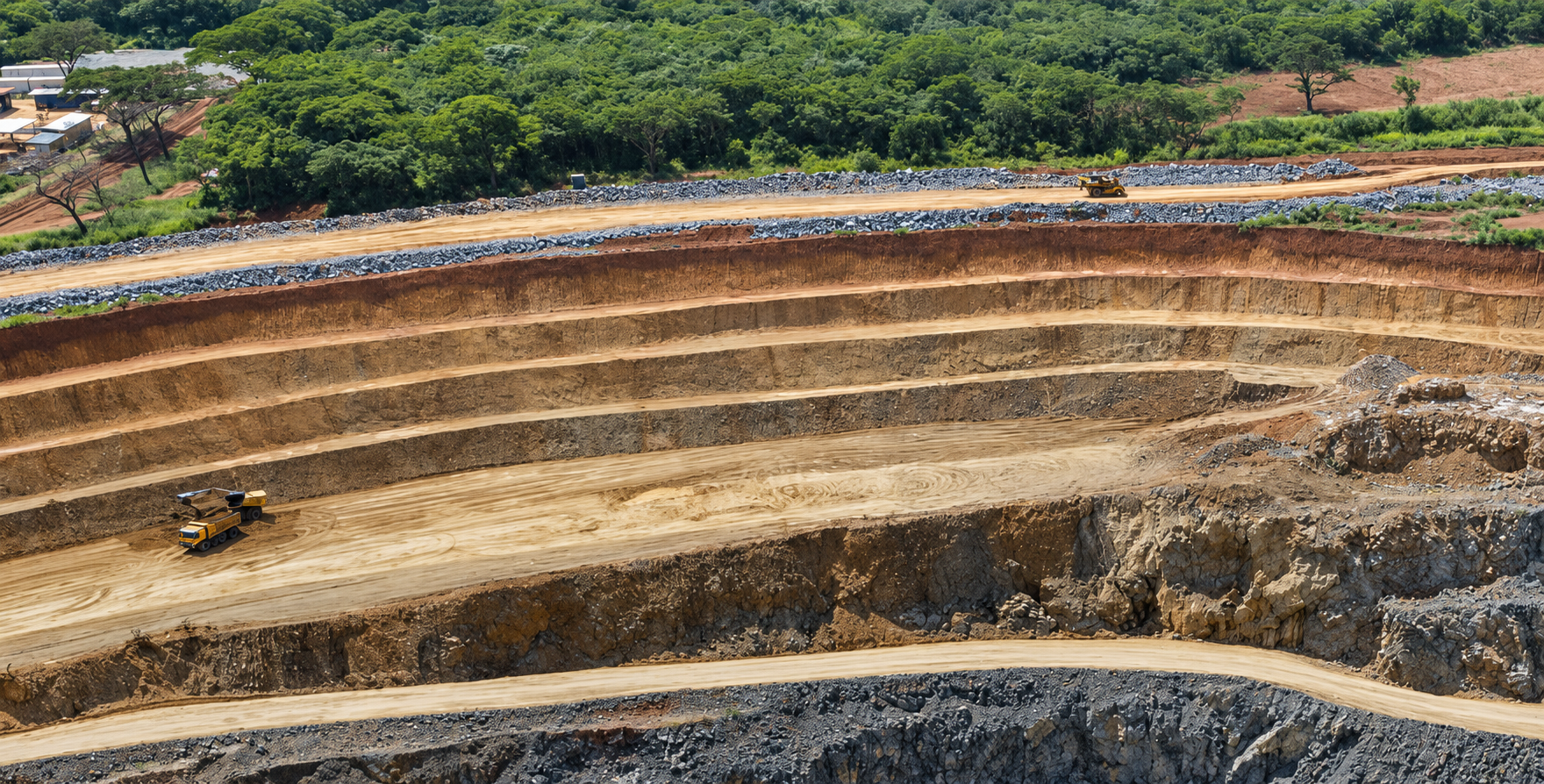
Buckreef Gold is an established open-pit gold mine with a 2,000 tonnes per day processing plant, held under a joint venture structure of 55% TRX Gold and 45% STAMICO, the government of Tanzania, giving the Tanzanian government a direct 45% stake in the project. The project's third quarter 2026 results, for the period ended May 31, 2026, are the operating evidence behind the index case: quarterly throughput of 1,690 tonnes per day, a 16% increase from 1,461 tonnes per day in the third quarter of 2025, and gold production of 7,426 ounces, up 58% from 4,687 ounces a year earlier. Revenue reached $32.8 million, up from $12.5 million, driven by higher production and an average realized gold price of approximately $4,703 per ounce, a 51% increase from $3,114 per ounce in the prior-year quarter. Both increases contributed to the revenue gain, though the source does not specify their relative weight, and neither source states whether the current price level is expected to persist.
Why This Matters for Investors, and What Still Has to Be Built
The index addition and the quarterly results raise the same underlying question: whether operating scale, once recognized by an index provider, converts into the institutional and passive capital that narrows a valuation gap, or whether the gap persists regardless. Working capital stood at $36.3 million as of May 31, 2026, against a cash position of $26.8 million and borrowings of just $2.9 million, with undrawn credit lines and $40 million in supplemental liquidity available: a $25 million at-the-market facility, a $15 million credit facility, and a gold pre-payment facility. That funding structure is what allows management to pursue the current processing plant expansion, adding 3,500-plus tonnes per day of capacity alongside the existing 2,000-tonne-per-day plant, using existing cash flow rather than the equity market. The expansion is underway, distinct from the three prior mill expansions the company has already completed on time and on budget since 2021, and its completion on a similar timeline is not established by either source.
Valuation Multiples Still Lag Peers on Two of Three Measures
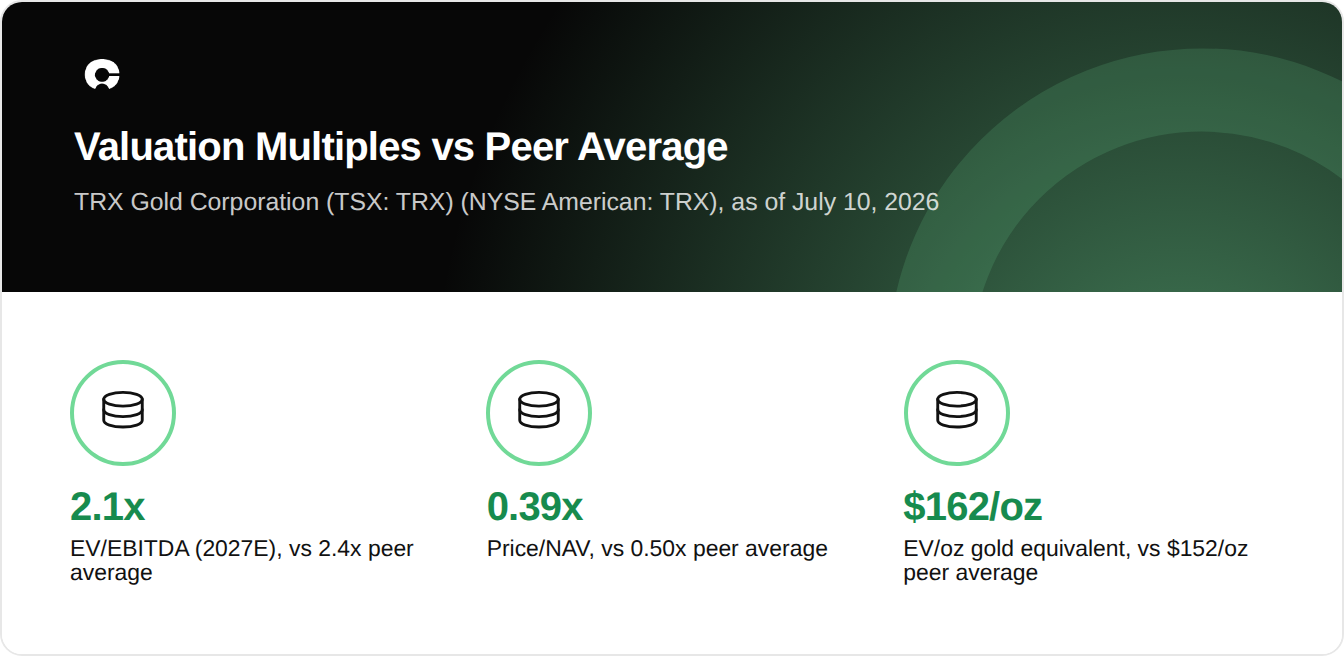
As of July 10, 2026, prior to the MVGDXJ announcement, TRX Gold traded at an enterprise value (EV) to 2027 estimated EBITDA multiple of 2.1 times against a producer peer average of 2.4 times, and a price to net asset value (NAV) multiple of 0.39 times against a peer average of 0.50 times, per the company's July 2026 corporate presentation, which cites FactSet, broker research, and company disclosure as its sources for the peer set. On an EV per ounce of gold-equivalent basis, the company traded at $162 per ounce against a peer average of $152 per ounce, the one metric on which TRX Gold already traded above peers as of that date.
An updated Preliminary Economic Assessment (PEA) is targeted for the fourth quarter of 2026. The study aims to increase nameplate processing capacity from 3,000 tonnes per day to 5,500 tonnes per day, building on the current PEA which outlines average annual gold production of 62,000 ounces over a 17.6-year mine life. That update is a targeted outcome, not a delivered result, and whether it, alongside the two index additions, narrows the remaining gap on the EBITDA and NAV multiples is an open question rather than a foregone conclusion.
FAQs (AI-Generated)
Analyst's Notes





Subscribe to Our Channel



.png)





Stay Informed






















