




Fed Odds Jump to 66.4%, Pressuring Gold But Mine Economics Stay Below Spot



Fed hike odds rose to 66.4%, pressuring gold while central-bank demand and below-spot mine assumptions support longer-term gold exposure.
- Market-implied odds of a 25 basis point September Fed hike rose from roughly one-third to 66.4% in the week ending August 28, 2026, after Chair Kevin Warsh signaled that inflation could require further tightening.
- The shift toward higher September rate expectations pulled spot gold from a three-month high toward $4,420 per ounce as higher expected real rates increased the opportunity cost of holding a non-yielding asset.
- The US Treasury's planned increase in long-bond buybacks from $2 billion to at least $4 billion per operation and renewed military risk near the Strait of Hormuz support gold through fiscal and safe-haven channels that do not depend on the September Fed decision.
- Published mine and development studies for Florida Canyon in Nevada and Porvenir in Nicaragua use gold prices of $3,873 and $3,150 per ounce, respectively, leaving project economics underwritten below current spot.
- The August nonfarm payrolls report, due September 4, 2026, is the final major labor release before the September Fed meeting, with a strong print likely to reinforce hike pricing and pressure gold while a weak print would strengthen the case for a hold.
Fed Hike Repricing Pressures Gold as Spot Prices Outpace Producer Realizations
Spot gold is trading between roughly $4,420 and $4,500 per ounce in early September 2026 after a two-week pullback from its January 29 record high, as markets repriced the probability of a September Fed hike. The speed of that repricing shows how quickly rate expectations can move spot gold even when the mine economics underpinning producer and developer valuations remain unchanged.
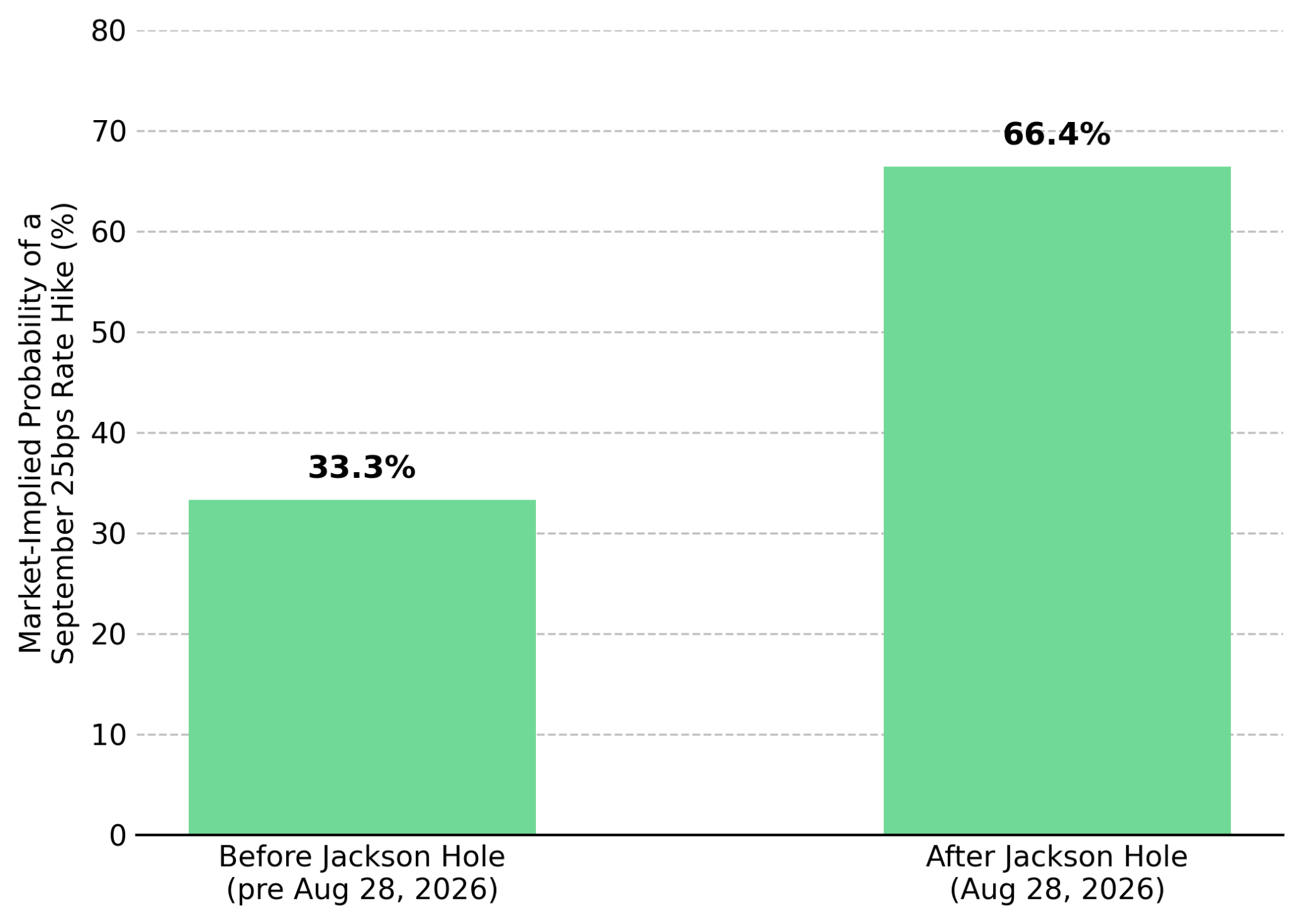
Before Chair Kevin Warsh spoke at Jackson Hole, market-implied probabilities put the chance of a September Fed hold at 60.4%. After his August 28 remarks, the probability of a 25 basis point September hike rose to 66.4%, reversing the market’s previous preference for a hold within days. The speed of the shift shows how quickly Fed communication can change near-term rate pricing and, through higher expected real rates, pressure gold. The same distinction between current spot prices and realized annual averages matters for producer economics because revenue reflects prices received across the year rather than the latest market quote.
Mike Hodgson, Chief Executive Officer of Serabi Gold, notes how a full year's average price gets confused with its final months:
"Our average gold price for the year was $3,451… It was only November and December that we popped to $4,000 and $4,500, and everyone seems to think that was all of the year."
Serabi Gold’s $3,451 per ounce average realized price shows why current spot levels can overstate the price captured across a full reporting period. The distinction matters for producer cash flow because revenue reflects prices realized throughout the year rather than the latest spot quote.
Warsh’s Hawkish Signal Reprices September Rates & Pressures Gold
Warsh told the Jackson Hole symposium on August 28, 2026 that the Fed still had work to do if underlying inflation was not clearly returning to target. The remarks challenged a market that had assigned a 60.4% probability to a September hold and shifted pricing toward a higher policy rate. Higher expected real rates increase the opportunity cost of holding non-yielding gold relative to interest-bearing assets, contributing to spot gold’s pullback from a three-month high toward the $4,420 support area.
Payrolls Will Test Fed Hike Pricing & Gold’s Near-Term Direction
The August nonfarm payrolls report, due September 4, 2026, is the final major labor-market release before the FOMC’s pre-meeting blackout period. A payroll result above consensus would strengthen the case for a September hike, supporting higher rate expectations and adding pressure to non-yielding gold. A below-consensus result would strengthen the case for a hold and could reverse part of the post-Jackson Hole rate repricing before the September 15-16 FOMC meeting, reducing near-term rate pressure on gold.
Gold Retains Central-Bank, Fiscal & Geopolitical Support Beyond the Fed Rate Path
A Fed rate decision changes the opportunity cost of holding non-yielding gold relative to interest-bearing Treasuries. It does not directly alter central-bank reserve buying, the US Treasury’s expanded bond buyback program, or geopolitical risk around the Strait of Hormuz, which operate through channels separate from the September rate decision.
China’s 21-Month Gold Buying Streak Signals Demand Beyond Fed Rates
The People’s Bank of China added 20 metric tons of gold in July 2026, its largest monthly increase since October 2023, extending its buying streak to 21 months and lifting official holdings to 2,366 metric tons. The World Gold Council’s Central Bank Gold Reserves Survey found that 89% of respondents expect global central-bank gold reserves to increase over the next 12 months, while 45% expect their own institutions to add gold. China’s 21-month buying streak predates the August Fed repricing, showing that at least part of official-sector gold demand is driven by longer-term reserve allocation rather than the September rate decision.
Higher Treasury Yields & Deficit Financing Keep Fiscal Support for Gold in Focus
The US Treasury announced on August 19, 2026 that it would at least double liquidity-support buybacks for longer-dated nominal Treasuries from $2 billion to at least $4 billion per operation, effective September 9 through November 4. The announcement followed the 30-year Treasury yield reaching 5.337% on August 19, a 19-year high, showing the pressure that elevated government borrowing costs were placing on the long end of the Treasury market. A Fed hike would raise the opportunity cost of holding non-yielding gold relative to cash and Treasuries. CBO estimated a $1.8 trillion federal deficit through the first 10 months of fiscal year 2026, $169 billion above the comparable 2025 period, leaving Treasury financing needs elevated regardless of the September rate decision.
Strait of Hormuz Risk Supports Gold & Sharpens Mining Jurisdiction Risk
US forces struck Iranian rocket and sea mine positions near the Strait of Hormuz on August 30, 2026, the first such action in a month, on top of a standing US naval blockade of Iran that Washington estimates is costing Iran roughly $500 million daily. That risk premium carries a second implication specific to mining capital. The same instability lifting gold's safe haven bid also raises the relative value of politically stable, well ranked mining jurisdictions, a thread that runs directly into the company evidence below.
Below-Spot Mine Economics Reduce Exposure to Fed-Driven Gold Pullbacks
Integra Resources, a producer at the Florida Canyon heap leach mine in Nevada, built its mine plan on a weighted average gold price of $3,873 per ounce through 2035. This compares with the $4,426 per ounce it realized in the second quarter of 2026. The mine plan effective May 31, 2026, lifted proven and probable reserves 74% to 1.19 million ounces at 0.31 grams per tonne gold and extended the mine life to 2033, all underwritten before this month's rate surprise occurred.
Lower Gold Assumptions Support Cash Flow as Processing Recovery Drives Margins
Paul Chawrun, Chief Operating Officer of i-80 Gold Corp, a producer advancing a hub-and-spoke processing model in Nevada, explains Lone Tree’s projected cash flow at a $3,000 gold price:
"If you take a look at the gold price now, we estimated somewhere around $150 million to $200 million in net cash flow per year once it operates, in the range of $3,000 gold. If you take a look at the numbers now, of course it's much higher than that."
The $3,000 per ounce gold assumption underlying i-80 Gold’s estimated $150 million to $200 million in annual net cash flow sits roughly $1,400 below gold prices around $4,400 per ounce during much of the second quarter of 2026. Third-party toll milling currently limits i-80 Gold’s payability to 55% to 60% of contained gold, leaving a processing constraint that a higher spot price does not remove. The $430 million Lone Tree refurbishment is targeting first gold by year-end 2027 and approximately 92% owner-operated recovery, which would increase recovered ounces and reduce reliance on third-party toll milling if achieved.
Lower Cut-Off Grades Expand Mineable Ore as Higher Tonnage Reduces Costs
Shane Williams, President and Chief Executive Officer of West Red Lake Gold Mines, a producer at the Madsen Mine in Ontario's Red Lake district, points to how higher gold prices can expand mineable ore:
"Gold price is also a factor. With the increasing gold price, cut-off grade can come down a lot more, which allows a lot more material, which allows us to switch to that long-hole mining."
A cut-off grade is the minimum grade considered economic to mine and process, and lowering it can bring previously uneconomic material into the mine plan without requiring new discovery. West Red Lake Gold Mines reported second-quarter 2026 all-in sustaining costs of $3,284 per ounce sold, down 30% quarter over quarter, alongside a 46% increase in mined ore tonnage. The cost improvement came from mine-level operating performance rather than a change in the Fed rate path, reducing the operation’s sensitivity to short-term gold-price swings.
$3,150 Gold Base Case Supports Development Economics Below Current Spot
Mineros S.A. operates the Panamá and Pioneer mines in Nicaragua and is evaluating Porvenir, a separate pre-feasibility-stage development project on the same land package. The March 31, 2026 pre-feasibility study uses a base-case gold price of $3,150 per ounce and reports an after-tax net present value at a 5% discount rate of $460 million, a 37.9% after-tax internal rate of return, and a 2.0-year payback. With a construction decision targeted for early 2027, Porvenir’s $3,150 per ounce base case sits roughly $1,270 to $1,350 below early-September spot prices, leaving its published development economics less dependent on maintaining gold near current levels.
TRX Gold, which operates the Buckreef Gold open-pit mine in Tanzania, shows the same gap between spot and underwritten economics. The base-case valuation in its PEA relies on a consensus forecast stepping down from $2,707 to $2,245 per ounce, roughly $2,000 below early-September spot. Yet in fiscal Q3 2026 (ended May 31), TRX Gold sold gold at a record realized price of $4,703 per ounce, pushing quarterly adjusted EBITDA to $20.7 million and trailing-twelve-month EBITDA to $66.8 million, with $26.8 million in cash and the company effectively debt-free, outsized cash flow even against a conservatively anchored valuation.
Fed Rate Repricing Pressures Gold Without Changing Published Mine Assumptions
The September 4 payrolls report could reinforce or reverse part of the post-Jackson Hole rate repricing before the September 15–16 FOMC meeting. It cannot change the gold-price assumptions already embedded in published studies completed before the August 28 repricing. Florida Canyon’s $3,873 per ounce weighted average assumption and Porvenir’s $3,150 per ounce base case were established before Warsh’s remarks and remain below early-September spot prices.
A rate surprise can move near-term gold prices by changing the opportunity cost of holding non-yielding gold relative to Treasuries. It does not retroactively change China’s 21-month official-sector buying streak, the Treasury buyback schedule already announced for September through November, or mine plans and operating assumptions established before Warsh’s August 28 remarks. Those longer-dated demand drivers and published project assumptions therefore provide a separate basis for assessing gold exposure beyond the September rate decision.
The Investment Thesis for Gold
- Changes in Fed rate expectations can move gold within days, but they cannot retroactively alter the gold-price assumptions already embedded in published mine plans and pre-feasibility studies.
- The People’s Bank of China’s 21-month buying streak and World Gold Council survey data showing continued official-sector demand indicate that central-bank gold allocation operates on a longer horizon than the September Fed decision.
- The US Treasury’s expanded long-dated buybacks and elevated federal financing requirements show that fiscal and Treasury-market pressures remain separate from the September Fed decision.
- Florida Canyon’s $3,873 per ounce weighted average assumption and Porvenir’s $3,150 per ounce base case reduce their published economics’ dependence on gold remaining near its current spot.
- Company-level operating catalysts can also remain separate from the Fed rate path, with higher mined tonnage reducing unit costs at Madsen and Lone Tree targeting greater owner-operated recovery and less reliance on third-party toll milling.
Near-term Fed repricing can move spot gold within days, while mine plans and development studies are built on assumptions established over much longer periods, so the two should be assessed separately when evaluating gold exposure.
TL;DR
September Fed hike odds rose to 66.4% after Chair Kevin Warsh’s Jackson Hole remarks, pushing gold toward $4,420 as higher expected rates increased the cost of holding a non-yielding asset. The September 4 payrolls report could reinforce or reverse part of that repricing. Longer-term gold support remains separate from the Fed decision, including China’s 21-month buying streak, expanded US Treasury buybacks, and geopolitical risk around the Strait of Hormuz. Company economics also remain underwritten below current spot, with Florida Canyon using a $3,873 per ounce weighted average assumption and Porvenir a $3,150 base case, reducing their dependence on gold maintaining current prices.
FAQs (AI-Generated)
Analyst's Notes





Subscribe to Our Channel






.png)




Stay Informed






















