




Tudor Gold's Mineral Resource Update: 10 Things You Need to Know


Tudor Gold's Treaty Creek update: 24.9M oz gold (up 15%), high-grade cores at 2.33-4.02 g/t. PEA expected 2026 for 300k oz/year underground mine in Golden Triangle.
- Tudor Gold released an updated Mineral Resource Estimate for its Treaty Creek Goldstorm Deposit, increasing Indicated resources by 15% to 24.9 million ounces of gold, plus 148.7 million ounces of silver and 3 billion pounds of copper
- Higher-grade sensitivities demonstrate exceptional potential: at $175/tonne NSR cut-off, the deposit contains 3.4 million ounces at 2.33 g/t gold in Indicated resources - triple the base case grade
- The company is advancing toward an underground mining scenario targeting approximately 300,000 ounces of gold production annually, with metallurgical testing underway and mine planning initiated
- Treaty Creek represents one of the largest undeveloped gold deposits in Canada's prolific Golden Triangle, strategically located between Seabridge Gold's KSM project and Newmont's producing Brucejack Mine
- A preliminary economic assessment is expected later in 2026, representing a significant de-risking milestone as Tudor transitions from exploration to development planning
Treaty Creek Project Overview
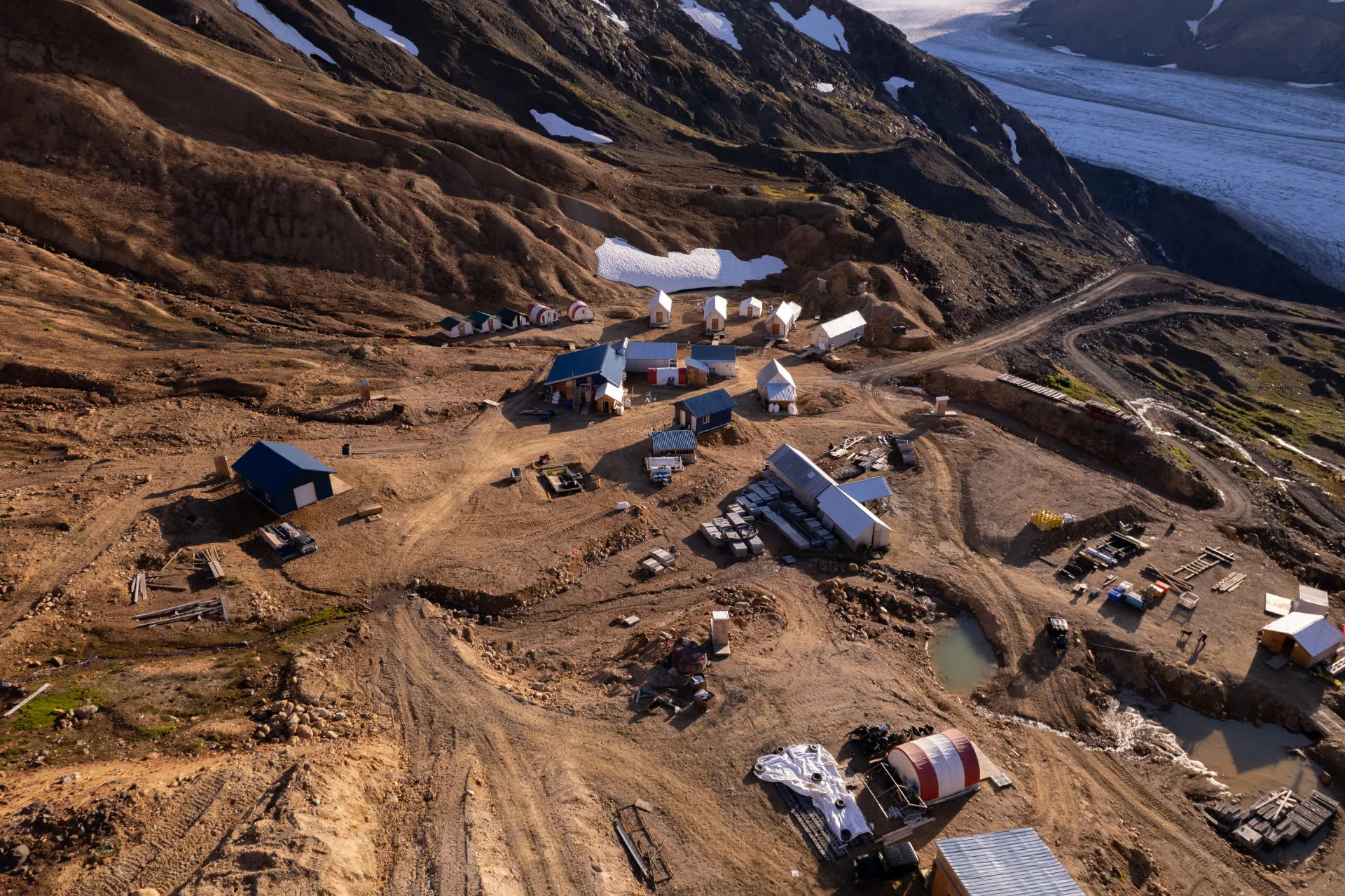
The Treaty Creek Project is an 80%-owned flagship property located in British Columbia's Golden Triangle, one of the world's most prolific mining districts. The project hosts the Goldstorm Deposit, a large-scale gold-copper-silver system discovered and expanded through systematic drilling since 2016.
Tudor Gold has completed 332 drill holes totaling over 191,000 meters, defining a mineralized system that extends over 400 meters along strike and remains open for expansion. The deposit sits strategically between two major neighbors: Seabridge Gold's massive KSM project to the southwest and Newmont Corporation's operating Brucejack Mine to the southeast.
The Golden Triangle has historically produced over 130 million ounces of gold and silver, and continues to attract major mining investment due to its world-class geology, established infrastructure, and mining-friendly jurisdiction.
1. The Numbers: Resource Highlights
The 2026 Mineral Resource Estimate, prepared by independent qualified person Garth Kirkham of Kirkham Geosystems, shows substantial scale at the base case $50/tonne net smelter revenue (NSR) cut-off.
Indicated resources total 912.3 million tonnes grading 0.85 g/t gold, 5.07 g/t silver, and 0.15% copper, containing 24.9 million ounces of gold, 148.7 million ounces of silver, and 3 billion pounds of copper. Inferred resources add another 86.1 million tonnes containing 4.0 million ounces of gold.
This represents a 15% increase in Indicated gold ounces compared to the 2024 resource estimate, reflecting continued geological understanding and refinement of the deposit model rather than new drilling.
The resource is reported at a conservative $50/tonne NSR cut-off value based on metal prices of $2,925/oz gold, $34/oz silver, and $4.25/lb copper - all below current market prices. With gold now trading around $5,040/oz and silver near $105/oz (69% and 150% above the resource assumptions respectively), the economic potential has improved substantially since the estimate parameters were set.
2. Higher-Grade Sensitivities: The Underground Mining Case
While the base case resource demonstrates enormous scale, the higher-grade sensitivities reveal the deposit's true potential for underground mining economics. These sensitivities show how grade increases as lower-grade material is excluded using higher cut-off values.
At a $125/tonne NSR cut-off, Indicated resources contain 5.8 million ounces at 1.78 g/t gold (more than double the base case grade) in 102.1 million tonnes. Inferred resources at this cut-off grade 3.64 g/t gold, demonstrating the high-grade core within the broader mineralized system.
At a $175/tonne NSR cut-off, Indicated resources contain 3.4 million ounces at 2.33 g/t gold in 45.1 million tonnes, nearly triple the base case grade. Inferred resources at this level grade an impressive 4.02 g/t gold.
These higher-grade sensitivities are not classified as mineral resources themselves, but rather demonstrate the deposit's potential to support selective underground mining methods targeting the highest-grade mineralization. This approach could enable a smaller-scale, higher-margin operation compared to bulk mining the entire resource.
3. Mining Strategy: Underground Development Focus
Tudor Gold's strategic direction has evolved toward underground mining, targeting approximately 300,000 ounces of gold production annually. This represents a significant shift from earlier bulk-tonnage concepts toward a more focused, high-grade approach.
Underground mining offers several advantages for Treaty Creek's geology. The deposit consists of five distinct mineralized domains dipping approximately 45-50 degrees to the northwest, making them well-suited for selective underground extraction methods. The mineralization occurs in structurally controlled zones ranging from 10 to 50 meters thick, extending over 400 meters along strike - geometries that favor conventional underground mining.
Block caving was initially evaluated given the deposit's scale and geometry, but the company is now developing mine plans around higher-grade zones that may be better suited to conventional underground methods such as longhole stoping or sub-level caving. This approach allows Tudor to target the highest-grade material first, improving project economics and reducing initial capital requirements compared to block cave development.
The 300,000 ounce annual production target would position Treaty Creek as a mid-tier gold producer - smaller than neighboring KSM's planned 500,000+ ounce profile, but comparable to other successful underground operations in British Columbia.
4. Deposit Geology: Understanding the Mineralization
The Goldstorm Deposit comprises five distinct mineralized domains, each with unique characteristics:
- Copper Belle represents a gold-dominant, shear-hosted system at the southwest end of the deposit. This zone demonstrates the structural controls that focused mineralization throughout the system.
- 300H/300N forms a near-surface zone characterized by pervasive disseminated gold-bearing pyrite and fine pyrite veinlets. This zone offers potential for early mining in an underground development scenario.
- CS-600 hosts the core gold-copper mineralization associated with quartz veinlet stockworks, hydrothermal breccias, and porphyritic intrusive rocks. This domain contains the majority of the copper and represents a classic intrusion-related porphyry system. The CS-600 zone distinguishes Treaty Creek from pure gold deposits by adding copper credits that improve overall economics.
- Deep Stockwork 5 (DS5) comprises a gold-dominant quartz-pyrite veinlet stockwork beneath the upper zones, carrying minor silver values and demonstrating depth potential.
- Route 66 is a narrow, high-grade corridor of gold-dominant quartz stockwork mineralization striking north through the deposit. This 20-50 meter wide zone could provide high-grade feed for mill blending.
All zones are predominantly gold-focused with varying silver and copper content, creating a polymetallic deposit where by-product credits enhance economics. The mineralization is hosted in late-stage quartz-anhydrite-pyrite veins containing chalcopyrite, sphalerite, galena, and other sulphides - a mineral assemblage amenable to conventional flotation processing.
5. Metallurgical Testing: The Path to Processing
Metallurgical testing is currently underway with initial results expected in Q1 2026. This work is critical to determining optimal processing methods and confirming the recovery assumptions used in the resource estimate (90% gold, 80% silver, 80% copper).
The testing program will evaluate flotation performance to produce a gold-silver-copper concentrate suitable for conventional smelting. Key parameters include grind size requirements, concentrate grades, recovery rates across different ore types, and potential deleterious elements that could affect smelter terms.
Different mineralized domains may require different processing approaches. The copper-rich CS-600 material will be tested separately from the gold-dominant zones to optimize recovery and concentrate quality. Understanding metallurgical behavior by zone allows mine planners to design optimal blending strategies.
Positive metallurgical results confirming the resource assumptions would represent a significant de-risking milestone, validating the technical basis for mine planning and economic studies.
6. Resource Classification: Three-Zone Model
The 2026 resource estimate reorganizes the deposit into three main zones for clarity:
- Upper Zone comprises Copper Belle, 300H, and 300N domains, containing 12.8 million ounces of gold in 577.9 million tonnes of Indicated resources at 0.69 g/t gold. This zone offers near-surface access potential for underground development.
- Central Zone includes CS-600, Route 66, and SC-1 domains, containing 10.0 million ounces in 277.3 million tonnes at 1.12 g/t gold - the highest-grade zone with substantial copper content. This represents the core target for initial mining.
- Lower Zone comprises the DS-5 domain with 2.1 million ounces in 57.1 million tonnes at 1.15 g/t gold, demonstrating depth continuity and expansion potential.
This three-zone framework simplifies mine planning by grouping geologically similar domains with comparable processing characteristics. It also clarifies the vertical distribution of mineralization for underground design and sequencing.
7. Resource Methodology: Industry-Standard Approach
The resource estimate employed standard industry practices using Leapfrog and MineSight software with 10-meter block sizes. Assay data from 359 drill holes were composited to 1.5-meter intervals for consistent sample support.
Grade estimation used ordinary kriging constrained within geologically defined domains. High-grade caps were applied ranging from 5-19 g/t for gold, 0.1-2.0% for copper, and 50-100 g/t for silver based on statistical analysis and spatial continuity.
Resource classification as Indicated or Inferred depends primarily on drill hole spacing. Indicated resources require drill spacing less than approximately 100 meters, while Inferred resources extend to roughly 150-meter spacing where geological continuity supports reasonable grade estimation.
The estimate satisfies NI 43-101 requirements for "reasonable prospects of eventual economic extraction" through demonstrated geological continuity, appropriate mining method selection (underground), and reasonable metal price and cost assumptions.
8. Location & Infrastructure: Golden Triangle Advantages
Treaty Creek's location in the Golden Triangle provides several strategic advantages. The property is accessible year-round via the Brucejack Mine access road, eliminating the need to construct new primary access infrastructure. A significant capital and permitting advantage.
The region has established power infrastructure, skilled mining workforce, and supplier networks supporting multiple operating mines. British Columbia offers a stable, mining-friendly jurisdiction with clear permitting processes and established consultation frameworks with First Nations.
Proximity to Newmont's operating Brucejack processing facility and Seabridge's planned KSM development creates potential for infrastructure sharing or processing arrangements, though Tudor has not announced any such agreements.
The Golden Triangle's mining history and current operations demonstrate that projects can advance from discovery through permitting to production, reducing jurisdictional risk compared to frontier districts.
9. Next Steps: Toward Economic Assessment
Tudor Gold outlined a clear pathway forward focused on three parallel workstreams:
- Metallurgical testing will continue through Q1 2026, with results expected to confirm processing methods and recovery assumptions. This data feeds directly into economic modeling.
- Mine planning is underway to develop an optimal extraction sequence targeting higher-grade zones for an underground operation. This work will define mining methods, production rates, development requirements, and capital costs.
- Preliminary Economic Assessment (PEA) is expected later in 2026, assuming positive metallurgical results and successful mine plan development. The PEA will provide the first comprehensive economic analysis including capital costs, operating costs, production schedules, and financial returns.
Completion of a PEA represents a major de-risking milestone, transitioning Treaty Creek from a resource-stage project to a development-stage asset with defined economics. This study would position the project for Pre-Feasibility and Feasibility studies in subsequent years.
10. Exploration Upside: Room to Grow
While the current resource estimate is substantial, significant expansion potential remains. The mineralized system remains open along strike and at depth, with 2025 drilling confirming continuity beyond the current resource boundaries.
The deposit model identifies multiple parallel, stacked vein systems ranging from 10-50 meters thick, suggesting additional tonnage could be defined with continued drilling. The structural controls and hydrothermal alteration extend well beyond the currently defined resource, indicating a large mineralized footprint.
Beyond Goldstorm, the broader Treaty Creek property covers 17,913 hectares with multiple early-stage targets that have received limited exploration. These regional targets could host additional deposits within the property boundary.
Tudor's 80% ownership provides strong exposure to any resource growth or new discoveries, while joint venture partner American Creek Resources (20% interest) shares in exploration costs and upside potential.
For Investors: Key Takeaways
- Scale and grade: 24.9 million ounces of gold in Indicated resources represents one of Canada's largest undeveloped gold deposits, with higher-grade sensitivities showing 2.33-4.02 g/t gold cores suitable for underground mining
- Strategic location: Position between Seabridge's KSM and Newmont's Brucejack in the world-class Golden Triangle provides infrastructure access, established supply chains, and validation of district-scale potential
- Clear development pathway: Focus on 300,000 oz/year underground operation with ongoing metallurgy and mine planning sets stage for PEA completion in 2026 - a major de-risking catalyst
- Metal price leverage: Resource estimate based on $2,925/oz gold and $34/oz silver is 69% and 150% below current prices ($5,040/oz gold, $105/oz silver), providing significant upside to future economics
- Polymetallic value: 3 billion pounds of copper and 148.7 million ounces of silver provide by-product credits that enhance overall economics compared to pure gold deposits
The Bottom Line
Tudor Gold has delivered a substantial resource update that confirms Treaty Creek as one of Canada's premier undeveloped gold deposits. The 15% increase in Indicated resources to 24.9 million ounces of gold, combined with compelling higher-grade sensitivities, validates the company's transition from exploration to development planning.
The strategic pivot toward underground mining targeting 300,000 ounces annually represents a practical, economically focused approach that capitalizes on the deposit's high-grade zones while managing capital intensity. With metallurgical testing underway and mine planning initiated, Tudor is positioning for a preliminary economic assessment in 2026 that will provide the first comprehensive view of project economics.
Located in British Columbia's Golden Triangle between two major mining projects, Treaty Creek benefits from established infrastructure, mining-friendly jurisdiction, and validation of world-class geology. For investors seeking exposure to a large-scale, polymetallic deposit advancing toward economic definition in a rising gold price environment, Tudor Gold offers compelling leverage to one of North America's most significant undeveloped precious metals assets.
Analyst's Notes





Subscribe to Our Channel





Stay Informed






















