




Undervalued? Omai Gold Nears Key Catalyst as PEA Approaches for 8Moz Project


%20(1).png)
Omai Gold Mines: 8Moz in Guyana, trading at $150/oz vs $425–$600 in recent M&A. Imminent PEA expected to drive re-rating.
- Omai Gold Mines has grown its total gold resource to 8 million ounces across two deposits in Guyana, nearly doubling from 4.3 million ounces in under a year, placing it among a small cohort of large undeveloped gold projects globally.
- The company trades at approximately $150 USD per ounce of enterprise value - a material discount to peers at $180–$226/oz and well below recent M&A transaction comparables completed at $425–$600/oz.
- A new Preliminary Economic Assessment (PEA), expected imminently, is anticipated to substantially revise the project's net asset value upward, with analyst models not yet updated to reflect the most recent resource estimate.
- The Omai site benefits from significant infrastructure advantages, including a paved highway within 8–10 km, an on-site airstrip, cleared land, existing tailings infrastructure, and proximity to planned hydropower and LNG energy sources.
- Guyana's mining-supportive jurisdiction, the project's past-producer status, simplified single-permit land tenure, and confirmed deep mineralization potential provide multiple layers of de-risking and upside for long-term investors.
Omai Gold Mines has quietly become one of the more compelling stories in the undeveloped gold project space. In less than a year, the company doubled its mineral resource estimate to 8 million ounces across two deposits in Guyana, crossing a threshold that places it among a rare group of large-scale, undeveloped gold assets globally. Yet despite this growth, the company's current market valuation - measured on an enterprise value per ounce basis - lags meaningfully behind both its direct peers and the prices paid in recent industry transactions. In a recent presentation to investors, CEO Elaine Ellingham outlined the reasons behind what she characterises as a persistent undervaluation, and identified the catalysts she believes could begin to close the gap.
A Resource That Outpaced the Market
The most defining event in Omai's recent history is the pace at which its gold resource has grown. As recently as August 2025, the company held 4.3 million ounces. That figure now stands at 8 million ounces across two separate deposits: the Winot (Wenatchee) deposit, a bulk-tonnage open-pit target grading approximately 1.5 grams per tonne of gold, and the Gilt Creek deposit, an underground asset. The combined scale of the two deposits, and the speed at which that scale was established, appears to have outpaced the market's ability to incorporate the development.
That view is supported, at least in part, by the admission from analysts covering the company that their models have not yet been refreshed. With the PEA pending, many have held off on formal NAV revisions, contributing to a lag between published analyst estimates and the updated resource reality.
The Valuation Gap: A Peer Comparison
Ellingham presented a peer comparison using enterprise value per gold ounce - one of the most widely used metrics for assessing relative value in the development-stage gold sector. On this measure, Omai's current $150 USD per ounce sits at a discount to Snowline Gold at approximately $180 per ounce, New Found Gold in Newfoundland at $226 per ounce, and Amex Exploration in Quebec at $217 per ounce.
The gap is wider still when compared to recent acquisition transactions. G Mining's acquisition of the G2 project in Guyana was completed at approximately $600 per ounce. Agnico Eagle's purchase of Rupert Resources' Lapland assets in Finland was transacted at around $425 per ounce. On a price-to-net asset value basis, Omai currently trades at approximately 0.3x, while recent sector M&A has been completed in the 0.6–0.7x range. If a higher NAV is formalised through the PEA, the effective P/NAV ratio at the current share price would decline further - making the relative undervaluation more visible.
Infrastructure and Jurisdictional Advantages
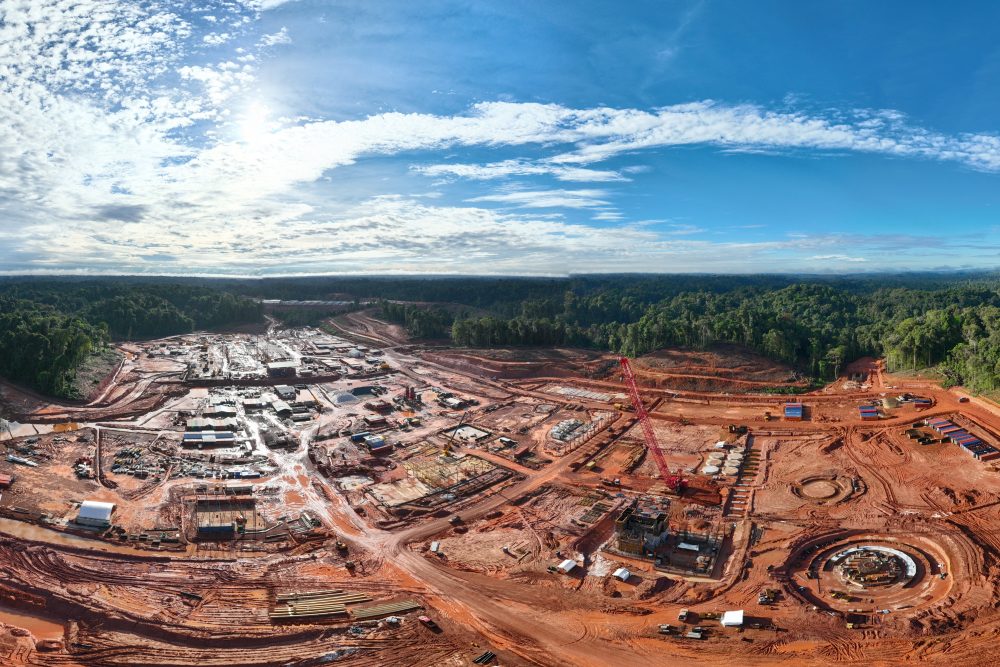
Part of the investment case rests on a collection of site-level attributes that are difficult to assign a precise value to but that materially reduce development risk and capital requirements. The Omai site is a past producer, meaning the metallurgy is largely understood, the land has been cleared, and the site has an existing airstrip and tailings infrastructure. These factors eliminate categories of uncertainty that remain open questions at many competing projects.
Access to the site is straightforward by frontier mining standards. A paved highway runs within 8–10 kilometres of the project - an advantage Ellingham noted is not always available even in Canadian jurisdictions. Looking ahead, a hydropower transmission line is expected to pass within approximately 20–22 kilometres of the site, and a liquefied natural gas plant is planned approximately 165 kilometres away, providing pathways to lower-cost and lower-emission energy sources for future mine operations.
On land tenure, the past-producer designation simplifies the permitting structure significantly. There is a single permit issued directly from the government of Guyana, with no intermediate small-scale mining claims or ownership disputes to resolve. Guyana has recently demonstrated its ability to move a large-scale mining project through the permitting process in a relatively timely manner. "My point is that there aren't many projects that can check all these boxes," Ellingham noted.
Interview with Elaine Ellingham, CEO of Omai Gold Mines
The PEA: A Near-Term Catalyst
The most immediately relevant catalyst for investors is the forthcoming PEA. The study is expected to reflect, for the first time, the combined economics of both the Wenot open-pit and Gilt Creek underground deposits at the 8-million-ounce scale. The last published economic study was based on a much smaller, single-deposit scenario and is widely regarded as no longer representative of the project's current potential.
Ellingham indicated that the production profile emerging from the new PEA is expected to be substantially larger than previously modelled. Her original target for the project was a production rate of 250,000 to 300,000 ounces per year. With the resource now at twice the scale she originally envisaged, that figure is likely to be revised upward.
One specific area where company expectations diverge from the market is the strip ratio - the measure of waste material that must be moved per tonne of ore mined. Analysts have incorporated a strip ratio of roughly 9 to 10, above the previous historical figure of 7.8. Ellingham directly challenged that assumption.
"A lot of the analysts are going, 'Oh, you're drilling deeper, it's going to go up.' So in fact the analyst consensus on our strip ratio is like nine or 10... we're pretty confident it's actually coming down, not going up."
A lower strip ratio would reduce operating costs and improve project margins - a potential positive surprise when the study is released.
Deep Potential and Strategic Positioning
Beyond the existing 8 million ounces, Omai has demonstrated that its open-pit deposit extends significantly deeper than the current resource boundary. A single drill hole extended mineralisation approximately 700 metres below the current pit shell and intersected seven distinct gold zones. This proof-of-concept result suggests the project's ultimate resource potential has not yet been established.
The orogenic style of the deposit also supports depth continuity. Orogenic gold systems are known geologically to persist at depth, often well below what surface and shallow drilling can confirm. For investors with a longer time horizon, this represents a meaningful source of resource growth optionality beyond what is currently reflected in the 8-million-ounce figure.
On the question of the company's longer-term strategic direction - whether Omai advances the project toward production independently or becomes an acquisition target - Ellingham was measured. The company's stated approach is to continue de-risking the project systematically: advancing permitting, completing technical studies, and demonstrating community alignment. In a global environment where quality mining jurisdictions are becoming scarcer and the pool of large undeveloped gold deposits is limited, she suggested the project's strategic value will only grow with time.
Conclusion
The global gold development sector is experiencing a structural shift driven by resource scarcity and growing jurisdictional risk. As gold prices have risen and traditional mining regions have grown more complex - whether through regulatory burden, political instability, or logistical challenges - the premium placed on large, accessible, and de-risked gold projects has expanded materially. Guyana has emerged as one of the more accessible and politically stable frontier jurisdictions for gold development, with demonstrated capacity to permit large-scale operations. Against this backdrop, projects combining scale, infrastructure, past-producer status, and simplified land tenure are increasingly rare. Capital from both institutional investors and strategic acquirers is gravitating toward assets that reduce execution risk without sacrificing size. Omai sits at that intersection. As Ellingham summarised:
"A lot of jurisdictions around the world are getting a little bit scarier and less welcoming to mining. I think we become more and more of something that is sought after."
TL;DR
Omai Gold Mines has grown its Guyana gold resource to 8 million ounces across two deposits in under a year, but continues to trade at approximately $150 USD/oz - well below peers at $180–$226/oz and recent acquisition comparables at $425–$600/oz. An imminent Preliminary Economic Assessment is expected to materially increase the project's published net asset value and update analyst models that have not yet incorporated the most recent resource. With a past-producer site, paved highway access, a supportive jurisdiction, and deep expansion potential still unmodelled, the PEA release represents the clearest near-term test of whether the market begins to close the gap.
FAQs (AI Generated)
Analyst's Notes





Subscribe to Our Channel



.jpg)




Stay Informed






















