Ur-Energy Targets US Uranium Production Leadership as Shirley Basin Nears Commissioning


.webp)
Ur-Energy ramps Wyoming uranium production through Lost Creek, commissions Shirley Basin Q1-Q2 2026, advances Lost Soldier PEA targeting Q3-Q4 2026 amid US supply gap.
- Matthew Gili joined as CEO in June 2025 with background from Rio Tinto, Barrick, and i-80 Gold, bringing operational expertise to uranium sector
- Lost Creek facility ramping to record Q4 production with 80%+ recovery rates; Shirley Basin under construction targeting Q1 commissioning and Q2 yellowcake production with 9M lb resource
- Lost Soldier project with 4,000 drill holes undergoing hydrological testing, targeting preliminary economic assessment in Q3-Q4 2026 for potential satellite operation
- $120M convertible raise in December 2025 funds Shirley completion, provides working capital, and enables Lost Soldier construction decision plus resource portfolio expansion
- US consumes 50M lbs U308 annually but produces only 2-3M lbs domestically, creating supply-demand gap that positions existing producers advantageously amid strategic stockpile initiatives
Ur-Energy is advancing a multi-asset uranium production strategy in Wyoming's proven basins at a pivotal moment for domestic nuclear fuel supply. With the United States consuming approximately 50 million pounds of U308 annually while producing only 2-3 million pounds domestically, the company occupies a strategic position as one of the few operating American uranium producers. The December 2025 capital raise of $120 million positions the company to complete construction at Shirley Basin while maintaining optionality for additional development and acquisitions.
New Leadership with Operations Background
Matthew Gili assumed a leadership role at Ur-Energy on June 30, 2025, bringing operational experience from Rio Tinto, Barrick Gold, and i-80 Gold across copper and gold commodities. The transition represents a shift toward mining operations expertise as the company scales production across multiple assets.
"I'm really excited to be in a new industry, uranium, learning uranium, learning the intricacies of the nuances that are in the uranium market," Gili stated during the interview. Despite his relative newcomer status to uranium, Gili emphasised the company's fundamental advantage:
"Our key advantage is that we are now producing... we have the people, we have the assets, we have the expertise, and we're on the ground making uranium."
Lost Creek: Ramping Production from Proven Asset
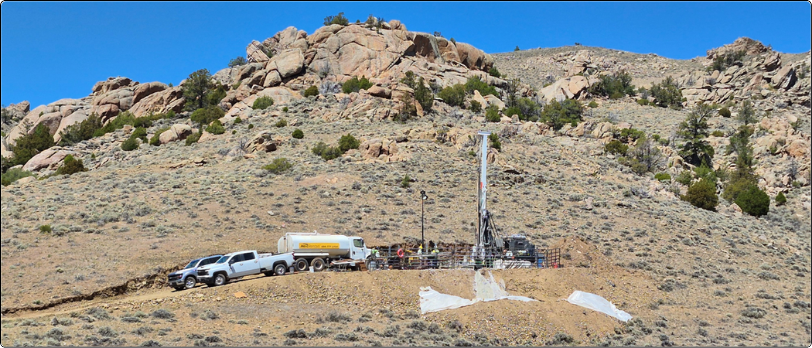
The Lost Creek facility represents Ur-Energy's primary production hub and is targeting record fourth-quarter production as operational improvements continue. Originally owned by Ur-Energy and placed into care and maintenance around 2016 during the uranium price downturn, the asset was restarted with a newly assembled team following the extended shutdown. The operation has demonstrated consistent performance with the ore body showing strong characteristics for in-situ recovery (ISR) mining. Gili described the technical performance:
"The ore body is a phenomenal ore body, just produced steadily. The uranium goes into solution easily. We're making high quality precipitate and shipping that into the US market."
The facility has achieved well over 80% recovery rates, and the company continues to add resources at the site through ongoing exploration. The ISR process at Lost Creek utilises oxygen, carbon dioxide, and bicarbonate as reagents, with the relatively simple chemistry contributing to operational predictability.
Shirley Basin: Satellite Facility Approaching Production
Shirley Basin represents Ur-Energy's second ISR operation and is currently in the construction phase. Located in a historically significant uranium mining region that has not been produced for several decades, the facility is designed as a satellite operation to Lost Creek. The smaller-scale plant will load uranium onto resin in the wellfield, with the loaded resin then transported to Lost Creek for stripping and yellowcake production.
The resource base at Shirley Basin totals approximately 9 million pounds, which management views as well-defined but constrained.
"We believe that's the bulk of resources. We don't see much potential for growth, but we also see very little risk for the 9 million pounds not being there."
The deposit is characterised by higher aquifer transmissivity compared to Lost Creek, requiring greater solution flow rates but offering the advantage of reaching more uranium particles. The company expects to begin moving uranium-impregnated solution across resin in the first quarter and commence yellowcake production in the second quarter of 2026.
Interview with Matthew Gili, President & CEO of Ur-Energy
Lost Soldier: Development Option with Established Resource
Lost Soldier represents the next potential development in Ur-Energy's portfolio, with the company owning the project since 2006. Located 8-10 miles from Lost Creek in the Great Divide Basin, the deposit contains approximately 4,000 drill holes establishing geological confidence in the resource. However, the historical drilling was conducted by Kerr-McGee with open-pit mining in mind, necessitating current work to remodel the resource for ISR applicability.
The company has drilled 18 test wells to characterise hydrological parameters including porosity, permeability, and confining layers critical to ISR design. This testing will inform the economic model and determine ISR viability for the deposit. Management targets publication of a preliminary economic assessment in the third or fourth quarter of 2026. If a positive construction decision is reached, Ur-Energy envisions Lost Soldier as an even more streamlined satellite operation than Shirley Basin, potentially requiring only a resin capture plant while utilising Lost Creek's existing office, warehouse, and maintenance facilities.
Permitting is expected to take approximately two years following a construction decision, with timeline advantages from operating in the same basin as Lost Creek. The company plans to initiate baseline permitting work in 2026 as a preparatory measure without prejudging the final construction decision.
Technical Framework: ISR Mining Economics and Optimisation
The interview provided detailed insight into ISR mining economics and operational parameters. Unlike conventional mining where costs vary with production rates, ISR operations maintain relatively fixed daily costs for personnel, drilling, and electricity.
"The amount of money you spend at an ISR mine per day is remarkably fixed. It's not so much about driving cost down, it's about driving production up, and that's where you get to your targeted cost per pound."
Recovery profiles follow predictable patterns, with wells typically running 60-90 days through a recovery curve that spikes initially before leveling off. The company models recovery based on pore volumes - the volume of oxygenated water needed to flow through the aquifer to recover uranium, typically targeting five pore volumes. Grade-thickness serves as the ISR equivalent to cutoff grade in conventional mining, measuring uranium quantity per unit of space rather than concentration alone.
The roll-front deposit model concentrates uranium at oxide-reduction boundaries where uranium precipitates from solution over geological timescales. Successful ISR mining targets these specific zones where uranium is concentrated over millions of years. Key risks include reducing agents that could cause uranium to re-precipitate underground before recovery, and calcium or magnesium concentrations that consume resin capacity similar to a water softener rather than capturing uranium.
Contracting Strategy
The December 2025 convertible financing of $120 million provides capital to complete Shirley Basin construction and commissioning while maintaining optionality for Lost Soldier development and potential portfolio additions. The company has deliberately avoided contracting all forward production, maintaining exposure to uranium price appreciation while securing baseline revenue.
For 2026, forecasted production is fully contracted. For 2027, approximately 70% of expected production is contracted, with this percentage declining in subsequent years. Contract structures have evolved from purely fixed-price agreements to hybrid arrangements combining fixed-price components with market-related pricing featuring floors and ceilings. Current fixed-price contract terms for new agreements are in the high $80s per pound. This balanced approach provides revenue certainty while preserving upside participation as the uranium market develops.
Market Context: Domestic Supply Gap
The strategic rationale for US uranium production centers on the substantial supply-demand imbalance. With domestic consumption of 50 million pounds annually against production of 2-3 million pounds, the United States relies heavily on imports for nuclear fuel. Policy initiatives including strategic stockpiles, uranium reserve programs, and the designation of uranium as a critical mineral are creating a supportive environment for domestic production.
The growing emphasis on nuclear energy as a component of America's energy strategy - driven by data center power demand, grid reliability concerns, and decarbonisation goals - reinforces the fundamental case for uranium supply development. Ur-Energy's positioning as an operating producer with near-term growth through Shirley Basin and medium-term optionality through Lost Soldier differentiates the company from exploration-focused peers in a market where production capacity remains constrained.
The Investment Thesis for Ur-Energy
- Operating Asset Advantage: Existing production at Lost Creek with demonstrated 80%+ recovery rates provides immediate cash generation and de-risked operations, contrasting with development-stage peers
- Near-Term Production Growth: Shirley Basin commissioning in Q1-Q2 2026 adds incremental production without capital-intensive greenfield development, leveraging Lost Creek processing infrastructure
- Pipeline Optionality: Lost Soldier's 4,000-hole resource database and ongoing hydrological testing creates 2027-2028 expansion option with reduced execution risk from basin proximity and satellite operation model
- Domestic Supply Gap: US production of 2-3M lbs against 50M lb consumption creates structural advantage for American producers amid strategic stockpile initiatives and critical mineral designation
- Balanced Contract Book: Progressive contracting approach (100% in 2026, ~70% in 2027, declining thereafter) provides revenue visibility while maintaining uranium price upside exposure through uncontracted production
- Capital Adequacy: $120M December 2025 raise funds Shirley completion, Lost Soldier construction decision, and potential M&A without near-term dilution pressure
- Technical Advantages: Simple ISR chemistry (O2, CO2, bicarbonate) and favorable aquifer characteristics minimise operational complexity and reagent cost volatility compared to more challenging deposits
- Jurisdictional Benefits: Wyoming operations in proven basins with streamlined permitting environments and established regulatory frameworks reduce execution risk
The United States faces an acute strategic vulnerability in nuclear fuel supply, consuming 50 million pounds of U308 annually while producing less than 5% domestically. This dependence on imports - historically dominated by Russian and Kazakhstani sources - has catalysed policy initiatives designating uranium as a critical mineral and establishing strategic stockpiles. The nuclear renaissance driven by data center electrification, grid baseload requirements, and decarbonisation mandates is accelerating demand while supply chains remain constrained. Small modular reactor deployment timelines further extend the demand horizon.
Domestic producers with operating assets and near-term expansion capacity occupy a privileged position as utilities and government agencies prioritise supply security over price sensitivity. The convergence of energy security concerns, technology sector power demand, and climate policy creates a multi-decade tailwind for American uranium production that transcends typical commodity cycles.
TL;DR: Executive Summary
Ur-Energy operates Wyoming's Lost Creek uranium facility with Q4 2026 targeting record production, while Shirley Basin approaches Q1 commissioning to add incremental output through a satellite operation model. A $120M December capital raise funds Shirley completion and enables a Lost Soldier construction decision following Q3-Q4 2026 PEA publication. The company's contracting strategy balances 100% coverage for 2026 production against declining contract percentages in outer years, capturing revenue certainty while maintaining uranium price exposure as US consumption of 50M lbs annually against 2-3M lbs domestic production creates structural advantages for American producers.
FAQs (AI Generated)
The company is currently producing uranium at Lost Creek with proven 80%+ recovery rates while most peers remain in exploration or development stages, providing first-mover advantage amid accelerating domestic demand.
Commissioning begins Q1 2026 with uranium-impregnated solution moving across resin, followed by yellowcake production in Q2 2026 as loaded resin ships to Lost Creek for processing.
The 8-10 mile proximity to Lost Creek enables a satellite model requiring only resin capture facilities while utilising Lost Creek's existing infrastructure, reducing capital requirements and operational complexity.
Progressive approach maintains 100% contracts for 2026, approximately 70% for 2027, declining thereafter. Hybrid structures combine fixed pricing (high $80s) with market-related components featuring floors and ceilings.
Capital funds Shirley Basin construction completion, provides working capital for commissioning, enables Lost Soldier construction decision flexibility, and supports potential resource portfolio additions through acquisition opportunities.
Analyst's Notes





Subscribe to Our Channel






Stay Informed