




110 Metres at 1.94% Copper Strengthens the Heap Leach Development Thesis at Fitzroy Minerals' Buen Retiro Project


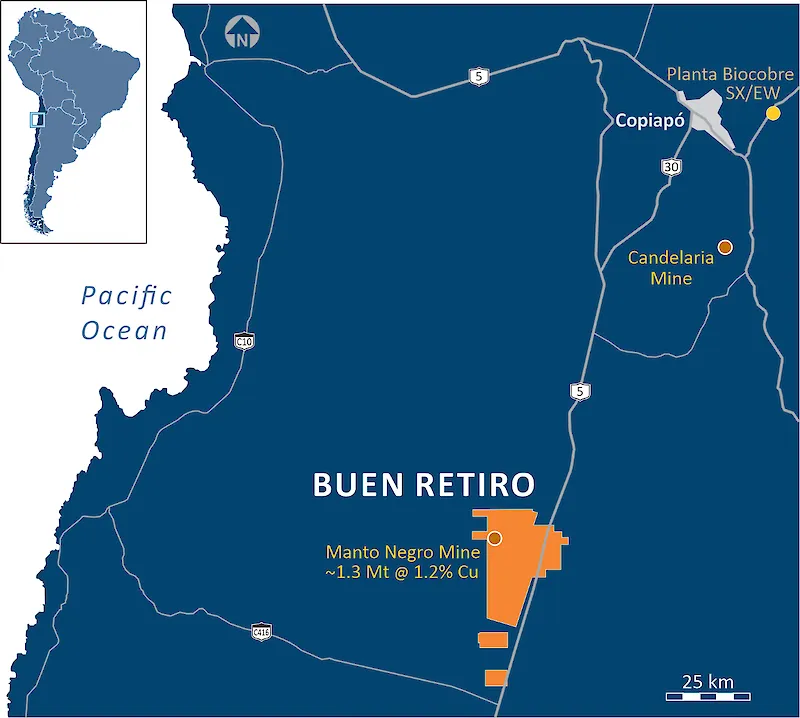
Fitzroy Minerals’ Buen Retiro project advances toward development as high-grade oxide drilling supports a low-capex heap leach strategy in Chile.
- Fitzroy Minerals has shifted Buen Retiro from early-stage exploration toward development-relevant definition drilling and execution sequencing.
- A standout near-surface oxide intercept materially strengthens the case for a low-capital, heap-leach development pathway.
- Deeper drilling continues to confirm Candelaria-style sulphide mineralisation, preserving long-term scale and mine-life optionality.
- Proximity to infrastructure and progress toward a heap leach joint venture with Pucobre reduce capital intensity and execution risk.
- The project’s advancing technical and permitting milestones increasingly anchor valuation to execution rather than speculative geology.
What Changed: The Latest Operational Update
Fitzroy Minerals’ Buen Retiro project has entered a new phase of development activity, marked by a clear shift from early-stage exploration to economically relevant definition drilling and development sequencing. Drilling in Q4 2025 delivered a thick, high-grade near-surface oxide intercept, materially advancing the case for a low-capital, heap-leach development pathway. At the same time, ongoing deeper drilling continues to indicate the presence of Candelaria-style sulphide mineralisation, reinforcing longer-term upside beyond the initial oxide strategy.
Recent Drill Results & Study Decisions
Drilling at Buen Retiro delivered one of the company’s most significant oxide results to date. Diamond hole BRT-DDH022 intersected 110 metres grading 1.94% copper from 62 metres, including 58 metres at 3.06% copper from 97 metres depth, confirming a thick, high-grade oxide body at shallow depth. The true thickness of the mineralised intercept is interpreted at approximately 63% of the reported drill interval, consistent with the sub-vertical structural geometry inferred from the drill orientation.
The geometry and mineralisation style are consistent with leachable copper oxides elsewhere in the Punta del Cobre belt, materially strengthening the economic case for a heap leach development pathway through lower strip ratios, reduced mining intensity, and faster timelines to first production. Fitzroy has confirmed progress toward formalising the terms of a heap-leach joint venture with Pucobre, reinforcing a staged strategy that prioritises lower-capital oxide development while preserving sulphide upside.
Drilling Outcomes & Geological Implications
The latest drilling reinforces Buen Retiro as a vertically extensive copper system with distinct mineralisation styles at different depths. Near the surface, oxide mineralogy in BRT-DDH022 comprises chrysocolla, atacamite, malachite, tenorite, cuprite, and chalcocite, all recognised as leachable copper minerals, along with minor native copper amenable to heap leach extraction. At depth, the system transitions into primary sulphide mineralisation hosted within volcanic breccias and altered volcanic units characteristic of Iron Oxide Copper-Gold (IOCG) systems in the Punta del Cobre belt.
Oxide mineralisation is economically significant because it bypasses the energy- and capital-intensive milling and flotation stages required for sulphide processing. Thickness and depth of oxide zones are critical economic variables: thicker, shallower oxide profiles reduce strip ratios, lower unit mining costs, and compress development timelines by accelerating access to leachable material.
The 110-metre oxide intercept therefore represents more than a high-grade drill result; it materially improves confidence in the scale and continuity required to underpin a staged heap leach development scenario, while deeper sulphide intersections continue to validate the broader system’s longevity potential.
Infrastructure & Development-Relevant Data
Buen Retiro benefits from proximity to established Chilean mining infrastructure that materially reduces development complexity. The project is located 35 km east of the coast and 5 km west of the Pan-American Highway and high-voltage transmission lines. The nearby coastal port serving the Copiapó region holds permits for seawater extraction and brine disposal, a critical consideration for heap leach and electrowinning (SX-EW) operations in a water-constrained desert environment.
The project is at an average altitude of approximately 370 metres above sea level, well below the elevation of most Andean copper developments, which reduces logistical, energy, and workforce complexity. Road access and grid power are available within a reasonable distance, limiting the need for large pre-production infrastructure investments. A potential water-recycling loop between an electrowinning facility and a proposed heap leach SX plant could further reduce operational water demand, an increasingly material cost and regulatory factor in the Atacama region.
President and Chief Executive Officer of Fitzroy Minerals, Merlin Marr-Johnson contextualised the infrastructure configuration within the broader development plan:
"There's a possibility to do some kind of recycling of water between the electro-wind plant and our proposed heap leach SX plant, and the coast is 35 km away; Copiapó port has permission to extract seawater."
Continuity of Execution: How This Update Builds on Prior Milestones
Buen Retiro’s current trajectory reflects a sequenced technical and regulatory strategy designed to reduce investment risk incrementally rather than through a single binary development step. The progression from historical production context to modern geological reinterpretation, followed by oxide definition drilling and formal study advancement, represents a coherent de-risking pathway.
From Historical Mining to Modern Re-Interpretation
The Punta del Cobre IOCG belt has supported copper-gold production for decades, anchored by operations such as Candelaria and Mantoverde. This long operating history provides a well-defined geological framework against which newer targets can be assessed.
Buen Retiro’s mineralisation, including chalcopyrite stringers within the Punta del Cobre formation and deeper sulphide intersections, is consistent with the architecture of these producing systems. The proximity of major operators with established processing infrastructure introduces the potential for third-party processing, allowing Fitzroy to advance toward production without committing to a standalone plant at this stage.
On the significance of belt-scale geological consistency, Marr-Johnson noted:
"There's the flagship asset of Lundin Mining, Candelaria nearby. There you've got the flagship asset of Capstone Copper, Mantoverde, and there's a new deposit called La Farola, all of which we've got the same geology that we can see of all of those three deposits within Buen Retiro."
Development Optionality: Economics Before Scale
A defining characteristic of Fitzroy’s approach at Buen Retiro is the prioritisation of economic validation before resource scale expansion. Rather than committing early to a capital-intensive development scenario, the company is advancing a staged model in which oxide heap leach cash flow is established first, while sulphide development remains a longer-term option.
Leveraging Existing Processing & Partnerships
The proposed heap leach joint venture with Pucobre reduces initial capital requirements by utilising existing processing infrastructure rather than constructing a new facility. Under a non-operated structure, Fitzroy would contribute oxide feed while Pucobre provides processing capacity, limiting early-stage capital exposure and dilution. Pucobre, a listed Chilean copper producer with 2023 output of 77.5 million pounds and an SX/EW plant (Planta Biocobre) located 13 km from Copiapó, also holds a 50% stake in the Buen Retiro option, a structural alignment of interests that distinguishes the JV arrangement from a standard third-party toll processing agreement. This structure reduces Internal Rate of Return (IRR) sensitivity to capital overruns and allows the company to retain greater ownership leverage as cash flow is established.
Marr-Johnson outlined the economic intent of the arrangement:
"We are working on terms with Pucobre to do a heap leach joint venture. We're looking at an attributable production of copper of somewhere in the region of 10 million pounds per annum attributable to Fitzroy coming through this plant. If we can get a one or two dollar margin on that, that's significant cash flow which is attributable to us."
Timeline & Valuation Implications
Advancement toward a maiden mineral resource estimate, preliminary technical assessment, and DIA submission over the next 12-18 months introduces a series of execution-based catalysts that may influence development-stage peer comparisons and EV/lb valuation metrics.
Projects entering the permitting phase with a defined heap-leach development path and third-party processing optionality occupy a meaningfully different risk-adjusted position than pre-resource exploration companies. If upcoming studies confirm the economic assumptions underlying the latest oxide drilling, valuation outcomes will be driven by study results and execution milestones rather than by speculative geology.
The Investment Thesis for Fitzroy Minerals
- Exposure to the copper electrification and decarbonisation theme through a project advancing toward development in a structurally constrained global supply environment.
- Asset location in Chile’s Punta del Cobre IOCG belt, a Tier-1 jurisdiction offering regulatory clarity, established mining law, and mature permitting frameworks.
- A staged, oxide-first development strategy aligned with capital discipline, prioritising lower-capex heap leach production before committing to sulphide-scale expansion.
- Favourable cost structure potential supported by shallow, high-grade oxide mineralisation that reduces strip ratios, mining intensity, and time to first cash flow.
- Development timelines are aligned with medium-term copper demand growth, with upcoming milestones including a maiden resource, technical studies, and DIA submission.
- Risk-adjusted growth optionality through deeper Candelaria-style sulphide mineralisation, preserving long-term scale upside without front-loading capital risk.
- Operational leverage enhanced by proximity to existing infrastructure and potential third-party processing, limiting dilution and improving IRR resilience in an inflationary cost environment.
- Asset-level flexibility that improves downside protection during copper price volatility while retaining upside torque through exploration success and study validation.
Fitzroy Minerals represents a copper investment case built around execution sequencing rather than speculative scale. Recent high-grade oxide drilling at Buen Retiro strengthens the near-term heap leach development pathway, while ongoing sulphide intersections preserve longer-term optionality within a proven IOCG belt. For investors, the thesis centres on disciplined capital allocation, jurisdictional quality, and advancing technical milestones that progressively shift the risk profile from exploration toward development-driven valuation metrics.
TL;DR
Fitzroy Minerals’ latest drilling at Buen Retiro delivered a thick, high-grade, near-surface oxide intercept, materially derisking a staged heap-leach development strategy. The result improves development economics through lower strip ratios and faster timelines to first cash flow, while continued identification of Candelaria-style sulphide mineralisation preserves longer-term upside. Combined with strong infrastructure access and progress toward a processing joint venture with Pucobre, Buen Retiro is transitioning from exploration risk to execution-and study-driven valuation.
FAQs (AI-Generated)
The 110m near-surface oxide intercept confirms thickness, grade, and continuity suitable for heap leach extraction, materially improving the project’s development economics and timeline.
Heap leach development avoids costly mills and concentrators, lowering upfront capital, technical complexity, and dilution risk while accelerating time to first cash flow.
No. Deeper drilling continues to confirm Candelaria-style sulphide mineralisation, preserving long-term scale and mine-life upside beyond the initial oxide phase.
By leveraging existing processing infrastructure, the JV lowers initial capital requirements, reduces IRR sensitivity to cost overruns, and limits the need for standalone plant construction.
Key catalysts include a maiden mineral resource estimate, preliminary technical studies, DIA permitting submission, and further drilling to define oxide continuity and sulphide scale.
Analyst's Notes





Subscribe to Our Channel









Stay Informed


