



Uranium Demand Is Effectively Doubling as New Mines Take 10 to 20 Years


Uranium demand is effectively doubling over 15 years while new mines take 10 to 20 years, and Madaouela is re-testing a 2022 resource under revised assumptions.
- Uranium demand is forecast to rise from about 200 million pounds (lb) today to about 350 to 390 million lb by 2040.
- More than 70% of uranium production comes from 10 mines.
- As of October 2026, uranium equities are down more than 50% since the beginning of January, while the long-term uranium price is up 12% this calendar year.
- Atomic Eagle now aims to release a JORC resource for Madaouela in the first quarter of 2027, so it can use revised mining assumptions.
- The 2022 Madaouela estimate was constrained at a uranium price of US$70 per pound for uranium oxide.
As of October 2026, the long-term uranium price is trading at all-time highs, and the spot price is not far off. Uranium is moving from a commodity to a strategic asset as energy security becomes a priority for governments and utilities.
Governments are chasing secure, domestic-aligned supply, and state and utility intervention in the market is increasing. The uranium supply pipeline has seen chronic underinvestment since Fukushima.
Uranium Supply & Demand Context
Uranium demand is forecast to grow while mine supply remains constrained. The World Nuclear Association forecasts demand rising from about 200 million pounds (lb) today to more than 220 million lb by 2030 and about 350 to 390 million lb by 2040. The supply deficit in that outlook is based entirely on existing reactor builds, and it exists despite optimistic supply models.
Demand growth comes from nuclear growth and reactor restarts, reversals of early retirements, energy-intensive industries such as AI and data centers, and the push to decarbonize. Demand is effectively doubling over the next 15 years.
Supply is concentrated and shrinking at the margin. More than 70% of production comes from 10 mines, and Kazakhstan supplies about 40% of global production. Kazatomprom’s production is declining and its costs are increasing, and secondary supply is shrinking. Kazatomprom also follows a “value over volume” strategy.
State Buyers & Strategic Capital
Governments and state-linked buyers are taking direct positions in uranium supply. In April 2026, Kazakhstan mandated the creation of a 100-kilotonne uranium reserve by 2040, more than 7 times 2025 production. China announced 10 new reactors in April 2025 and has 58 operating reactors and 30 under construction, against a target of 200 gigawatts by 2035.
The US is targeting a tripling of nuclear capacity by 2050, imports 95% of its uranium, and restricts Russian-origin products. India is pursuing rapid nuclear expansion to about 100 gigawatts by 2047, with a large long-term supply deal with Kazatomprom and a 22 million lb supply deal over 9 years with Cameco. Canada launched a Nuclear Energy Strategy in June 2026, and Japan has adopted a policy to maximize nuclear, reversing its post-Fukushima stance, with reactor restarts accelerating.
State-linked capital is also reaching developers. CNNC has made a strategic investment in ASX-listed Bannerman, which recently concluded a US$320 million strategic financing from a Chinese nuclear state-owned enterprise.
Constraints on New Uranium Supply
Higher uranium prices have not carried through to uranium equities. As of October 2026, uranium equities are down more than 50% since the beginning of January, while the long-term uranium price is up 12% this calendar year. For developers that fund work with equity, share prices and the commodity price have diverged.
New mine developments take 10 to 20 years. For utilities and state buyers, supply from a project that has not yet started development is supply measured in decades rather than years.
Permitting limits where uranium projects can advance at all. Among ASX-listed undeveloped uranium projects, Yanrey and Westmoreland are in jurisdictions that do not currently permit uranium mining, and Salamanca is subject to arbitration proceedings. For developers, a resource in a jurisdiction that does not currently permit uranium mining cannot move toward production on its grade and tonnage alone.
Madaouela's Resource Re-Test
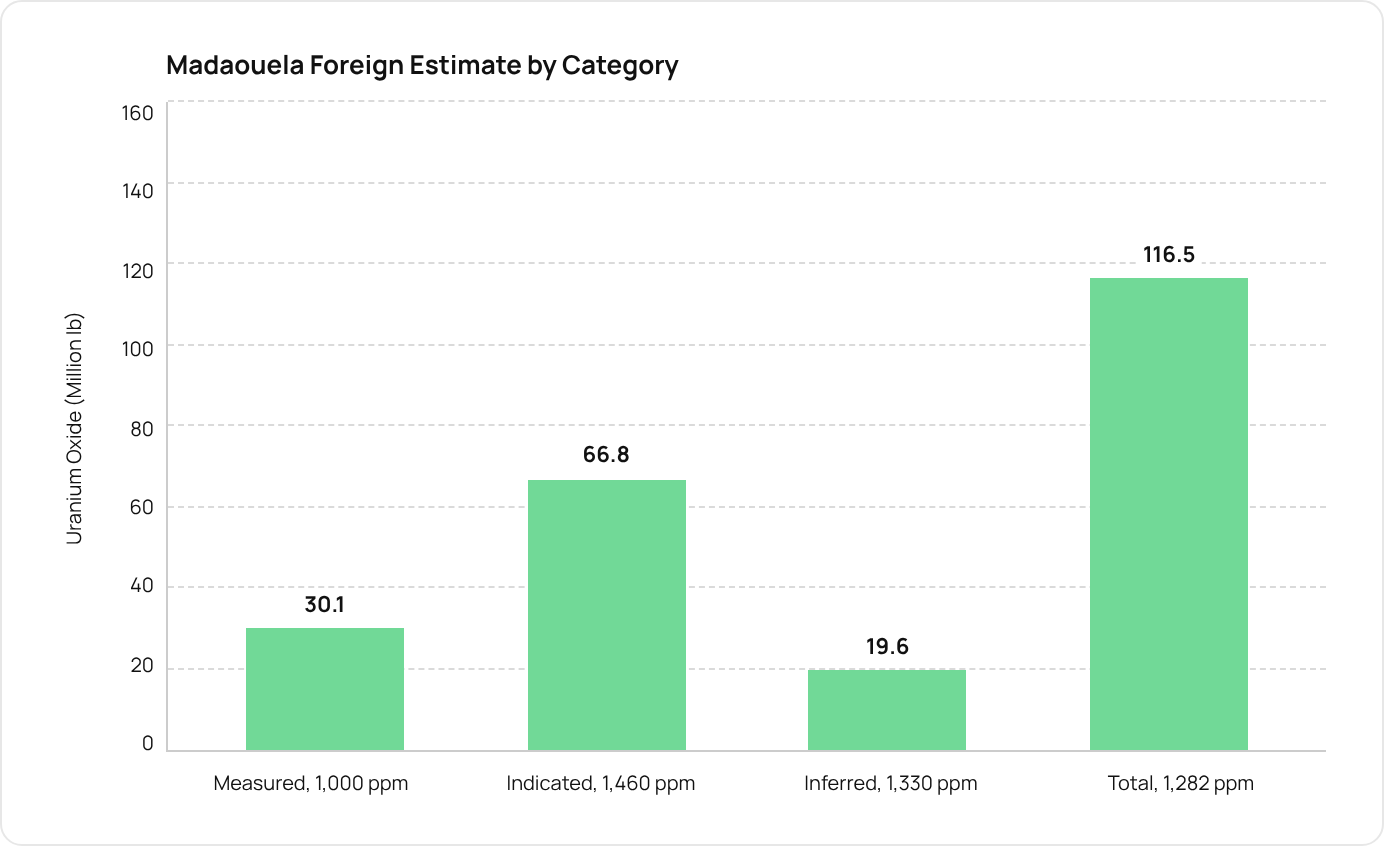
Atomic Eagle (ASX: AEU | OTCQX: AEUXF) holds a 60% interest in the Madaouela Uranium Project in Niger, alongside a 58.8 million lb JORC resource at its Muntanga Uranium Project in Zambia. Madaouela hosts a foreign estimate not compliant with the JORC Code of 116.5 million lb at 1,282 parts per million (ppm), effective July 1, 2022. It comprises 30.1 million lb measured at 1,000 ppm, 66.8 million lb indicated at 1,460 ppm, and 19.6 million lb inferred at 1,330 ppm. The project is supported by approximately 600,000 meters (m) of historical drilling and approximately US$160 million of historical project expenditure.
The estimate is based on work by GoviEx and SRK Consulting and was reported under NI 43-101. SRK constrained the open-pit resources within an optimized pit shell, the modeled outline of the most economic open pit, at a uranium price of US$70 per pound for uranium oxide, above a cut-off of 220 ppm equivalent uranium, a grade estimated from the rock’s natural radioactivity. Underground resources were limited to contiguous volumes grading above 400 ppm over a minimum diluted thickness of 1.8 m at the same price. It is uncertain whether the estimate can be reported under the JORC Code after further evaluation or exploration.
Chief Executive Officer of Atomic Eagle, Phil Hoskins, ties the expected change in the mine plan to the distance between the old and current price decks:
"The fact that the mining was done at $55 a pound, we're now at a long-term price of $96 a pound says to you there's going to be a lot more uranium available in the mine plan."
Atomic Eagle has begun a value optimization and technical review program. It covers alternative mining methods and equipment, mineralization outside the historical mine plan, revised open-pit and underground optimization at updated uranium price assumptions, underground production alongside open-pit mining, and bringing higher-value material forward in the schedule. To use revised mining assumptions in the reasonable prospects of economic extraction test, the check that a deposit could plausibly be mined at a profit, which a JORC resource requires, the company is now aiming to release the converted resource in the first quarter of 2027. The first output of the program is a scoping study targeted for release in the same quarter, with updated economic outcomes and plans for future feasibility work. A separate review of historical metallurgical testwork and the existing process flowsheet, the sequence of plant steps that recovers uranium from ore, will assess Madaouela against contemporary uranium processing technologies.
Niger's Development Framework
Niger now has a newly agreed legal framework for Madaouela. Atomic Eagle and the Republic of Niger formally executed the Mining Convention in late September 2026, effective from signing, and the exploitation permit has been granted to Atomic Eagle's newly incorporated Nigerien subsidiary, MAMICO. Atomic Eagle owns 60% and the state 40%, through a 15% free-carried interest, a stake held without paying toward project costs, and a 25% contributing interest, and the arbitration has been withdrawn, which ICSID has since confirmed. The convention establishes the legal framework for development, including legal and tax stabilization, and provides a framework for future project financing. The initial US$5 million payment was made in October 2026, and a US$40 million credit applies against the government's future equity contributions to project development, a credit that is not an additional upfront cash payment.
Elsewhere in the country, Global Atomic's Dasa uranium project has a conditional approval from the US International Development Finance Corporation for a proposed debt facility of up to US$414.2 million. Hoskins draws a conclusion for the whole jurisdiction from that financing:
"So, what that demonstrates is that Niger is a financeable jurisdiction if you have the right regulatory framework in place."
The district around Madaouela has produced at scale before. SOMAIR has more than 178 million lb of historical production, and COMINAK has 165 million lb.
Industry Outlook
Governments are moving into direct investment in uranium, and Atomic Eagle expects that shift to continue.
Hoskins attaches a price condition to the new mines the sector needs:
"We're going to need much higher uranium prices to be able to incentivize new developments as well as new exploration in the sector."
For the sector, the re-run of an already-drilled 2022 estimate under revised mining assumptions has a timeline. Atomic Eagle is now aiming to release a converted JORC resource for Madaouela in the first quarter of 2027, with a scoping study targeted for the same quarter.
FAQs (AI-Generated)
Analyst's Notes





Subscribe to Our Channel





Stay Informed


