




US Diesel Forecast Rises 12%, Putting Copper Development Costs in Focus



Copper projects that can reuse suitable infrastructure may require less upfront capital, improving potential returns on development spending.
- The Payne Institute’s October 26, 2026, working paper estimates US$360 billion in copper mine-development spending through 2050, in 2024 dollars, assuming 16.1 million metric tons of additional annual capacity at US$22,359 per metric ton of annual capacity.
- Alternative development-cost assumptions produce a US$304-504 billion range for the same additional capacity, showing why construction budgets must be assessed against achievable output.
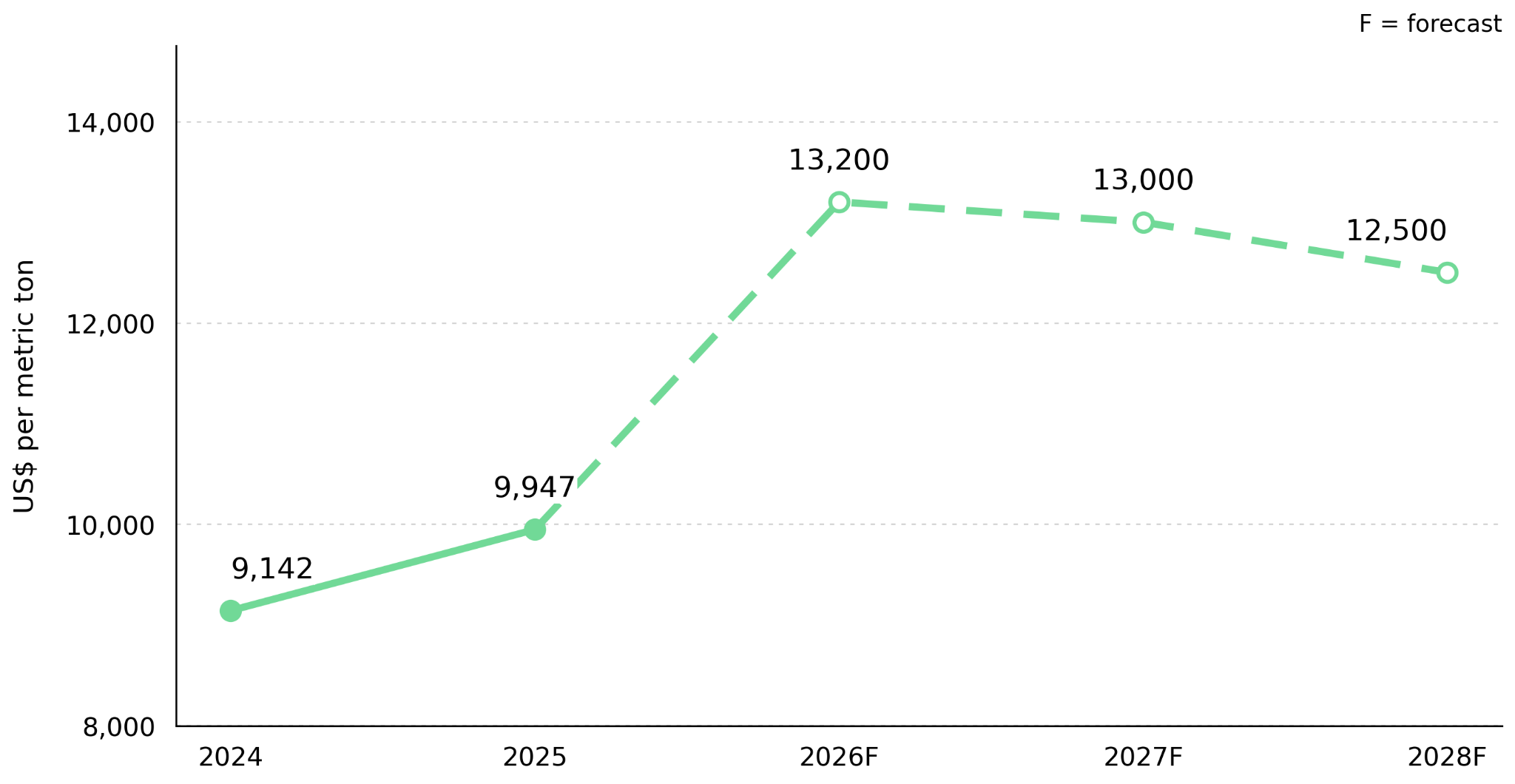
- The World Bank Group (WBG), in its October 28, 2026, Commodity Markets Outlook, forecasts copper averaging US$13,200 per metric ton in 2026 and US$13,000 in 2027, providing near-term revenue benchmarks rather than mine-life price assumptions.
- Explorers use drilling and processing tests to guide subsequent spending, while developers use engineering and permitting work to define construction budgets, schedules, and financing requirements.
- Suitable existing infrastructure can reduce new construction needs, while staged work programs help match funding requirements to project milestones.
Development Costs Determine Copper Mine Funding Requirements
The Payne Institute estimates US$360 billion in 2024 dollars to add 16.1 million metric tons of annual copper production capacity through 2050. Its baseline assumes development spending of US$22,359 per metric ton of annual capacity, full capacity use, and no inflation-adjusted cost increases or budget overruns. Alternative cost benchmarks produce a US$304-504 billion range for the same additional capacity. The estimates exclude exploration, sustaining capital, financing, smelting, and refining. Capital intensity measures development spending per unit of annual production capacity, providing a basis for comparing upfront funding requirements.
The Payne Institute’s October 26, 2026, working paper, The Investment Gap in Copper Mining, estimates US$360 billion in 2024 dollars to add 16.1 million metric tons of annual copper production capacity through 2050. The calculation assumes development spending of US$22,359 per metric ton of annual capacity, full capacity use, and no increases in inflation-adjusted costs or budget overruns. Alternative cost benchmarks produce a US$304-504 billion range for the same additional capacity, excluding exploration, sustaining capital, financing, smelting, and refining. Capital intensity measures development spending per unit of annual production capacity, allowing budgets to be assessed against the output they can support.
Mogotes Metals is targeting a Preliminary Economic Assessment (PEA) for Beskauga within 12 months of its September 22, 2026, update, alongside a drilling program of up to 50,000 meters. The planned study can help assess development options and capital requirements as drilling adds information about the deposit.
Target Testing Directs Copper Exploration Spending
Drilling programs can guide subsequent spending by testing whether geological targets justify additional work before larger commitments to resource definition or economic studies.
Fitzroy Minerals has begun a 5,000-meter drilling program to test nine new copper targets at Buen Retiro. Its October 22, 2026, update combines subsurface imaging with existing drilling results to prioritize untested ground, with new results intended to guide subsequent drilling decisions
Geological Evidence Defines Copper Development Requirements
S&P Global Market Intelligence identifies 165 of 263 major copper discoveries made between 1990 and 2025 that have not entered production, including 135 without completed feasibility studies. Its dataset covers deposits containing at least 500,000 metric tons of copper across reserves, resources, and past production, limiting the counts to large discoveries. Drilling and processing tests provide inputs for assessing deposit size, continuity, recovery, and future processing requirements. At unchanged recovery rates, lower grades require more ore to be processed for the same copper output, increasing the processing capacity needed.
Abitibi Metals Corp reported 1.08% copper over 60.2 meters of core at B26 in its September 17 update, with an estimated true width of 52.1 meters. Ongoing drilling is targeting greater resource confidence and testing extensions to support a future resource update. An updated estimate would help define the deposit’s scale and provide a basis for subsequent economic assessment.
Cobra Resources’ November 5 update highlights confirmed copper-gold mineralization across several Manna Hill prospects, including shallow discoveries and indications of a potentially larger system. Follow-up assessment can test how far the shallow mineralization extends and whether the broader system warrants additional drilling.
Existing Infrastructure Can Reduce New Copper Construction Requirements
A copper restart can reduce new construction spending by reusing facilities that fit the proposed mine plan, after accounting for refurbishment and upgrades.
Selkirk Copper filed the independent technical report supporting Minto’s PEA on November 5, 2026. The existing processing plant, mine workings, roads, and power line provide a base for redevelopment planning alongside ongoing exploration.
Colin Joudrie, Chief Executive Officer and President, explains how existing infrastructure supports the restart:
“We're not building from the ground up. We're leveraging over $330 million of above-ground investment by prior operators.”
Financing Requirements Raise the Value of Copper Construction Readiness
Engineering, permitting, and supply arrangements help define a copper project’s construction budget and operating inputs. Matching those requirements to a construction schedule establishes how much funding is needed and when.
Marimaca Copper’s October 1, 2026, update confirms grid-connection authorization and a preliminary power-supply framework for its oxide project. The proposed renewable energy terms have estimated costs close to feasibility-study assumptions and flexibility during production startup. Detailed engineering and access-road upgrades are also advancing construction preparations.
Hayden Locke, Chief Executive Officer, explains a conservative approach to debt financing:
“Our philosophy as a management team is very much one of not overlevering… We're going to take a relatively conservative approach to our debt-to-equity ratio.”
Energy Cost Uncertainty Requires Copper Project Sensitivity Tests
WBG’s Commodity Markets Outlook, released October 28, 2026, forecasts energy prices rising 32% in 2026 and declining approximately 12% in 2027, assuming a gradual increase in crude oil exports from the Middle East. Applying the forecasts to a copper project requires its energy consumption, supply terms, and operating schedule to be reflected in cost estimates.
Project comparisons should use consistent copper-price, recovery, and exchange-rate assumptions, with construction spending, ongoing costs, and production timing included. Sensitivity tests can then identify how changes in the assumptions affect funding requirements and projected cash flow.
The Investment Thesis for Copper
- Development spending per unit of annual capacity should be assessed alongside operating costs, financing terms, and production timing to compare potential returns.
- Developers use recovery testing, engineering budgets, and permitting work to define construction requirements and the timing of potential revenue.
- Explorers use drilling and processing tests to establish deposit size, continuity, and copper recovery before committing to larger economic studies.
- Suitable infrastructure can reduce new construction requirements when refurbishment and upgrades cost less than the facilities otherwise needed.
- Funding plans should reflect construction schedules, permitting requirements, and community obligations so capital is available when project work requires it.
Future copper supply will depend on projects that convert geological potential into economically recoverable output. The clearest basis for assessing progress is a development plan that connects technical results with construction budgets, funding requirements, and realistic production schedules. A consistent focus on complete costs and potential cash flow helps identify opportunities capable of supporting development through changing copper-price conditions.
TL;DR
Copper development costs determine how much funding is needed to add production capacity. Explorers use drilling and processing tests to guide subsequent spending, while developers define construction budgets, permitting requirements, and financing schedules. Suitable infrastructure can reduce new construction needs after refurbishment and upgrades are assessed. Potential returns depend on copper prices during operating years, recovery, complete costs, and production timing. Testing these assumptions helps establish whether development spending can support the output and cash flow needed to justify the investment.
FAQs (AI-Generated)
Analyst's Notes





Subscribe to Our Channel














Stay Informed


