




US Inflation Cools to 3.4%, Cutting Hike Odds While Silver’s Six-Year Deficit Restricts Supply


.png)
Cooling US inflation cuts Fed hike odds, while silver’s sixth annual deficit and China’s export licensing restrict physical supply.
- US Bureau of Labor Statistics data showed annual consumer inflation at 3.4% in July 2026 and monthly producer inflation at 0%, pulling CME FedWatch odds of a September rate hike to roughly 40% from nearly 50% a week earlier.
- The Silver Institute’s World Silver Survey 2026 forecasts a 46.3-million-ounce deficit in 2026, the 6th consecutive annual shortfall, as mine output remains roughly flat.
- China’s 2026 to 2027 licensing regime covers an estimated 60% to 70% of global refined silver exports, despite the country producing only 13% of mined supply.
- Higher silver prices can expand producer margins, improve development-project economics, and increase the value of ounces added through exploration.
- Federal Open Market Committee (FOMC) minutes due August 19, 2026, could extend silver’s pullback if they reinforce expectations for higher rates, which raise the cost of holding the non-yielding metal.
Cooling Inflation Cuts Hike Odds to 40%, Reducing Silver’s Rate Headwind Despite Fed Dissent
The US Bureau of Labor Statistics reported that the Consumer Price Index (CPI) rose 0.1% month over month in July 2026, lowering annual inflation to 3.4% from 3.5% in June. The Producer Price Index (PPI) was unchanged, below the 0.2% consensus forecast. These readings lowered CME FedWatch odds of a September rate hike to roughly 40% from nearly 50% a week earlier, reducing a key headwind for non-yielding silver.
The Federal Open Market Committee (FOMC) held the federal funds rate at 3.50% to 3.75% for a fifth consecutive meeting on July 29, 2026. However, three of 12 voting members supported a 25-basis-point increase, leaving further tightening under consideration and preserving some rate pressure on silver.
Silver reached a seven-week high of roughly $65.94/oz on August 11 before falling 1.4% to 2.9% into a $64-to-$65/oz range by August 13. The gold-silver ratio fell to roughly 67 from nearly 69, confirming silver’s relative outperformance. The move shifts attention toward whether six consecutive annual deficits reflect slow mine-supply growth and concentrated export capacity rather than short-term rate expectations.
Byproduct Supply and China’s Export Licensing Drive Silver’s Sixth Annual Deficit, Limiting Supply Response
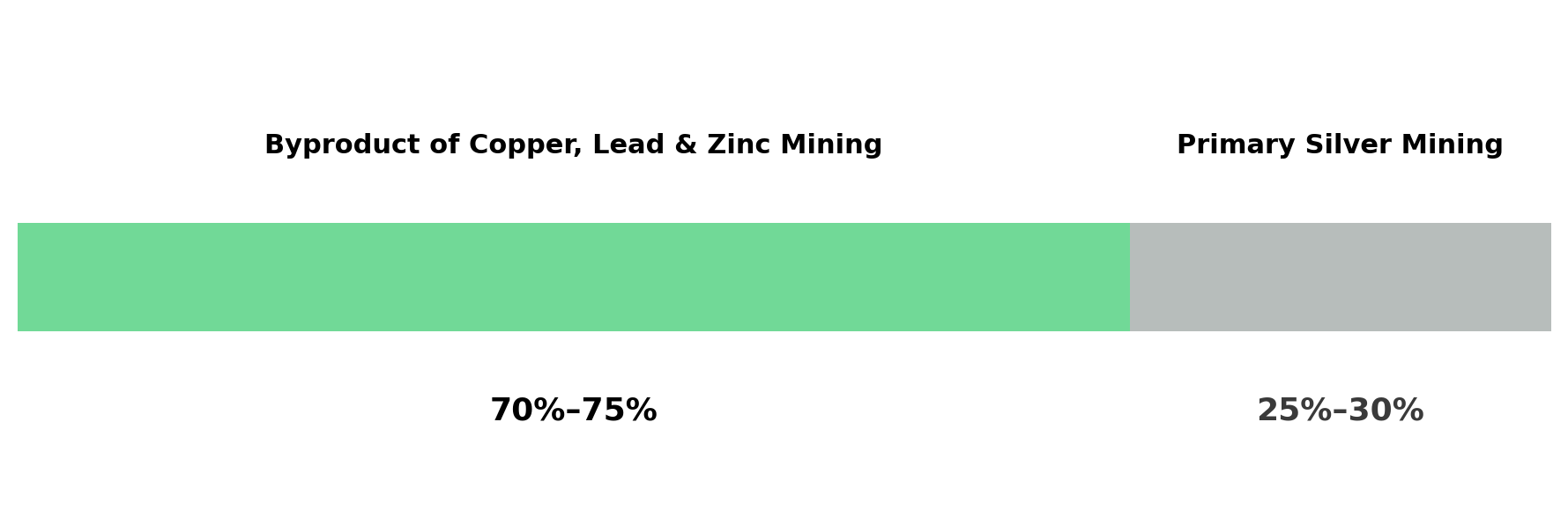
Inflation and rate expectations influence silver’s short-term price, but the Silver Institute’s World Silver Survey 2026 shows that demand has exceeded supply every year since 2021. The deficit reflects two supply constraints: 70% to 75% of mined silver comes as a byproduct of other metals, limiting its response to silver prices, while China’s estimated control of 60% to 70% of refined exports restricts physical availability outside the country.
Byproduct Dependence Limits Mine Growth, Extending Silver’s Sixth Deficit and Draining Bar Stocks
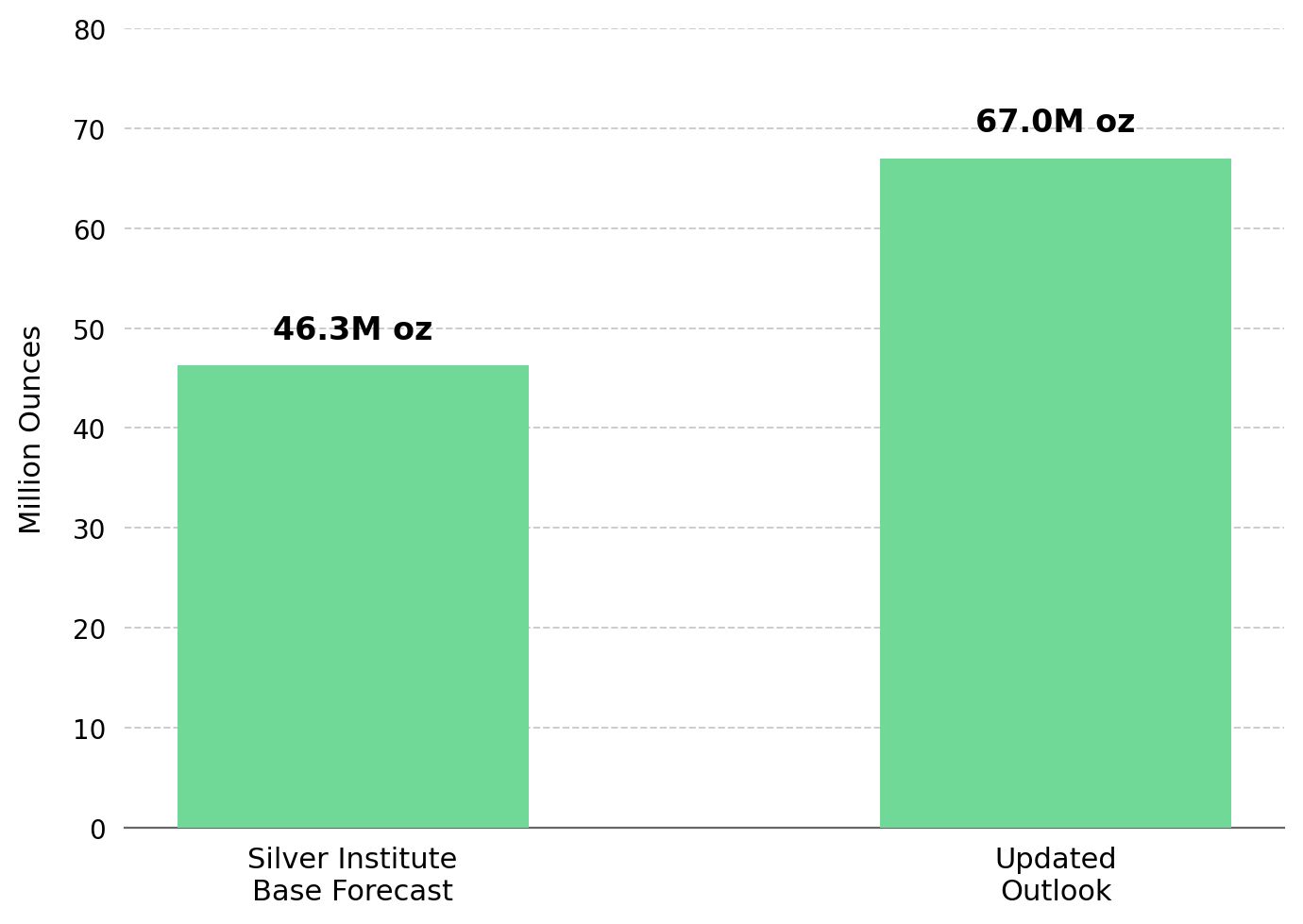
The Silver Institute’s *World Silver Survey 2026* forecasts a sixth consecutive annual deficit of 46.3 million ounces, while a later outlook places the shortfall at 67 million ounces. Both estimates require continued withdrawals from above-ground bar inventories as mine supply remains below demand. Mine production rose 3% to 846.6 million ounces in 2025 but is forecast to grow only modestly in 2026 because 70% to 75% of output is produced as a byproduct of lead, zinc, and copper operations.
China’s Export Licensing Covers 60%-70% of Refined Silver Exports, Slowing COMEX and London Replenishment
China authorized 44 companies to export silver during 2026 and 2027, two more than in the previous licensing period. Although China produces about 13% of mined silver, it accounts for an estimated 60% to 70% of refined exports, giving its licensing policy outsized influence over physical supply. Silver refined in China must clear this process before reaching COMEX-approved or London vaults, slowing inventory replenishment outside the country.
Six-Year Silver Deficit Exposes Different Margin & Valuation Sensitivities Across Project Stages
A sustained silver deficit can affect asset values differently across production, development, and exploration stages because each stage carries a distinct source of price leverage and execution risk. A producer can expand operating margins when higher throughput and realized silver prices increase revenue faster than unit costs. A developer can improve project value when higher silver-price assumptions increase forecast cash flow enough to support financing and a construction decision. An explorer can lower discovery costs by identifying more mineralized ounces per meter drilled, although those ounces require further drilling and resource estimation before entering a compliant mineral resource.
H3: Production-Stage Leverage in an Established Silver District
Americas Gold & Silver reported second-quarter 2026 production of 664,971 ounces from the Galena Complex in Idaho and Cosalá Operations in Mexico. In the same results release, management reaffirmed full-year guidance of 3.2 million to 3.6 million ounces at an all-in sustaining cost (AISC) of $30 to $35/oz, defining the production and cost thresholds required for operating leverage at current silver prices. Galena shaft upgrades increased hoisting capacity by approximately 163%, from 40 to 105 metric tons per hour, while mechanized long-hole stoping raised productivity by more than 300% on completed panels, supporting higher throughput and lower unit costs if the gains extend across the operation.
Oliver Turner, Executive Vice President of Corporate Development at Americas Gold & Silver, connects leverage to industry-wide constraint:
"We've had 6 years now of a structural deficit, about 150 to 200 million ounces a year. 70% of silver is a byproduct from other mines, and copper mines are now constrained because of sulfuric acid supply due to the Strait of Hormuz. You don't have an elastic supply of silver, and by elastic I mean a highly responsive supply. You can't just turn on more silver supply when the world needs it."
During the second quarter of 2026, Americas Gold & Silver eliminated more than $85 million in legacy precious-metal delivery obligations associated with Sprott Mining and a Royal Gold affiliate. The transaction removed more than $28 million in annual servicing costs, increasing the cash available for operations and capital investment.
Silver Above $35.50 Base Case Strengthens Project Economics as Procurement & Leadership Advance Construction
Vizsla Silver’s November 2025 feasibility study for the wholly owned Pánuco project in Sinaloa, Mexico, forecasts average annual production of 17.4 million silver-equivalent ounces over an initial 9.4-year mine life. Under base-case prices of $35.50/oz silver and $3,100/oz gold, the study estimates an after-tax net present value at a 5% discount rate (NPV5) of $1.8 billion and an internal rate of return (IRR) of 111%. The company has not made a construction decision but is targeting first silver production in the second half of 2027, subject to financing, permitting, construction, and commissioning.
On June 16, 2026, Vizsla Silver awarded contracts for eight major processing-plant equipment packages sized for an initial capacity of 3,300 metric tons per day and a targeted expansion to 4,000 metric tons per day, advancing procurement ahead of construction. On August 5, 2026, the company appointed a president of Mexico operations to oversee the remaining permitting and construction work required to support its targeted first production in the second half of 2027.
Michael Konnert, President and Chief Executive Officer of Vizsla Silver, framed the appointment as a marker of the shift from development toward execution:
"As we transition from project development toward construction and ultimately production, his appointment adds further depth to our leadership team and strengthens our in-country capabilities."
8,579 g/t Silver Core Raises Discovery Potential While 80% of Intrusive Perimeter Remains Untested
GR Silver Mining is drilling the Plomosas and San Marcial project area along the Sinaloa-Durango border in Mexico. In its May 19, 2026, drill-results release, the company reported a step-out intercept of 45.1 meters true width grading 1,623 grams per metric ton silver, including 8.25 meters at 8,579 grams per metric ton, extending high-grade mineralization beyond previous drilling but not yet adding compliant resource ounces.
On May 21, 2026, Mexico’s Ministry of Environment and Natural Resources, Secretaría de Medio Ambiente y Recursos Naturales (SEMARNAT), ruled that the targeted pilot plant could use 7.4 kilometers of permitted underground workings without new environmental authorization, although commercial production requires further approvals. With C$27.5 million in cash and no debt as of March 31, GR Silver Mining is funding a 20,000-meter, three-rig drill program targeting a preliminary economic assessment (PEA) in the first half of 2027.
Eric Zaunscherb, President and Chief Executive Officer of GR Silver Mining, frames the scale of what remains untested at San Marcial:
"We've only covered about 20% of the perimeter of that intrusive, so the other 80% of the perimeter of the intrusive is prospective."
Peru Energy, Mexico Security, and Hormuz Shipping Raise Silver Risks
Peru’s May 11, 2026, emergency decree addressing a nationwide energy shortage raised operating risk for power-dependent mines, although no silver-production loss was quantified. The government also extended the Registro Integral de Formalización Minera (REINFO) through 2026, giving an estimated 300,000 informal miners more time to obtain legal status and prolonging uncertainty over formal supply.
GR Silver Mining relocated its logistics base to Durango City in November 2025 in response to security disruptions along Sinaloa transport routes, enabling three drill rigs to continue operating and limiting delays to its 20,000-meter exploration program.
Negotiations involving Iran and Oman had not restored normal Strait of Hormuz traffic as of August 13, 2026, sustaining the risk of further delays to energy shipments. The waterway carries petroleum volumes equal to roughly 20% of global liquids consumption, so an extended disruption could raise oil prices, add to inflation pressure, and increase the probability of higher Fed rates, which would raise silver’s opportunity cost relative to yield-bearing assets.
Byproduct Dependence & China’s Licensing Sustain Silver Deficit While Fed Minutes Shape Near-Term Price Risk
Six consecutive annual deficits indicate a multi-year supply shortfall driven by byproduct-dependent mine output and concentrated refining and export capacity, rather than silver’s latest price movement. Because 70% to 75% of mined silver is produced as a byproduct, higher silver prices generate a limited near-term supply response unless copper, lead, and zinc producers also increase output. China’s 2026 to 2027 licensing regime covers an estimated 60% to 70% of refined silver exports, limiting the volume available outside the country regardless of quarterly changes in mine production. A September Fed decision could change silver prices by altering the opportunity cost of holding the metal, but it would not directly increase mine output or change China’s export-licensing controls.
Fed communications can change silver’s near-term price response to the deficit by raising or lowering the opportunity cost of holding a non-yielding metal. If the Federal Open Market Committee (FOMC) minutes due August 19, 2026, show broader support for the three members who favored a rate increase, higher expected yields could place further downward pressure on silver. If the minutes instead show majority support for holding rates or considering a cut, lower expected yields could support silver prices while the Silver Institute’s two 2026 forecasts continue to show a sixth consecutive annual deficit.
The Investment Thesis for Silver
- The Silver Institute’s two 2026 forecasts both mark a sixth consecutive annual silver deficit, confirming a multi-year supply shortfall rather than a one-quarter anomaly.
- Because 70% to 75% of mined silver comes as a byproduct of copper, lead, and zinc operations, higher silver prices generate a limited near-term supply response unless production of those metals also rises.
- China’s 2026 to 2027 licensing regime covers an estimated 60% to 70% of refined silver exports, despite its 13% share of mine production, limiting supply outside China independently of Fed policy.
- A Fed hold or rate cut could lower expected yields and reduce the opportunity cost of holding silver, supporting prices without changing the six-year supply deficit.
- Higher silver prices can expand producer margins, improve development-project economics, and increase exploration value when drilling supports growth in compliant mineral resources.
- Jurisdiction-specific risks require asset-level assessment because Peru’s energy and transport disruptions can affect mine supply, while security and permitting delays in Mexico can raise project costs and extend development schedules.
After silver fell 1.4% to 2.9% from its August 11 high, the August 19 FOMC minutes are the next macro catalyst because changes in rate expectations directly affect the opportunity cost of holding the metal. The physical deficit does not depend on a rate cut because Silver Institute data show demand exceeding supply for six consecutive years under different monetary-policy conditions. FOMC support for holding or cutting rates could reduce silver’s opportunity cost and support prices, while broader support for a rate increase could extend the pullback. Neither outcome would directly change the six-year supply deficit.
TL;DR
US inflation fell to 3.4% in July 2026, lowering September rate-hike odds to roughly 40% and reducing pressure on silver. However, three Fed dissenters still supported higher rates. The Silver Institute forecasts a sixth annual deficit of 46.3 million to 67 million ounces as mine output responds slowly because 70% to 75% of silver is produced as a byproduct. China’s licensing regime covers an estimated 60% to 70% of refined exports, restricting supply outside the country. The August 19 FOMC minutes could shape silver’s near-term price, but Fed policy will not resolve the underlying supply shortage.
FAQs (AI-Generated)
Analyst's Notes





Subscribe to Our Channel










Stay Informed






