Discovery Group's Playbook: Scale, Skin in the Game and Multi-Year Funding


Discovery Group's Jim Paterson explains how new capital lets juniors like Kodiak Copper and Prospector Metals trade one-hole raises for multi-year plans.
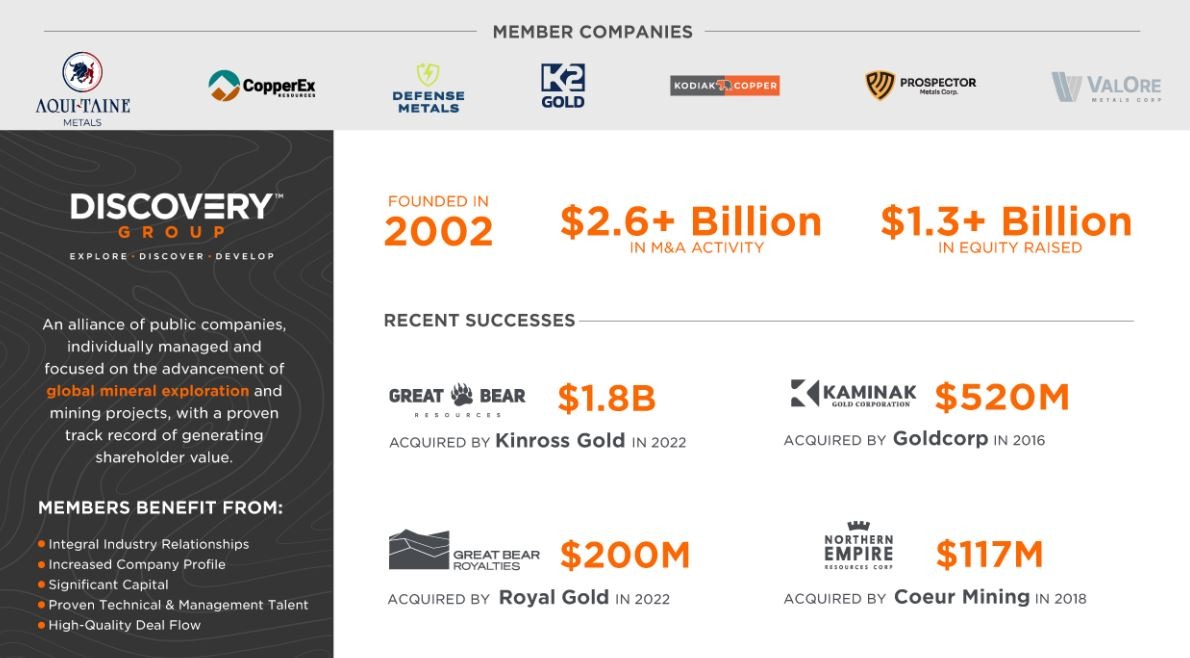
- Co-founder and Principal of Discovery Group Jim Paterson believes capital has returned to junior mining but has not yet reached the excess that tends to fund weak projects.
- Funded companies can plan two- and three-year programmes which lowers contractor costs, retains key staff and reduces the cost of capital.
- Member companies are financially secured for catalysts: Kodiak Copper is fully funded and drilling, while Prospector Metals and K2 Gold have capital to continue into next year.
- Private Aquitaine Metals is exploring a historic gold district in southwest France and hopes to list by the end of the year.
- Paterson advises investors to favour management teams that own stock they bought themselves and that have been vetted in person over time.
For much of the past two decades, junior explorers have lived from one financing to the next. Speaking with Crux Investor at the Beaver Creek conference, Jim Paterson, Co-founder and Principal of Discovery Group, argued that this pattern is finally breaking. Rising metal prices and a political focus on mineral security have brought capital back, and it is changing how experienced teams plan and execute exploration.
Discovery Group is not a listed company. It is an alliance of individually managed public companies founded in 2002 by Paterson and John Robins. Its members have been involved in more than $2.6 billion of M&A activity and have raised more than $1.3 billion in equity. Current members include Kodiak Copper (TSXV:KDK), Prospector Metals (TSXV:PPP), K2 Gold (TSXV:KTO), Defense Metals (TSXV:DEFN), ValOre Metals (TSXV:VO), CopperEx Resources (TSXV:CUEX) and the privately held Aquitaine Metals.
Capital Returns, But Not Yet in Excess
Paterson described a conference mood that is noticeably better than in recent years. People who have lasted 30 years in the business generally know what they are doing, and they are now being rewarded for it. The main theme of his meetings was that capital is back, and it is shortening timelines.
He was careful to distinguish the current market from a speculative peak. In his view, money is wasted when generalists and private equity investors who do not understand the business are sold a story by a banker or promoter and fund projects that do not deserve to advance. He does not believe the market has reached that point. The distinction matters for investors, because an abundance of capital does not make every project a winner.
What has changed, Paterson said, is the ability of competent teams to execute. He drew on his own career to make the point:
"I've been in the business since 1997 and for [the] majority of my career, none of the companies that [I was] associated with or my friends in the business had enough capital to move fast. They were always waiting to raise money."
That shortage had a damaging side effect. Good news often became a liquidity event for existing investors rather than a re-rating, and companies had to fight the market to raise money again.
From Single Drill Holes to Multi-Year Programmes
The more important shift, according to Paterson, is in planning. Capital does not simply allow a company to do the work it already knew was needed. It allows management to plan over two or three years instead of a single season.
"It's a totally different industry an it totally benefits shareholders because if you're planning your costs are going to be lower."
A funded company can also offer its best people secure employment for two years rather than one drill hole at a time. Paterson argued this benefits shareholders directly. Planned costs are lower, and spending money over two years rather than a few weeks reduces the cost of capital.
A rising market capitalisation means little to an investor if the share price stays flat. The relevant measure is value per share, and growth needs to be accretive.
Interview with Jim Paterson, Co-founder and Principal of Discovery Group
Funded Members: Kodiak Copper, Prospector Metals and K2 Gold
Paterson pointed to three members that illustrate the shift. Prospector Metals and K2 Gold both went through periods without enough capital to answer key questions about their projects. He said both are now answering those questions and have plenty of capital to continue into next year. Kodiak Copper is fully funded and drilling.
Kodiak Coppsr's 357 km² MPD project sits in a copper-gold porphyry belt in south-central British Columbia, with seven confirmed zones and an initial Mineral Resource Estimate. Paterson noted that the project had been known for decades but sat dormant. Chris Taylor, whose discovery at Great Bear Resources preceded its $1.8 billion acquisition by Kinross Gold in 2022, is Kodiak's Chairman. Paterson said Taylor's involvement is helping President and CEO Claudia Tornquist execute.
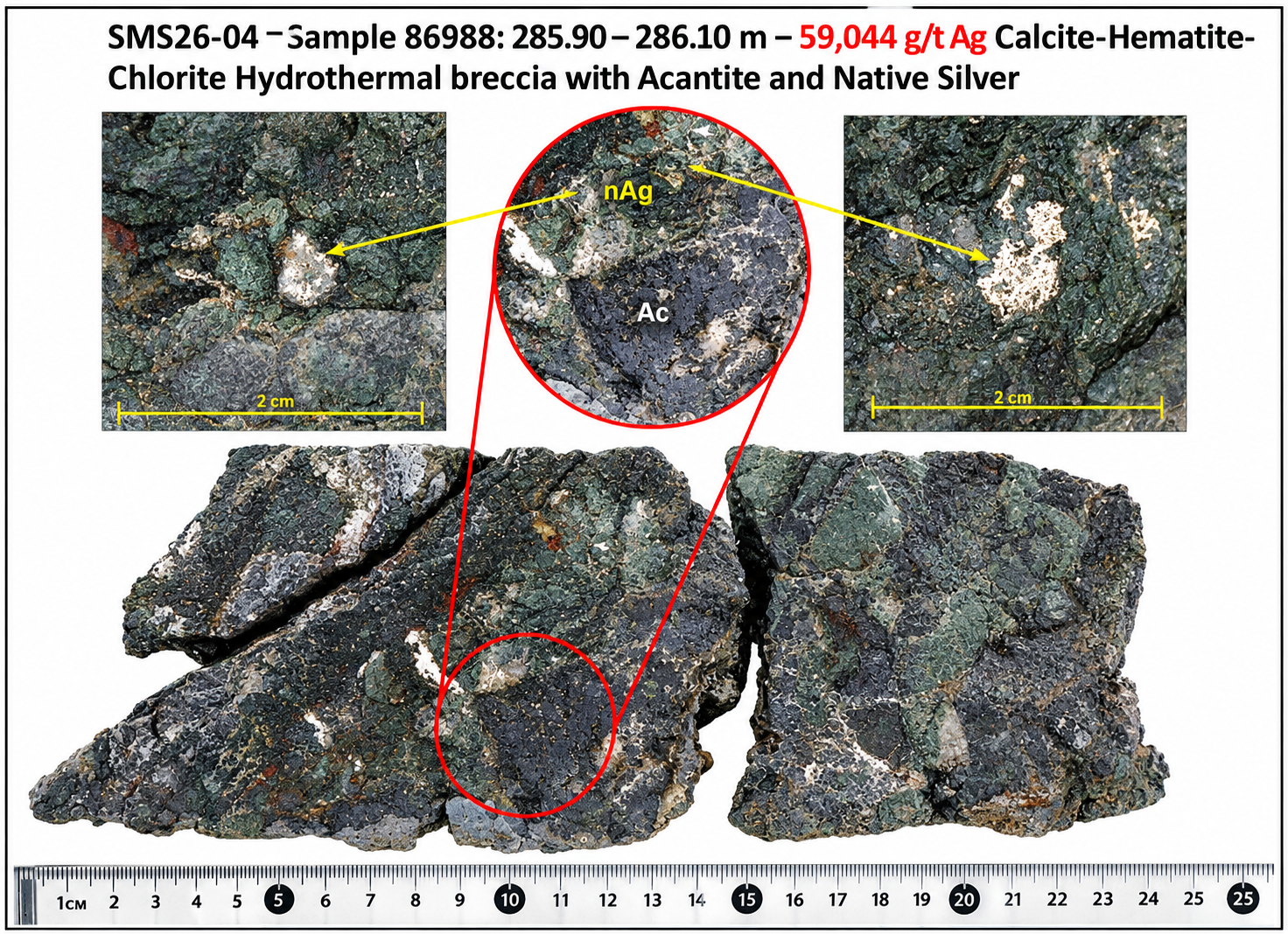
Prospector Metals is exploring the ML Project in the Yukon, where the 2025 discovery of the TESS Zone returned 44m of 13.79 g/T Au, 38.08 g/T Ag and 1.89% Cu in hole ML31.
K2 Gold's Mojave project in California has produced 86.9m of 4.0 g/T Au from surface.
Paterson's broader preference is for scale. Large projects are easier to finance if a company intends to hold them, and easier to sell if it does not.
Management Alignment & the Vetting Process
When asked how CEOs can be encouraged to focus on share price rather than market capitalisation, Paterson gave a direct answer: he believes the only reliable mechanism is for the CEO and senior management to be significant shareholders who bought their stock with their own money.
On vetting new projects for the group, Paterson described a team approach. He is not a geologist or mining engineer, so he relies on colleagues such as co-founder John Robins, who he said can identify a strong deal, and a weak one far faster than he can.
The group also learned from mistakes. Paterson said it made a couple of errors around the pandemic by agreeing deals with counterparties it had only met on video calls. He stated that he will never do a deal over Zoom again. His personal red flags include how someone treats restaurant staff and how they speak about their spouse when that person is not present.
Europe Reopens: Aquitaine Metals
Aquitaine Metals is Discovery Group's newest move into Europe. The private company is led by CEO Chris Taylor alongside a French team. Its Limousin project in southwest France covers 40 km² of exploration licences, with exclusivity over a total of 330 km². The area includes 23 past-producing gold mines and more than 900 ancient high-grade gold workings along over 200km of aggregate strike length. The district also hosts copper, zinc, antimony and silver, which the European Union designates as critical minerals.
Paterson said that 10 years ago nobody from the mining industry would have set foot in France. His experience today is that the jurisdiction is highly supportive. Aquitaine is not yet listed. Paterson said the group hopes it will be public by the end of the year, and that it has its fingers crossed for a valuation above roughly $500 million next year. Both are stated hopes, not commitments.
The Investment Thesis for Discovery Group
- Capital has returned to the junior sector, and Paterson believes the market has not yet reached the excess that typically funds weak projects.
- Funded companies can plan over two to three years, which lowers contractor costs, secures key staff and reduces the cost of capital.
- Partner companies Kodiak Copper, Prospector Metals and K2 Gold are funded to continue work into next year, reducing near-term financing risk.
- Investors should check insider buying on SEDI, because management teams that own stock bought with their own money share the same incentives as shareholders.
- Monitor Aquitaine Metals' proposed public listing, which the group hopes to complete by the end of the year but which has not yet happened.
- Track the Elemental Royalty acquisition from Orion to see whether it closes as expected in Q4 2026.
- The key risk is that capital later arrives in excess, allowing weaker teams to fund projects that do not deserve to advance.
Macro Thematic Analysis
The interview placed the junior sector's recovery within a wider geopolitical shift. Back during the pandemic, when border closures across South America and Africa and the collapse of just-in-time logistics exposed how fragile supply chains had become. The war in Ukraine, widening sanctions and tensions involving Iran have since reinforced the case for supply security.
Paterson framed the issue in terms of sovereignty. He argued that nations, like individuals, should be able to look after themselves rather than depend on suppliers they may later fall out with.
For investors, this changes the risk map. Jurisdictions such as France, once effectively closed to exploration, are now open to well-structured projects with local partners. Political will does not remove technical risk, however. Paterson noted that some niche metals rarely attract investment because their projects face difficult metallurgy or challenging locations. Throwing money at those projects will not make them work.
Generalist investors are returning to the sector as metal prices rise. Critical minerals have been widely discussed for three years and are starting to draw attention, if not yet capital at scale. The likely result is a more selective market. Projects with scale, sound geology and experienced management are best placed to benefit. Projects that rely only on a strategic narrative may struggle once investors start to discriminate.
TL;DR
Jim Paterson, Co-founder and Principal of Discovery Group, says capital has returned to the junior mining sector but is not yet in excess. For experienced teams, this means planning over two to three years instead of raising money for one drill hole at a time. That lowers contractor costs, retains key staff and reduces the cost of capital. Member companies Kodiak Copper, Prospector Metals and K2 Gold are funded and active, according to Paterson. Private Aquitaine Metals is exploring a gold district in southwest France and hopes to list by year end. Paterson's advice to investors is to back management teams that own stock they paid for and communicate a clear plan.
FAQ (AI-generated)
Analyst's Notes





Subscribe to Our Channel

Stay Informed