US Nuclear Fuel Supply Restructuring through $2.7 Billion in Federal Grants: Where the Feedstock Deficit Gets Filled


US HALEU grants of $2.7B reshape uranium supply chain risk, creating premiums for domestic producers and demand signals for high-grade Canadian deposits before 2035.
- The Trump administration's $2.7 billion federal grant program, announced in January 2026 and split equally among Centrus Energy, General Matter, and Orano Federal Services, is the largest US government commitment to nuclear fuel infrastructure since the Cold War, targeting a HALEU deficit the Department of Energy projects could reach 50 metric tons per year by 2035 against current domestic production of 1 metric ton per year.
- Grants are disbursed against technical milestones over a 10-year period; near-term supply risk is not resolved by the awards, and the gap between 1 metric ton of current HALEU output and the DOE's 50 metric ton projection cannot close before 2030 at the earliest under Centrus's stated target of 12 metric tons per year.
- For US-based producers such as Energy Fuels and enCore Energy, domestic uranium now competes as a policy-compliant input to enrichment facilities legally restricted from accepting Russian feedstock - a condition that supports a supply premium above spot for contracted domestic material.
- For development-stage and exploration-stage companies in Canada's Athabasca Basin and Angikuni Basin, the program signals that a rebuilding US enrichment complex will require feedstock volumes beyond what domestic mines can provide, making grade, depth, permitting status, and proximity to existing milling infrastructure the qualifying variables.
- The primary thesis-falsification risk is geopolitical: if restrictions on Russian uranium are relaxed before domestic enrichment reaches economies of scale - a condition Centrus does not project achieving before 2030 - the supply premium underpinning domestic producer valuations narrows materially.
A Policy Event That May Restructure an Entire Supply Chain
The United States nuclear fuel supply chain withered after the Cold War as cheaper imports from Russia, France, the Netherlands, and the UK took over the market. By 2024, the US was heavily reliant on these imports to supply its commercial nuclear power plants, with its only domestic large-scale low-enriched uranium (LEU) enrichment plant having the capacity to meet roughly one-third of the country's needs.
In 2024, following Russia's invasion of Ukraine, the US set strict annual limits on Russian uranium imports, escalating to a total ban by 2028. This created an immediate procurement problem because Russia has historically been the sole commercial producer of HALEU, uranium enriched to between 5% and 19.75% U-235, compared to the 3% to 5% standard used in existing conventional reactors. Without HALEU, Small Modular Reactors cannot complete the fuel qualification testing required before commercial operation. A failure to close that gap before SMR construction completions are scheduled in the early 2030s means completed reactors without licensed fuel, delaying return on capital by years. The January 2026 grant awards address the capital structure of enrichment development, not the timeline risk, a distinction that is the central analytical frame for investors.
The Grant Program: What $2.7 Billion Actually Buys
The $2.7 billion is infrastructure seed capital, milestone-gated over a decade, designed to lower first-loss risk for private and sovereign co-investors by absorbing the fixed costs that have historically made unsubsidized US enrichment uneconomic. Each $900 million award covers centrifuge procurement, facility construction, and staffing. Orano Federal Services' award sits within the $5 billion Project IKE facility in Oak Ridge, Tennessee, the federal grant representing approximately 18% of total projected cost. General Matter's award applies to the former Paducah Gaseous Diffusion Plant in Kentucky, a brownfield site whose existing infrastructure reduces civil construction cost relative to a greenfield build. Centrus Energy, operating the only HALEU facility in the US at its Piketon, Ohio site, signed a Memorandum of Understanding with Korea Hydro and Nuclear Power and POSCO International in August 2025, indicating the leverage thesis, federal capital restructuring the return profile for institutional co-investors, is operating as designed.
Against a DOE projection of up to 50 metric tons per year by 2035, Centrus's funded target of 12 metric tons after 2030 leaves a deficit of at least 38 metric tons at the start of the next decade before General Matter or Orano contribute. Urenco, excluded from the grants, is self-funding a 15% capacity increase at its New Mexico LEU facility and constructing a 27 metric ton per year HALEU facility in the United Kingdom, a non-domestic supply vector that introduces a pricing variable outside the original policy calculus.
Implications for US-Based Uranium Producers: Domestic Supply Premium
The Russian import restrictions removed the lowest-cost competing supply from the procurement market, meaning contracted domestic uranium no longer needs to match Russian spot pricing to win utility tenders, it needs only to be available, compliant, and reliable. For producers with permitted, operating assets, this supports a durable premium above unconstrained spot.
Financial Health & Strategic Positioning of US Producers
Energy Fuels (producer) holds the White Mesa Mill in Utah, the only operating conventional uranium mill in the United States, and the Pinyon Plain Mine in Arizona. The company reported working capital of approximately $298.5 million as of September 30, 2025, and completed a $700 million convertible senior notes offering in October 2025 at an effective pre-tax yield of approximately 2.1%, oversubscribed seven times. Phase 1 heavy REE oxide production including dysprosium and terbium is planned for 2026, with Phase 2 REE expansion permitting underway. A Final Investment Decision for the Donald HMS and REE project in Australia is targeted within the 2026 to 2027 timeframe. Chief Executive Officer Mark Chalmers has addressed the vulnerability of operators without vertical integration:
"What we're seeing is there are lots of players in this business that have one small step, and the way the market is moving is if you have one step you're vulnerable upstream, downstream, because you have one step... We have to have that integration step to get the maximum leverage."
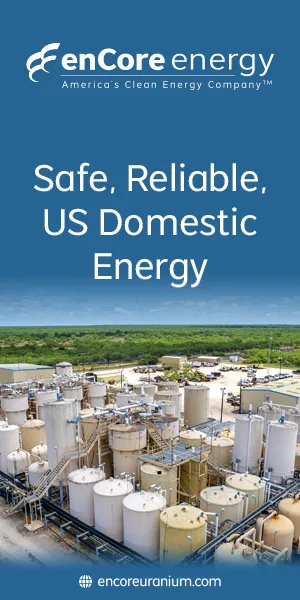
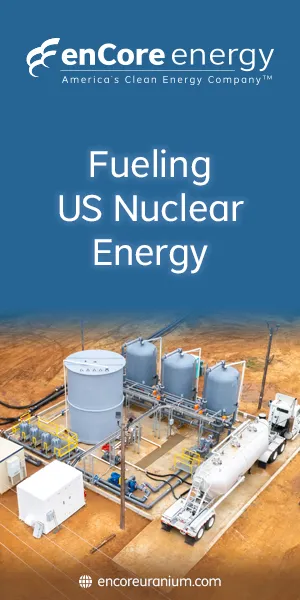
enCore Energy (producer) operates exclusively through In-Situ Recovery, or ISR, a process requiring capital expenditure that is typically a fraction of conventional mining, across three licensed Central Processing Plants in South Texas: Alta Mesa at 1.5 million pounds per year nameplate capacity, which commenced operations in Q2 2024; Rosita at 800,000 pounds per year, with the first wellfield near completion awaiting final permitting; and the Kingsville facility. Executive Chairman William Sheriff has described the direct mechanical connection between well construction efficiency and production volume on the operational pathway from well construction speed to daily output:
"We went from a little over seven days average of getting a production or injector well in, into just about 1.3 now. In order to up your production you've got to get more wells in the ground - more wells, more fluid flow, more uranium going through the plant, higher recovery, higher daily production rate."
What the Grant Signals to Non-US Producers
A domestic enrichment complex targeting 12 metric tons of HALEU per year from Centrus alone against a DOE projection of 50 metric tons by 2035 requires feedstock that US mines cannot supply unilaterally. The asset characteristics that determine which deposits qualify, grade, depth, permitting status, and proximity to licensed milling infrastructure, are already present in a small number of Canadian assets.
Exploration Outlook & Resource Development in Allied Jurisdictions
IsoEnergy (development-stage) holds the Hurricane Deposit at Larocque East in Saskatchewan's Athabasca Basin, carrying a published indicated resource of 48.6 million pounds U3O8 at 34.5% grade. At a depth of 325 meters with no surface water cover, the deposit avoids the dewatering costs that inflate capital expenditure for deeper Athabasca Basin assets. Hurricane sits within 50 kilometers of the McClean Lake mill, reducing infrastructure planning requirements, though no formal processing arrangement has been publicly disclosed. A Winter 2026 drill program of approximately 5,200 meters across up to 13 holes is underway, and a 2,000-ton Bulk Sample Program at the Tony M Mine in Utah is advancing toward a potential production restart pending technical and economic evaluations. Chief Executive Officer Philip Williams has stated the company's long-term intent regarding Hurricane's position within the global resource inventory:
"When you think about the world, and you think about where are the better projects, it's unquestionable that Hurricane rises to the top of that list for a lot of different companies... We're not ever looking to offload Hurricane. Our job is to maximize the value of it."
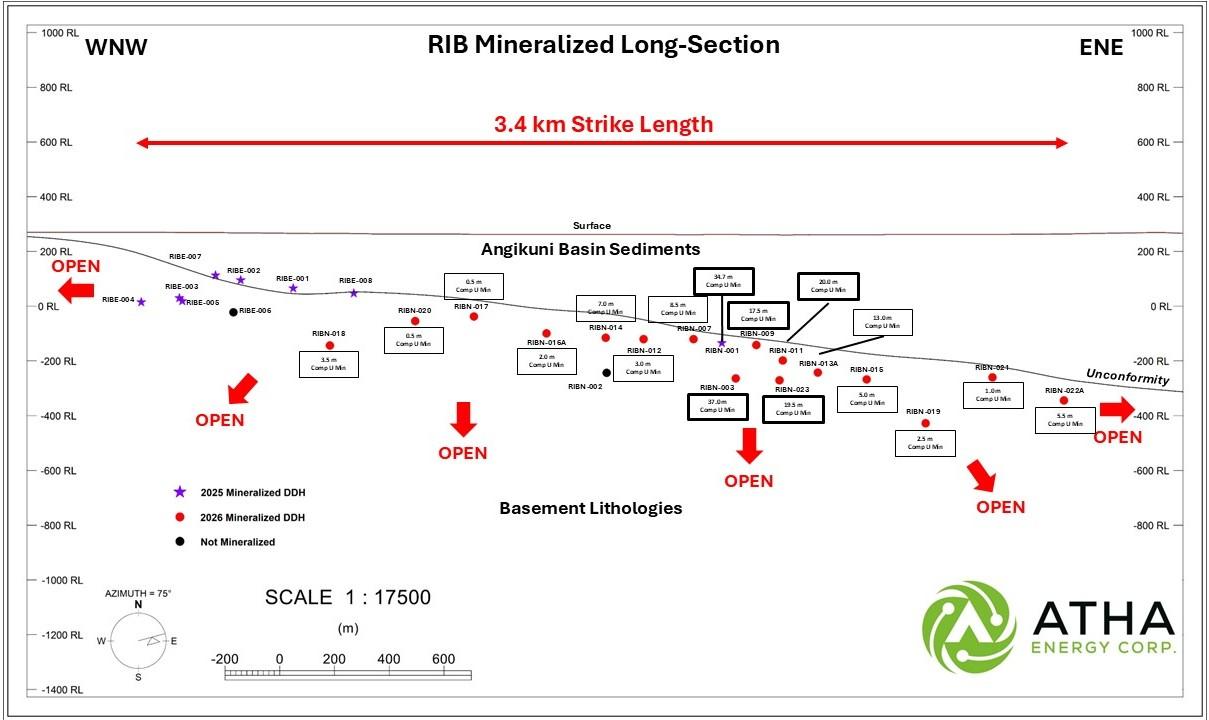
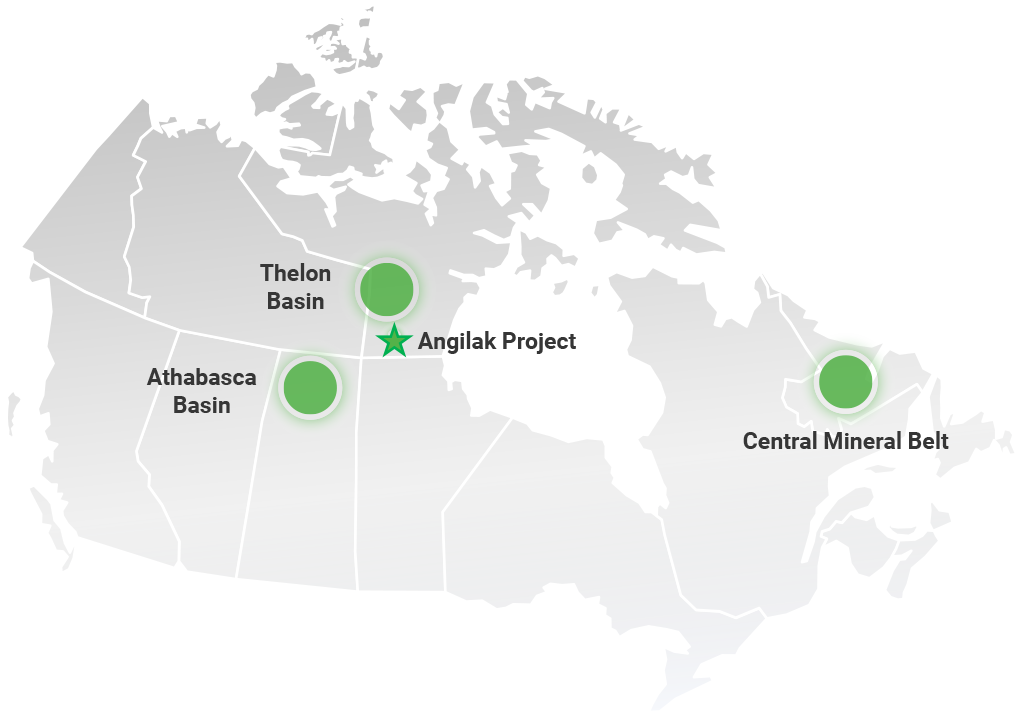
ATHA Energy holds over 7 million acres across Canada's top uranium districts: 3.8 million acres in the Athabasca Basin, which ranked 3rd in the world for mining investment attractiveness according to the 2025 Fraser Institute survey; 3.1 million acres in Nunavut; and 267,795 acres in the Central Mineral Belt of Newfoundland and Labrador. A 2025 program of 48 diamond drill holes totaling over 20,000 meters identified the 18-kilometer Mineralized RIB Corridor with a 100% drill hit rate. ATHA also holds a 10% carried interest on IsoEnergy and NexGen lands in actively developed areas of the Athabasca Basin, covering zones proximal to the Arrow, Triple R, Spitfire, and Centennial deposits, providing exposure to exploration success without additional capital deployment. Chief Executive Officer Troy Boisjoli highlighted the supply-side context on scale potential and uranium supply constraints:
"We have the opportunity and the ability to be executing on a project that has tremendous scale potential at a time in the uranium sector when the vast majority of the risk is on the supply side."
The Investment Thesis for Uranium
- US-based producers with permitted, operating assets carry a supply premium enforced by statute through 2028, as the Russian import restrictions removed the lowest-cost competing supply from the procurement market and that condition does not reverse absent a formal policy reversal.
- The enrichment build-out targets 12 metric tons of HALEU per year from Centrus after 2030 against a DOE projection of 50 metric tons by 2035, creating a feedstock demand signal for high-grade Canadian deposits whose development timelines align with the post-2030 ramp and whose proximity to operating mills reduces standalone processing infrastructure requirements.
- Capital structure is a primary institutional qualifier: Energy Fuels' approximately $298.5 million in working capital as of September 30, 2025, and IsoEnergy's approximately C$156 million cash position following the Toro Energy acquisition represent the balance sheet runway that mandated holding periods require in a sector with multi-year development horizons.
- Exploration-stage exposure to district-scale land packages, such as ATHA Energy's 7 million acres supported by an October 2025 NI 43-101 technical report on the Angilak Property, offers discovery upside in a supply environment where the DOE has quantified a deficit that existing capacity cannot close without new resource development.
- The primary risk is geopolitical: if Russian uranium re-enters Western procurement before domestic enrichment reaches commercial scale, the supply premium narrows and the capital leverage thesis underpinning the grant program weakens in direct proportion.
The January 2026 grant program commits $2.7 billion in milestone-gated capital to an industry that market forces failed to rebuild for three decades. At 1 metric ton of current annual HALEU production against a DOE projection of up to 50 metric tons by 2035, the deficit cannot be closed without new construction at scale. The awards make that construction financeable - they do not guarantee it happens on schedule.
Domestic producers operating within the Russian import restriction perimeter hold a supply premium embedded in utility procurement decisions being written now. Allied-jurisdiction producers with high-grade, low-cost deposits and credible production pathways before 2035 are the logical feedstock complement to a rebuilding enrichment complex whose domestic mine base is insufficient to meet its own input requirements. The 2028 total ban implementation is the critical policy checkpoint: if it is delayed or reversed before domestic and allied supply chains reach economies of scale, the supply premium narrows and the investment case for capital-intensive enrichment infrastructure weakens in direct proportion.
TL;DR
The Trump administration's $2.7 billion HALEU enrichment grant program, split among Centrus Energy, General Matter, and Orano Federal Services, is the largest U.S. nuclear fuel infrastructure commitment since the Cold War. It addresses capital structure, not timeline risk: current domestic HALEU production of 1 metric ton per year faces a DOE-projected deficit of 50 metric tons by 2035, with Centrus's funded target of just 12 metric tons after 2030. Russian import restrictions create a durable supply premium for compliant domestic producers like Energy Fuels and enCore Energy, while the feedstock gap signals strong demand for high-grade Canadian deposits in the Athabasca and Angikuni Basins. The primary risk remains geopolitical, a relaxation of Russian import restrictions before domestic enrichment scales would materially narrow the supply premium underpinning current producer valuations.
FAQs (AI-Generated)
HALEU — High-Assay Low-Enriched Uranium, enriched to between 5% and 19.75% U-235 — is the fuel required by next-generation Small Modular Reactors. Without a reliable domestic HALEU supply, completed SMRs cannot obtain fuel qualification licensing, potentially delaying return on capital by years. Russia has historically been the sole commercial producer, making the current policy shift a structural supply event rather than a cyclical one.
The U.S. currently produces approximately 1 metric ton of HALEU per year. The Department of Energy projects demand could reach 50 metric tons per year by 2035. Even with the $2.7 billion grant program, Centrus's funded target of 12 metric tons per year after 2030 leaves a deficit of at least 38 metric tons at the start of the next decade before other grantees contribute meaningfully.
The restrictions — escalating to a total ban by 2028 — removed the lowest-cost competing supply from the procurement market. U.S. producers with permitted, operating assets no longer need to match Russian spot pricing to win utility contracts; they need only to be available, policy-compliant, and reliable. This statutory condition supports a durable supply premium above unconstrained spot pricing for domestic material through at least 2028.
US domestic mines cannot unilaterally supply the feedstock volumes a rebuilding enrichment complex requires. High-grade Canadian deposits — particularly in Saskatchewan's Athabasca Basin — with shallow depths, proximity to operating mills, and credible pre-2035 development timelines represent the logical feedstock complement. Asset characteristics including grade, permitting status, depth, and mill proximity are the qualifying variables determining which deposits benefit most.
If restrictions on Russian uranium are relaxed or delayed before domestic and allied enrichment infrastructure reaches economies of scale — a threshold Centrus does not project achieving before 2030 — the supply premium enforcing domestic producer valuations narrows materially. The 2028 total import ban implementation date is the critical policy checkpoint investors should monitor.
Analyst's Notes





Subscribe to Our Channel










Stay Informed