




West Red Lake Gold & Madsen: Second Quarter Financials Deliver C$9.7 Million Free Cash Flow as AISC Drops 30%


West Red Lake Gold transitioned to positive free cash flow of C$9.7 million in the second quarter of 2026, compressing all-in sustaining costs by 30% to US$3,284 per ounce of gold.
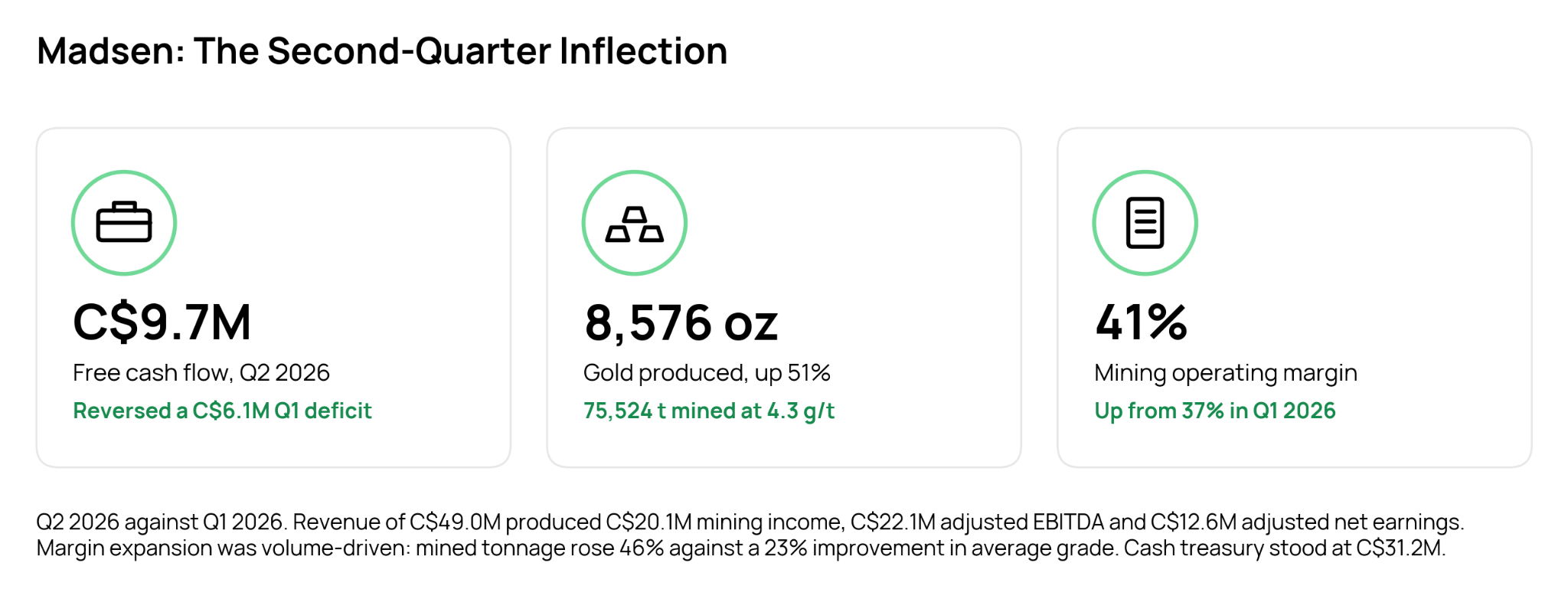
- West Red Lake Gold generated C$9.7 million in free cash flow (FCF), reversing a C$6.1 million first-quarter deficit.
- Gold production increased 51% to 8,576 ounces as mined ore rose to 75,524 tonnes.
- Average mining and milling rates reached 878 and 842 tonnes per day, respectively.
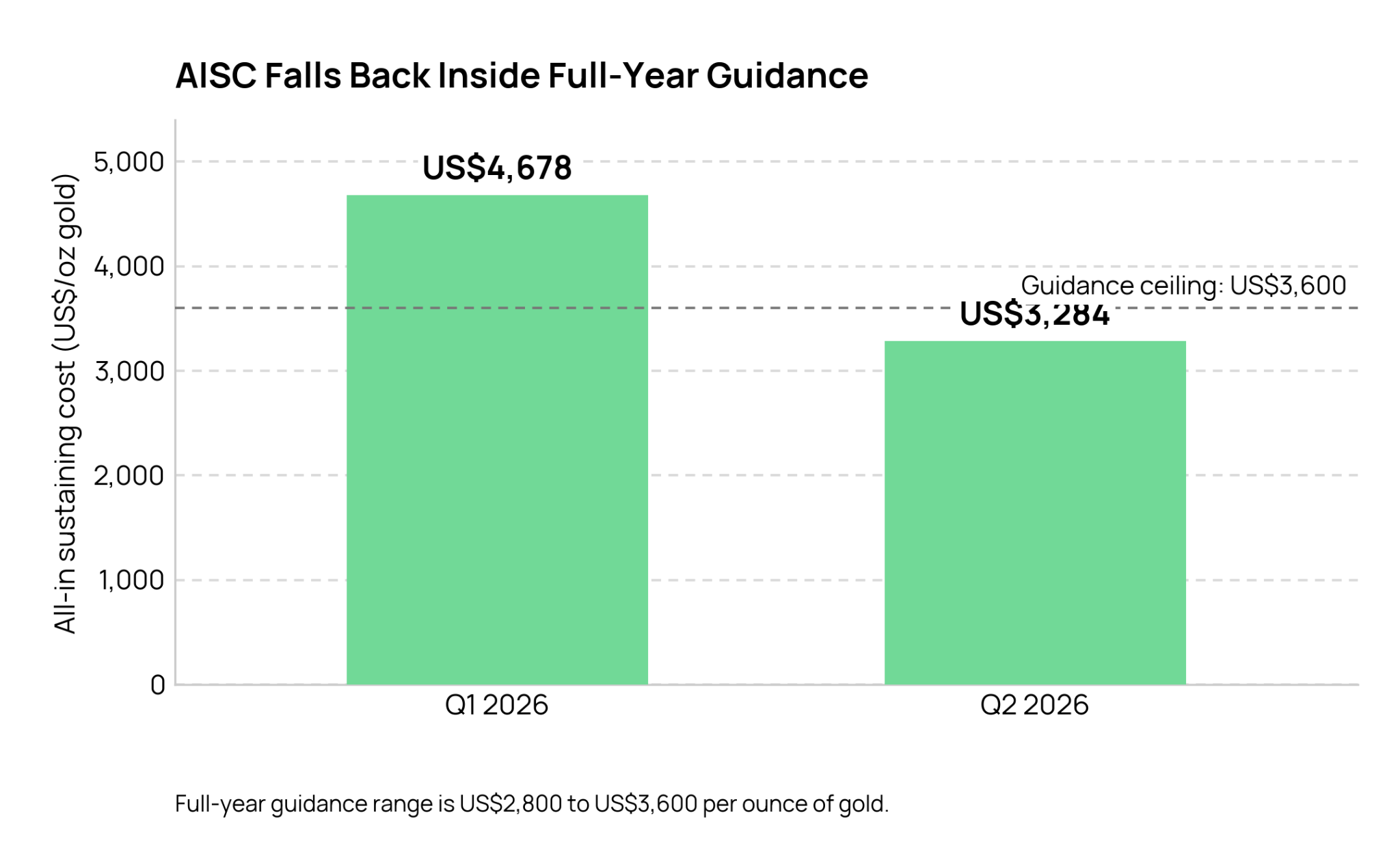
- All-in sustaining costs (AISC) declined 30% to US$3,284 per ounce, within the full-year guidance range.
- The mill’s 800-tonne-per-day permit limit and deeper-zone grade reconciliation remain key operational risks.
What Has Happened
West Red Lake Gold Mines Ltd. (TSXV: WRLG | OTCQX: WRLGF) transitioned from a cash shortfall in the first quarter of 2026 to active cash generation, reporting positive free cash flow (FCF) of C$9,664,000 for the second quarter of 2026, representing a 257% reversal from the first quarter of 2026's C$6,140,000 deficit. Gold production rose 51% to 8,576 ounces in the second quarter of 2026, demonstrating that the technical underground scale-up has achieved critical-mass cost dilution at the central Madsen Mine in Ontario, Canada.
Volume Scale-Up Dilutes Fixed Operating Costs
The primary mechanism driving this transition is the scale-up of mining throughput, which has successfully diluted legacy operating overheads. In the second quarter of 2026, mined ore reached 75,524 tonnes, compared with 51,616 tonnes in the first quarter of 2026. This scale-up was supported by an average mined grade of 4.3 grams per tonne of gold. Daily mining rates averaged 878 tonnes per day in the second quarter of 2026, driving average mill throughput to 842 tonnes per day and resolving previous mechanical bottlenecks.
This volumetric expansion unlocked cost efficiencies. Total sustaining capital expenditures (CAPEX) dropped to C$12,265,000. Because these fixed capital requirements were spread over more ounces sold, unit cash costs fell to US$2,000 per ounce of gold. This dilution compressed the second-quarter all-in sustaining cost (AISC) by 30% to US$3,284 per gold ounce, bringing West Red Lake Gold’s operating costs directly within its full-year guidance range of US$2,800 to US$3,600 per gold ounce. This cost reduction offsets the first quarter's highly elevated AISC of US$4,678 per ounce of gold, establishing operational credibility relative to junior peers who frequently experience prolonged cash burn during production ramp-ups.
Expanded Margin & Profitability Inflection
Scaling production volume and compressing unit operating costs expanded mining operating margins, and adjusted net earnings increased by 98%. Gold sales revenue reached C$49,035,000 in the second quarter of 2026, up from C$41,755,000 in the first quarter of 2026, generating C$20,083,000 of income from mining operations. Higher sales volume expanded the company's mining operating margin to 41% in the second quarter of 2026, up from 37% in the first quarter of 2026. This margin expansion was primarily volume-driven rather than price-driven, as the 46% increase in mined ore tonnage outpaced the 23% improvement in average gold grade, demonstrating that fixed-overhead dilution remains the primary driver of profitability.
This expanded margin had an immediate impact on bottom-line profitability. Adjusted Earnings Before Interest, Taxes, Depreciation, and Amortization (EBITDA) rose to C$22,106,000 in the second quarter of 2026. Furthermore, adjusted net earnings climbed to C$12,632,000, translating into basic adjusted earnings per share of C$0.03. The company spent C$6,322,000 on growth capital in the quarter and ended with C$31,214,000 in cash, down from C$35,917,000.
Balance Sheet Discipline & Operational Risks
Corporate leadership has prioritized balance sheet de-risking and active debt repayment, monitoring cash flow to systematically de-risk the company's capital structure. The financial step-change achieved in the second quarter of 2026 has allowed the operating team to shift focus toward consistent operational execution. Mining rates regularly exceeded 1,000 tonnes per day, resulting in a 10,768-tonne surface stockpile containing approximately 1,500 ounces of gold. This surface inventory provides 0.5 months of mill feed buffer, insulating operations from delays in underground stope sequencing.
While the second-quarter operational metrics demonstrate rapid progress, several residual risks remain. Sustaining daily underground mining rates above 1,000 tonnes per day is technically viable, but the Madsen Mill's permanent permit is capped at 800 tonnes per day. The company remains mill-constrained and must secure expansions of environmental permits to process future mining surpluses. The next test is whether grades stay predictable as mining moves from remnant zones into deeper non-remnant panels, including the Austin 904 Complex. Finally, while the second-quarter AISC of US$3,284 per gold ounce brings costs inside full-year guidance, the highly elevated first-quarter AISC of US$4,678 per gold ounce highlights that West Red Lake Gold requires consistent, high-volume performance in the third and fourth quarters of 2026 to achieve its full-year targets.
President and Chief Executive Officer of West Red Lake Gold Mines, Shane Williams, framed the ramp-up around cash flow and debt:
"Getting that cash flow, are we building cash on the balance sheet? Are we gradually building that up over time? Because, remember, we've also started paying the debt now. We took on some debt. We've debt loads to pay. As we're ramping up, it's at the right time to be ramping up because. As we've done, we're paying down some debt. All those are good metrics as we're ramping up."
Key Takeaway for Investors
West Red Lake Gold Mines has systematically de-risked its operational profile by demonstrating that the Madsen Mine can generate positive cash flow as mined tonnage and mill throughput rise. The second quarter of 2026 results demonstrate the high sensitivity of the operation's margin to volumetric scale: when daily mining rates consistently exceed the 800 tonnes per day threshold, fixed overheads and capital costs are rapidly diluted. Reversing a net cash burn to generate C$9,664,000 in positive FCF within 6 months of commercial production shows the mine can fund itself in a strong quarter. While the sustainability of this cash generation remains dependent on securing environmental permit expansions to process mining rates exceeding 800 tonnes per day and on maintaining grade predictability as extraction transitions deeper into non-remnant complexes, the current progress is the operating record against which the next two quarters will be judged.
FAQs (AI-Generated)
Analyst's Notes





Subscribe to Our Channel




.png)



Stay Informed






















