




What Blue Rose Drill Core Says About Cobra's Porphyry Copper Model


Cobra Resources' Blue Rose core and first diamond assays at Manna Hill: how skarn copper, potassic alteration and breccia fit its porphyry copper model.
- Cobra Resources' diamond drilling at Blue Rose, within the Manna Hill project in South Australia, logged bornite veining, anhydrite veining, and hydrothermal breccia beneath shallow skarn copper mineralization.
- Alteration chemistry changes with depth, from a retrograde serpentine-chlorite assemblage near the surface to a prograde phlogopite-albite assemblage with potassic alteration in the diamond core.
- The chalcopyrite, bornite, and potassium-rich alteration logged in the diamond core match the copper-enriched, potassium-rich zone in Cobra's porphyry model, which also includes a potassium-rich, copper-depleted zone.
- Assays from 2 of 4 diamond holes returned 23 meters at 0.63% copper, including 12.4 meters at 1.01% copper, and 36 meters at 0.39% copper, including 10 meters at 0.99% copper, with mineralization open beyond 300 meters downhole.
- Cobra reported 211 million warrants outstanding at 2.0 pence, 2.3 pence and 6.0 pence, and holders exercised warrants for 1,000,000 shares at 2.0 pence on September 25, 2026 for £20,000.
What Has Happened
Cobra Resources plc (LSE: COBR) is exploring the Manna Hill copper project in South Australia's Nackara Arc alongside its Wudinna rare earths project. Its first reverse circulation (RC) drilling program at the Blue Rose prospect, in January 2026, returned thick copper intersections from shallow depths in skarn. The company followed with diamond drilling beneath the skarn, with core logged to depths of up to 402 meters.
Cobra interprets the diamond drilling as delivering indications that the shallow skarn is related to a larger porphyry system at depth, across a 1.6-kilometer section. On September 24, 2026, Cobra reported assays from 2 of its 4 diamond holes, with assays from the other 2 still pending. Up to 6,000 meters of follow-up RC drilling across 52 holes is underway at 4 prospects: Blue Rose, Neptune Rose, Anabama and Netley Hill.
With visual core logs, alteration chemistry and a drawn geological model now in hand, each Blue Rose observation can be checked against the specific zone Cobra has assigned to it. That comparison shows which parts of the model the drilling has already reached and which parts it has not yet described.
The Shallow Skarn Is the Starting Point
The RC program defines the upper level of the system. One hole returned 20 meters at 0.78% copper and 0.13 grams per tonne gold from 38 meters, and 74 meters at 1.02% copper and 0.25 grams per tonne gold from 70 meters. A second returned 86 meters at 0.60% copper and 0.14 grams per tonne gold from 18 meters, and a third returned 62 meters at 1.0% copper and 0.08 grams per tonne gold from 62 meters. Cobra's cross-section through the first 2 of those holes shows a mineralized zone with an estimated width of about 70 meters.
Another RC hole gives the first sign that the metal mix changes downhole. It returned 56 meters at 0.34% copper from 34 meters, then 14 meters at 0.21% copper and 0.01% molybdenum from 122 meters, and 10 meters at 0.12% molybdenum from 144 meters. Molybdenum grades rise in the deeper intervals of the same hole, and Cobra lists molybdenum with copper and gold as the project's target metals.
Cobra describes the shallow copper as calc-silicate hosted skarn mineralization. The shallow intersections measure that skarn. The deeper diamond holes are testing a different part of the system, and Cobra's own geochemistry work indicates the controls on copper change between the shallow and deeper parts of the system.
Alteration Chemistry Changes With Depth
The clearest evidence of that change comes from geochemistry. Geological Advisor Professor Ross Large AO, a Distinguished Professor of Economic Geology and former head of CODES, performed the 2026 analysis comparing an RC hole with a diamond hole.
Samples from the 86-meter skarn intersection plot as a retrograde serpentine-chlorite assemblage. Portable X-ray fluorescence chemistry across 0-321 meters of one diamond hole plots as a prograde phlogopite-albite assemblage, with only a minor retrograde overprint of chlorite and serpentine. Cobra states that at depth, copper mineralization is associated with increasing potassic alteration, a change in chemical and geological control from the shallow calc-silicate hosted copper.
In Cobra's model, these are 2 separate systems: a copper-magnesium retrograde system in the upper levels and a copper-potassium prograde system below it. The diamond hole with the prograde chemistry profile returned 23 meters at 0.63% copper and 0.09 grams per tonne gold from 186 meters, including 12.4 meters at 1.01% copper, and a further 10.5 meters at 0.38% copper from 297.9 meters. Copper in that hole therefore occurs within the potassium-rich, prograde setting that Cobra has identified at depth.
What the Core Shows, Hole by Hole
The visual core logs add physical evidence to the chemistry. One diamond hole shows calc-silicate with chalcopyrite at 186 meters, coarse potassium-rich chalcopyrite at 195 meters and bornite veining at 220-230 meters. A second shows anhydrite sulfate veining from 199 to 220 meters. A third hole, drilled to 402 meters, intersected hydrothermal breccia from 350 to 402 meters.
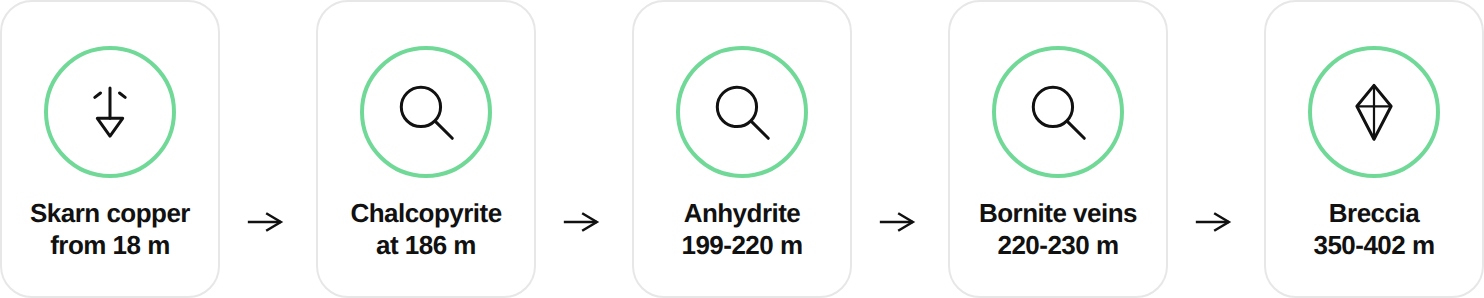
The depths in the sequence are downhole measurements from 4 different holes, 1 RC hole and 3 diamond holes, so the sequence shows the type of feature logged at each depth, not a single continuous column. Cobra groups more than 50 meters of hydrothermal breccia, large anhydrite veining, and copper-potassic mineralization at depth as its porphyry vectors. Within the first of those holes alone, the core moves from calc-silicate skarn host rock at 186 meters to potassium-rich chalcopyrite and then bornite by 220-230 meters, the same shift the chemistry records.
How the Observations Fit Cobra's Porphyry Model
In its Blue Rose porphyry model, Cobra places shallow skarn beneath the interpreted present-day surface, with normal faults acting as fluid pathways and multiple alteration overprints. Below the skarn, Cobra's model includes a copper-depleted, potassium-rich zone, then a potassium-rich zone enriched in chalcopyrite and bornite, arranged around a central hydrothermal breccia. The model also includes diorite and dacite porphyry intrusions and a propylitic alteration zone. Cobra's September 24 section through the copper-bearing hole shows mineralized dacite porphyry dikes, and the company reports that a number of porphyry-related intrusions have a spatial relationship to mineralization at Blue Rose.
The core observations line up with the named parts of that model. The chalcopyrite, bornite and potassium-rich alteration in the diamond core match the zone Cobra labels as enriched in chalcopyrite and bornite and rich in potassium, and the breccia hole corresponds to the model's breccia body. The model also contains a potassium-rich zone that is depleted in copper, so potassic alteration on its own does not establish copper at depth. Where chalcopyrite was logged at 186 and 195 meters, assays returned 23 meters at 0.63% copper from 186 meters, which places that interval in the copper-bearing zone. The bornite interval at 220-230 meters returned narrower results, including 1.7 meters at 0.61% copper and 0.24 grams per tonne gold from 228 meters.
The breccia hole returned 36 meters at 0.39% copper and 0.05 grams per tonne gold from 232 meters, including 10 meters at 0.99% copper, and 16.9 meters at 0.08% molybdenum from 335.5 meters, including 1.1 meters at 0.48% molybdenum, within strongly altered wall rock in contact with the hydrothermal breccia. Cobra states that molybdenum is generally more proximal to the potassic alteration zone, which becomes more enriched in metals and can host higher-grade copper. On Cobra's 1.6-kilometer section, this hole is drawn extending into an induced polarization resistivity feature beneath the drilled zone. All intervals are downhole lengths, which Cobra expects to be greater than true widths.
Broader Context
Blue Rose is one of several prospects on the Manna Hill landholding. Anabama, a porphyry prospect, has returned 27 meters at 0.2% copper and 24 meters at 0.06% molybdenum. Netley Hill, also a porphyry, has returned 350 meters at 0.1% copper, 0.015% molybdenum and 1 gram per tonne silver. State radiometric datasets show large uranium and thorium anomalies that Cobra interprets as associated with hydrothermal alteration, and the company has identified Round Hill and Welsh Prince as further porphyry targets.
Funding the Test
Testing the deeper model requires further drilling, so the capital structure determines how much of it Cobra can do. On September 25, 2026, the company received notices to exercise warrants over 1,000,000 new shares at 2.0 pence each, for total consideration of £20,000. The shares were issued under Cobra's existing block listing, bringing issued share capital to 1,089,696,892 ordinary shares. Further warrant exercises will show up in the issued share count.
In its September 2026 update, Cobra reported 211 million warrants outstanding at strike prices of 2.0 pence, 2.3 pence and 6.0 pence, a share price of 4.2 pence on August 18, 2026 and a market capitalization of £47.7 million. Cobra will also own 6.45 million Barton Gold (ASX: BGD) shares at final settlement of the 2025 sale of its gold assets, plus A$9.5 million in further future payments.
What to Watch Next
Assays from select intervals of the 2 remaining diamond holes are pending, covering the hole that logged anhydrite veining from 199 to 220 meters and a fourth hole drilled to about 440 meters. Petrology and petrophysical test work is also pending for all 4 holes. Those results will show whether the copper-bearing, potassium-rich setting reported so far extends across more of the drilled section, or whether potassic alteration in other holes proves to be the copper-depleted zone that the model also contains.
Follow-up RC drilling at Blue Rose, Neptune Rose, Anabama and Netley Hill, up to 6,000 meters across 52 holes, will show whether porphyry-style features repeat beyond the first prospect. Cobra expects that drilling to continue over about 6 weeks, with follow-up diamond drilling at Blue Rose and a drone magnetic survey over Blue Rose and surrounding prospects also planned.
FAQs (AI-Generated)
Analyst's Notes





Subscribe to Our Channel


%20(1)%20(1).jpg)
.jpg)
Stay Informed






















