




Why New Copper Supply Failed to Prevent a Global Output Decline



Copper mine output fell 1.1% despite 3.8% capacity growth, increasing reliance on permitted projects, discoveries, and infrastructure-backed restarts.
- World copper mine production declined 1.1% in the first half of 2026 as a 2.6% drop in concentrate output outweighed 4.3% growth in solvent extraction-electrowinning (SX-EW), according to the International Copper Study Group (ICSG).
- Copper production losses were concentrated in Chile, where mine output fell 6.6%, and in Indonesia and the Democratic Republic of Congo (DRC), where concentrate output declined 32% and 34%, respectively, while gains of 2% in Peru and roughly 20% in Mongolia were insufficient to offset those declines.
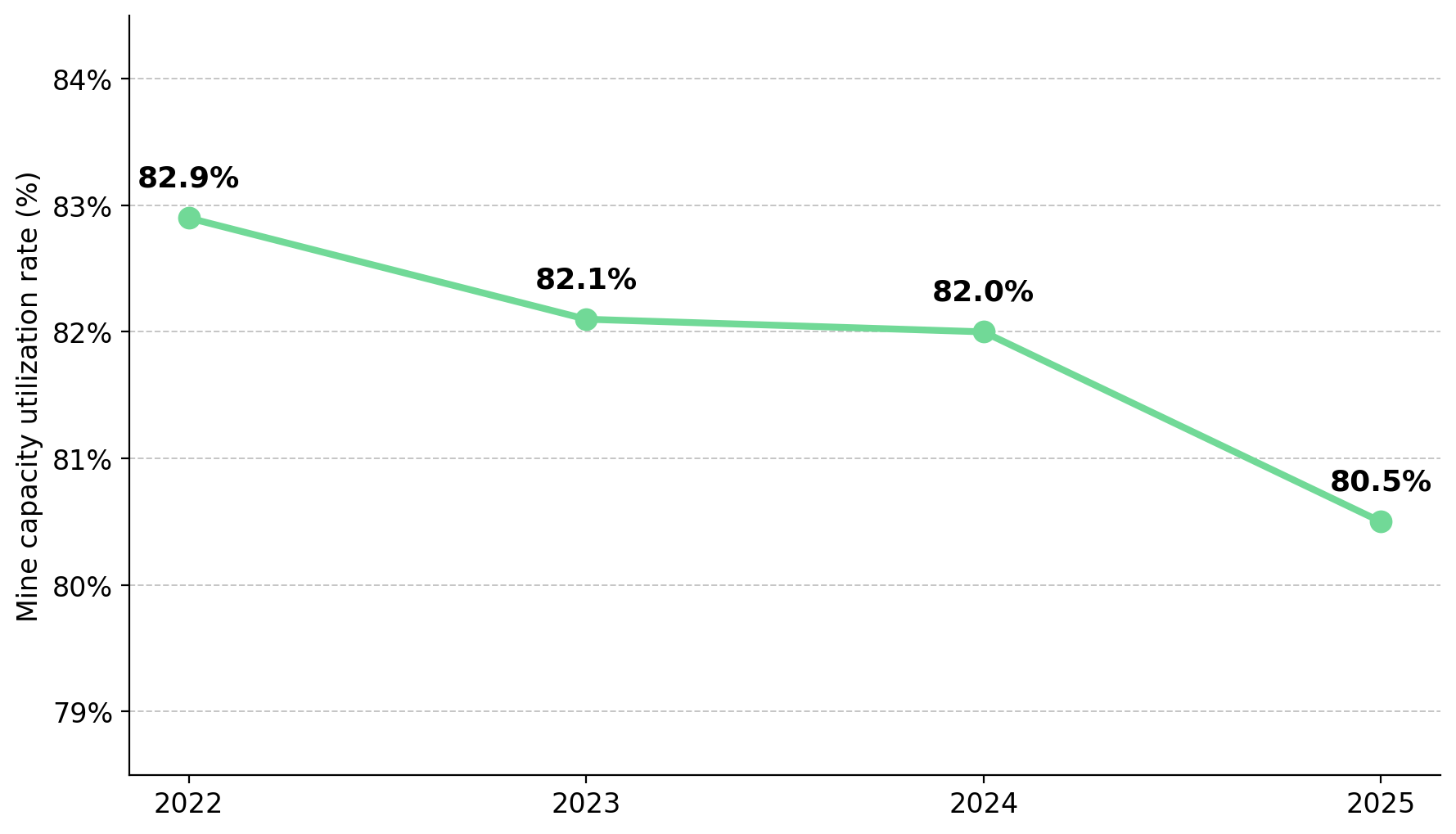
- Mine capacity rose roughly 3.8%, but utilization fell from 81.0% to 77.1%, showing that weaker operating performance, rather than insufficient installed capacity, drove the production shortfall.
- Development-stage projects with completed feasibility studies and environmental approvals face fewer steps before construction than earlier-stage assets, making them the nearest potential source of replacement copper supply.
- If second-half ICSG data show mine capacity utilization recovering toward 81.0%, the first-half decline would appear temporary; if utilization remains near 77.1%, it would support the case for a longer replacement-supply gap.
New Mine Ramp-Ups Failed to Offset Losses, Cutting Copper Output 1.1%
ICSG preliminary data show world copper mine production, including concentrate and SX-EW output, fell 1.1% to 11.34 million tonnes in the first half of 2026 from 11.47 million tonnes a year earlier. Concentrate output declined 2.6%, outweighing 4.3% growth in SX-EW, while project ramp-ups failed to offset losses at existing mines. Development projects approaching construction can add supply this decade, while exploration-stage discoveries require years of drilling, studies, permitting, and financing before contributing in the 2030s. Because ICSG classifies the data as preliminary and partly estimated, later revisions could change the reported shortfall and the volume of replacement supply required.
Losses in Chile, Indonesia, and the DRC Outpaced Gains, Constraining Global Copper Supply
Chilean mine production fell 6.6% as reduced output at El Teniente, Escondida, and Spence drove concentrate output down 8% and SX-EW output down 1%. Indonesian concentrate production declined 32% as the September 2025 mud rush continued to restrict Grasberg, while an 8% increase in DRC SX-EW output offset a 34% concentrate decline following Kamoa’s 2025 seismic event. Because the Indonesian and DRC declines followed operating incidents rather than depletion, the duration of the global shortfall depends partly on recoveries at Grasberg and Kamoa.
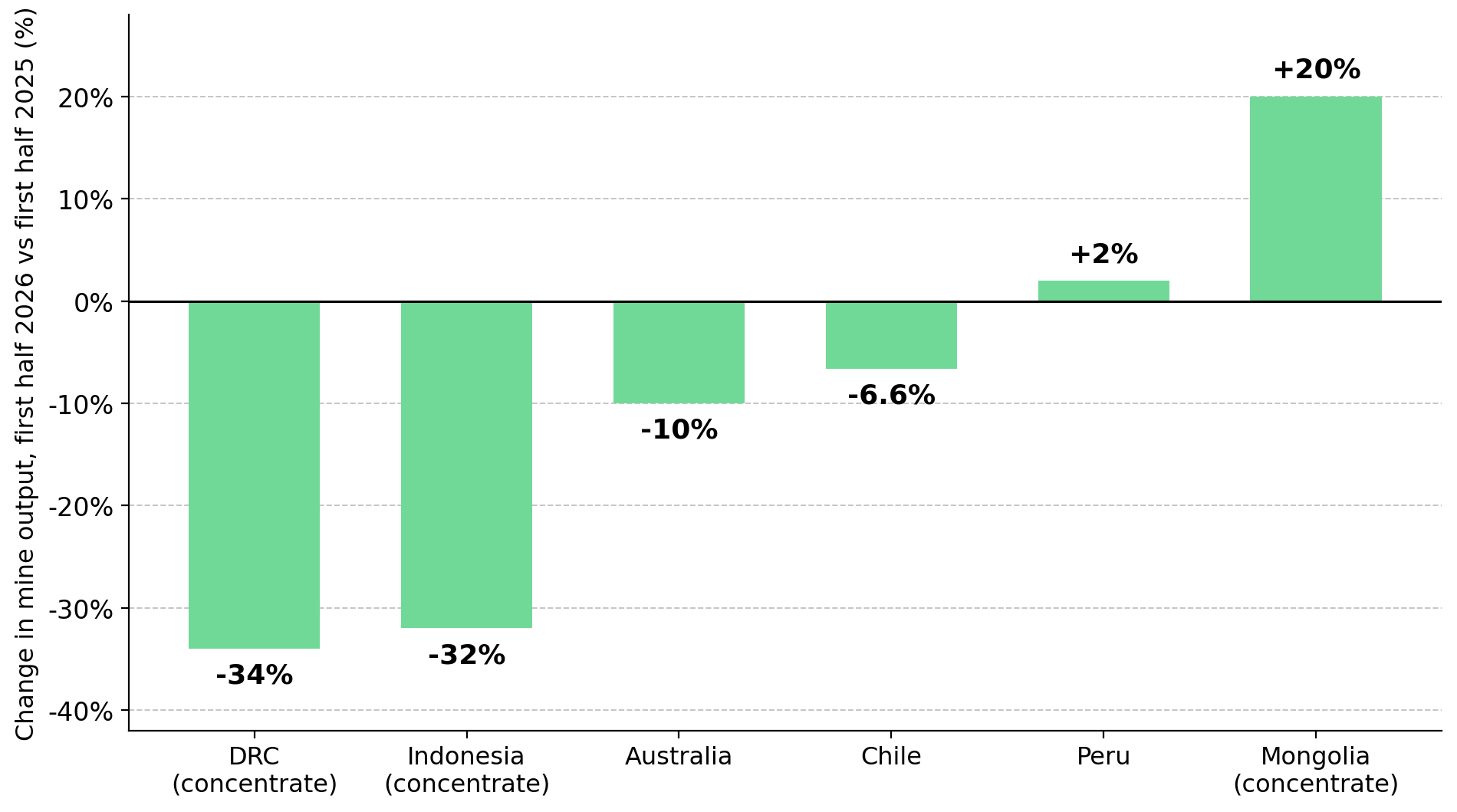
Peruvian mine production rose 2%, and Mongolian concentrate output increased about 20% as Oyu Tolgoi ramped up, while Australian output fell about 10% following the Mount Isa closure. These movements left global production 1.1% lower. Cochilco also cut its 2026 Chilean production forecast to 5.27 million tonnes, 2.6% below 2025, before forecasting a recovery to 5.55 million tonnes in 2027 based on improvements across existing operations rather than new mines.
Mine Capacity Rose as Utilization Fell to 77.1%
World copper mine capacity rose roughly 3.8% to 14.70 million tonnes in the first half of 2026, while production fell 1.1% and utilization declined from 81.0% to 77.1%. Utilization recovered from 76.4% in March to 79.6% in June but remained below its prior-year rate. Applying the 3.9-percentage-point decline to first-half capacity implies roughly 570,000 tonnes of output below the level achievable at the previous utilization rate. Simple mine designs, proven processing, secured infrastructure, and lower ground-instability risk provide greater visibility on how much designed capacity can reach the market.
Permitting, Financing, and Scale Determine Which Projects Can Add Near-Term Supply
With mine production falling despite new project ramp-ups, projects that have completed feasibility studies and secured key environmental approvals can reach construction sooner than earlier-stage assets. Feasibility studies define costs and production plans, while environmental approvals remove a major pre-construction requirement, leaving financing and a final investment decision as the next steps before planned production can reach the market.
Marimaca Copper is advancing the Marimaca Oxide Deposit toward a final investment decision, with engineering and financing underway, early works and long-lead procurement planned, and its key environmental approval secured. The August 2025 Definitive Feasibility Study (DFS) targets 50,000 tonnes of annual copper cathode production at steady-state all-in sustaining costs (AISC) of $2.09 per pound and pre-production capital of $587 million; using a $4.30-per-pound copper price, it estimates a $709 million post-tax net present value at an 8% discount rate (NPV8) and a 31% internal rate of return (IRR). With additional permits progressing, project financing and the final investment decision are the next major milestones toward construction. Hayden Locke, Chief Executive Officer of Marimaca Copper, explains why few junior copper projects reach production:
“In the copper space, there aren’t really any juniors with significant-scale development assets that can come into production. They’re either too small in terms of production, far too big to finance, or they’re not permitted.”
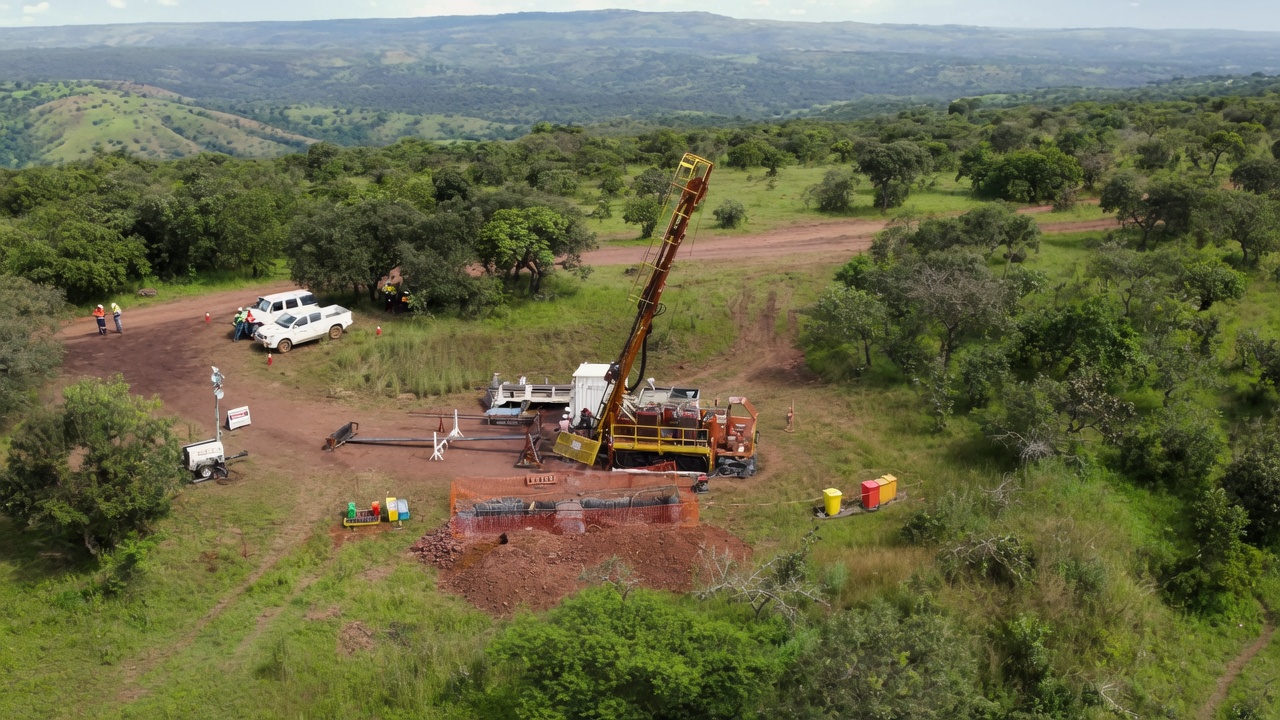
Cobra Resources exercised its option to acquire the Manna Hill Copper Project after a four-hole, 1,465-meter drilling program identified signs of a larger copper system beneath the shallow Blue Rose discovery. Copper mineralization observed to about 300 meters below surface, combined with magnetic survey results, has defined targets for follow-up work. Because the findings are based on visual observations, laboratory assays and additional drilling remain the next tests of the project’s grade and scale.
Mine Disruptions Increase Reliance on New Discoveries & Restarts for Future Supply
Projects already in development are the most likely new sources of copper this decade because feasibility, permitting, financing, and construction take years, while supply in the 2030s also depends on discoveries now moving through those stages. Disruptions at Grasberg and Kamoa, combined with Chile’s reliance on recoveries at existing mines, increase the need for new projects to supplement legacy operations. Measured and Indicated resources provide the geological confidence required for mine planning, while inferred resources require additional drilling before they can support economic studies, making resource conversion a key driver of project timelines and funding needs.
Processing Results & Resource Drilling Reduce Project Uncertainty
Abitibi Metals reported initial metallurgical testing at the B26 Deposit that recovered 98.2% of copper into a concentrate grading 23.7% copper. Independent confirmation using a larger, more representative sample indicates that copper may be recovered through a relatively simple process, reducing processing uncertainty ahead of the Preliminary Economic Assessment (PEA). Further testing of concentrate quality and zinc-rich material, together with the 40,000-meter drilling program, will provide additional inputs for the PEA and its assessment of potential project economics. Jon Deluce, President and Chief Executive Officer of Abitibi Metals, explains why producers need more development assets:
"There's very few multi-million ounce developers available in the market. And there's producers just printing record levels of cash flow that are still behind the eightball of replenishing exploration and development targets."
Fitzroy Minerals reported its highest-grade copper result to date at the Buen Retiro Project, including 1 meter at 21.84% copper within 8.8 meters at 3.70% copper near surface. Additional drilling returned 105 meters at 0.74% copper, while another hole extended the Tenorita trend by 200 meters to 1.9 kilometers, with assays pending. The 22,000-meter 2026 drilling program is building the geological evidence for a maiden Mineral Resource Estimate, which will provide the first defined measure of the project’s scale.
Existing Infrastructure Supports Faster Restarts as Producer Capital Funds Exploration
Selkirk Copper reported Phase 2 drilling at the Minto Project led by 1.93 meters at 13.12% copper equivalent within 33 meters at 1.49% copper equivalent. Step-out drilling extended mineralization beyond the previous interpretation at Minto North and by 50 meters at Area 118 near historical underground development, supporting potential resource growth close to existing infrastructure. With 90% of the planned 50,000-meter program completed, the results will inform a PEA targeted for the third quarter of 2026 as the next step in evaluating a restart of the former Minto mine. Colin Joudrie, Director and Chief Executive Officer of Selkirk Copper, explains why markets value timely new copper supply:
“The market likes it, and they really are attracted to the timing. If we can get even close to our mid-2028 objective for the restart and then be at full run rate by the end of that year or early 2029, that’s just anomalous in the market. There’s not much out there.”
Mogotes Metals entered a binding term sheet for a US$15 million strategic investment from Rio Tinto that would fund further work at the Filo Sur Project in exchange for an initial interest of approximately 5%, 15 months of exclusivity, and the right to increase that interest to 9.99%. Separately, existing shareholders subscribed for 39.2 million shares, raising C$19.2 million. Together, the completed share financing and proposed producer investment would expand funding for exploration, while the exclusivity terms reflect nterest in Filo Sur before a resource has been defined.
23-Year Exchange Stock High Fails to Signal Stronger Supply
ICSG reported that combined copper stocks at the London Metal Exchange (LME), COMEX, and Shanghai Futures Exchange (SHFE) rose 29.6%, or 219,980 tonnes, from the end of December 2025 to 964,095 tonnes at the end of July 2026, the highest level since August 2003. The global refined copper balance showed an apparent surplus of 131,000 tonnes in the first half of 2026, narrowing to 98,000 tonnes after adjusting for estimated changes in Chinese bonded inventories.
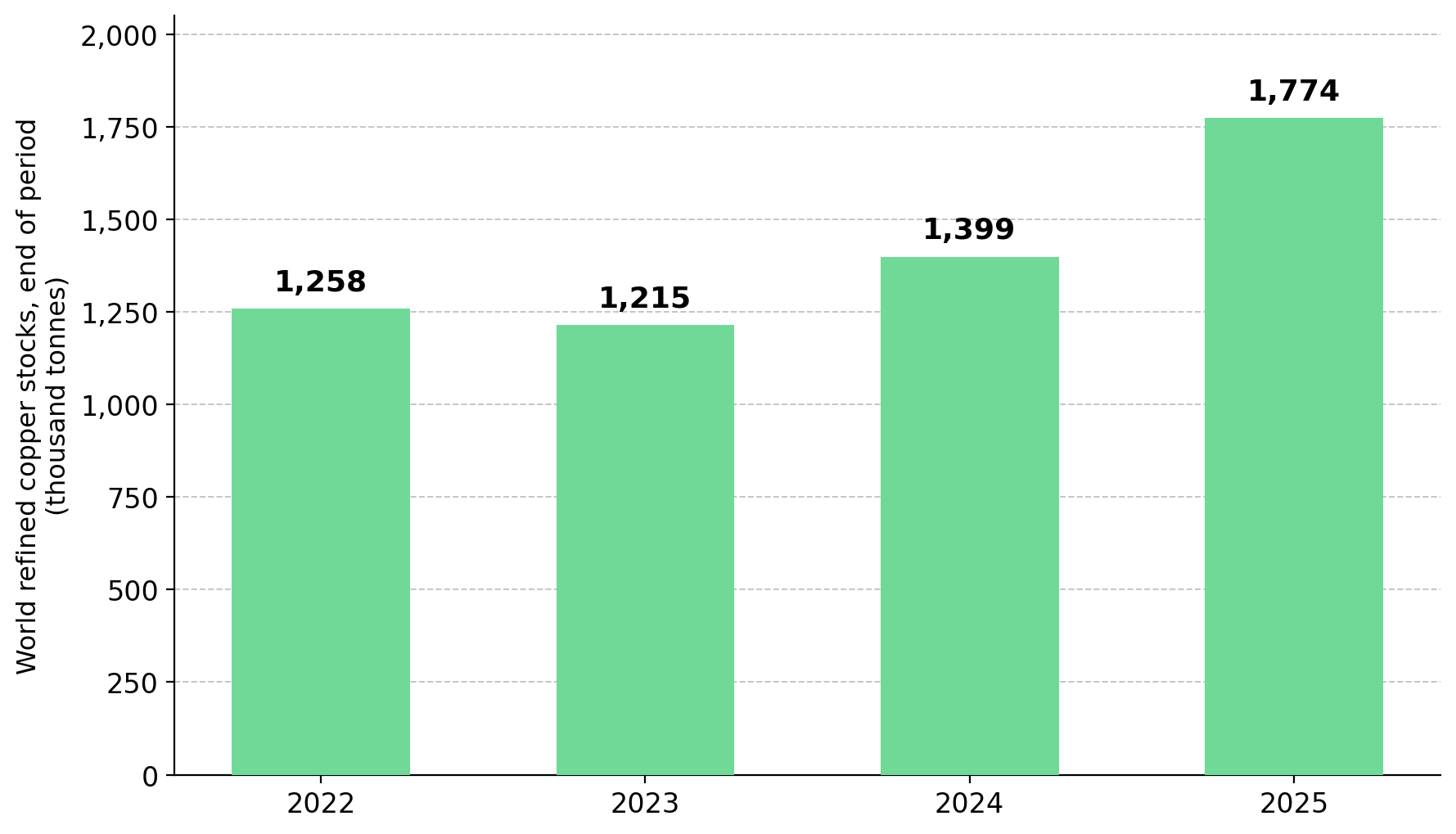
The increase in exchange inventories does not indicate higher current mine supply. Refined production rose 2.4% even as mine production fell 1.1%, partly because secondary refined output from scrap increased 4.3%. Stocks shifted toward Western exchanges, with LME inventories up 98,700 tonnes and COMEX up 197,288 tonnes, while SHFE inventories fell 76,008 tonnes. LME metal available for exchange delivery rose by more than 20,000 tonnes in one August session, showing that reported warehouse supply can change faster than mine production.
Mine capacity utilization is a more direct measure of operating performance than exchange inventories because warehouse stocks can shift between regions without a change in mine output. ICSG’s monthly data and Cochilco’s quarterly forecasts provide regular tests of whether the first-half shortfall was temporary. Utilization returning toward the 81.0% recorded in the first half of 2025, or Chilean output tracking toward Cochilco’s 5.55-million-tonne forecast for 2027, would support a recovery in mine supply, while continued weakness in both measures would point to a longer replacement-supply gap.
The Investment Thesis for Copper
- World copper mine production fell 1.1% in the first half of 2026 despite added output from projects ramping up, showing that new supply was insufficient to offset losses at existing mines.
- Mine capacity utilization fell to 77.1% from 81.0% even as installed capacity rose roughly 3.8%, showing that forecasts based on announced capacity can overstate supply when mines convert less of that capacity into output.
- Mine output fell 6.6% in Chile, while concentrate production declined 32% in Indonesia and 34% in the DRC, with disruptions at Grasberg and Kamoa making projects with simpler mine designs, lower ground-instability risk, and completed environmental approvals more credible candidates to deliver replacement supply.
- Development-stage projects with completed feasibility studies and environmental approvals face fewer pre-construction steps than earlier-stage assets, making them the nearest potential source of replacement copper supply this decade.
- Exploration-stage projects require drilling, resource definition, studies, and permitting before they can contribute copper supply in the 2030s, while capital from major producers can fund this work in exchange for equity, temporary exclusivity, and rights to match future offers.
- Pre-production copper equities provide exposure to future supply growth, while permitting progress, financing terms, project execution, and copper prices determine how much of that potential translates into shareholder value.
Reliable future copper supply depends on advanced projects reaching construction and earlier discoveries progressing through drilling and studies. Development assets with defined engineering, approvals, and financing pathways provide nearer-term exposure to supply growth, while exploration assets offer longer-term value through discovery and greater resource confidence. Across both stages, completed milestones improve visibility on production timelines and equity value, building the replacement pipeline required beyond today’s operating mines.
TL;DR
Copper mine production fell 1.1% in the first half of 2026 even as installed capacity rose roughly 3.8%, because losses in Chile, Indonesia, and the DRC outweighed project ramp-ups and gains elsewhere. Capacity utilization fell from 81.0% to 77.1%, showing that installed capacity does not guarantee deliverable supply. Development projects with feasibility studies, permits, financing pathways, and simpler designs offer the clearest route to near-term replacement tonnes, while discoveries and infrastructure-backed restarts support longer-term supply. Exchange stocks reached a 23-year high, but scrap growth and regional inventory shifts mean warehouse stocks do not signal stronger mine output. For copper equities, completed milestones provide greater visibility on production timelines and potential value.
FAQs (AI-Generated)
Analyst's Notes





Subscribe to Our Channel














Stay Informed


