




410M-Barrel Draw Shrinks Supply Cushion Despite 1.6M b/d Demand Drop


Oil supply is falling faster than demand, supporting $93 Brent, record diesel cracks, exposing gaps in pre-conflict valuations, and raising mining costs.
- The International Energy Agency’s (IEA) August 12, 2026 Oil Market Report forecasts global oil demand will fall by 1.6 million barrels per day in 2026, but inventories have declined by 410 million barrels since the Iran conflict began on February 28, showing supply losses are outweighing weaker consumption.
- The IEA forecasts global oil supply will fall by 4.3 million barrels per day to 102 million barrels per day in 2026, outpacing the 1.6 million-barrel-per-day demand decline and creating a third quarter deficit of 1.8 million barrels per day, the largest quarterly deficit since the fourth quarter of 2021.
- The US Energy Information Administration’s (EIA) August 19, 2026 Weekly Petroleum Status Report shows commercial crude stocks at 428.8 million barrels, matching the five-year average, while the Strategic Petroleum Reserve (SPR) fell to 293.4 million barrels from 403.4 million a year earlier, reducing the public buffer available to absorb another supply disruption.
- The EIA shows the deficit is concentrated in refined products, with US distillate inventories, including diesel and heating oil, at 105.6 million barrels, about 13% below the five-year average, while refineries ran at 97.2% of operable capacity, leaving little unused capacity to rebuild stocks before winter.
- Independent resource valuations based on pre-conflict oil prices may not reflect the benefit of higher current prices, while planned drilling and testing target converting contingent resources into reserves that can support future production and cash flow.
Supply Losses Outpace Demand Decline & Support $93 Brent
The IEA cut its 2026 global oil demand outlook by 510,000 barrels per day from its July estimate, taking the projected decline to 1.6 million barrels per day. Demand is projected to contract by 2.8 million barrels per day in the third quarter before returning to growth in the fourth, a pattern that would normally pressure crude prices if supply remained stable.
Global oil supply is projected to fall by 4.3 million barrels per day to 102 million barrels per day in 2026, as 1.4 million barrels per day of growth from the Americas only partly offsets losses in the Middle East and Russia. Supply is therefore contracting about 2.7 times faster than demand, creating a third quarter deficit of 1.8 million barrels per day, the largest quarterly deficit since the fourth quarter of 2021. The imbalance has reduced inventories by 410 million barrels since the Iran conflict began on February 28, explaining why weaker consumption has not lowered crude prices.
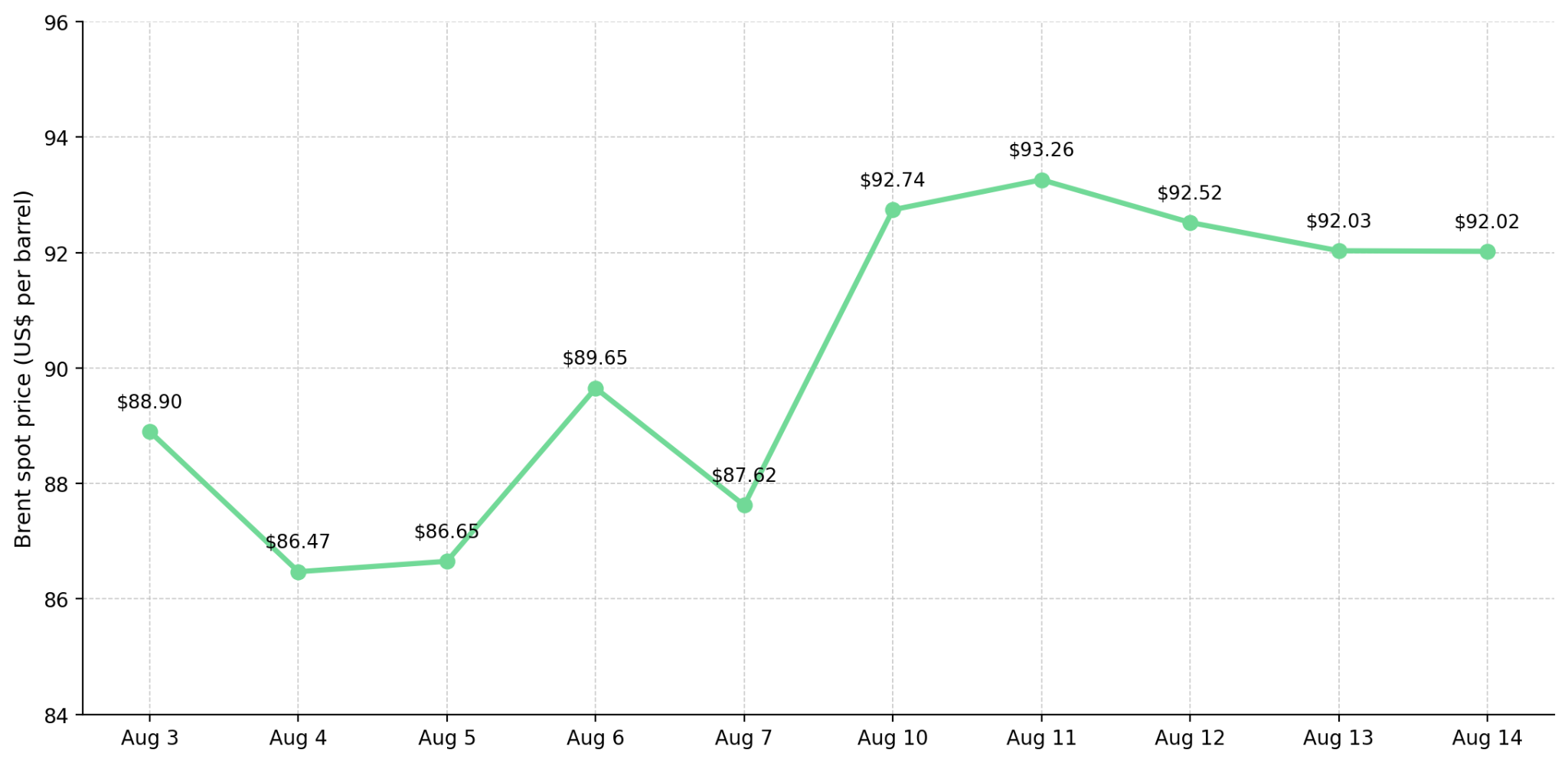
Brent traded near $93 per barrel on August 20, 2026, as the projected 1.8 million-barrel-per-day third quarter deficit made available inventories more important to pricing than consumption growth. Continued stock draws would maintain upward pressure on Brent, while restored Gulf supply and rebuilding inventories would reduce that pressure.
8.3M bpd Gulf Shortfall Supports Crude Prices Despite Weaker Demand
Gulf oil production increased by 2.5 million barrels per day in July to 23.9 million barrels per day, but remained 8.3 million barrels per day below pre-war levels, limiting the downward price effect of weaker global demand. Regional exports fell by 2.1 million barrels per day to 15 million barrels per day despite routes bypassing the Strait of Hormuz, showing that alternative channels have not restored pre-war flows. The 8.3 million-barrel-per-day shortfall is roughly five times the projected 1.6 million-barrel-per-day global demand decline, making Gulf supply recovery the larger near-term price driver.
Crude oil and petroleum liquids transported through the Strait of Hormuz fell from 21.6 million barrels per day in the fourth quarter of 2025 to 4.9 million barrels per day in the second quarter of 2026, a decline of 16.7 million barrels per day from the pre-conflict level. Alternative export routes are slower, more expensive, and more limited in capacity than direct transit, restricting their ability to replace disrupted flows and keeping crude prices sensitive to further supply losses.
The United Arab Emirates (UAE) suspended trade and financial transactions with Iran on August 19, 2026, after the UAE Ministry of Defense reported that two ballistic missiles had been launched toward the country. Attacks on vessels linked to the Abu Dhabi National Oil Company have increased the risk of further export disruptions. Weekly consumption changes typically move the oil balance by hundreds of thousands of barrels per day, while Gulf supply disruptions can remove millions, making regional supply developments the stronger near-term price signal.
5.3M-Barrel SPR Draw Exceeds Commercial Crude Build & Shrinks US Supply Buffer
Commercial crude inventories rose by 4.4 million barrels to 428.8 million barrels in the week ending August 14, 2026, marking a third consecutive build. Stocks now match the five-year seasonal average after standing about 6% below it at the end of July, a recovery that would weaken the deficit if it reflected newly produced supply.
Over the same week, SPR holdings fell by 5.3 million barrels to 293.4 million barrels, down from 403.4 million barrels a year earlier. Because the SPR draw exceeded the 4.4 million-barrel commercial build, combined commercial and reserve inventories declined by about 0.9 million barrels, leaving the US supply buffer smaller despite the increase in commercial stocks.
Refining & Export Constraints Keep Diesel Scarce & Push Crack to Record $102
The deficit is concentrated in distillates rather than crude, with inventories falling by 1.5 million barrels to 105.6 million barrels in the week ending August 14, 2026, leaving stocks about 13% below the five-year average compared with 12% a week earlier. The 107.1 million-barrel reading in early August was already the lowest for that time of year since 1996. Because distillates include diesel and heating oil, the shortfall increases cost pressure across freight, agriculture, and household heating ahead of winter.
US refineries ran at 97.2% of operable capacity in the week ending August 14, 2026, the highest rate since September 2019, yet distillate production fell to 5.2 million barrels per day, showing that higher margins have limited ability to lift output when facilities are near capacity. Global refinery throughput was 80.9 million barrels per day in July, nearly 5 million barrels per day below a year earlier, reducing the volume available to rebuild product inventories. Russian diesel and gasoil exports fell about 92% year over year to 80,000 barrels per day in the first seven days of August, while the export ban through January 2027 limits a major source of replacement supply.
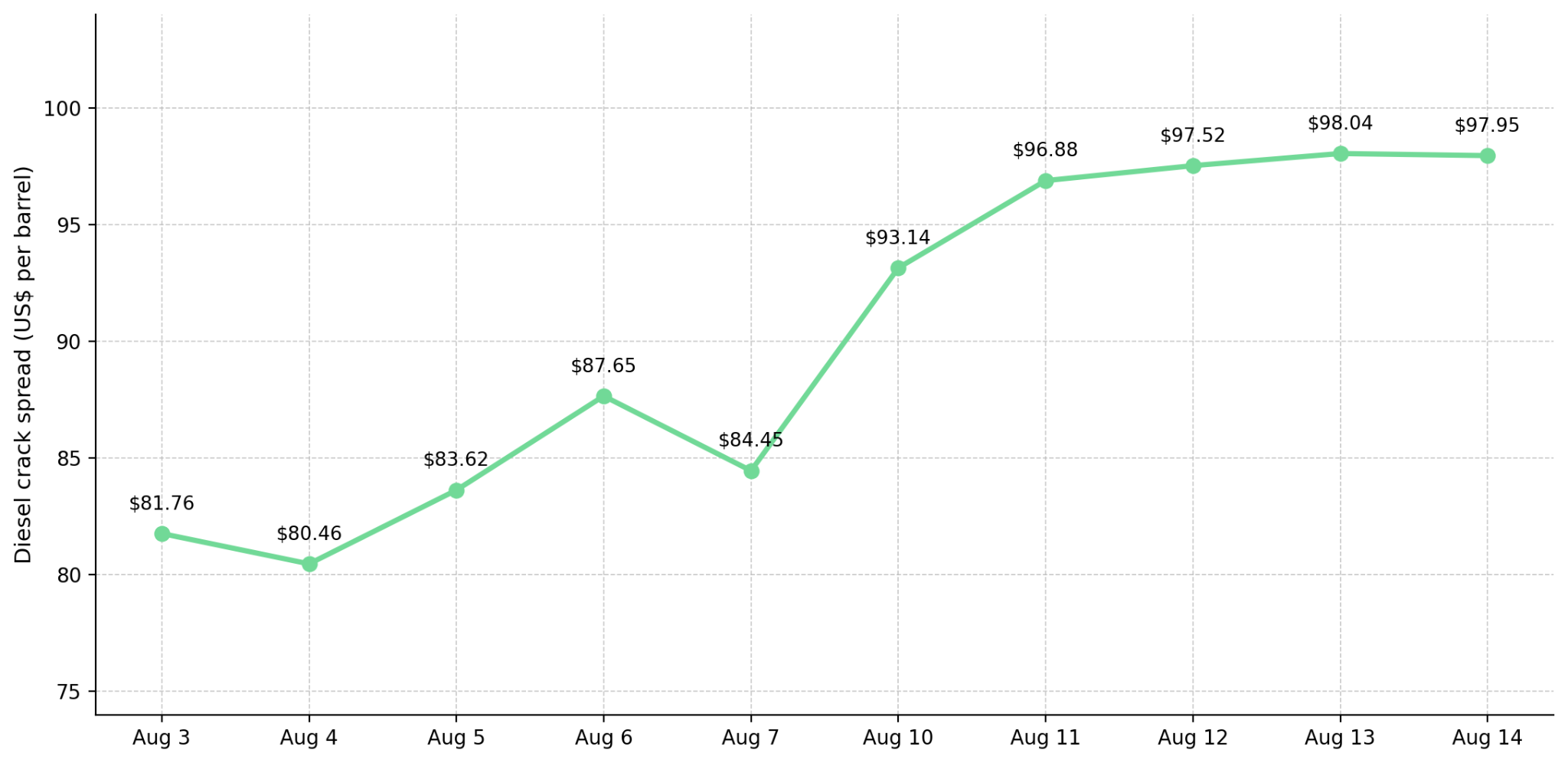
The US diesel crack, the premium of ultra-low sulfur diesel futures over West Texas Intermediate (WTI) crude, reached an all-time high of $102.20 per barrel on August 17, 2026, and settled above $100 for the first time the following session, compared with its normal range of $20 to $30. Goldman Sachs favors a long December 2026 to March 2027 European gasoil timespread over crude, gasoline, or US diesel. The trade benefits if December gasoil prices strengthen relative to March, directly targeting the shortage in European middle distillates.
Higher Brent & Turkey Oil Import Demand Widen Gap With Pre-War Valuations
Independent resource evaluations use a fixed effective date and forecast price assumption, so valuations completed before February 28, 2026 do not incorporate the higher oil prices created by subsequent supply disruptions. Light, low-sulfur crude may command additional value in a market short of the refined products produced from that grade, making the difference between evaluated prices and current market prices relevant to exploration-stage economics.
Dune Oil’s independent evaluation assigned the Gabar Block’s North Prospect a 2C contingent resource of 27.6 million barrels, a US$594.2 million risk-adjusted value, and an 81% chance of commerciality. With total unrisked potential of 51.6 million barrels net to Dune and the valuation based on January 1, 2026 forecast prices, the assessment provides a pre-conflict benchmark for comparing the project’s published economics with current oil prices as drilling and testing advance.
Scott Lower, President of Dune Oil, explains how Turkey’s oil imports support higher prices:
“We’re benchmarking in the $70 to $72 range because that is a conservative pre-war number. Everything is bought and sold at that level because Turkey is a massive oil importer. We’re selling at top dollar, and you’re selling to the refinery that’s just up the road. They’ll buy every bit of it because they’re displacing Russian, Iranian, and Iraqi oil.”
$102 Diesel Crack Raises Mining Fuel Costs & Pressures Margins Across Metals
Low distillate inventories and record diesel crack spreads are increasing fuel costs for mining operations, reducing margins even when crude-price assumptions are accurate. Diesel is a major energy input for open-pit mines, but producers often report fuel sensitivity against crude benchmarks even though they purchase a refined product whose price includes the crack spread. When that spread is four to five times its normal range, crude-linked cost models can understate delivered diesel prices and increase the risk of operating costs exceeding guidance.
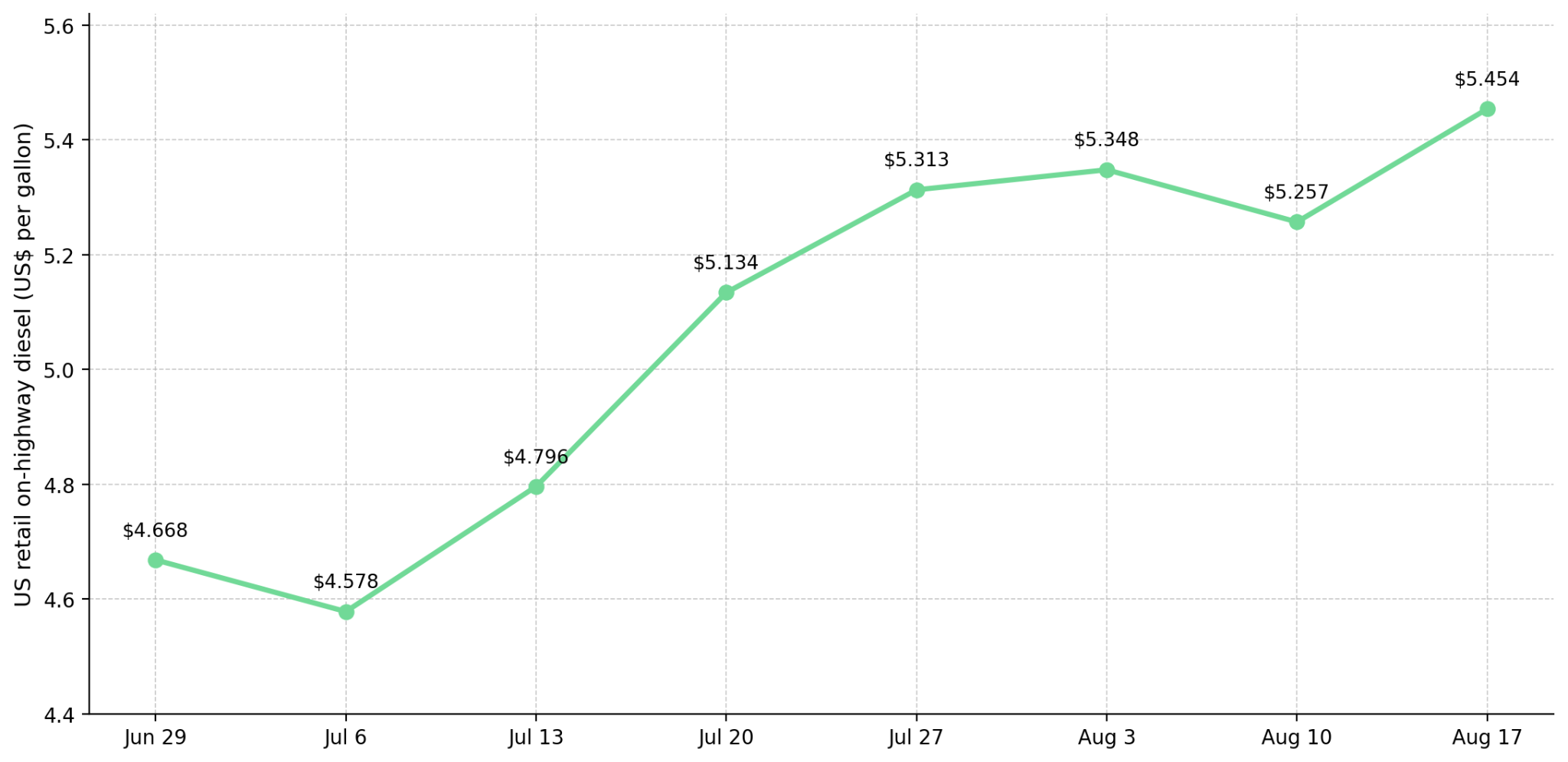
S&P Global Market Intelligence modeled a Strait of Hormuz disruption that could increase the global iron ore cost base by US$5.76 per dry metric ton, or 11.3%, and found that a 60% fuel-price increase could raise manganese cash costs by an average of US$7.59 per dry metric ton. South African and Gabonese producers face the greatest modeled impact because of diesel-intensive operations and long inland haulage, making fuel hedges, owned logistics, grid or gas-fired power, and lower diesel use important protections for margins.
115M Distillate Stocks & Sub-$80 Diesel Crack Signal Weaker Brent Support
With Gulf output still 8.3 million barrels per day below pre-war levels and global inventories down 410 million barrels, available supply rather than consumption growth is setting crude prices. The supply loss is more than five times the projected 1.6 million-barrel-per-day demand decline, explaining why weaker consumption has not lowered crude or diesel prices.
Supply-driven support for crude and diesel prices would weaken if de-escalation restores Gulf output and allows inventories to rebuild. Global oil supply is projected to rise by 8.3 million barrels per day to 110.3 million barrels per day in 2027, exceeding demand by 4.61 million barrels per day and potentially restoring inventories to their February 2026 level by mid-2027. Confirmation would require distillate inventories to rise from 105.6 million barrels toward 115 million barrels, the diesel crack to remain below $80 per barrel, and an agreement to restore Gulf refined-product exports rather than crude loadings alone.
Each Wednesday’s EIA inventory release will show whether distillate stocks rebuild from 105.6 million barrels while refineries maintain utilization near 97.2%. Seven members of the Organization of the Petroleum Exporting Countries and its allies (OPEC+) coordinating production adjustments meet on September 6, 2026, followed by the EIA’s next Short-Term Energy Outlook on September 9, providing two near-term signals on whether additional supply could reduce crude and diesel price pressure.
The Investment Thesis for Oil & Gas
- Supply is projected to fall by 4.3 million barrels per day in 2026, compared with a 1.6 million-barrel-per-day decline in demand, making inventory levels a stronger guide to crude prices than weaker consumption alone.
- Commercial crude inventories rose by 4.4 million barrels while the Strategic Petroleum Reserve fell by 5.3 million barrels in the same week, reducing their combined balance by about 0.9 million barrels and leaving the US supply buffer smaller than commercial stock data alone suggest.
- The deficit is concentrated in middle distillates, with inventories at 105.6 million barrels, about 13% below the five-year average, despite US refineries operating at 97.2% of capacity, limiting the ability to rebuild stocks before the Northern Hemisphere heating season.
- Independent resource valuations based on pre-conflict oil-price assumptions may not reflect higher current crude prices, leaving room for project economics to improve as resources advance toward production.
- Diesel-intensive mining operations can face higher all-in sustaining costs when diesel crack spreads remain elevated even as crude prices fall, while fuel hedges, owned logistics, and lower diesel use can protect margins.
Global oil demand is projected to fall by 1.6 million barrels per day in 2026, but the larger 4.3 million-barrel-per-day supply decline has contributed to a 410 million-barrel inventory draw, supporting crude and diesel prices. Distillate inventories rising toward 115 million barrels and the diesel crack remaining below $80 per barrel would signal that supply recovery is weakening price support. Until then, inventory trends and refinery utilization provide a stronger guide to crude and diesel prices than daily reports of diplomatic or military developments in the Gulf. Pre-conflict resource valuations may not reflect higher current oil prices, while mining companies with fuel hedges, owned logistics, and lower diesel use are better positioned to protect margins.
TL;DR
Global oil demand is projected to fall by 1.6 million barrels per day in 2026, but supply is forecast to decline by 4.3 million barrels per day, creating a 1.8 million-barrel-per-day third quarter deficit and supporting $93 Brent. Commercial US crude stocks have risen, but a larger Strategic Petroleum Reserve draw has reduced the combined supply buffer. Distillate inventories remain 13% below the five-year average despite 97.2% refinery utilization, pushing the diesel crack above $100 and raising mining fuel costs. Pre-conflict oil valuations may understate current project economics. Distillate stocks approaching 115 million barrels, a diesel crack below $80, and restored Gulf exports would signal weaker price support.
FAQs (AI-Generated)
Analyst's Notes





Subscribe to Our Channel




Stay Informed


