Nuclear Tripling Target Pulls Uranium Supply Investment Forward



Long uranium mine timelines, import dependence, and project readiness are pulling supply investment forward as nuclear demand rises.
- Under the global nuclear tripling scenario, the World Nuclear Association (WNA) estimates that a 1,200 gigawatt electrical (GWe) fleet could require about 250,000 tonnes of uranium annually, compared with roughly 60,000 tonnes of primary production in 2025.
- Uranium investment must begin well before reactor demand arrives because uranium projects typically require 15 to 20 years to progress through identification, permitting, and development.
- The uranium investment case depends less on resource scarcity than on converting identified resources into mine supply, as the OECD Nuclear Energy Agency (NEA) and International Atomic Energy Agency (IAEA) identify more than 8.1 million tonnes of uranium recoverable below US$260 per kilogram.
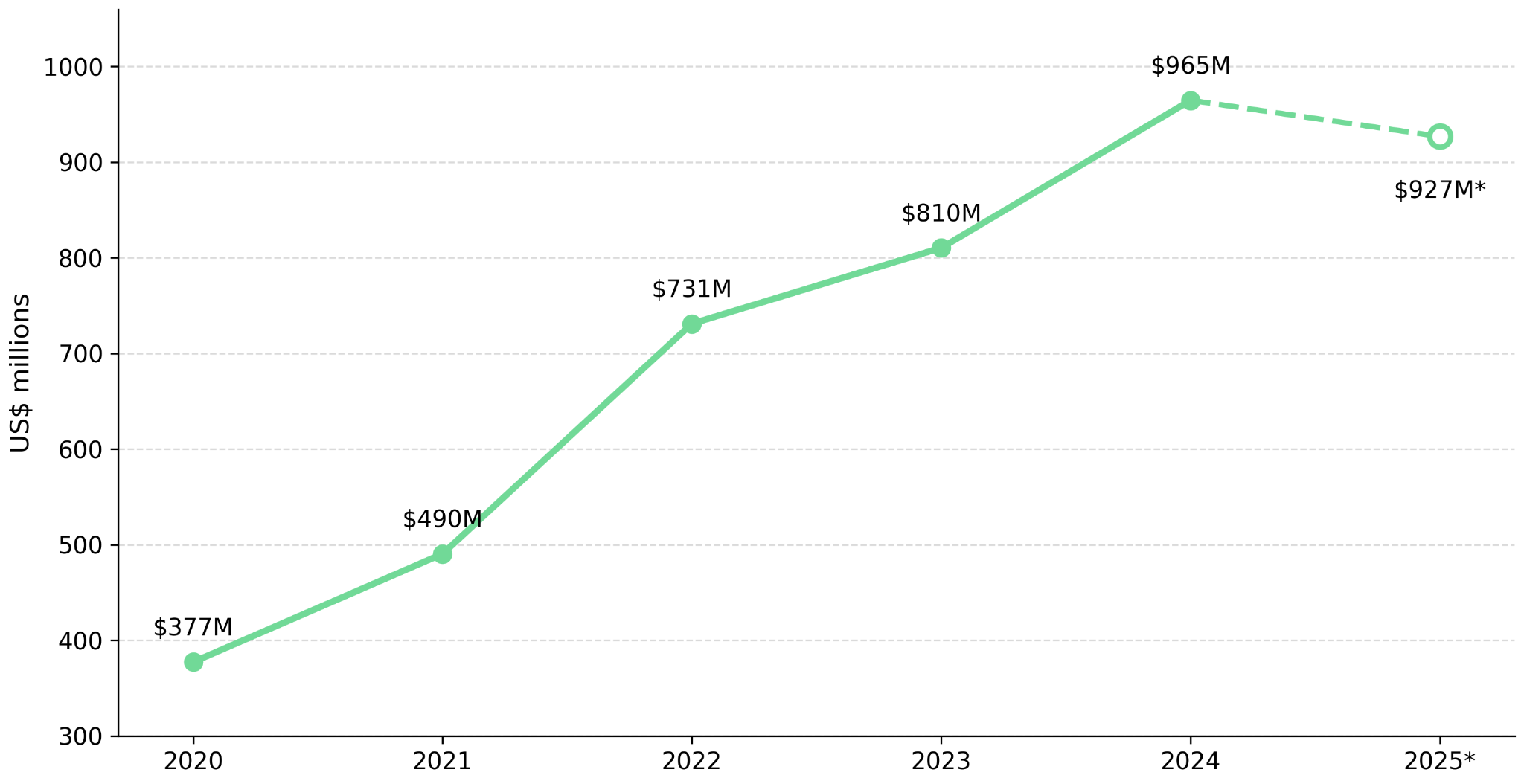
- Global uranium exploration and mine-development spending rose from about US$377 million in 2020 to US$965 million in 2024, while incomplete preliminary 2025 reporting reached US$927 million.
- The 15-to-20-year uranium development cycle makes early project advancement increasingly important because future supply must be prepared well before reactor requirements are fully visible.
Long Mine Timelines Bring Uranium Investment Forward
Nuclear expansion requires uranium projects to advance years before new reactors begin consuming fuel because mine development can take 15 to 20 years. WNA estimates that national targets, identified projects, and continued operation of existing reactors could raise global nuclear capacity to 1,457 GWe by 2050. Although that capacity is not guaranteed, long mine timelines require uranium supply projects to advance before the final scale of reactor demand is known.
The Declaration to Triple Nuclear Energy corresponds to approximately 1,200 GWe of global capacity by 2050. WNA estimates today’s fleet requires around 70,000 tonnes of uranium annually, while a 1,200 GWe fleet could require approximately 250,000 tonnes per year, compared with roughly 60,000 tonnes of primary production in 2025. More than 550 GWe needed to meet current national targets is not yet associated with projects under construction, planned, or proposed.
Uranium projects typically require 15 to 20 years to progress through identification, permitting, and development, requiring capital to enter the project pipeline well before utilities need additional fuel. Exploration drilling, resource definition, metallurgy, environmental studies, permitting, financing, mine construction, and processing infrastructure are sequential steps that convert geological resources into commercial supply.
Large Uranium Resources Shift Supply Focus to Project Execution
More than 8.1 million tonnes of uranium can be recovered below US$260 per kilogram, sufficient to cover their higher projected requirements through 2050. The supply challenge is therefore less about resource availability and more about whether projects can complete technical studies, permitting, financing, and construction in time to meet future demand.
Limited New-Mine Growth Raises Need for Resource Expansion
Global uranium exploration and mine-development spending rose from about US$377 million in 2020 to US$965 million in 2024, while preliminary 2025 reporting totaled about US$927 million despite missing estimates from several countries. Mine production reached 61,924 tonnes of uranium in 2024, but recent growth came mainly from restarts and expansions rather than new mines. This increases the relevance of exploration programs expanding known mineralization and building the next pipeline of potential uranium resources.
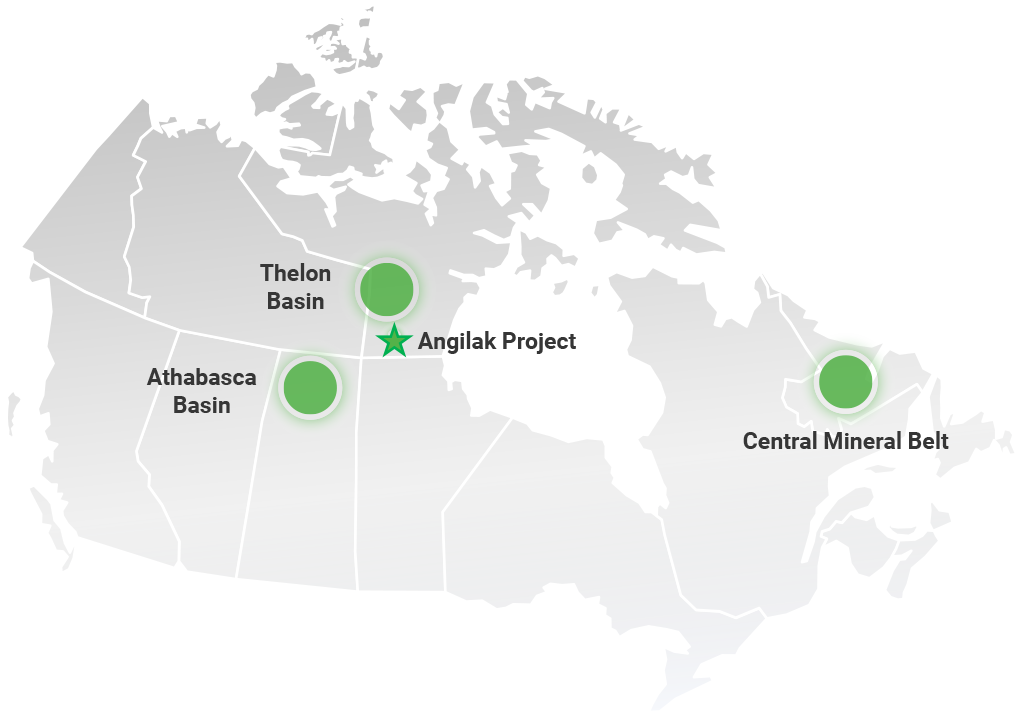
ATHA Energy expanded the primary mineralized horizon at RIB North to 1.45 kilometers during its 2026 exploration program, strengthening evidence of continuity across the discovery. At Lac 50, the company maintains a conceptual exploration target of 60.8 million to 98.2 million pounds of uranium oxide grading 0.37% to 0.48%, giving additional scope to define the scale of Angilak through continued drilling.
Troy Boisjoli, Chief Executive Officer of ATHA Energy, explains why declining uranium supply raises project demand:
“You look at declining production rates going into the 2030 to 2040 decade and the scarcity of assets that are backfilling those. Then look at the number of companies that actually have a focus on building, going from discovery hole through to a strategy to build assets into the cycle. There are very few.”
Metallurgy Moves Defined Pounds Closer to Future Supply
Discovering uranium is only the first step toward future supply. Projects also need to demonstrate that the uranium can be recovered efficiently enough to support further development. Metallurgical testwork therefore becomes an important measure of which defined resources can move closer to production.
Atomic Eagle reported uranium recoveries of approximately 81% to 86% from recent Muntanga East testwork, with acid consumption of about 3 kilograms per tonne during the main extraction period. The results extend Muntanga’s favorable heap-leach performance to the newly discovered deposit, supporting confidence that Muntanga East can add scale and improve the economics of the 58.8 million-pound Mineral Resource.
Supply Gap Favors Higher-Quality Uranium Projects
Higher uranium requirements do not make every deposit equally capable of advancing toward production because grade and resource confidence affect how a resource can be evaluated and developed. Higher grades can reduce the amount of material that must be mined and processed, while Indicated resources provide a firmer basis for technical evaluation.
IsoEnergy reported summer drilling at Hurricane South that intersected the strongest radioactivity to date along the trend, adding exploration upside around its existing 48.6 million-pound Indicated resource grading 34.5% uranium oxide. With approximately C$70.9 million in cash and equivalents and C$46.0 million in equity holdings, the company has financial capacity to continue drilling and technical work across its portfolio.
Uranium projects can require years of expenditure before generating operating cash flow, making sustained funding important throughout development. Companies with sufficient capital can continue resource definition, engineering, environmental work, and permitting, allowing projects to advance through the technical and regulatory work required before production.
US Import Dependence Raises Domestic Uranium Value
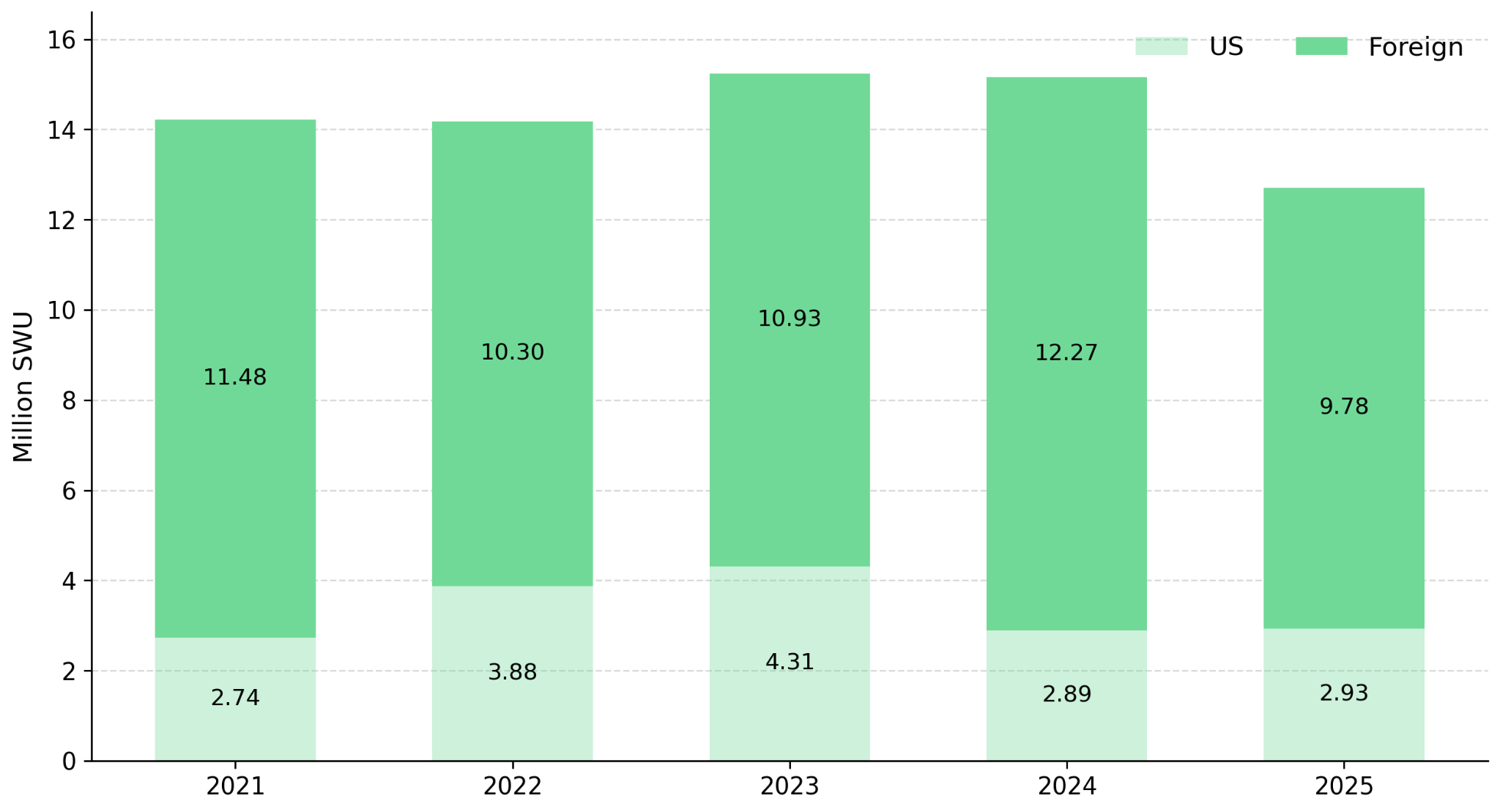
Uranium investment is shaped by both supply volume and fuel origin because reactor demand requires reliable access to mined uranium and fuel-cycle services. US civilian nuclear operators purchased 46.9 million pounds of uranium oxide equivalent in 2025, while US-origin material accounted for only 7% of deliveries, with Canada supplying 32%, Kazakhstan 28%, Australia 15%, Uzbekistan 7%, and Namibia 4%. US operators also purchased roughly 12.7 million separative work units (SWU) of enrichment services, with foreign sources supplying 77% and Russia providing about 26% of the total, showing that US uranium supply security depends on both foreign mine supply and enrichment capacity.
In-situ recovery (ISR) can provide a shorter path to additional uranium supply where processing plants and wellfield infrastructure are already in place. Compared with a greenfield mine requiring entirely new facilities, existing ISR infrastructure can reduce the amount of new construction needed before additional production begins.
enCore Energy operates Alta Mesa with 1.5 million pounds per year of operating capacity plus 0.5 million pounds of drying capacity. Its Wellfield 3 Extension is fully expensed and ready for immediate operation once final permits are received, which the company anticipated in the fourth quarter of 2026, positioning the extension to add production without requiring a new processing facility.
William Sheriff, Executive Chairman of enCore Energy, highlights limited near-term growth in domestic uranium supply:
“There aren’t very many producers in the US. There are unlikely to be very many new ones in the next two or three years, or even within the next 39 months.”
Lower Nuclear Growth Still Raises Uranium Supply Needs
The uranium case does not depend on every reactor target being achieved. NEA and IAEA estimate annual uranium requirements could rise from about 64,500 tonnes in 2025 to 84,800-143,900 tonnes by 2050, while mine production reached 61,924 tonnes in 2024. That production growth came mainly from restarts and expansions, with no new uranium mining project entering production during the assessment period.
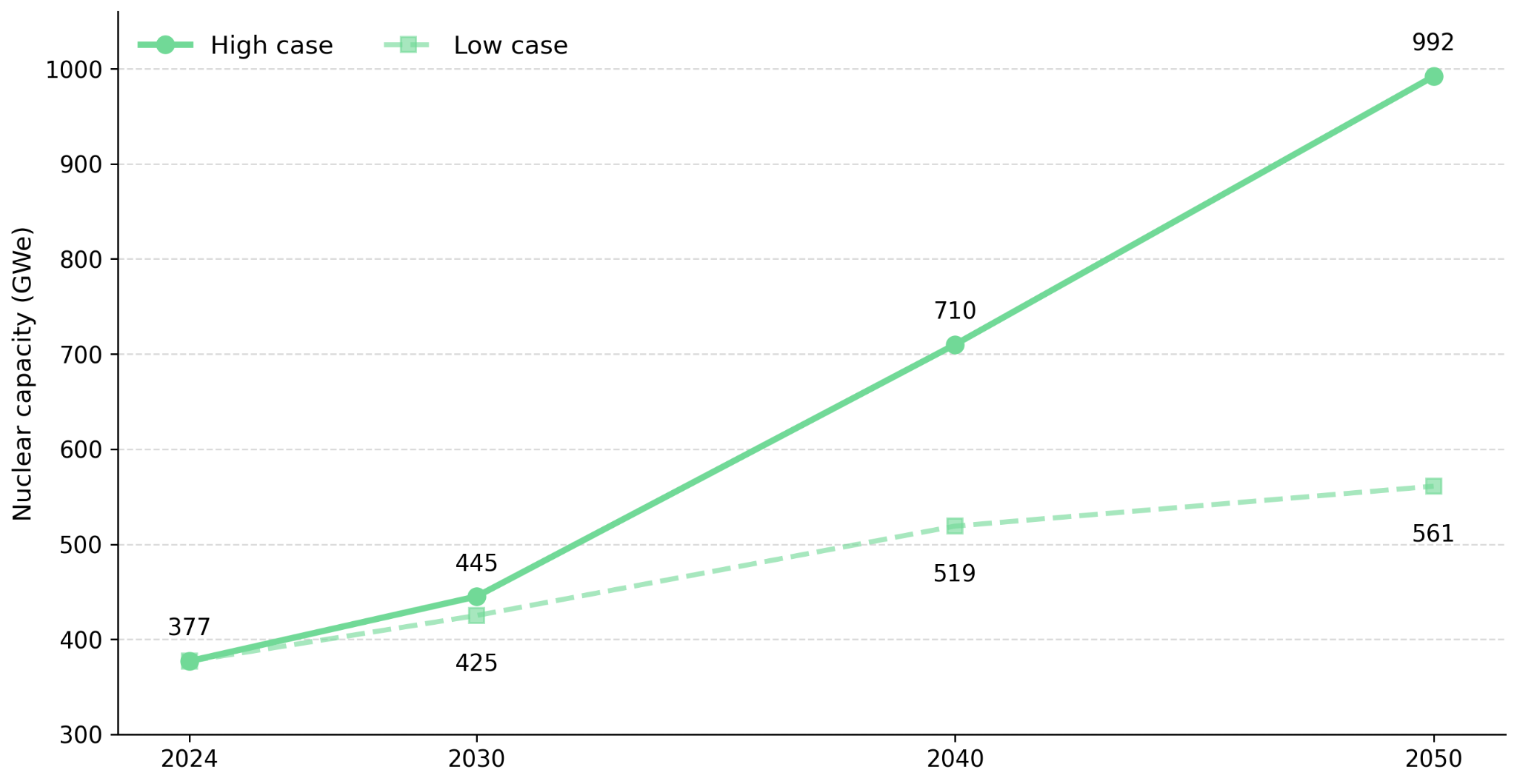
WNA’s 1,457 GWe 2050 outlook depends on reactor life extensions, planned projects reaching operation, and additional capacity being delivered. Even under lower-growth outcomes, higher uranium requirements would still require exploration to expand future resources, development projects to add new mine supply, and existing producers to contribute through established operations.
The Investment Thesis for Uranium
- Higher long-term uranium requirements support a longer investment cycle because NEA and IAEA project annual demand rising from about 64,500 tonnes in 2025 to at least 84,800 tonnes by 2050.
- Explorers offer early-stage leverage to future supply growth because discoveries made today can require many years of resource definition before they are positioned for development.
- Developers gain relevance as metallurgy, engineering, permitting, and financing convert geological resources into credible future production options.
- Producers provide the most direct exposure to near-term supply requirements where existing processing infrastructure and permitted expansion capacity can shorten the response to stronger contracting demand.
- High-quality jurisdictions can command greater supply-chain relevance as utilities and governments place more weight on diversified, dependable uranium supply chains.
- Capital discipline remains essential across commodity cycles because long development timelines require companies to keep advancing assets even when uranium equity markets or spot prices become volatile.
- Uranium exposure combines resource quality with execution readiness rather than relying solely on higher uranium prices or aggressive assumptions about reactor construction.
Nuclear expansion shifts the uranium investment case toward supply readiness rather than resource scarcity. The strongest opportunities lie across assets that can convert geological resources into dependable supply through exploration, technical work, permitting, financing, and construction, while existing infrastructure can shorten the path to additional production. Because uranium projects require years to advance, capital must move before future reactor demand is fully visible. The broader opportunity therefore depends less on every nuclear target being achieved and more on which projects can progress early enough to serve a larger, more supply-conscious uranium market.
TL;DR
Nuclear expansion is increasing the need to advance uranium supply years before new reactor demand arrives because mine development can take 15 to 20 years. The challenge is less about geological scarcity than converting identified resources into dependable production through exploration, metallurgy, permitting, financing, and construction. Limited new-mine additions increase the importance of resource expansion and project execution, while US reliance on foreign uranium and enrichment services raises the value of secure supply chains. Even lower nuclear-growth scenarios imply higher uranium requirements through 2050, supporting opportunities across exploration, development, and production-stage assets.
FAQs (AI-Generated)
Analyst's Notes





Subscribe to Our Channel







Stay Informed